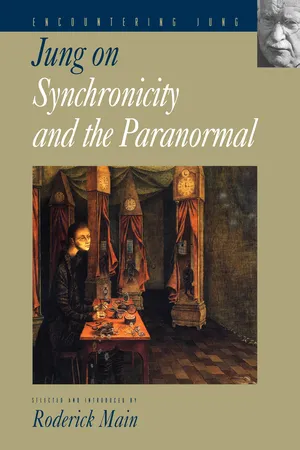
C. G. Jung had a lifelong interest in the paranormal that culminated in his influential theory of synchronicity. Combining extracts taken from the Collected Works; letters; the autobiographical Memories, Dreams, Reflections; and transcripts of seminars, Jung on Synchronicity and the Paranormal sets out clearly his seminal contribution to our understanding of this controversial area.
In his introduction, Roderick Main discusses Jung's encounters with and observations of the paranormal, the influences that contributed to his theory of synchronicity, and the central ideas of the theory itself. The selections include Jung's writings on mediumistic trance phenomena, spirits and hauntings, anomalous events in the development and practice of analytical psychology, and the divinatory techniques of astrology and the I Ching. The book also features Jung's most lucid account of his theory in the form of his short essay "On Synchronicity," and a number of Jung's less-known writings on parapsychology, his astrological experiment, and the relationship between mind and body.
Jung on Synchronicity and the Paranormal addresses subjects that were fundamental to Jung's personal and professional development. Probing deeply into the theory of synchronicity, Roderick Main clarifies issues that have long been a source of confusion to Jung's readers.
- English
- ePUB (mobile friendly)
- Available on iOS & Android
eBook - ePub
Jung on Synchronicity and the Paranormal
About this book
Trusted by 375,005 students
Access to over 1.5 million titles for a fair monthly price.
Study more efficiently using our study tools.
Information
Part I
Encountering the paranormal
1 Spiritualism
From: Memories, Dreams, Reflections (1963), pp. 102-3, 107-10
At the end of my second semester, however, I made another discovery, which was to have great consequences. In the library of a classmate‘s father I came upon a small book on spiritualistic phenomena, dating from the seventies. It was an account of the beginnings of spiritualism, and was written by a theologian. My initial doubts were quickly dissipated, for I could not help seeing that the phenomena described in the book were in principle much the same as the stories I had heard again and again in the country since my earliest childhood. The material, without a doubt, was authentic. But the great question of whether these stories were physically true was not answered to my satisfaction. Nevertheless, it could be established that at all times and all over the world the same stories had been reported again and again. There must be some reason for this, and it could not possibly have been the predominance of the same religious conceptions everywhere, for that was obviously not the case. Rather it must be connected with the objective behaviour of the human psyche. But with regard to this cardinal question - the objective nature of the psyche -I could find out absolutely nothing, except what the philosophers said.
The observations of the spiritualists, weird and questionable as they seemed to me, were the first accounts I had seen of objective psychic phenomena. Names like Zoellner and Crookes impressed themselves on me, and I read virtually the whole of the literature available to me at the time. Naturally I also spoke of these matters to my comrades, who to my great astonishment reacted with derision and disbelief or with anxious defensiveness. I wondered at the sureness with which they could assert that things like ghosts and table-turning were impossible and therefore fraudulent, and on the other hand at the evidently anxious nature of their defensiveness. I, too, was not certain of the absolute reliability of the reports, but why, after all, should there not be ghosts? How did we know that something was “impossible”? And, above all, what did the anxiety signify? For myself I found such possibilities extremely interesting and attractive. They added another dimension to my life; the world gained depth and background. Could, for example, dreams have anything to do with ghosts? Kant‘s Dreams of a Spirit Seer came just at the right moment, and soon I also discovered Karl Duprel, who had evaluated these ideas philosophically and psychologically. I dug up Eschenmayer, Passavant, Justinus Kerner, and Görres, and read seven volumes of Swedenborg.
During the summer holidays, however, something happened that was destined to influence me profoundly. One day I was sitting in my room, studying my textbooks. In the adjoining room, the door to which stood ajar, my mother was knitting. That was our dining-room, where the round walnut dining-table stood. The table had come from the dowry of my paternal grandmother, and was at this time about seventy years old. My mother was sitting by the window, about a yard away from the table. My sister was at school and our maid in the kitchen. Suddenly there sounded a report like a pistol shot. I jumped up and rushed into the room from which the noise of the explosion had come. My mother was sitting flabbergasted in her arm-chair, the knitting fallen from her hands. She stammered out, ‘W-w-what‘s happened? It was right beside me!’ and stared at the table. Following her eyes, I saw what had happened. The table top had split from the rim to beyond the centre, and not along any joint; the split ran right through the solid wood. I was thunderstruck. How could such a thing happen? A table of solid walnut that had dried out for seventy years - how could it split on a summer day in the relatively high degree of humidity characteristic of our climate? If it had stood next to a heated stove on a cold, dry winter day, then it might have been conceivable. What in the world could have caused such an explosion? ‘There certainly are curious accidents’, I thought. My mother nodded darkly. ‘Yes, yes’, she said in her No. 2 voice, ‘that means something.’ Against my will I was impressed and annoyed with myself for not finding anything to say.
Some two weeks later I came home at six o‘clock in the evening and found the household - my mother, my fourteen-year-old sister, and the maid - in a great state of agitation. About an hour earlier there had been another deafening report. This time it was not the already damaged table; the noise had come from the direction of the sideboard, a heavy piece of furniture dating from the early nineteenth century. They had already looked all over it, but had found no trace of a split. I immediately began examining the sideboard and the entire surrounding area, but just as fruitlessly. Then I began on the interior of the sideboard. In the cupboard containing the bread basket I found a loaf of bread, and, beside it, the bread knife. The greater part of the blade had snapped off in several pieces. The handle lay in one corner of the rectangular basket, and in each of the other corners lay a piece of the blade. The knife had been used shortly before, at four-o‘clock tea, and afterwards put away. Since then no one had gone to the sideboard.
The next day I took the shattered knife to one of the best cutlers in the town. He examined the fractures with a magnifying glass, and shook his head. ‘This knife is perfectly sound’, he said. ‘There is no fault in the steel. Someone must have deliberately broken it piece by piece. It could be done, for instance, by sticking the blade into the crack of the drawer and breaking off a piece at a time. Or else it might have been dropped on stone from a great height. But good steel can‘t explode. Someone has been pulling your leg.’ I have carefully kept the pieces of the knife to this day.
My mother and my sister had been in the room when the sudden report made them jump. My mother‘s No. 2 looked at me meaningfully, but I could find nothing to say. I was completely at a loss and could offer no explanation of what had happened, and this was all the more annoying as I had to admit that I was profoundly impressed. Why and how had the table split and the knife shattered? The hypothesis that it was just a coincidence went much too far. It seemed highly improbable to me that the Rhine would flow backwards just once, by mere chance - and all other possible explanations were automatically ruled out. So what was it?
A few weeks later I heard of certain relatives who had been engaged for some time in table-turning, and also had a medium, a young girl of fifteen and a half. The group had been thinking of having me meet the medium, who produced somnambulistic states and spiritualistic phenomena. When I heard this, I immediately thought of the strange manifestations in our house, and I conjectured that they might be somehow connected with this medium. I therefore began attending the regular séances which my relatives held every Saturday evening. We had results in the form of communications and tapping noises from the walls and the table. Movements of the table independently of the medium were questionable, and I soon found out that limiting conditions imposed on the experiment generally had an obstructive effect. I therefore accepted the obvious autonomy of the tapping noises and turned my attention to the content of the communications. I set forth the results of these observations in my doctoral thesis. After about two years of experimentation we all became rather weary of it. I caught the medium trying to produce phenomena by trickery, and this made me break off the experiment - very much to my regret, for I had learned from this example how a No. 2 personality is formed, how it enters into a child‘s consciousness and finally integrates it into itself. She was one of these precociously matured personalities, and she died of tuberculosis at the age of twenty-six. I saw her once again, when she was twenty-four, and received a lasting impression of the independence and maturity of her personality. After her death I learned from her family that during the last months of her life her character disintegrated bit by bit, and that ultimately she returned to the state of a two-year-old child, in which condition she fell into her last sleep.
All in all, this was the one great experience which wiped out all my earlier philosophy and made it possible for me to achieve a psychological point of view. I had discovered some objective facts about the human psyche. Yet the nature of the experience was such that once again I was unable to speak of it. I knew no one to whom I could have told the whole story. Once more I had to lay aside an unfinished problem. It was not until two years later that my dissertation appeared.1
From: ‘On the Psychology and Pathology of so-called Occult Phenomena’ (1902) (CW1)
[36]The following case was under my observation during the years 1899 and 1900. As I was not in medical attendance upon Miss S.W., unfortunately no physical examination for hysterical stigmata could be made. I kept a detailed diary of the séances, which I wrote down after each sitting. The report that follows is a condensed account from these notes. Out of regard for Miss S.W. and her family, a few unimportant data have been altered and various details omitted from her ‘romances’, which for the most part are composed of very intimate material.
[39]At home and from friends she heard about table-turning and began to take an interest in it. She asked to be allowed to take part in such experiments, and her desire was soon gratified. In July 1899, she did some table-turning several times in the family circle with friends, but as a joke. It was then discovered that she was an excellent medium. Communications of a serious nature arrived and were received amid general astonishment. Their pastoral tone was surprising. The spirit gave himself out to be the grandfather of the medium. As I was acquainted with the family, I was able to take part in these experiments. At the beginning of August 1899, I witnessed the first attacks of somnambulism. Their course was usually as follows: S.W. grew very pale, slowly sank to the ground or into a chair, closed her eyes, became cataleptic, drew several deep breaths, and began to speak. At this stage she was generally quite relaxed, the eyelid reflexes remained normal and so did tactile sensibility. She was sensitive to unexpected touches and easily frightened, especially in the initial stage.
[40]She did not react when called by name. In her somnambulistic dialogues she copied in a remarkably clever way her dead relatives and acquaintances, with all their foibles, so that she made a lasting impression even on persons not easily influenced. She could also hit off people whom she knew only from hearsay, doing it so well that none of the spectators could deny her at least considerable talent as an actress. Gradually gestures began to accompany the words, and these finally led up to ‘attitudes passionnelles’ and whole dramatic scenes. She flung hereself into postures of prayer and rapture, with staring eyes, and spoke with impassioned and glowing rhetoric. On these occasions she made exclusive use of literary German, which she spoke with perfect ease and assurance, in complete contrast to her usual uncertain and embarrassed manner in the waking state. Her movements were free and of a noble grace, mirroring most beautifully her changing emotions. At this stage her behaviour during the attacks was irregular and extraordinarily varied. Now she would lie for ten minutes to two hours on the sofa or the floor, motionless, with closed eyes; now she assumed a half-sitting posture and spoke with altered voice and diction; now she was in constant movement, going through every possible pantomimic gesture. The content of her speeches was equally variable and irregular. Sometimes she spoke in the first person, but never for long, and then only to prophesy her next attack; sometimes - and this was the most unusual - she spoke of herself in the third person. She then acted some other person, either a dead acquaintance or somebody she had invented, whose part she carried out consistently according to the characteristics she herself conceived. The ecstasy was generally followed by a cataleptic stage with flexibilitas cerea, which gradually passed over into the waking state. An almost constant feature was the sudden pallor which gave her face a waxen anaemic hue that was positively frightening. This sometimes occurred right at the beginning of the attack, but often in the second half only. Her pulse was then low but regular and of normal frequency; the breathing gentle, shallow, often barely perceptible. As we have already remarked, S.W. frequently predicted her attacks beforehand; just before the attacks she had strange sensations, became excited, rather anxious, and occasionally expressed thoughts of death, saying that she would probably die in one of these attacks, that her soul only hung on to her body by a very thin thread, so that her body could scarcely go on living. On one occasion after the cataleptic stage, tachypnoea was observed, lasting for two minutes with a respiration of 100 per minute. At first the attacks occurred spontaneously, but later S.W. could induce them by sitting in a dark corner and covering her face with her hands. But often the experiment did not succeed, as she had what she called ‘good’ and ‘bad’ days.
[41]The question of amnesia after the attacks is unfortunately very unclear. This much is certain, that after each attack she was perfectly oriented about the specific experiences she had undergone in the ‘rapture’. It is, however, uncertain how much she remembered of the conversations for which she served as a medium, and of changes in her surroundings during the attack. It often looked as if she did have a vague recollection, for often she would ask immediately on waking: ‘Who was there? Wasn‘t X or Y there? What did he say?’ She also showed that she was superficially aware of the content of the conversations. She often remarked that the spirits told her before waking what they had said. But frequently this was not the case at all. If at her request someone repeated the trance speeches to her, she was very often indignant about them and would be sad and depressed for hours on end, especially if any unpleasant indiscretions had occurred. She would rail against the spirits and assert that next time she would ask her guide to keep such spirits away from her. Her indignation was not faked, for in the waking state she could barely control herself and her affects, so that any change of mood was immediately reflected in her face. At times she seemed barely, if at all, aware of what went on around her during the attack. She seldom noticed when anyone left the room or came into it. Once she forbade me to enter the room when she was expecting special communications which she wished to keep secret from me. I went in, nevertheless, sat down with the three other sitters, and listened to everything. S.W. had her eyes open and spoke to the others without noticing me. She only noticed me when I began to speak, which gave rise to a veritable storm of indignation. She remembered better, but still only vaguely, the ...
Table of contents
- Cover Page
- Title Page
- Copyright Page
- Contents
- Acknowledgements
- Introduction
- Part I: Encountering the paranormal
- Part II: The theory of synchronicity
- Part III: Outer limits
- Subject index
- Name index
Frequently asked questions
Yes, you can cancel anytime from the Subscription tab in your account settings on the Perlego website. Your subscription will stay active until the end of your current billing period. Learn how to cancel your subscription
No, books cannot be downloaded as external files, such as PDFs, for use outside of Perlego. However, you can download books within the Perlego app for offline reading on mobile or tablet. Learn how to download books offline
Perlego offers two plans: Essential and Complete
- Essential is ideal for learners and professionals who enjoy exploring a wide range of subjects. Access the Essential Library with 800,000+ trusted titles and best-sellers across business, personal growth, and the humanities. Includes unlimited reading time and Standard Read Aloud voice.
- Complete: Perfect for advanced learners and researchers needing full, unrestricted access. Unlock 1.5M+ books across hundreds of subjects, including academic and specialized titles. The Complete Plan also includes advanced features like Premium Read Aloud and Research Assistant.
We are an online textbook subscription service, where you can get access to an entire online library for less than the price of a single book per month. With over 1.5 million books across 990+ topics, we’ve got you covered! Learn about our mission
Look out for the read-aloud symbol on your next book to see if you can listen to it. The read-aloud tool reads text aloud for you, highlighting the text as it is being read. You can pause it, speed it up and slow it down. Learn more about Read Aloud
Yes! You can use the Perlego app on both iOS and Android devices to read anytime, anywhere — even offline. Perfect for commutes or when you’re on the go.
Please note we cannot support devices running on iOS 13 and Android 7 or earlier. Learn more about using the app
Please note we cannot support devices running on iOS 13 and Android 7 or earlier. Learn more about using the app
Yes, you can access Jung on Synchronicity and the Paranormal by C. G. Jung, Roderick Main in PDF and/or ePUB format, as well as other popular books in Psychology & Psychoanalysis. We have over 1.5 million books available in our catalogue for you to explore.