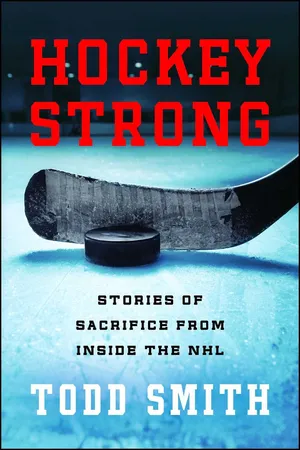
Hockey Strong
eBook - ePub

Hockey Strong

Stories of Sacrifice from Inside the NHL

  1. 320 pages
  2. English
  3. ePUB (mobile friendly)
  4. Available on iOS & Android
eBook - ePub

Hockey Strong

Stories of Sacrifice from Inside the NHL

About this book

This is the story of hockey, one scar at a time.

For the casual enthusiast and hockey fanatic alike comes a brilliant collection of essays and photographs celebrating the grit and dedication of hockey players who regularly and willingly withstand injury and hardship to play the sport they love.


Veteran hockey writer Todd Smith explores a side of the NHL that is rarely seen. Through in-depth player interviews and inside-the-locker-room reportage, Hockey Strong gives readers a behind-the-pads look at the playing in pain ethos that has been woven into the fabric of the game. What separates a hockey player’s toughness from other athletes’ is the fact that being hockey strong is more than a single performance or bout or game or series. Hockey strong is a way of life.

Superstars, muckers, snipers, and enforcers alike: the arduous journey of an NHL player is a story of the human body. It is the cracking left fist of the Philadelphia Flyers’ Dave Brown and the battering ram right hand of the Detroit Red Wings’ Joe Kocur. It is the unbreakable hockey heart of Rob McClanahan during “The Miracle on Ice” at the 1980 Winter Olympics in Lake Placid. It is the smashed face Kris Draper suffered during the bloody rivalry between the Colorado Avalanche and the Detroit Red Wings.

Medical clearance to fight. Midgame root canals. Crushed orbital bones. Beer league determination. Legendary beat-downs. Collapsed lungs that go unreported. Unrelenting pain. Recovery and valor. Players refusing to go out because they owe it all to their brothers in uniform.

Includes stories from: Shjon Podein, Dave Brown, Kris Draper, Kirk Maltby, Joe Kocur, Darren McCarty, Chris Nilan, David Clarkson, Rob McClanahan, Herb Brooks, Jack Carlson, Zach Parise, Charlie Coyle, Rick Tocchet, the Playoffs, and more!
Frequently asked questions

Yes, you can cancel anytime from the Subscription tab in your account settings on the Perlego website. Your subscription will stay active until the end of your current billing period. Learn how to cancel your subscription.
No, books cannot be downloaded as external files, such as PDFs, for use outside of Perlego. However, you can download books within the Perlego app for offline reading on mobile or tablet. Learn more here.
Perlego offers two plans: Essential and Complete
  • Essential is ideal for learners and professionals who enjoy exploring a wide range of subjects. Access the Essential Library with 800,000+ trusted titles and best-sellers across business, personal growth, and the humanities. Includes unlimited reading time and Standard Read Aloud voice.
  • Complete: Perfect for advanced learners and researchers needing full, unrestricted access. Unlock 1.4M+ books across hundreds of subjects, including academic and specialized titles. The Complete Plan also includes advanced features like Premium Read Aloud and Research Assistant.
Both plans are available with monthly, semester, or annual billing cycles.
We are an online textbook subscription service, where you can get access to an entire online library for less than the price of a single book per month. With over 1 million books across 1000+ topics, we’ve got you covered! Learn more here.
Look out for the read-aloud symbol on your next book to see if you can listen to it. The read-aloud tool reads text aloud for you, highlighting the text as it is being read. You can pause it, speed it up and slow it down. Learn more here.
Yes! You can use the Perlego app on both iOS or Android devices to read anytime, anywhere — even offline. Perfect for commutes or when you’re on the go.
Please note we cannot support devices running on iOS 13 and Android 7 or earlier. Learn more about using the app.
Yes, you can access Hockey Strong by Todd Smith in PDF and/or ePUB format. We have over one million books available in our catalogue for you to explore.

Information

Publisher
Gallery Books
Year
2016
Print ISBN
9781501157233
eBook ISBN
9781501118371

CHAPTER ONE

SHJON PODEIN

Images
The Mayor of Muckerville sits on a stool in a suburban Minneapolis ice rink holding court. Shjon Podein is yucking it up and slapping backs. Great guffaws roll around deep inside him and then move up . . . up . . . up . . . and detonate in the rink lobby as he regales the hockey moms and dads around him with stories from his one-of-a-kind hockey odyssey.
During his decadelong career in the NHL, Podein was one of the most beloved third-line players. He was never the fastest or biggest or strongest or most gifted player on the four NHL teams he played for between 1992 and 2003, but he was tough, and hockey toughness comes in many shapes and forms. There are the fighters, of course, who practice the dark arts of the sport, punching and slashing and bashing and intimidating opponents. Then there are the players who battle through horrific injuries for the good of the team. Then there are the players like Podein, who are just extremely tough to play against.
For the entirety of his career, Podein was known as a sandpaper guy, a gritty player whose main job was to rub opponents down the hard way, doing everything he could to take the shine right out of their stars. He was up in the opponent’s kitchen, their comfort zone, grabbing and sticking, scrumming, and chirping smack talk. Every team in the league has a player or an entire line whose whole goal is to make life miserable for the opponent’s top line, hitting them at every turn, shift after shift. They’re often anonymous players who are only appreciated by their hometown fans and are offhandedly referred to simply as grinders or plumbers or scrappers or, as in Podein’s case, muckers. These third-line players toil in the hockey trenches, literally leaving skin in the game, and then they are gone, never to be heard from again.
What makes Podein the Mayor of Muckerville is that his turbulent and abrasive on-ice playing style was mixed with an off-ice personality that was equal parts Jeff Spicoli and Evel Knievel with a dash of The Big Lebowski sprinkled in for good measure. He was both a practical joker and a scrapper, a wild-eyed cartoon character with real-life wounds, a dude of the highest ilk who’ll tell you that playing in 699 NHL games and winning the Stanley Cup with the Colorado Avalanche in 2001 were all nice, but what he’s most proud of is his 25 Foundation, which he started to help sick kids.
Podein’s career was a traveling circus of sorts that began in southern Minnesota and then hit the beaches of California, only to return to the Midwest, where he engaged in a one-man Cannonball Run, driving back and forth to play hockey at a college that initially didn’t want him. His professional career started in the Edmonton Oilers’ organization, where he yo-yoed back and forth between their minor league team in Nova Scotia and the Oilers in Alberta. Then Podein hit and scratched and clawed his way into a permanent roster spot in the NHL and stayed in the top league, including three full seasons with the Philadelphia Flyers. After becoming a forechecking folk hero in Philly he was traded to Colorado and won the Cup as a feral, bearded whirling dervish. He was beloved by fans and teammates for his stout work ethic and unrelenting willingness to go hard into the dirty areas of the ice rink. This led to multiple scars and injuries and getting tangled up with a slew of legendary NHL tough guys.
If you take a close look past Podein’s jovial personality, you’ll see that a third-line mucker like him doesn’t leave the game unscathed. In his role, his body paid a heavy price, and he is deeply scarred. Some of the markings are clearly visible, and some are hidden on his face and mouth by a thick tuft of blond stubble. But each one of these scars has a story, and Podein is happy to oblige you with any of them.
ā€œThe curved scar over my left eye is from a wound cut so deep it reached my skull,ā€ Podein says as calmly as a man describing his grocery list. ā€œThere is a chipped tooth that’s been repaired twice but kept on getting knocked out, so I said the hell with it and just left it chipped.ā€
As Podein talks, ears perk up. Dads normally bored stiff by yet another youth sports practice stop scanning their cell phones for a second and listen to Podein as he revs up a story.
ā€œPlease don’t bring up the time that big farm boy Jeff Beukeboom beat the living tar out of me,ā€ Podein says flatly. Then a thick laugh rolls out.
Two dads standing behind him in the lobby lean back and start hooting. Everyone loves Podes.
EVEN ON THIS RIPE summer day in the Twin Cities, the ice rink in suburban Minneapolis is full of skaters. The humid air outside is as thick as soup, and summer pummels its way inside, crushing the frigid rink air and fogging the lobby windows over. Podein’s golf shirt, cargo shorts, and flip-flops are standard-issue dad apparel. He watches his seven-year-old son play hockey through both the lobby viewing windows and the Plexiglas around the rink, which gives the appearance that his son is playing hockey in an aquarium. Podein wipes away the fog on the viewing window and then applauds his son’s efforts and waves at him at every turn. Every couple of minutes two large steel doors at the end of the ice rink lobby swing open, and the riotous summer squeals of the kids in the adjacent outdoor pool fill the lobby and laughter ricochets off the cold concrete walls. The doors slam shut, and in an instant the laughter is gone. In its wake is only the sound of pucks tink-tink-tinking off the Plexiglas.
At the end of a long drill, Podein’s son slides up against the glass and waves at him again, a wide Cheshire-cat smile stretching out and over a chunk of mouth guard. As the son starts yet another skating drill, his smile recedes slowly. Podein feels it; he shrugs his shoulders because he knows all too well what it feels like to have your lungs burning out there on the ice.
ā€œI know, son,ā€ Podein says sympathetically to himself as he gives his boy another wave of encouragement. ā€œYou’ve been doing line drills for forty-five minutes. I get it. I’ve been there.ā€
Among the swirl of jerseys and cones and bleeping whistles Podein finds his son again and enthusiastically waves at him. It’s not hard to spot Podein’s son, either. Junior’s the spitting image of his father, right down to the shock of blond hair, the wild-eyed gleam in his eyes, and the number 25 on the back of his uniform. Podein watches Junior burst through the drills, and gives no mind to the fact that he’s the smallest player on the ice. In addition to the looks Junior inherited from his dad, he also got a healthy dose of the unrelenting hustle, drive, and reckless abandon that made Podes such a popular role player.
According to the elder Podein, when it comes to hockey, there is one striking difference between father and son.
ā€œJunior is way tougher than I ever was,ā€ he says, chuckling, full of his usual good-natured self-deprecation. ā€œI was a total baby as a kid.ā€
As Podein begins to tell the story of his professional hockey career, he looks out toward the ice to gather himself, to find his bearings. The rink—any rink, in any city—has been his home for so long that it seems to ground him.
ā€œI was blessed with a dad who taught me a strong work ethic,ā€ Podein says. He looks out toward the ice again and watches Junior Podein bang around in the corner like a racquetball and lets out a hearty laugh because of it. ā€œSo when things got tough, that’s how I always trained. I embraced it.ā€
Podein, a native of Rochester, Minnesota, was no star, a player with a straight-line trajectory into Division I hockey or the NHL. He was more of a rogue comet, hurling himself through every space on the ice and crashing into every opponent who came near him. Although Podein showed tremendous character and potential at Rochester’s John Marshall High School, after graduation there were few offers.
From the very beginning, though, Podein didn’t quit on a shift or on his dream of playing hockey. When his dream of playing at the University of Minnesota–Duluth died, he took an odd detour to the sunny beaches of Southern California.
ā€œAfter high school hockey, I had a short stint playing hockey for the Soaring Sea Gulls at the United States International University in San Diego,ā€ Podein says. The Plexiglas in San Diego was forty feet high to keep the cool air near the ice, and the obscure hockey outpost, the team run by Minnesota native Brad Buetow, just didn’t seem right.
ā€œI didn’t want to regret giving up on my dream of playing hockey at the University of Minnesota–Duluth,ā€ Podein says. ā€œSo I headed home.ā€
There was only one problem: UMD still didn’t want him. Podein lets out another loud chortle at the memory. Then he says, ā€œUMD literally told me not to come. They told me that there was no room for me, so I shouldn’t bother coming up there!ā€
Podein didn’t listen and just went ahead and enrolled, unbowed and determined to play for the Bulldogs. He went to school Monday through Friday in Duluth. Then he started playing for the Rochester Mustangs of the USHL on weekends. His Mustangs coach, Frank Serratore, somehow convinced the UMD hockey program to let Podein practice with the team during the week.
ā€œI was practicing with UMD, one of the best college programs in the country, during the week and playing in junior hockey on the weekends,ā€ Podein says with a righteous inflection. ā€œHow awesome is that?ā€
The Podein family didn’t have a lot of money to fund his dream. So Shjon took matters into his own hands and bought a used 1978 Chevy Vega that had no heat, an AM-only radio, and a plastic Chicago Cubs helmet taped to the front. He drove the beast 230 miles back and forth between Rochester and Duluth every week.
ā€œI’d get up at four a.m. on Monday morning and be in Duluth for my eight a.m. classes,ā€ Podein says. ā€œI’d drive fifty-five miles per hour, try to stay out of the ditches, and listen to the Sex Talk radio show out of Chicago to stay awake.ā€
All of those snowy miles and early-morning wake-up calls, and seven days of hockey per week, eventually paid off. He won a national championship with the Rochester Mustangs and through sheer force of will earned a spot on the UMD roster. He was put on the fourth line at Duluth and became a dependable, lunch-bucket type of player with a hot-running motor. By the end of his first season with the University of Minnesota–Duluth, Podein was drafted 166th overall by the Edmonton Oilers. In his third year in Duluth he scored 39 points in 35 games. After his junior year in college, Podein turned pro and reported to Cape Breton, the home of the Oilers’ top minor-league affiliate in the American Hockey League.
Paths to the NHL aren’t always pretty and smooth, like moves on a game board where a player slides easily from one team to the next, and always with upward mobility. There can be only so many players on the autobahn to the NHL; guys like Sidney Crosby and Patrick Kane ride straight into the bright lights. The road to the NHL for most players is filled with detours to the minor-league outposts of the AHL or the IHL, places such as Wheeling, West Virginia, to play for the Nailers or Milwaukee to play for the Admirals. During a player’s time in the minor leagues, emotional and physical land mines can explode all around them, tearing apart their path and dreams with injuries, rejection, and failure.
This is a universal journey for players such as Podein, and it reminded me of a talk I had with Paul Ranheim about the same subject. Ranheim was raised in Edina, Minnesota, and after he retired from his long professional hockey career in the NHL he coached Minnesota high school hockey with Podein at St. Louis Park High School and currently coaches at Eden Prairie High School, a hockey powerhouse in Minnesota. During the late 1980s, Ranheim was a collegiate all-American at the University of Wisconsin and a lofty second-round pick of the Calgary Flames. When Ranheim turned pro in 1988, the Flames were a stocked team, loaded with veterans who were dug into their roles and the lineup. More important, the Battle of Alberta between the Flames and the Edmonton Oilers was raging, and it was no place for a college kid to start his career. So the Flames sent the twenty-two-year-old Ranheim down to their IHL minor league affiliate, the Salt Lake Golden Eagles, in Utah.
ā€œWe bused to towns like Flint, Michigan, and Muskegon and Peoria, and it was a real mental test,ā€ Ranheim says. ā€œWe’d play three games in four nights. It’d be dreary out and miserable, and we’d pull into these towns in the middle of the night. You’d stare out the window and ask yourself, How bad do I really want this?ā€
ā€œNova Scotia was the true minor leagues,ā€ Podein says. ā€œLast call at the bar Smooth Herman’s was three forty-five in the morning. Everyone thinks pro hockey is like Zach Parise: ten million dollars a year. Between the taxes and finances and exchange rate and agent fees, I literally lost money playing professional hockey for the first year.ā€
Life on the road in the NHL means that the team bus picks up the players at their swank hotel, with its five-star chef, Egyptian cotton sheets, and center-city locale, and then conveniently drops them off on the tarmac next to their chartered plane. In the minor leagues, though, the players get on the bus, and it doesn’t stop until it gets to the next town. In the minor leagues, all the players, regardless of their skill level or draft selection, are literally on the same bus. Whether it’s a mucker like Shjon Podein playing in Nova Scotia for the Cape Breton Oilers or a highly valued draft pick like Charlie Coyle playing in Houston for the Aeros or a former NCAA Hobey Baker Award finalist like Paul Ranheim doesn’t matter. If you’re in the minors, you’re on the bus: veterans in the back, rookies up front, and pizzas delivered straight to the bus as it idles outside the arena after the game. Every player looks out the same window as the bus drives across the country into these minor-league towns that are stuck out on the margins of the sports world: there are the sun-scrubbed frontier towns out West, where hockey is nothing more than a circus attraction; there are the blue-collar towns of the Midwest, cities that have typically been pummeled by a failing economy and are now rusting carcasses of their former industrial selves; and there are the East Coast towns that are encased in concrete and shrouded in sheet-metal skies.
Ranheim remembers playing in ice rinks with names like the Corn Palace and the Salt Palace. These rinks were so far off the map, so far from the bright lights of Madison Square Garden, so far away from the buzzing metropolitan NHL hubs, that they were like islands in the South Pacific. Some of these arenas would have so few fans that an air of ambivalence hung over the game with enough weight to crush all the hopes and dreams in a player’s heart, making him question his career choice and his future.
In the next game, Ranheim’s team would enter a raucous bunker of an arena and play against an opponent and a town that treated the game like it was the last stand at the Alamo. Despite the shuttered factories and downturned economy, the town would be more than ready for the game at hand, each fan having circled it on his calendar with the finality of a death sentence. Each player knew he had to get up for the game, for the battle at hand, because it would all be on the line for their team and the town.
ā€œWe had a really tough team, too. Five guys with over two hundred penalty minutes. And we had Stu Grimson,ā€ Ranheim quips. ā€œOh boy, did we have some battles.ā€
The hard times of daily life in these minor-league towns could be sensed in the rink on game night. It would be a Friday night in Peoria, Illinois. The beer would be cheap, served in tall wax-paper cups. The city’s main employer, maybe a tire factory or an auto plant, would be struggling. There’d be rumors of layoffs, which felt like a noose being tied slowly around the whole town. But the fans would not think about any of that on game night. These minor-league fans had spent what little money they had for a slight reprieve, and they’d come to see their beloved Peoria Rivermen play. The fans paid for their tickets with their calluses, their square shoulders, their lives spent under hard hats, and would award themselves full license to berate the opponent. Through cupped fists and with pungent beer breath they would bark out words like ā€œtwatā€ and ā€œfuckholeā€ as the visiting team came out onto the ice. Sometimes they would throw dead rodents onto the ice. They would bang the glass and pound drums and clang cowbells. And that’d just be in warm-ups.
After the game, regardless of the outcome, it would be back on the bus to the next town, to the next game, and to the next battle.
ā€œEach bus ride was long enough to be uncomfortable but not long enough to let you sleep,ā€ Ranheim says. ā€œWe’d bus all night from Milwaukee to Indianapolis. I remember on that trip thinking that it was fall and football season and that I’d rather be home with my buddies watching a game. Then we pulled into our hotel, called the Knights Inn. I entered my room straight from the parking lot. I opened the door to my room, and the first thing I saw was purple velour sheets. It was disgusting. But we were all paying our dues.ā€
Podein sympathizes with Ranheim’s plight and lets out a riotous snort as he recalls his own ā€œwelcome to the minor leaguesā€ moment. After a long road trip, the Cape Breton team pulled into the home arena, and Podein’s car was up on blocks. Someone had taken the tires, which were worth more than the car.
ā€œPodes just stood there not knowing what to do,ā€ Kirk Maltby, a Cape Breton teammate, says, laughing.
As Podein bounced back and forth between the minors and the luxurious big league, he needed more than just physical strength. He had to continuously stoke his inner fire and his love of the game, the same things that had fueled him on those drives between Rochester and Duluth. He remembered the ’78 Vega; he remembered Duluth’s initial rejection. So he kept plugging away, charging up that ladder to ring the big bell.
Every player in the minor leagues has to do this. They have to find their own personal way of getting up for the game at hand and the long road beyond it. AHL rosters are a mix of valued draft picks and retreads, of lifers and developing rookies, of Canadians and American college kids and European imports. And each one of these players is working inside this h...

Table of contents

  1. Cover
  2. Dedication
  3. Glossary
  4. Introduction
  5. Chapter One: Shjon Podein
  6. Chapter Two: Dave Brown
  7. Chapter Three: The Grind Line
  8. Chapter Four: Chris Nilan
  9. Chapter Five: David Clarkson
  10. Chapter Six: Rob McClanahan versus Herb Brooks
  11. Chapter Seven: Jack Carlson
  12. Chapter Eight: Zach Parise
  13. Chapter Nine: The Stanley Cup Playoffs
  14. Conclusion
  15. Photographs
  16. A Note on Sources
  17. Acknowledgments
  18. Photo Credits
  19. About Todd Smith
  20. Copyright