Touchdown Tony
eBook - ePub

Touchdown Tony

Running with a Purpose

  1. 256 pages
  2. English
  3. ePUB (mobile friendly)
  4. Available on iOS & Android
eBook - ePub

Touchdown Tony

Running with a Purpose

About this book

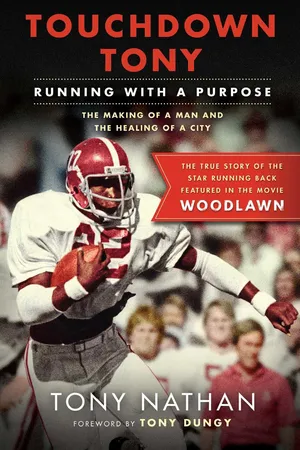
The true story from which the inspirational movie Woodlawn starring Jon Voight, Sean Astin, and C. Thomas Howell, is based on African American running back Tony Nathan and his experiences on a mostly white team in 1970s Birmingham, Alabama, and how his courage and superb athletic ability helped heal a city, propelling him on to a successful football career as both a player and a coach in the NFL.

When Tony Nathan got his hands on a football, it was like Superman putting on his cape. He stepped onto the field and became a different person—a hero destined to change the course of Alabama history. Somehow, when he held a football, he knew exactly what to do, and it was those instincts that helped him navigate life in one of the most tumultuous cities in America.

In this powerful memoir, Tony reveals how he summoned the courage to “run with a purpose” during the times when racial tensions were at their highest as he grew from a boy trapped by the racial divide in Birmingham, Alabama, into a successful man and football hero.

Tony’s courage, character, passion, and strength contributed to his impressive career on the field—including two Super Bowls with the Miami Dolphins—and then as a coach who helped train other winning players.

Inspirational and uplifting, Touchdown Tony is not only a behind-the-scenes look at a great football player’s life and career, it is also a story of redemption and one man’s hope to change the future.
Frequently asked questions

Yes, you can cancel anytime from the Subscription tab in your account settings on the Perlego website. Your subscription will stay active until the end of your current billing period. Learn how to cancel your subscription.
At the moment all of our mobile-responsive ePub books are available to download via the app. Most of our PDFs are also available to download and we're working on making the final remaining ones downloadable now. Learn more here.
Perlego offers two plans: Essential and Complete
  • Essential is ideal for learners and professionals who enjoy exploring a wide range of subjects. Access the Essential Library with 800,000+ trusted titles and best-sellers across business, personal growth, and the humanities. Includes unlimited reading time and Standard Read Aloud voice.
  • Complete: Perfect for advanced learners and researchers needing full, unrestricted access. Unlock 1.4M+ books across hundreds of subjects, including academic and specialized titles. The Complete Plan also includes advanced features like Premium Read Aloud and Research Assistant.
Both plans are available with monthly, semester, or annual billing cycles.
We are an online textbook subscription service, where you can get access to an entire online library for less than the price of a single book per month. With over 1 million books across 1000+ topics, we’ve got you covered! Learn more here.
Look out for the read-aloud symbol on your next book to see if you can listen to it. The read-aloud tool reads text aloud for you, highlighting the text as it is being read. You can pause it, speed it up and slow it down. Learn more here.
Yes! You can use the Perlego app on both iOS or Android devices to read anytime, anywhere — even offline. Perfect for commutes or when you’re on the go.
Please note we cannot support devices running on iOS 13 and Android 7 or earlier. Learn more about using the app.
Yes, you can access Touchdown Tony by Tony Nathan in PDF and/or ePUB format. We have over one million books available in our catalogue for you to explore.

Information

CHAPTER ONE


MOM AND POPS

As a twelve-year-old kid in 1968, I had no notions of being a professional football player. In fact, I hadn’t played much football up until that point. Sure, I’d played with the other boys in my neighborhood, but I’d never played on an actual team in an organized league. While I enjoyed playing the sport, I didn’t really like running with the football. I much preferred being the one who did the tackling, rather than being the one who was getting tackled.
Even though I didn’t have big dreams for my future, I knew two things I didn’t want to do when I became an adult: I didn’t want to pick cotton, and I didn’t want to work in a steel mill. My father, William Nathan II, worked the graveyard shift at Conner Steel, which was one of the bigger plants in Birmingham, Alabama. My father, whom my family calls Pops, started his career as a laborer in the steel mill. Because of his strong work ethic, he was eventually promoted to mechanic. Pops went to school and learned how to fix things—a skill that was very valuable at the steel mill. My father worked hard, and I rarely heard him complain about his job. But working at the steel mill was dangerous, and hearing the horror stories about the accidents there made me realize that I wanted no part of it. Pouring steel wasn’t easy, and the plant was always hot——especially during the sweltering Alabama summers. I remember seeing my dad covered in grease, dirt, and sweat when he came home in the morning. He always looked exhausted. I was sure that I didn’t want to punch the clock at the mill when I was older.
I also knew I didn’t want to pick cotton, because that’s what I did when I spent time at my grandfather’s farm. My paternal grandfather, William Nathan, had a farm near Uniontown, Alabama, which is where my dad grew up. My grandfather’s farm was about ten acres, and he raised cows and other animals. He also planted cotton, corn, watermelons, peanuts, potatoes, and other fruits and vegetables every spring. Farming was hard work, and my grandfather went to the fields every day. When I was twelve or thirteen, I spent a lot of weekends and most of the summer working my grandfather’s farm. He woke up every morning about 4:00 a.m., and then he’d get me up a couple of hours later. Though I could have helped him with his earliest chores, he’d always let me sleep a little longer. We’d harness a mule to a wagon, and then the mule would take us out to his land, which was a couple of miles from the house. The mule knew exactly where to go, so we’d sleep during the short ride.
Once we were old enough, my two brothers, two sisters (my biological aunt Erma Gean was only a couple of years older than me, so I refer to her as my sister), and I picked cotton, hoed weeds, and helped my grandfather harvest the fruits and vegetables. During those weekends and hot summer days, we usually worked from sunup till sundown. Those days were long. The constant threat of being eaten alive by fire ants and gnats made it even worse. It was difficult work, and I didn’t want to do it, but I learned to respect anyone who did. It was a tough way to make a living. More than anything, it taught me what I didn’t want to do with the rest of my life. Don’t get me wrong: I appreciated what my father and grandfather did for a living, and I certainly didn’t think the work was beneath me.
By having me work on the farm, my dad and grandfather gave me an opportunity to see how they were raised and what they had to do to survive, and I’ve always respected them for what they did. And they definitely passed on a strong work ethic to me—a valuable lesson that has served me well.
Even though I didn’t want any cotton picking in my future, I also knew that if farming was what I had to do to make my way in life, then that’s what I would do. In the fields, I learned that you do what you have to do to make ends meet and provide for your family. And if I had to work in a steel mill, then I knew I could do that, too. If it was good enough for my father, it was good enough for me. My father was my mentor and is now my best friend. I can’t thank him enough for providing me with the chance to do what I wanted in life.
Pops didn’t have much in terms of material possessions when he was growing up. He went to school, and he worked on the farm; he did what he needed to do to help his family survive. After high school, my dad joined the army and was stationed at Fort Rucker in Dale County, Alabama. A week before my dad was to be deployed to fight in the Korean War, the United States and North Korea signed an armistice ending the three-year-old conflict. Obviously, he was among the lucky ones. Pops spent the next two years working as a drill sergeant at Fort Benning in Columbus, Georgia. He was discharged from the army in July 1955, following the end of the Korean War.
The year before my dad joined the army in 1953, he met my mother, Louise, whose sister was dating one of his brothers. My mom said she really wasn’t attracted to my dad initially, but he seemed to grow on her because he was at her house so often. Even though my mom was only fifteen years old, Pops persuaded her parents to let them marry on Christmas Day 1955. My dad was twenty-two years old on his wedding day. While my mother would be considered too young nowadays, they’ve been happily married for nearly sixty years. They taught me a lot about the sacrifices a husband and wife have to make for a marriage to work.
In the spring of 1955, Pops moved to Birmingham and my mom joined him there the next spring, where they started their lives together. I was born on December 14, 1956. My sister, Diane, was born two years later, and then my brothers, Vincent and Cedric, came along after her. I was five years older than Vince and ten years older than Cedric, and I still regret that I missed so much of Cedric’s childhood. I was out of the house by the time he went to high school, but despite our age difference, we’re still very close today.
When I was seven years old, my aunt Erma Gean came to live with us in Birmingham after my maternal grandmother died. Erma Gean was only two years older than I was, so she’s always been more like my sister than my aunt. When I was a kid, she and I spent some fun times together at my maternal grandparents’ farm. My mom’s parents, Dorsey and Mary Williams, lived about twenty-five miles from Grandpa Nathan’s farm. I loved spending time with Erma Gean. She and I liked to run through the cotton rows and cornfields together. We ran to the end of dirt roads and back. She was probably the one who taught me how to run. Erma Gean was bigger than me, and I had a difficult time keeping up with her. Even though she might have been faster than me, I was determined to ramp up my speed. By the end of the day, my calves were usually swollen from trying to catch her. Sometimes, we rode my grandfather’s big pig in the front yard, which was quite an adventure. Erma Gean and I were always looking for ways to have fun.
Once I reached high school and was old enough to drive, I went to work for a man who owned a farm near my aunt Elizabeth’s house. The man paid me three dollars a day to drive a tractor. I was lucky that I didn’t have to help bale the hay, like the other boys who were younger than me. They would load up a wagon with hay, and then I’d drive the tractor to the barn. At the time, three dollars a day was a lot of money to me, so at the end of the summer, I didn’t want to go back to Birmingham. But Pops told the farmer he couldn’t keep me because I had to go back to school. Being young and naive, I tried to talk my dad into letting me stay. I told him I’d just drop out of school. Fortunately, Pops persuaded me to go back to Birmingham by promising me a weekly allowance of three dollars. That’s all it took to change my mind.
My mother and father couldn’t have been more different, and you know what they say about how opposites attract. That was my parents in a nutshell. My father is a soft-spoken man and always has a smile on his face. People like to say that Pops has never met a stranger. I have great admiration for my father regarding the way he treats other people and shows them respect. He’s a levelheaded man and rarely becomes angry—I remember only a very few times when he actually raised his voice. My father is a cool individual.
My dad’s friends called him “Coon Man” because he’s a great coon hunter. Hunting has always been his outlet; it’s how he gets away from everybody else and the chaos of life. He loves being in the woods, and while he was still working in the noisy, busy steel mill, he enjoyed the freedom of the woods and having time to relax. He also likes to train dogs to chase coons, so while I was growing up, we usually had a backyard full of hunting dogs. As soon as the school day ended on Friday, we’d jump into my dad’s truck and head to my grandfather’s farm.
I liked going to the farm with Pops, but I didn’t like to hunt. In fact, I’ve only been hunting with him twice. The first time, my mom made Pops take me because she wasn’t convinced he was actually hunting when he left home. After Pops came home empty-handed two or three times, my mother started to wonder if he wasn’t really spending the weekend at a honky-tonk. My dad blamed it on his sorry dogs. Still, my mom made him take me the next time for good luck. My grandfather came along, too, but we didn’t see a coon the entire weekend. At the end of Saturday night’s hunt, I told him, “Pops, now we’re in trouble. Momma sent me with you for good luck.”
Fortunately, my grandfather had a raccoon in his deep freezer that he’d recently killed. We stopped by to get it, then let it thaw out on the way home. When we showed it to my mom, she said, “I’m going to have to send Tony with you every time!”
That wasn’t exactly what I wanted to hear. Although I enjoyed spending time with my dad and grandfather, I wasn’t particularly excited about hunting. You have to hunt coons at night, and you never know whether you’ll actually see one. It was usually pretty cold when we hunted, and there wasn’t enough action to keep me interested—or warm. I would have rather been playing baseball, basketball, or football with my friends than chasing a raccoon through the woods. I guess I don’t have the patience required for hunting.
On our second hunting trip, I followed Pops around for what seemed like forever. His dogs finally picked up a raccoon’s scent and took off running. We started to chase the dogs, but I quickly lost sight of my dad, who was in front of me. His dogs chased the raccoon up a tree. Pops could hear the dogs, but he couldn’t find me. After going in circles for about thirty minutes, his dogs lost interest in the coon and came back. Then they started barking and charged another tree. Pops found me leaning against a tree, sound asleep.
“Hey, Pops, where’s the truck?” I asked, after he woke me up.
“I gotta go shoot this coon,” he said. “You go back to the truck.”
When Pops returned to the truck, I said, “You’re going to have to get you another partner. This is the last hunt for me.”
I never went hunting with Pops again. Pops loves the sport, and it works for him—but it isn’t for me. Spending all night in the woods just isn’t my idea of fun. My brothers, Vince and Cedric, didn’t like coon hunting much, either. Fortunately, Pops found a boy in our neighborhood who liked to hunt, and they’ve been hunting together for about thirty-five years.
While Pops is a quiet man, my mother is loud, boisterous, and outspoken. When Mom came to watch my games, she was usually the loudest person in the stands. If the woman has an opinion, she’ll let you know what it is. She is spunky and likes to get her point across. When my mom wants to talk, she doesn’t mind talking. When she’s tired of talking about something, she’ll let you know that, too.
My mother was a homemaker, and her primary job was raising her family. She taught herself how to sew and earned extra money by making clothes for others. To save money, she made clothes for my brothers, sisters, and me. My clothes didn’t have tags from department stores, but I knew no one else could buy replicas of them—my clothes were one of a kind. My mom also worked as a caretaker and tended to the sick and elderly when she was needed. She was always busy and rarely sat still.
Make no mistake: my mom was the boss when I was growing up. She had to raise three boys and two girls. She had her hands full. She is a big-boned woman with a large frame and booming voice. She didn’t play around when it came to discipline, and she didn’t mind if others disciplined us, too. Where I grew up, the parents believed it took a village to raise a child. If you were at a friend’s house and stepped out of line, his parents took it upon themselves to discipline and spank you. When we returned home, our parents spanked us again because somebody else had to discipline us. The threat of double jeopardy usually kept us out of trouble.
My momma made it very clear to us that we did not want to embarrass our family. We were taught to respect other people, obey our elders, and not get into trouble. She didn’t want us bringing negative attention to our family. My momma likes to say that she and my dad tried to raise us to do right and then let God do the rest. As Proverbs 22:6 teaches, “Start children off on the way they should go, and even when they are old they will not turn from it.” My parents were also firm believers of Proverbs 23:13, which says: “Do not withhold discipline from a child; if you punish them with the rod, they will not die.”
There was a clear chain of command in our house. My mother and father were in charge, and my brothers, sisters, and I were expected to follow their rules. They also expected us to attend church and Sunday school at St. James Baptist Church in the Woodlawn neighborhood of Birmingham every week. We had to obey our teachers in school and complete our daily chores without complaining. There was a rotating schedule of chores, and we each had different duties every week. If it was my turn to wash dishes for a week, I couldn’t do anything else after dinner until the dishes were clean. It was the same thing with sweeping and mopping the floors, washing and hanging out the clothes, or cleaning up the yard. If I didn’t attend church on Sunday morning because I was too tired or didn’t feel well, I wasn’t allowed to do anything else the rest of the day. I had to stay in the house and couldn’t go outside.
I didn’t skip church very often, because I didn’t want to miss out on playing with my friends. When I was younger, we lived in Parker Heights, which was across the street from Birmingham’s airport. Our neighborhood was near Daniel Payne College, which was a historically black college until it closed in 1979. Our neighbors had seven boys, and Vince and I played sports with them as much as possible. Our backyard was about fifty feet wide and their backyard was about as big. Together, we had a 100-yard-long football field. We played football so much that we killed the grass in both yards. After a while, my dad didn’t even own a lawnmower. He never complained about his grass. That’s the way Pops was. He cared more about us having fun than he did about the appearance of his yard, even if some of our neighbors liked to complain about it.
When I was about seven years old, I told Pops I wanted a football of my own. At the time, he didn’t have the extra money to buy me one. So he did something even better—he made one for me. Pops was taking upholstery classes at the time, and he and his instructor sewed me a cloth football and stuffed it with cotton and rags. My friends and I played with that football until the next Christmas, when I found a real one under the tree. That’s what I remember most about my father. Even if he didn’t have the money to buy me everything I wanted, he found a way to make me happy. Because of those long days I spent working in the cotton fields, I learned to appreciate everything my parents gave me. More than anything, I appreciated the sacrifices they made to ensure that my brothers, sisters, and I had a better life when we were adults than they’d had.
My family learned to make the most of what we had. There’s no doubt in my mind that the work ethic I witnessed in my mom and dad made me a success at Woodlawn High School, the University of Alabama, and the National Football League. From an early age, my parents taught me to do my job, do it well, and not make excuses. More important, my parents taught me to respect people and treat them the way I wanted to be treated. I had no idea how valuable those lessons would be once I started attending Woodlawn High School in Birmingham.

CHAPTER TWO


VILLAGE CREEK

Village Creek is a stream that runs for forty-four miles and snakes through the heart of Birmingham, Alabama. The creek channels through tunnels beneath Birmingham-Shuttlesworth International Airport, meanders through East Thomas Yards, North Ensley, and other parts of town, then eventually ends at a fork of the Black Warrior River.
At one time, Village Creek filled reservoirs throughout Birmingham and was the primary water source for people who lived there. During the late nineteenth century, miners pulled barges down Village Creek to carry coal. The creek is only about waist-deep, but it might as well have been as deep and wide as the Amazon River because of what it represented to my friends and me when we were growing up.
When my family lived in the Parker Heights neighborhood across from the airport, my friends and I liked to go swimming in Village Creek. Summers in Alabama were usually pretty hot and humid, and we didn’t have a community swimming pool. So we’d jump into Village Creek in our blue-jean shorts to cool off. But there was a problem: Village Creek separated our all-black neighborhood from an all-white community on the other side. It was a border of sorts, and kids from both neighborhoods liked to control who swam in Village Creek.
If the white cats caught us in Village Creek, they threw stones at us to run us off. If we caught the white cats in the creek, we returned the favor by throwing rocks at them. We weren’t allowed on the white side of the creek, and we expected the white kids to stay off our side, too. It wasn’t that we actually hated anybody. It’s the way it was back then. I didn’t dislike anyone because of the color of his or her skin. I wouldn’t have tried to hurt anyone, but I wasn’t going to let anyone hurt me. Our battles went back and forth, and I had my share of bumps and bruises.
Growing up in Alabama during the 1960s and early 1970s, I was aware of a lot of crazy things that were happening around me. I heard the stories about church bombings, lynchings, marches, lunch counter sit-ins, and bus boycotts during the civil rights movement. My parents tried to insulate my brothers, sisters, and me from what was happening in Birmingham. Maybe the violence was one of the reasons my parents sent us to my grandfather’s farm every summer. My mom and dad knew we’d have a difficult time finding trouble—or trouble finding us—if we were in the country.
Birmingham was the battleground for the civil rights struggle. It was a dark time in America’s history, and there was an international spotlight on my hometown. But I was too young to understand the magnitude of what was happening around me. I didn’t realize or appreciate the sacrifices others were making to ensure that people who looked like me would have better lives in the future. And I certainly didn’t know that someday I’d have a small part in making things better.
I heard about tragic incidents like the 16th Street Baptist Church bombing, which killed four young African American girls as they prepared for Sunday school on September 15, 1963. Our parents rarely took us to downtown Birmingham during that time, but I knew that was where Birmingham police commissioner Bull Connor ordered his officers to turn their water hoses and dogs on student protesters during the Children’s Crusade in 1963. We were only a few miles from where everything occurred, but my parents did a good job of shielding us from the violence.
My mother attended a few civil rights meetings, and she heard Dr. Martin Luther King Jr. and other African American leaders talk about nonviolent protest. Dr. King’s beliefs very much aligned with what my parents tried to teach my siblings and me. We were taught to find a peaceful resolution if we were confronted with violence. From an early age, Pops told my brothers and me to walk away if someone wanted to fight. He told us, “Don’t turn your back to them, but walk away. Don’t start it; but if you have to finish it, you’d better finish it.” My mom was big on that one. She told us we’d better never start a fight; but if we had to use our fists, we’d sure better see it through.
When I became older, I had a difficult time understanding why racism existed. Sadly, ignorance still exists today. I never understood how someone could judge another person by the color of his or her skin. Racists don’t even know me, but they judge me because I look diffe...

Table of contents

  1. Cover
  2. Foreword by Tony Dungy
  3. 1. Mom and Pops
  4. 2. Village Creek
  5. 3. Chicken Big
  6. 4. Amnesia
  7. 5. Breakout
  8. 6. Rivalry
  9. 7. Recruiting
  10. 8. Magic Bank Account
  11. 9. Roll Tide
  12. 10. Rebound
  13. 11. Champions
  14. 12. NFL
  15. 13. Coaching
  16. 14. Praise Your Pond
  17. Photographs
  18. About Tony Nathan
  19. Copyright