The Yucks
eBook - ePub

The Yucks

Two Years in Tampa with the Losingest Team in NFL History

  1. 256 pages
  2. English
  3. ePUB (mobile friendly)
  4. Available on iOS & Android
eBook - ePub

The Yucks

Two Years in Tampa with the Losingest Team in NFL History

About this book

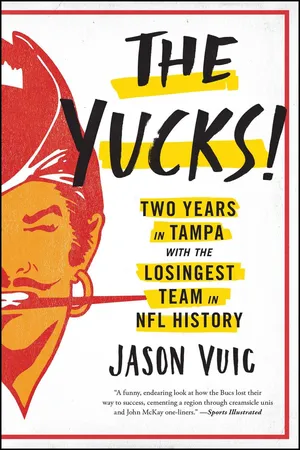
Friday Night Lights meets The Bad News Bears in "a brisk, warmhearted reminder of how professional sports can occasionally reach stunning unprofessional depths" ( Publishers Weekly ): the first two seasons with the worst team in NFL history, the hapless, hilarious, and hopelessly winless 1976­–1977 Tampa Bay Buccaneers. Long before their first Super Bowl victory in 2003, the Tampa Bay Buccaneers did something no NFL team had ever done before and that none will ever likely do again: They lost twenty-six games in a row.This was no ordinary streak. Along with their ridiculous mascot and uniforms, which were known as "the Creamsicles, " the Yucks were a national punch line and personnel purgatory. Owned by the miserly and bulbous-nosed Hugh Culverhouse, the team was the end of the line for Heisman Trophy winner and University of Florida hero Steve Spurrier, and a banishment for former Cowboy defensive end Pat Toomay after he wrote a tell-all book about his time on "America's Team." Many players on the Bucs had been out of football for years, and it wasn't uncommon for them to have to introduce themselves in the huddle. They were coached by the ever-quotable college great John McKay. "We can't win at home and we can't win on the road, " he said. "What we need is a neutral site."But the Bucs were a part of something bigger, too. They were a gambit by promoters, journalists, and civic boosters to create a shared identity for a region that didn't exist—Tampa Bay. Before the Yucks, "the Bay" was a body of water, and even the worst team in memory transformed Florida's Gulf communities into a single region with a common cause. The Yucks is "a funny, endearing look at how the Bucs lost their way to success, cementing a region through creamsicle unis and John McKay one-liners" ( Sports Illustrated ).
Frequently asked questions

Yes, you can cancel anytime from the Subscription tab in your account settings on the Perlego website. Your subscription will stay active until the end of your current billing period. Learn how to cancel your subscription.
No, books cannot be downloaded as external files, such as PDFs, for use outside of Perlego. However, you can download books within the Perlego app for offline reading on mobile or tablet. Learn more here.
Perlego offers two plans: Essential and Complete
  • Essential is ideal for learners and professionals who enjoy exploring a wide range of subjects. Access the Essential Library with 800,000+ trusted titles and best-sellers across business, personal growth, and the humanities. Includes unlimited reading time and Standard Read Aloud voice.
  • Complete: Perfect for advanced learners and researchers needing full, unrestricted access. Unlock 1.4M+ books across hundreds of subjects, including academic and specialized titles. The Complete Plan also includes advanced features like Premium Read Aloud and Research Assistant.
Both plans are available with monthly, semester, or annual billing cycles.
We are an online textbook subscription service, where you can get access to an entire online library for less than the price of a single book per month. With over 1 million books across 1000+ topics, we’ve got you covered! Learn more here.
Look out for the read-aloud symbol on your next book to see if you can listen to it. The read-aloud tool reads text aloud for you, highlighting the text as it is being read. You can pause it, speed it up and slow it down. Learn more here.
Yes! You can use the Perlego app on both iOS or Android devices to read anytime, anywhere — even offline. Perfect for commutes or when you’re on the go.
Please note we cannot support devices running on iOS 13 and Android 7 or earlier. Learn more about using the app.
Yes, you can access The Yucks by Jason Vuic in PDF and/or ePUB format, as well as other popular books in Biological Sciences & Sport & Exercise Science. We have over one million books available in our catalogue for you to explore.
Chapter One

The Promoter(s)

People always say: “Hey! You’re the guy who brought the Bucs to Tampa!” And I say: “No. I helped bring a team to Tampa. I had nothing to do with the Bucs.”
—Leonard Levy, Tampa booster
Bill Marcum was a promoter—not your smooth-talking, backslapping, sell-anything-to-anyone type of promoter—but a promoter nonetheless. His product was football, professional football. The thirty-three-year-old’s plan, in early 1967, was to bring his hometown something it had never seen before: a preseason exhibition game featuring two teams from the National Football League (NFL).1 This was before the Bucs, before Tampa even had a stadium. A 46,000-seat, two-grandstand structure had been approved by local officials and was slated to open in November 1967, with a game between the University of Tennessee Volunteers and the University of Tampa Spartans.
In the meantime, the stadium’s chief administrator, a local agency known as the Tampa Sports Authority (TSA), was looking for occupants. “The TSA was trying to justify the four million dollars it had spent to build that thing,” remembers Marcum, a tallish University of Florida grad and former tennis star from Fort Myers, “so it focused on college games as a way of recouping its money.” The University of Tampa would play home games there, but then the TSA hoped that Florida, Florida State, Miami, and Florida A&M would also play in Tampa at least once a year. The TSA had never even considered the NFL. “That was the bottom of the list,” says Marcum. “That was literally the last thing in their minds when they built the stadium in the first place.”2
But Marcum thought, “Why not?” Tampa was football crazy, and it was common in the 1960s for NFL squads to play preseason games, called “exhibition games,” in even the smallest of cities. The rival American Football League (AFL) did it, too. There were games in Princeton, Ithaca, Bridgeport, New Haven, Norfolk, Rochester, Richmond, Raleigh, Morgantown, Tulsa, Wichita, Shreveport, Mobile, Memphis, Birmingham, and San Antonio, among others. Joe Namath’s first pro touchdown was a 60-yard completion to Hall of Fame receiver Don Maynard in a 1965 preseason game in Allentown, Pennsylvania.3 The games were almost always charity events, hosted by Boys Clubs or Rotary Clubs, and backed by Chambers of Commerce.
Marcum belonged to the Tampa chapter of the Junior Chamber of Commerce, the “Jaycees,” and in 1966 he’d organized a Jaycee national tennis tournament at Tampa’s University of South Florida. He’d done it for charity, for the fun of it; but then, in 1967, it occurred to Marcum that once Tampa finished its stadium, the Jaycees could bring an exhibition game to Tampa, too. So he bought an NFL Handbook, looked up the names and numbers of the league’s general managers, and started calling.
His first call was to the Washington Redskins, which despite being a mediocre-to-bad team in 1966 was the most popular pro team in the South. The owner of the Redskins was George Preston Marshall, an infamous racist who created a Redskins radio and TV network that spanned Dixie and stretched as far south as Miami. In fact, in the years prior to 1966, when the Dolphins entered the AFL and Falcons the NFL, the Redskins were the only professional football team south of the Mason-Dixon Line. The price was sixty thousand dollars—thirty for Washington and thirty for the other team Marcum found, the Atlanta Falcons.
Sixty thousand dollars, “big bucks then,” wrote Tampa Tribune sports editor Tom McEwen, a friend of Marcum’s and early expansion supporter, but “chicken feed now.”4 To pay for the game, Marcum, who made maybe $12,000 a year as a sales engineer with General Cable, persuaded one hundred Jaycee members to sign personal guarantees of three hundred dollars each, with the rest, he hoped, coming through ticket sales. At Marcum’s urging, the Jaycees called the game the Florida Suncoast NFL Classic, instead of the Tampa Classic, in order to attract fans from the surrounding communities of St. Petersburg, Bradenton, Clearwater, Lakeland, and Sarasota. Marcum told the club that Tampa alone couldn’t support a game like this, but that the entire area could.
Indeed, as of 1967, the Tampa–St. Petersburg–Clearwater “metropolitan statistical area,” a term used by the U.S. Census Bureau, was the thirty-first largest metropolitan statistical area in the United States. If you added Lakeland, Bradenton, and Sarasota, Tampa had a local population of more than one million people. The region, known colloquially as the “Suncoast,” or simply the “Bay Area,” was growing. Florida as a whole was growing as few American states or regions had ever grown before. Consider this: When Florida first entered the Union in 1822, there was no Miami. There was no Tampa, no St. Petersburg, and no Orlando, and everything south of St. Augustine was either forest or prairie land, or, of course, swamp. By 1900, in spite of a railroad boom and growth in the citrus, phosphate, timber, tobacco, fishing, and cattle industries, there were just 528,542 Floridians. Population-wise, the state was a tad bigger than Baltimore.5
It grew somewhat in the 1920s, but beginning in the 1950s, Florida boomed. Aided by cheap land and sunshine, a surging U.S. economy, an expanding interstate system, the GI Bill for veterans, and Social Security benefits for retirees, not to mention air-conditioning, the state’s population grew 145 percent, to 6.7 million, between 1950 and 1970. It grew another 43.5 percent, to almost 10 million, by 1980. “In the half century after 1950,” wrote Florida historian Gary R. Mormino, “the lure of retirement villages, beachfront condominiums, and trailer parks brought millions of new residents to the state, causing a chain reaction that resulted in new construction, landscaping, utilities, schools, highways, hospitals, and strip malls. To the question what does Florida do for a living? Modern history seemed to answer, Florida grows!”6
The unintended consequence was that no one was from there. By 2000, for example, more than half of Florida’s residents had moved there since 1970.7 And, in the five years preceding 1970, Florida had gained 1.4 million new inhabitants, including 189,446 New Yorkers, 83,347 Ohioans, 70,868 New Jerseyans, 67,813 Michiganders, and 60,715 Pennsylvanians. It also gained more than 184,000 foreign immigrants and 50,000 transcontinental “immigrants” from California.8 Therefore, Bill Marcum was pitching his “Florida Suncoast NFL Classic” to a community, or, rather, a series of communities, in flux.
First, there was Tampa. A gritty industrial center at the confluence of upper Tampa Bay and the Hillsborough River, Tampa was founded in 1824 as a military fort during the decades-long conflict between the U.S. Army and Florida’s Seminole Indian tribes known as the Seminole Wars. It survived as a fishing village until the 1880s, when a surveyor discovered phosphate deposits to the east of Tampa and the South Florida Railroad chose the city as its terminus. With lines running from Tampa to New York, the city then attracted Vicente Martinez Ybor (pronounced “E-bor”), a wealthy cigar manufacturer from Key West who moved his firm to an unincorporated plot of land immediately northeast of Tampa in 1886. This was “Ybor City.” Other producers followed, including, among others, a young Cuban immigrant named Arturo Fuente, and by the early twentieth century, Tampa was the cigar capital of the world.
The Great Depression and the advent of mechanized cigar-rolling devastated Ybor City, but in 1939, the U.S. military established the Southeast Air Base in Tampa (a precursor to today’s MacDill Air Force Base, home of the Pentagon’s Central Command, whose area of responsibility includes Afghanistan and Iraq), and the city continued to grow. By 1950, it had 124,000 inhabitants, which more than doubled to 275,000 inhabitants by 1960. Yet, like other American cities, in the early postwar period Tampa experienced “white flight,” the suburbanization of its white population to unincorporated planned communities in surrounding Hillsborough County. Despite the fact that in 1953 Tampa had annexed forty-four square miles of territory and more than 92,000 people, it had 611 fewer residents in 1970 than in 1960.9
Across the bay, and twenty-five miles by car southwest of Tampa, is St. Petersburg. Founded in 1888 when Russian aristocrat Peter Demens brought the Orange Belt Railway south from Longwood, Florida, to a mostly uninhabited stretch of the Pinellas Peninsula, St. Petersburg was a retirement mecca. Dubbed “Wrinkle City,” “God’s Waiting Room,” or (even worse) “the place Mom and Pop go to die,” St. Petersburg was one of the first retirement communities in the United States. For years, the city’s symbol was a green park bench—for seniors to sit on—and by the late 1940s it had the largest shuffleboard club in the world.
In 1960, St. Petersburg had 181,298 inhabitants, whose median age was 47.1. Although in the 1960s civic leaders attempted to rejuvenate the downtown by removing green benches and redeveloping the waterfront district, by 1970 the city’s 216,232 residents had actually grown older, to 48.1. In all, an astonishing 31 percent of St. Petersburg residents were sixty-five or older. Thus, with Tampa declining in population and St. Petersburg aging, the real growth was in the suburbs, in beachfront and inland communities in Pinellas County, such as Clearwater, in Bradenton and Sarasota to the south, and in unincorporated areas of north Tampa. “It was like the Wild West,” says Betty Castor, a former Hillsborough County commissioner in charge of planning. “It didn’t matter what it was—a house, a gas station, a condo—the thinking was, ‘if you build it, they will come.’ ”10
And people did come, to three-bedroom, two-bath, ranch-style cinder-block-and-stucco homes in planned communities that appeared, seemingly, overnight. Typically, a developer would buy, say, fifty acres of land, a former farm or a citrus grove. Then he graded the land, gave it a made-up name such as “Seminole Hills,” and divided the acreage into lots. At the edge of the property, preferably on a highway, the developer then built three model homes, with names like the “Colonial,” the “Waldorf,” or the “Rusticana.” Then it was sell, sell, sell—often a hard sell, with television and radio spots as far away as New York, mailings, magazine ads, cold calls, “Win a Week in Florida” contests, and tours.
Some developments, built by corporations, were huge. In 1967, for example, the Deltona Corporation acquired more than 21,000 acres of uninhabited land forty miles north of Tampa in Spring Hill. In the blink of an eye, the company staked out more than 33,000 lots. It then sold 28,500 lots in three years.11 Needless to say, the region’s planned communities are too numerous to mention, but here’s a tiny list: Carrollwood, Carrollwood Village, Winston Plaza Estates, Bay Ridge Estates, Lake Magdalene Arms, Four Oaks, Town N’ Country Park, River Grove Park, Paradise Park, Westgate, East Bay, New Port, Tierra Verde, and Sun City Center. Now add thousands of apartments, built at twice the rate of houses, and nearly three hundred trailer parks in Pinellas alone.12
Although experts predicted that in fifty years, the one-hundred-mile region from Clearwater in the north to Punta Gorda in the south would be “Onecontinuouscity,” the Bay Area’s dozen or so communities proved stubbornly distinct.13 For one, Tampa and St. Petersburg were rivals. They had been since the early 1900s, when a passionate St. Petersburg Times editor named W. L. Straub led an editorial campaign to “free” Pinellas from Hillsborough. (The two officially split in 1912.) Since then, they’d fought over everything, from railroad lines, military bases, and airports to bridges, highways, water treatment systems, pollution restrictions, state university campuses, even shrimp.
Tampa and St. Petersburg were so antagonistic that prior to the 1970s neither city actually embraced the term “Tampa Bay.” The “Bay” was a body of water—a huge body of water—but it wasn’t a locale. No one was from Tampa Bay. No one lived in Tampa Bay. And, if you asked residents if they were from there, they would have told you, invariably, “I am not fish!” “Of all the 1950s and ’60s travel brochures in the Tampa Bay History Center,” explains Travis Puterbaugh, the museum’s former Curator of Collections and Research, “I cannot recall ever seeing any that explicitly referred to this area as Tampa Bay.”14
Still, the Bay Area was a clearly identifiable region, a sprawling collection of Florida Gulf Coast communities whose capital, unofficially, was Tampa. Home to the region’s only Fortune 500 company, the Jim Walter Corporation, a home builder; the Lykes Brothers meatpacking and citrus conglomerate; regional offices of GTE, Westinghouse, Honeywell, General Cable, and Metropolitan Life; Busch Gardens; the University of South Florida; the University of Tampa; and MacDill, it was Florida’s busiest port. It also had a glistening new airport and, by 1968, a stadium.
“When we promoted that first game,” says Marcum, “the stadium had just opened. It’d been open for less than a year. The Bay Area was booming, but it never occurred to me we’d get a team in Tampa. I mean our own team. I just wanted to sell tickets.”15 But, in promoting the Florida Suncoast NFL Classic, Marcum frequently stated, rather coyly, that “nothing impresses” the NFL more than “a good crowd.”16 He figured that at five dollars a ticket, roughly $34.00 in today’s terms, he needed to sell nineteen thousand tickets to break even. By July, he’d sold twenty thousand tickets, and was told by the general managers of Washington and Atlanta that, as a rough estimate, he should multiply by two.
If that was the case, the Florida Suncoast NFL Classic would draw 40,000 people, the largest preseason crowd at a neutral site in the NFL that year. This was big news, bigger than anything Marcum had expected, and bigger than anything anyone in Tampa had expected, either. When the teams met on August 10, 1968, there were 41,651 fans in attendance. Wrote one journalist, the crowd “cared less about the caliber of play than about the reality that was unfolding. The NFL had anointed Tampa” and “never was such a meaningless preseason game so momentous to a community.”17
The next day, local attorney Ed Rood, a former Florida Jaycee president and Tampa power broker, called Tom McEwen at work. Rood was interested in bringing an NFL franchise to Tampa, and asked McEwen for help forming the Suncoast Pro Football Committee, a nonprofit association tasked with winning a team. McEwen, a forty-five-year-old University of Florida grad, was more than a sports editor. He was a fixer, a doer, a civic-booster-cum-journalist who used his position at the Tribune, critics be damned, to put Tampa on the map....

Table of contents

  1. Cover
  2. Dedication
  3. Epigraph
  4. Introduction
  5. Chapter 1: The Promoter(s)
  6. Chapter 2: The Suns of Beaches
  7. Chapter 3: Ten Weeks of Two-a-Days
  8. Chapter 4: The Aft Deck of the ‘Lusitania’
  9. Chapter 5: Go for O!
  10. Chapter 6: We Is the Champions!
  11. Epilogue: From the Yucks to the Bucs and Back Again . . .
  12. Photographs
  13. Acknowledgments
  14. About Jason Vuic
  15. Notes
  16. Copyright