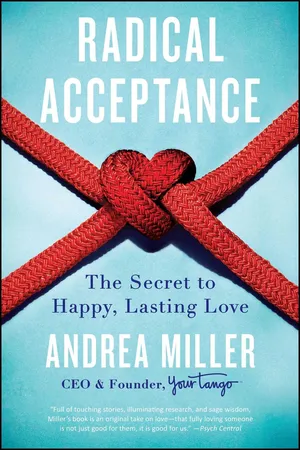
Radical Acceptance
eBook - ePub

Radical Acceptance

The Secret to Happy, Lasting Love

  1. 320 pages
  2. English
  3. ePUB (mobile friendly)
  4. Available on iOS & Android
eBook - ePub

Radical Acceptance

The Secret to Happy, Lasting Love

About this book

If you’re at the end of your relationship rope, reach for Radical Acceptance.” —Elle

A refreshing new approach to romantic partnerships, grounded in the importance of unconditional love that shows how “prioritizing your partner [creates] true happiness in your relationship” (John Gray, PhD, author of Men Are From Mars, Women Are From Venus).

Loving the lovable parts of your partner is easy. He’s funny, charming, smart, successful, and kind. He’s perfect. Except for when he is not. Like when he is late. Or short-tempered. Or lazy. Or he’s incorrectly loaded the dishwasher (again). Maybe he feels like the most frustrating person on the planet. Or maybe you’re simply not feeling heard or seen. Or loved enough.

It’s these proverbial unlovable parts that make loving all of him so tough. But imagine if you let go of your itch to fix, judge, improve, or control your partner. Imagine if you replaced judgement with compassion and empathy. Tremendous empowerment and liberation come from loving someone—and being loved—for who we really are. This practice is called Radical Acceptance. Whether you’re looking for Mr. Right or are already with him, this is your powerful five-step guide to attaining life’s ultimate prize: unconditional love.

You’ll learn how to increase your emotional resilience, feel more confident, determine whether you’re settling, quiet those doubt-filled voices in your head, get out of that endless cycle of dead-end dates, reduce conflict, and build a deeply fulfilling, affirming relationship—all through highly actionable advice. Best of all, you will discover how amazing it feels to have your heart expanded by an abundance of love and compassion for your partner and yourself.

Featuring compelling stories for real-life couples and insights from the foremost thought leaders and researchers in brain science, sexuality, psychotherapy, and neurobiology, Radical Acceptance illustrates that embracing your partner for exactly who they are will lead to a more harmonious relationship—and provide an unexpected path to your own personal transformation.
Frequently asked questions

Yes, you can cancel anytime from the Subscription tab in your account settings on the Perlego website. Your subscription will stay active until the end of your current billing period. Learn how to cancel your subscription.
At the moment all of our mobile-responsive ePub books are available to download via the app. Most of our PDFs are also available to download and we're working on making the final remaining ones downloadable now. Learn more here.
Perlego offers two plans: Essential and Complete
  • Essential is ideal for learners and professionals who enjoy exploring a wide range of subjects. Access the Essential Library with 800,000+ trusted titles and best-sellers across business, personal growth, and the humanities. Includes unlimited reading time and Standard Read Aloud voice.
  • Complete: Perfect for advanced learners and researchers needing full, unrestricted access. Unlock 1.4M+ books across hundreds of subjects, including academic and specialized titles. The Complete Plan also includes advanced features like Premium Read Aloud and Research Assistant.
Both plans are available with monthly, semester, or annual billing cycles.
We are an online textbook subscription service, where you can get access to an entire online library for less than the price of a single book per month. With over 1 million books across 1000+ topics, we’ve got you covered! Learn more here.
Look out for the read-aloud symbol on your next book to see if you can listen to it. The read-aloud tool reads text aloud for you, highlighting the text as it is being read. You can pause it, speed it up and slow it down. Learn more here.
Yes! You can use the Perlego app on both iOS or Android devices to read anytime, anywhere — even offline. Perfect for commutes or when you’re on the go.
Please note we cannot support devices running on iOS 13 and Android 7 or earlier. Learn more about using the app.
Yes, you can access Radical Acceptance by Andrea Miller in PDF and/or ePUB format, as well as other popular books in Personal Development & Mental Health & Wellbeing. We have over one million books available in our catalogue for you to explore.

PART 1

Images

PREPARING FOR RADICAL ACCEPTANCE

COMMIT TO RADICAL ACCEPTANCE: THE BEST GIFT EVER


IT’S EASY TO complain that your partner isn’t living up to your expectations. But what’s actually effective—what puts the energy of love in motion—is seeing someone who has flaws, yes, but realizing you can help this person become the best version of himself through unconditional love. This is Radical Acceptance.
A friend of mine once described Radical Acceptance as the “EpiPen of relationships.” I love that metaphor, but it needs a very big caveat. What she meant was how unbelievably helpful Radical Acceptance can be in a flash—that is, when things are about to spiral out of control and you are about to react badly to some dumb little thing. In that regard, Radical Acceptance is an instant, ready-made injection that can stave off toxic, avoidable outcomes. When my blood is boiling after Sanjay says something irritating, I always try to ask myself, “Are you practicing Radical Acceptance right now?” Instead of reacting badly, I try exercising restraint and extending tenderness to him. As we’ll explore later in the book, controlling our emotional reactions is key to Radical Acceptance.
But here’s where the metaphor breaks down: Unlike an actual EpiPen, which is merely a temporary fix and is unable to permanently rid the body of life-threatening allergies, Radical Acceptance effects profound, lasting change. It’s built to work for the long haul—and while it can work wonders in a pinch, significant effort is required for it to truly take root in a transformative, healing way. I will provide you with a ton of data and offer many suggestions for how to make your journey easier, but the absolutely essential key is that you have to practice Radical Acceptance for it to really work.
I know. Buzzkill. Barely three paragraphs in and we’re already talking about hard work.
But here’s the good news: Radical Acceptance can introduce (or reintroduce) healing, grace, confidence, and, ultimately, tremendous love, into your relationship. You will replace that vicious cycle of negativity with a virtuous cycle of positivity. Yes, you will face resistance and setbacks during your journey, and you will slip up from time to time. That’s okay. The key is not to be discouraged. Radical Acceptance will only remain a great idea and an interesting theory if you do not make the regular, daily effort to practice it. After all, fundamentally changing your habits and your way of thinking doesn’t happen overnight. By consciously choosing to accept his unlovable parts (and your own!), by focusing on the positive and overlooking the negative, you will actually establish new neural pathways. Thankfully, our brains are more than capable of changing in positive, profound ways, even well into adulthood. This is called neuroplasticity, and we’ll revisit this and related concepts regularly in this book.
I want to raise some foundational points before we progress further the heart of the program. The first are the most burning concerns people have about Radical Acceptance: “What if I practice Radical Acceptance but he never gets it? What if he never reciprocates? Won’t this put me in a position of weakness?” I touch on reciprocation, along with how Radical Acceptance makes you stronger, below, and address these themes in depth throughout this book.
Next we’ll take a look at trust in a relationship and why it is so crucially important to establish in your Radical Acceptance journey. Loving and being loved unconditionally means taking a leap of faith. It means feeling safe in your relationship and making room for vulnerability. It means taking off your mask and enabling him to do the same, so that you can both be truly seen for who you are. This level of security may take time to develop, but I will hold your hand as you learn this process.

RECIPROCATION

Just loving him fully without expecting immediate reciprocation . . . that sounds tough. Will it work? Will opening your heart actually make you feel stronger and more confident in your relationship and in your life?
You can’t possibly know unless you try. And what you will get, no matter what, is clarity. Clarity on whether you should stay in the relationship or if you should end it. After you have done everything you can to love and radically accept him, if the relationship still isn’t working or if his behavior just proves too challenging, you know it’s time to say good-bye. You’ve tried everything. The what-ifs—What if I tried harder? What if he wasn’t seeing the real me? What if I needed to give him a chance?—will evaporate. You may be sad and angry for a time, but you will harbor much less—if any—uncertainty or doubt. Because of that, you will find how much easier it is for you to move on.
Understandably, most people want to ensure their efforts aren’t “wasted.” To those I say: love is never wasted. When it comes to love, there are never guarantees of success. All you can do in the relationship is your part, which is why I always urge each partner to initially quit worrying about how the other is reciprocating. It rarely works to go halfway and expect him to immediately meet you there, fifty-fifty, even-steven. In fact, when I offer advice to people who want to improve their relationship, I always encourage them to each go all in, to each give 150 percent. This might feel scary for a little while, but it’s a winning long-run approach.
“There is no safe investment.2 To love at all is to be vulnerable. Love anything, and your heart will certainly be wrung and possibly be broken. If you want to make sure of keeping it intact, you must give your heart to no one, not even to an animal. Wrap it carefully round with hobbies and little luxuries; avoid all entanglements; lock it up safe in the casket or coffin of your selfishness. But in that casket—safe, dark, motionless, airless—it will change. It will not be broken; it will become unbreakable, impenetrable, irredeemable. The alternative to tragedy, or at least to the risk of tragedy, is damnation. The only place outside Heaven where you can be perfectly safe from all the dangers and perturbations of love is Hell.”
—C. S. LEWIS, THE FOUR LOVES
But won’t you look desperate if you offer your undivided love and affection to your partner without knowing if you’ll get something in return? Won’t you just be a doormat? And shouldn’t the guy always love the girl just a tiny bit more?
Nope, definitely not, and heck no!
Radical Acceptance requires radical giving—giving more, giving your all, and doing it all again, over and over. I know this may be a different way of thinking about love and life than you’re used to. We live in an instant-gratification world in which we are conditioned to get what we pay for, stat. Radical Acceptance requires a fundamental recalibration of your relationship expectations. It’s about not expecting someone else to “make you happy,” but thinking much more about what you have to offer your partner. The relationship has to make you happy. As Katharine Hepburn once said, “Love has nothing to do with what you are expecting to get, only with what you are expecting to give, which is everything.”
While you will ultimately need and deserve reciprocation, giving love to others is still self-serving. At the same time, it’s about remembering that you are worthy of tremendous love from others and yourself.
Far too often, we are our own worst enemies. We think shitty, defeating thoughts about ourselves as often as pop radio stations play Taylor Swift—again and again and again. We beat ourselves up and refuse to give ourselves a break. And then we expect someone else to magically treat us as rock stars.
Um, do you see the paradox here? I always say that love starts with you. It is the opposite of selfish to love yourself, to know your worth, and to claim your beauty. As we will discuss in part 3, even the most successful women fall prey to a very debilitating “confidence gap” in which they are mired in self-doubt. No one can stop this debilitating cycle but you. You have to believe that you are worthy of love, praise, sacrifice, tenderness, and, yes, because we are all flawed, that you are worthy of forgiveness and compassion. As my wise big sis Maria says, “It’s an inside job!”
Practicing Radical Acceptance is the ultimate inside job—it’s doing that crucial inner work that leads to personal transformation and your ability to be a far better partner (and friend, parent, son or daughter, etc.).
Friend: I am here to tell you that YOU. ARE. WORTHY. You are worthy of love. You are worthy of respect. You are worthy of admiration. Believe it.
As we all know, it’s a common fallacy to “just put a ring on it” and expect that we will live happily ever after. My close friend Kimberly’s experience in her marriage exemplifies this problem. She wrote to me,
I had all sorts of fantasies about “happily ever after” that I was not aware of when my boyfriend Phillip and I decided to marry. What I was aware of was that Phillip possessed many qualities I found attractive and important in a lifelong partner. However, over the years, I found myself developing resentment, as my needs—ones that I was not even aware of—went unmet.
I blamed my husband.
In the deep emotional recess of my heart, I really, really thought that marriage (and raising a family) would make me feel fulfilled: I thought this was supposed to make me happy. What made it harder was my resistance to the truth of my marriage. I looked to my husband to give me validation, affirmation, help (on my timetable), attention, and friendship. If I’m rigorously honest, I demanded that Phillip give me what I wanted or I’d feel let down by him.
Basically what I wanted from him was what I imagined was a male version of myself. Naturally, that is not who he is! Although I didn’t ask him to “change,” I did measure his behavior against an internalized image of how I thought he “should” be. And when I wanted to talk about us, what I really wanted to do was point fingers and dwell on what he was doing wrong.
As I have started to practice Radical Acceptance, I can’t help but see how I am in our way. I realize that one of our biggest challenges is my expectations of Phillip. And that’s not going to change by coming up with rules or making suggestions on how we can “improve” or “do it differently.”
What I’m now much more tuned into is that my husband truly means well and loves me dearly. If he drops the ball, it’s not because he doesn’t care about or love me. In loving without judgment, I am reminded that Phillip is who he is and how he is. We have areas of similarity and areas of complete differentness. Frankly, when I really allow myself to see him, I thoroughly value who he is. And when I do, magic happens!
Our life together now is a pleasure. I realize blaming him never ever fixes me or helps us. It simply doesn’t. When I am “blaming,” Radical Acceptance helps me bring my focus back to me. For me, Radical Acceptance is tuning into Grace.
I love this beautiful testimonial because Kimberly is so honest about experiences that are incredibly common in relationships. She blamed and judged her husband and projected her own insecurities onto him. She clung to an idealized version of her partner—essentially, a man that was her flawless mirror image—instead of loving him for who he was, right there in front of her. We will delve into these common traps in greater detail throughout this book.
Kimberly’s experience encapsulates a crucial but simple insight, one that should be self-evident but often isn’t. I said it above and I am going to say it again here, but more emphatically.
LOVE STARTS WITH YOU.
You must be prepared to give it and not be obsessed with a preconceived, perfect version coming right back to you. Why aren’t we taught this in school as, like, a basic life lesson? I suppose Paul and John tried when they sang that “the love you take is equal to the love you make.” But seriously, it’s time for some government-sponsored PSAs and billboards.
I suspect some Christians (and others of faith) might tell me, “Girl, we’ve been saying that for a long time. Get with the program!” Maybe my haphazard Catholic upbringing failed to sufficiently educate me on this, but I also don’t think love is the exclusive province of the church. This should be social doctrine rooted in science, medicine, and cultural norms. Let love and kindness start with you. Let loving without judgment start with you.
I had a fascinating conversation with Dr. Dan Siegel, a clinical professor of psychiatry at the UCLA School of Medicine and bestselling author of Mindsight, among many other brilliant books. Based on his groundbreaking research in interpersonal neurobiology, Dan has reached a provocative conclusion: “Rather than relationships shaping people,3 my research shows that relationships make people.” The implication is that relationships have vastly more impact on individual development and well-being than is commonly believed.
“Take South Africans, for example,” Dan told me. “Many communities subscribe to a philosophy known as Ubuntu, which means that you as an individual exist in the response of someone else.” Among the Zulu people of South Africa, a customary greeting has two parts. The first, Sikhona, means, “I am here to be seen.” The second, Sawubona, means, “I see you.” This same idea of being seen is also the core of Radical Acceptance. Being truly seen allows vulnerability to take root, creating fertile ground for intimacy and connection to flourish. See, and be seen.
Ubuntu has roots in pluralism—community and togetherness is emphasized over the individual. In Ubuntu culture, Dan told me, “Yelling at another person and yelling at yourself are literally synonyms for the same thing. You exist within the connections to others and because of them.” (For more about Dan’s exploration into the mysteries of the human mind, I urge you to pick up his latest book, Mind: A Journey to the Heart of Being Human.) In the same spirit, Radical Acceptance urges couples to see themselves as one self-supporting unit. Negativity and hurt directed at one partner is directed at the relationship as a whole, while joy for one partner should be joy for both.
Dan advocates passionately for a new definition of self, one that is not determined by “you” and “me.” Given the crucial role our relationships play in every aspect of our being, self is really a version of “we.” There was a famous antidrug PSA4 during the 1980s that showed a rat alone in a cage with two water bottles. One bottle was filled with pure water and the other was laced with cocaine. Unsurprisingly, the rat became addicted to the cocaine water. The ad ominously warned: “Nine out of ten laboratory rats5 will use it . . . and use it . . . and use it . . . until they are ...

Table of contents

  1. Cover
  2. Dedication
  3. Author’s Note
  4. Introduction
  5. Part 1: Preparing For Radical Acceptance
  6. Part 2: The Five Steps For Happy, Lasting Love
  7. Part 3: Beyond Radical: Living Happily Ever After
  8. Acknowledgments
  9. About the Author
  10. Notes
  11. Index
  12. Copyright