The Everything Tarot Book
eBook - ePub

The Everything Tarot Book

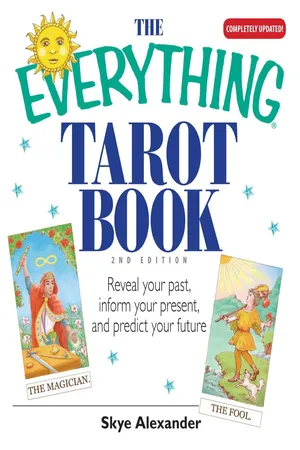
Reveal Your Past, Inform Your Present, And Predict Your Future

  1. 320 pages
  2. English
  3. ePUB (mobile friendly)
  4. Available on iOS & Android
eBook - ePub

The Everything Tarot Book

Reveal Your Past, Inform Your Present, And Predict Your Future

About this book

Realize your psychic potential with the Tarot!

Everyone is psychic to one degree or another. And with The Everything Tarot Book, 2nd Edition, you’ll unlock the mysteries of the cards and thus boost your innate psychic abilities. Completely revised, this easy-to-use guide has everything you need to conduct complete Tarot readings for yourself and others.

The Tarot deck has been used for centuries to divine the future and as a guide to spiritual development. Now you can learn how to interpret the images on the cards, arrange them into meaningful spreads, and unleash your hidden psychic powers. Each individual card in the Major and Minor Arcana is described in detail, along with the history of the Tarot from ancient times to the present.

The Everything Tarot Book, 2nd Edition helps you:
-Gain insight into yourself and other people
-See into the future and the present more clearly
-Understand the effects of the past
-Work through personal problems and challenges
-Develop your intuition
-Enhance your connection with your Higher Self

Explore. Engage your curiosity. Use your imagination. Keep an open mind and an open heart. Your future really is in the cards!
Frequently asked questions

Yes, you can cancel anytime from the Subscription tab in your account settings on the Perlego website. Your subscription will stay active until the end of your current billing period. Learn how to cancel your subscription.
No, books cannot be downloaded as external files, such as PDFs, for use outside of Perlego. However, you can download books within the Perlego app for offline reading on mobile or tablet. Learn more here.
Perlego offers two plans: Essential and Complete
  • Essential is ideal for learners and professionals who enjoy exploring a wide range of subjects. Access the Essential Library with 800,000+ trusted titles and best-sellers across business, personal growth, and the humanities. Includes unlimited reading time and Standard Read Aloud voice.
  • Complete: Perfect for advanced learners and researchers needing full, unrestricted access. Unlock 1.4M+ books across hundreds of subjects, including academic and specialized titles. The Complete Plan also includes advanced features like Premium Read Aloud and Research Assistant.
Both plans are available with monthly, semester, or annual billing cycles.
We are an online textbook subscription service, where you can get access to an entire online library for less than the price of a single book per month. With over 1 million books across 1000+ topics, we’ve got you covered! Learn more here.
Look out for the read-aloud symbol on your next book to see if you can listen to it. The read-aloud tool reads text aloud for you, highlighting the text as it is being read. You can pause it, speed it up and slow it down. Learn more here.
Yes! You can use the Perlego app on both iOS or Android devices to read anytime, anywhere — even offline. Perfect for commutes or when you’re on the go.
Please note we cannot support devices running on iOS 13 and Android 7 or earlier. Learn more about using the app.
Yes, you can access The Everything Tarot Book by Skye Alexander in PDF and/or ePUB format. We have over one million books available in our catalogue for you to explore.

Information

Publisher
Everything
Year
2006
Print ISBN
9781593376567
eBook ISBN
9781440523878
Chapter 1
The Two Books of the Tarot
A typical Tarot deck consists of seventy-eight cards. Of these, the first twenty-two are identified as the Major Arcana. The fifty-six remaining cards are called the Minor Arcana, presumably because they contain information that is of a less important or mystical nature. Because the Tarot can be viewed and understood as a body of wisdom and guidance, it is sometimes thought of as a book— or more accurately, as two books—of knowledge.
The Major Arcana
These arcana (which means mysteries or secrets) represent the mysteries or secrets of the universe that reflect universal law. As such, they are the most complex cards in the deck and require more diligence to understand. Each of the Major Arcana cards, which are also often called trump cards, is illustrated with specific symbols or scenarios, which are basically the same in all decks, even though they may differ thematically according to the philosophy of the designer. Each of the Major Arcana cards has a title, such as The Magician, The Empress, The Lovers, The Moon, The Tower, and so forth. They are numbered from zero—The Fool—to twenty-one— The World. (In Chapter 12, the individual cards are discussed and interpreted in detail.)
As seems to be the case in most schools of thought, particularly those that have been around for a while, there is disagreement about many aspects of the Major Arcana. Some scholars and authors focus primarily on the numerical order of the cards (zero to twenty-one) contending that they form a system through which the development of an individual's life can be traced. Some interpreters have interjected psychological meanings into the Major Arcana, while others have viewed them as a representative of spiritual development and growth.
Sally Gearhart, in A Feminist Tarot, asserts that the various systems of organizing the Major Arcana came into being as a result of the oral tradition. People developed stories to help them remember the specific attributes of each card. In her opinion, it is easier to remember what the individual cards mean if we relate them to each other in groups.
The Major Arcana cards also describe a path to enlightenment—The Fool's Journey. Beginning with The Fool, which represents innocence and the initial step of the journey, and ending with The World, which signifies wisdom and completion, the twenty-two cards can be viewed as stages in the seeker's personal development. According to some schools of thought, they outline a course in initiation into the mysteries of life and the nature of the universe. (Chapter 8 examines this process and its significance in greater depth and detail.)
Fate and Universal Forces at Work
The cards in the Major Arcana represent forces beyond yourself and the limits of mundane, earthly human existence. Depending on your personal worldview, you could think of these forces as fate, god, goddess, cosmic, karma, or your own Higher Self. Whichever way you choose to see the energies or entities behind the cards, they indicate that something larger, outside yourself is operating and influencing you and the issue about which you are seeking advice.
TheEverythingTarotBook-1
[There are] forces operating within that are capable of producing phenomenal results. That is, the power of your own suggestion starts the machinery into operation or causes the subconscious mind to begin its creative work [that] leads to belief, and once this belief becomes a deep conviction, things begin to happen.
—Claude M. Bristol, The Magic of Believing
When many trumps turn up in a reading, it's a signal that the situation is not entirely in your own hands or that you are not alone in the matter that concerns you. Spiritual or higher forces outside your control may be at work, perhaps guiding the outcome. Because these cards can be linked with archetypes, they may portray dimensions of greater significance that are influencing your situation.
A reading that contains more cards from the Major Arcana than from the Minor Arcana suggests that you may not have a great deal of choice in how your question or issue turns out. You might not be able to control what happens. In some cases, a predominance of trump cards shows that previous actions or decisions have set things in motion, and now you are being propelled toward the inevitable result.
The Major Arcana cards possess many different layers. As you work with them, these layers reveal themselves. It's a bit like digging into an archeological site. For example, on a strictly practical level, The Empress may be a direct reference to your mother or your desire to become a mother. On the mundane or worldly level, The Magician may refer to your desire to live a more creative life, to be more creative in your work. On the level of spiritual development, The Devil may indicate that it is time for you to throw off the obstacles that are preventing your living more fully and deeply, that you should tend to your soul needs rather than your material concerns.
Each individual unfolds according to his or her own inner blueprint. There's no hurrying the process, which ultimately takes place on its own time schedule. The cycles in life show you the patterns you are following and suggest new directions. (These are most clearly shown in the astrological chart, which is an excellent adjunct to the Tarot.) The Major Arcana can be a guide that helps us to explore universal concepts as they apply to our lives at any given moment.
The Minor Arcana
Most scholars agree that the Minor Arcana were added to the Major Arcana sometime in the fourteenth or fifteenth century. It is believed that this portion of the Tarot was originally used for fortune-telling, and that in earlier times, it was considered safe for nonadepts to have access to this part of the Tarot. The Minor Arcana consists of four suits of fourteen cards each: Wands, Pentacles, Swords, and Cups. Each suit contains four Court Cards (King, Queen, Knight, and Page) and ten number cards from Ace through Ten, also called pip cards.
Everyday Guidance
The Minor Arcana cards can be extremely accurate in answering questions about the here and now, as they refer to specific areas of everyday life and human experience. They do not describe spiritual growth per se, but each of the areas to which these cards refer can certainly be incorporated into a pattern of spiritual development. You don't need to search for some deep mystical meaning to attach to them, however.
To understand the Minor Arcana, it's important to realize that they serve as an adjunct to the Major Arcana—a sort of commentary within the context of the reading. This is not to imply that they have no real significance on their own, but rather that they are an integral part of the context of the entire reading. Their main function is to relate the readee (the person for whom the reading is being done) to the elements of the everyday world, which exist for all of us no matter how spiritual we are or how seriously we pursue a spiritual path.
Generally speaking, the cards of the Minor Arcana represent lesser, or mundane, lessons. They show the everyday concerns, situations, challenges, and achievements you experience in your personal life. As such, they also present advice and describe conditions and possibilities related to the subject of a reading.
TheEverythingTarotBook-2
The Minor Arcana may seem less important, but they provide immediate information. Through the study of the Minor Arcana, you can observe the ongoing process of how you grow and develop.
When many (or all) of the cards in a reading come from the Minor Arcana, it's safe to say your future is in your own hands. Your decisions and actions will produce your future. You have the ability to control your destiny.
Real Life Situations and Solutions
As you begin to study the Minor Arcana, especially if you read different books on the subject, you will find a mixture of interpretations, some of which conflict with each other. Some experienced Tarot readers have developed their own unique views about the cards and their meanings. Your intuition plays a key role in interpreting the Minor Arcana, as will your own experiences with the cards. Take what you like from the “expert” information you read and leave the rest.
In time, you will begin to develop your own renderings of the cards, discovering by trial and error what works and what doesn't. Bear in mind that what works for one reader may not work for another, and that your own insights and experiences with the cards are just as valid as anyone else's.
As you explore the suits and the numbers and begin to test interpretations in actual readings, you will become aware of an overall system operating. It's kind of like learning to play the piano. You first have to learn the notes (symbols), then practice the scales to get familiar with fingering (readings), and then you begin to understand how the composer created a piece of music. In time, you may even write your own music.
Life Situations Represented by the Four Suits
In medieval times the four suits (usually called Wands, Pentacles, Swords, and Cups) represented the four main classes of people—the nobility, the clergy, the merchant class, and the working class. In today's society, there are correspondences—an elite, or old money, class is the nobility; today's version of the clergy has expanded to include the professions and academia; the merchant class includes businesses and people employed by corporate institutions; and those in blue collar or service positions are the working class.
TheEverythingTarotBook-1
It is clear that civilization cannot evolve further until the occult is taken for granted on the same level as atomic energy.
—Colin Wilson, The Occult
These suits help us pinpoint the areas of life that need our attention, because each of the suits represents a distinct realm of activity, experience, and personal growth. When many cards of the same suit appear in a reading, it's a clear indication that the person consulting the Tarot is concerned about a particular area of life—or should be. A reading about a relationship will usually turn up several cards in the suit of Cups, whereas Pentacles are likely to predominate in a reading about finances. (See Chapter 5 for more information on the symbolism of the suits.)
Court Cards
In most decks, each suit contains fourteen cards, including four Court Cards. Usually these cards are called the King, Queen, Knight, and Page, although some designers use labels such as Knave, Prince, Princess, Lord, and Lady. The images on the Court Cards are usually quite similar to those on ordinary playing cards—straightforward illustrations of a King, a Queen, a Knight, and a Page. Though there may be some variation in costume or colors, depending upon the philosophical orientation of the deck's creator, sometimes the only way to differentiate the suits is to note the symbol of the suit—Cup, Sword, Wand, or Pentacle—which is usually held by the person on the card.
TheEverythingTarotBook-2
In some cases, a King could represent a woman with the qualities of that particular King card. For example, the King of Pentacles could signify a strong, successful businesswoman.
The Court Cards often represent actual people in the life of the individual for whom a reading is being done, or they may personify the readee. They can also be used as Significators. (Significators are discussed in further detail in Chapter 10).
King
A king is a powerful ruler who exercises absolute authority over the territory he rules. He is, so to speak, at the top of the heap. Thus, the King of any suit represents a completion point: There's no higher position to attain. A cycle that began with the Ace has been completed, and it's now time to either consolidate your position or begin a new cycle. The level of the King is where you release and let go, complete old tasks, and prepare for a new and more fulf...

Table of contents

  1. Cover Page
  2. Title Page
  3. Copyright
  4. Contents
  5. Top Ten Ways the Tarot Can Help You
  6. Introduction
  7. 1. Chapter 1: The Two Books of the Tarot
  8. 2. Chapter 2: Exploring the Tarot
  9. 3. Chapter 3: Choosing a Tarot Deck
  10. 4. Chapter 4: Learning to Interpret the Tarot
  11. 5. Chapter 5: Tarot Symbolism
  12. 6. Chapter 6: Astrology and the Tarot
  13. 7. Chapter 7: Using the Tarot for Personal Growth
  14. 8. Chapter 8: The Fool's Journey
  15. 9. Chapter 9: How to Do Readings
  16. 10. Chapter 10: Tarot Spreads
  17. 11. Chapter 11: Sixteen Spreads
  18. 12. Chapter 12: The Major Arcana
  19. 13. Chapter 13: The Minor Arcana—The Suit of Wands
  20. 14. Chapter 14: Interpreting the Pentacles
  21. 15. Chapter 15: The Minor Arcana—The Suit of Swords
  22. 16. Chapter 16: The Minor Arcana—The Suit of Cups
  23. 17. Chapter 17: Where to Go from Here
  24. Appendix A • Glossary of Tarot Terms
  25. Appendix B • Resources