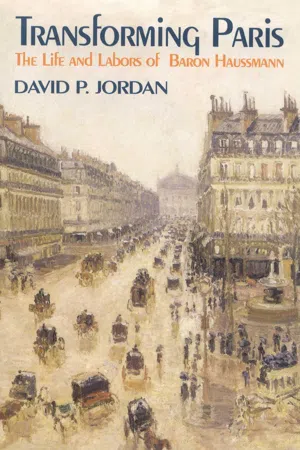
The Paris we know today, with its grand boulevards, its bridges and parks, its monumental beauty, was essentially built in only seventeen years, in the middle of the nineteenth century. In this brief period, whole neighborhoods of medieval and revolutionary Paris -- over-crowded, dangerous, and filthy -- were razed, and from the rubble a modern city of light and air emerged. This triumphant rebuilding was chiefly the work of one man, Baron Georges Haussmann, Napoleon III's Prefect of the Seine.It was Haussmann's task to assert, in stone, the power and permanence of Paris, to show the world that it was the seat of an empire of mythic proportions. To this end, he imposed grand visual perspectives, as when he transformed Napoleon I's Arc de Triomphe into a magnificent twelve-armed star from which radiated the broadest boulevards of Europe. Below ground, his modern sewer system became one of the wonders of the civilized world, eagerly toured by royalty and commoners alike.Haussmann's mandate was not only to create an impression of grandeur but to secure the city for better control by government. By creating formal spaces where there had previously been a maze of chaotic streets, Haussmann opened Paris to effective police control and thwarted the recurrent demonstration of its well-known revolutionary fervor. The determined and autocratic Haussmann imprinted rational order and bourgeois civility on the unruly city which had for so long simmered with riot and insurrection.Though he planted chestnut trees, installed gas lights, rebuilt the water supply, and improved transportation and housing, Haussmann's labors were (and remain) controversial. He forced tens of thousands of the poor from the center of the city, and destroyed significant parts of old Paris. But in this important new biography David Jordan reminds us that Haussmann was not immune to the charms of the old city. By leaving some areas intact, the Baron achieved the grand effect of implanting a modern city boldly within an ancient one. Here, at last, Haussmann's labors are given the aesthetic as well as the historical appreciation they deserve.
- 455 pages
- English
- ePUB (mobile friendly)
- Available on iOS & Android
eBook - ePub
About this book
Information
Topic
ArtSubtopic
Artist BiographiesTable of contents
- Cover Page
- Title Page
- · CONTENTS ·
- · MAPS ·
- · ABOUT THE MAPS ·
- · ACKNOWLEDGMENTS ·
- I Paris Before Haussmann
- II Haussmann Before Paris
- III Climbing the Greasy Pole
- IV Paris in Crisis
- V “My Combative Prefectship”
- VI “This Province I Have So Loved”
- VII “A State Within the State”
- VIII “The Implacable Axes of a Straight Line …”
- IX “The Vice Emperor Is the Prefect of the Seine”
- X Money
- XI “Lackey of a Good House”
- XII “Organs of the Large City”
- XIII “The Vandalism of Triumph”
- XIV Haussmann After Paris
- XV Paris After Haussmann
- · EPILOGUE · “One of the Most Important Men of Our Time”
- · NOTES ·
- · WORKS CITED ·
- · INDEX ·
- · PICTURE CREDITS ·
Trusted by 375,005 students
Access to over 1.5 million titles for a fair monthly price.
Study more efficiently using our study tools.
Frequently asked questions
Yes, you can cancel anytime from the Subscription tab in your account settings on the Perlego website. Your subscription will stay active until the end of your current billing period. Learn how to cancel your subscription
No, books cannot be downloaded as external files, such as PDFs, for use outside of Perlego. However, you can download books within the Perlego app for offline reading on mobile or tablet. Learn how to download books offline
Perlego offers two plans: Essential and Complete
- Essential is ideal for learners and professionals who enjoy exploring a wide range of subjects. Access the Essential Library with 800,000+ trusted titles and best-sellers across business, personal growth, and the humanities. Includes unlimited reading time and Standard Read Aloud voice.
- Complete: Perfect for advanced learners and researchers needing full, unrestricted access. Unlock 1.5M+ books across hundreds of subjects, including academic and specialized titles. The Complete Plan also includes advanced features like Premium Read Aloud and Research Assistant.
We are an online textbook subscription service, where you can get access to an entire online library for less than the price of a single book per month. With over 1.5 million books across 990+ topics, we’ve got you covered! Learn about our mission
Look out for the read-aloud symbol on your next book to see if you can listen to it. The read-aloud tool reads text aloud for you, highlighting the text as it is being read. You can pause it, speed it up and slow it down. Learn more about Read Aloud
Yes! You can use the Perlego app on both iOS and Android devices to read anytime, anywhere — even offline. Perfect for commutes or when you’re on the go.
Please note we cannot support devices running on iOS 13 and Android 7 or earlier. Learn more about using the app
Please note we cannot support devices running on iOS 13 and Android 7 or earlier. Learn more about using the app
Yes, you can access Transforming Paris by David P. Jordan in PDF and/or ePUB format, as well as other popular books in Art & Artist Biographies. We have over 1.5 million books available in our catalogue for you to explore.