In the Line of Fire
eBook - ePub

In the Line of Fire

  1. 368 pages
  2. English
  3. ePUB (mobile friendly)
  4. Available on iOS & Android
eBook - ePub

In the Line of Fire

About this book

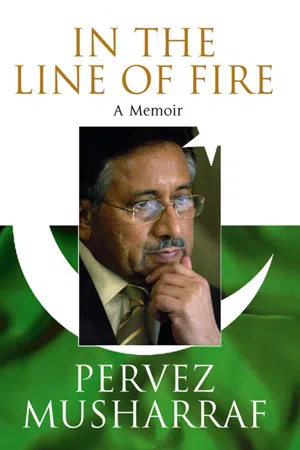
It is almost unprecedented for a head of state to publish a memoir while still in office. But Pervez Musharraf is no ordinary head of state. As President of Pakistan since 1999, his is one of the most dangerous jobs in the world, and he continues to play a crucial role in the global war on terror. A one-time supporter of the Taliban, a general who fought in several wars, President Musharraf took a decisive turn against militant Islam in 2001. Since then he has survived two assassination attempts; rooted out militants in his own government; helped direct countless raids against al-Qaeda both in his cities and in the mountains; and tracked Osama bin Laden with technical and human intelligence. IN THE LINE OF FIRE is astonishingly revealing and honest about dozens of topics of intense interest to the world. Among its many revelations: exactly how Pakistani authorities tracked down and smashed three major al-Qaeda control centres in the mountains; how al-Qaeda's many-layered structure was revealed after the assassination attempts; Bin Laden's current position within the al-Qaeda hierarchy; what it has been like to deal with Bush and Blair; how Pakistan and India have avoided nuclear confrontation; and much more. The terrible earthquake of 2005, killing nearly 40, 000 Pakistanis, is just one chapter in a life and career that has been filled with danger and drama. The worldwide launch of President Musharraf's memoir promises to be a sensation.
Frequently asked questions

Yes, you can cancel anytime from the Subscription tab in your account settings on the Perlego website. Your subscription will stay active until the end of your current billing period. Learn how to cancel your subscription.
No, books cannot be downloaded as external files, such as PDFs, for use outside of Perlego. However, you can download books within the Perlego app for offline reading on mobile or tablet. Learn more here.
Perlego offers two plans: Essential and Complete
  • Essential is ideal for learners and professionals who enjoy exploring a wide range of subjects. Access the Essential Library with 800,000+ trusted titles and best-sellers across business, personal growth, and the humanities. Includes unlimited reading time and Standard Read Aloud voice.
  • Complete: Perfect for advanced learners and researchers needing full, unrestricted access. Unlock 1.4M+ books across hundreds of subjects, including academic and specialized titles. The Complete Plan also includes advanced features like Premium Read Aloud and Research Assistant.
Both plans are available with monthly, semester, or annual billing cycles.
We are an online textbook subscription service, where you can get access to an entire online library for less than the price of a single book per month. With over 1 million books across 1000+ topics, we’ve got you covered! Learn more here.
Look out for the read-aloud symbol on your next book to see if you can listen to it. The read-aloud tool reads text aloud for you, highlighting the text as it is being read. You can pause it, speed it up and slow it down. Learn more here.
Yes! You can use the Perlego app on both iOS or Android devices to read anytime, anywhere — even offline. Perfect for commutes or when you’re on the go.
Please note we cannot support devices running on iOS 13 and Android 7 or earlier. Learn more about using the app.
Yes, you can access In the Line of Fire by Pervez Musharraf in PDF and/or ePUB format. We have over one million books available in our catalogue for you to explore.

Information

Print ISBN
9781416527787
eBook ISBN
9781847395962

PART ONE

IN THE BEGINNING

CHAPTER 1

TRAIN TO PAKISTAN

Date: August 14, 1947
Place: India and Pakistan
Event: The twilight of the British Empire, with the independence of India and the creation of the nation-state of Pakistan.
These were troubled times. These were momentous times. There was the light of freedom; there was the darkness of genocide. It was the dawn of hope; it was the twilight of empire. It was a tale of two countries in the making.
On a hot and humid summer day, a train hurtled down the dusty plains from Delhi to Karachi. Hundreds of people were piled into its compartments, stuffed in its corridors, hanging from the sides, and sitting on the roof. There was not an inch to spare. But the heat and dust were the least of the passengers’ worries. The tracks were littered with dead bodies—men, women, and children, many hideously mutilated. The passengers held fast to the hope of a new life, a new beginning in a new country—Pakistan—that they had won after great struggle and sacrifice.
Thousands of Muslim families left their homes and hearths in India that August, taking only the barest of necessities with them. Train after train transported them into the unknown. Many did not make it—they were tortured, raped, and killed along the way by vengeful Sikhs and Hindus. Many Hindus and Sikhs heading in the opposite direction, leaving Pakistan for India, were butchered in turn by Muslims. Many a train left India swarming with passengers only to arrive in Pakistan carrying nothing but the deafening silence of death. All those who made this journey and lived have a tale to tell.
This is the story of a middle-class family, a husband and wife who left Delhi with their three sons. Their second-born boy was then four years and three days old. All that he remembered of the train journey was his mother’s tension. She feared massacre by the Sikhs. Her tension increased every time the train stopped at a station and she saw dead bodies lying along the tracks and on the platforms. The train had to pass through the whole of the Punjab, where a lot of killings were taking place.
The little boy also remembered his father’s anxiety about a box that he was guarding closely. It was with him all the time. He protected it with his life, even sleeping with it under his head, like a pillow. There were 700,000 rupees in it, a princely sum in those days. The money was destined for the foreign office of their new country.
The little boy also remembered arriving in Karachi on August 15. He remembered, too, the swarm of thankful people who greeted them. There was food, there was joy, there were tears, there was laughter, and there was a lot of hugging and kissing. There were thanksgiving prayers too. People ate their fill.
 
I have started my narration in the third person because the story of that August train is something I have been told by my elders, not something I remember in detail. I have little memory of my early years. I was born in the old Mughal part of Delhi on August 11, 1943, in my paternal family home, called Nehar Wali Haveli—“House Next to the Canal.” A haveli is a typical Asian-style home built around a central courtyard. Nehar means canal.
My brother Javed, who is something of a genius, was born one year before me. When my younger brother Naved arrived later, our family was complete.
Nehar Wali Haveli belonged to my great-grandfather, Khan Bahadur Qazi Mohtashim ud din, who was the deputy collector of revenue in Delhi. He arranged for his daughter Amna Khatoon, my paternal grandmother, to be married to Syed Sharfuddin. The honorific Syed denotes a family that is descended directly from the Holy Prophet Muhammad, peace be upon him. I am told that generations ago my father’s family came from Saudi Arabia.
My grandfather was said to be an exceptionally handsome man and was a landlord of some stature from Panipat, in northern India. He left my grandmother, Amna Khatoon, and married a second time, leaving their two sons, Syed Musharrafuddin (my father) and Syed Ashrafuddin, to their mother. She moved with her sons to her father’s home, where I would be born.
My father, Syed Musharrafuddin, and his elder brother graduated from the famous Aligarh Muslim University, now in India. My father then joined the foreign office as an accountant. He ultimately rose to the position of director. He died just a few months after I took the reins of my country.
Khan Bahadur Qazi Fazle Ilahi, my mother’s father, was a judge—the word qazi means judge. He was progressive, very enlightened in thought, and quite well off. He spent liberally on the education of all his sons and daughters. My mother, Zarin, graduated from Delhi University and earned a master’s degree from Lucknow University at a time when few Indian Muslim women ventured out to get even a basic education. After graduation, she married my father and shifted to Nehar Wali Haveli.
My parents were not very well off, and both had to work to make ends meet, especially to give their three sons the best education they could afford. The house was sold in 1946, and my parents moved to an austere government home built in a hollow square at Baron Road, New Delhi. We stayed in this house until we migrated to Pakistan in 1947.
My mother became a schoolteacher to augment the family income. My parents were close, and their shared passion was to give their children the best possible upbringing—our diet, our education, and our values. My mother walked two miles (more than three kilometers) to school and two miles back, not taking a tonga (a horse-drawn carriage), to save money to buy fruit for us. We always looked forward to that fruit.
Providing a good education to our children has always remained the focus of our family, a value that both my parents took from their parents and instilled in us. Though we were not by any means rich, we always studied in the top schools. In Delhi, Javed and I joined Church High School, but I have no memory of it. Neither do I have any memory of friends or neighbors.

CHAPTER 2

SETTLING IN KARACHI

Karachi is a very old city; like most of our cities, it dates back to antiquity. It started off as a fishing village on the coast of the Arabian Sea. In 1947 it became the capital of Pakistan. The capital has since been shifted to Islamabad, a picturesque new city nestled in the foothills of the Himalayas.
On our arrival in Karachi, my father was allotted two rooms in a long barracks of ten two-room units in a place called Jacob Lines. There was a kitchen and an old-style toilet that had no flush mechanism. Along one side of the building ran a veranda covered by a green wooden trellis. Other uprooted members of our family—assorted aunts and uncles and cousins—came to live with us. At one time there were eighteen of us living in those two rooms. But we were all happy. I now realize that we accepted all this discomfort because our morale was supremely high—as were our spirit of sacrifice and our sense of accommodation. Actually, we could have filed a claim to get a house in place of the huge home that my maternal grandfather had owned in Delhi. Left behind, it had become “enemy property.” But for some reason no one pursued this.
One night I saw a thief hiding behind the sofa in our apartment. Though I was only a little boy, I was bold enough to quietly slip out to my mother, who was sleeping on the veranda (my father had left for Turkey). I told her that there was a thief inside, and she started screaming. Our neighbours assembled. The thief was caught with the only thing of value we had—a bundle of clothes. While he was being thrashed, he cried out that he was poor and very hungry. This evoked such sympathy that when the police came to take him away, my mother declared that he was not a thief and served him a hearty meal instead. It was a sign of the sense of accommodation and of helping each other that we shared in those days.
Our cook, Shaukat, who had come with my mother when she got married—in her dowry, so to speak—also came with us from Delhi. He was an excellent cook. He now lives in Hyderabad, Sindh, and I last met him when I was a major general.
My brother Javed and I were enrolled in St. Patrick’s School, run by Catholic missionaries, but I don’t remember much about it at this time, except that we had to walk a mile to it and a mile back (about 1.5 kilometers each way).
My father started working at the new foreign office, which was then located in a building called Mohatta Palace. It was later to become the residence of Miss Fatima Jinnah, sister of Pakistan’s founding father, Mohammad Ali Jinnah, whom we respectfully call Quaid-e-Azam, “great leader.” It is now a museum. We would visit him there sometimes. I remember that the facilities were so sparse that he didn’t even have a chair to sit on. He used a wooden crate instead. Often the office ran short of paper clips, thumbtacks, and even pens. My father would use the thorns of a desert bush that grows everywhere in Karachi to pin his papers together. He would also sometimes write with a thorn by dipping it in ink. This was the state of affairs in the new Pakistan, not least because India was stalling and raising all sorts of hurdles rather than sending us our portion of the pre-Partition assets. Actually, the British had decided to quit India—“grant freedom,” as they arrogantly called it—in June 1948. But Lord Louis Mountbatten, the last viceroy, persuaded London that Britain could not hold on till then and had the date moved forward to August 1947. This was announced in April 1947. In the frenetic four months before Partition, one of the many decisions made mutually by the representatives of Pakistan, India, and the British government was the allocation of assets to the two new countries. Now free and no longer under the dictates of the British government, India was not honoring its commitment.
My father was a very honest man, not rich at all, but he would give money to the poor—“because their need is greater.” This was a point of contention with my mother, who was always struggling to make ends meet. “First meet your own needs before meeting the needs of others,” she would tell him. Like most Asian mothers, despite their demure public demeanor, my mother was the dominant influence on our family. But on the issue of giving to the needy my father always got his way, because he wouldn’t talk about it.
My mother had to continue working to support us. Instead of becoming a schoolteacher again, she joined the customs service. I remember her in her crisp white uniform going to Korangi Creek for the arrival of the seaplane, which she would inspect. I also remember that she once seized a cargo of smuggled goods and was given a big reward for it.
One sad event that I remember vividly was the death of our founder, the Quaid-e-Azam, on September 11, 1948. It was akin to a thirteen-month-old baby losing its only parent. Quaid-e-Azam Mohammad Ali Jinnah has best been described by his biographer, the American writer Stanley Wolpert: “Few individuals significantly alter the course of history. Fewer still modify the map of the world. Hardly anyone can be credited with creating a nation-state. Mohammad Ali Jinnah did all three.” His death shook the confidence and exuberance of the infant nation. The funeral procession had to pass through Bundar Road—the main avenue of Karachi—very close to our house. I remember sitting on a wall along the road for hours waiting for the funeral cortège, with friends from our locality. When it came, everyone cried. I could not hold back my tears. It was a day of the greatest national loss and mourning. The nation felt a sense of hopelessness and uncertainty. It is to the credit of the Quaid’s successor, Liaqat Ali Khan, our first prime minister, that he ably pulled the nation out of its depression.
Those were happy years in Karachi. Hardship was overcome by hope and the excitement of being in our new country and playing one’s part in building it. This excitement and hope infused the young too. The thrill that comes from the memory of hope to be fulfilled, the excitement of great things to come, often returns to me. Once again I am transported back to being a little boy on the train to Pakistan. Those years in Karachi were an important time for me, as indeed they were for all of us who had taken such a risk by migrating to our new country. Gradually, as we settled down, the initial exuberance wore off, and the uncertainties of our present and future began to weigh on my parents.
A metamorphosis took place in me in the first months and years after Partition. An uprooted little boy found earth that was natural to him. He took root in it forever. I would protect that earth with my life.

CHAPTER 3

TURKEY: THE FORMATIVE YEARS

Two years after arriving in Karachi, my father was posted to our embassy in Ankara, Turkey, as superintendent of the accounts department. My brothers and I were very excited by the idea of going to another country. Our seven-year stay there would prove to have a huge influence on my worldview.
Turkey and Pakistan have many things in common—first and foremost, Islam. Just as Pakistan was a new country in 1947, Atatürk’s country was a “New Turkey.” With the fall of the Ottoman caliphate, Mustafa Kemal had saved Turkey from balkanization and modernized it by dragging it out of dogma and obscurantism. His grateful people call him Atatürk, “father of the turks.” As a victorious commander he was perhaps inevitably also called pasha, “general.” In fact, even his second name, Kemal, which means “wonderful,” was given to him by a teacher because he was quite remarkable as a young boy. Thus, Mustafa Kemal Pasha Atatürk.
Much of Pakistan’s cuisine originated in Turkey. So does Urdu, our national language—my parents’ tongue. Ordu is a Turkish word meaning “army.” Two characteristics of the Turkish people have made a special imprint on my mind. One is their deep sense of patriotism and pride in everything Turkish. The other is their very visible love and affection for Pakistan and Pakistanis.
For three young boys, the journey to Turkey was filled with wonder. First, we sailed on HMS Dwarka from Karachi to Basra in Iraq. Traveling by ship w...

Table of contents

  1. Cover
  2. Copyright
  3. CONTENTS
  4. Preface
  5. Prologue: Face-to-Face with Terror
  6. PART ONE
  7. Chapter 1: Train to Pakistan
  8. Chapter 2: Settling in Karachi
  9. Chapter 3: Turkey: The Formative Years
  10. Chapter 4: Home
  11. Chapter 5: Leaving the Nest
  12. PART TWO
  13. Chapter 6: The Potter’s Wheel
  14. Chapter 7: Into the Fire
  15. Chapter 8: Life in the Fire
  16. Chapter 9: Living Through the Dreadful Decade
  17. Chapter 10: From Chief to Chief Executive
  18. Chapter 11: The Kargil Conflict
  19. PART THREE
  20. Chapter 12: Plane to Pakistan
  21. Chapter 13: The Conspiracy
  22. Chapter 14: The Countercoup
  23. Chapter 15: Anatomy of Suicide
  24. PART FOUR
  25. Chapter 16: Pakistan First
  26. Chapter 17: The Quest for Democracy
  27. Chapter 18: Putting the System Right
  28. Chapter 19: Kick-Starting the Economy
  29. PART FIVE
  30. Chapter 20: One Day That Changed the World
  31. Chapter 21: Omar and Osama
  32. Chapter 22: The War Comes to Pakistan
  33. Chapter 23: Manhunt
  34. Chapter 24: Tightening the Noose
  35. Chapter 25: al Qaeda in the Mountains
  36. Chapter 26: The Symbiosis of Terrorism and Religion
  37. PART SIX
  38. Chapter 27: Nuclear Proliferation
  39. Chapter 28: International Diplomacy
  40. Chapter 29: The Social Sector
  41. Chapter 30: The Emancipation of Women
  42. Chapter 31: The Soft Image of Pakistan
  43. Chapter 32: Leadership on Trial: The Earthquake
  44. Epilogue: Reflections
  45. Index
  46. Photographic Insert