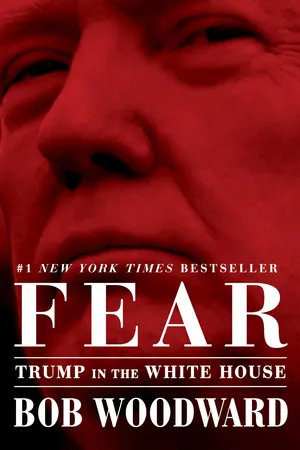
Fear
eBook - ePub

Fear

Trump in the White House

  1. 448 pages
  2. English
  3. ePUB (mobile friendly)
  4. Available on iOS & Android
eBook - ePub

Fear

Trump in the White House

About this book

OVER 2 MILLION COPIES SOLD

RUNAWAY #1 NEW YORK TIMES BESTSELLER

SENSATIONAL #1 INTERNATIONAL BESTSELLER

“Explosive.”—The Washington Post

“Devastating.”—The New Yorker

“Unprecedented.”—CNN

“Great reporting...astute.”—Hugh Hewitt

THE INSIDE STORY ON PRESIDENT TRUMP, AS ONLY BOB WOODWARD CAN TELL IT

With authoritative reporting honed through nine presidencies, author Bob Woodward reveals in unprecedented detail the harrowing life inside President Donald Trump’s White House and precisely how he makes decisions on major foreign and domestic policies.

Fear is the most intimate portrait of a sitting president ever published during the president’s first years in office. The focus is on the explosive debates and the decision-making in the Oval Office, the Situation Room, Air Force One and the White House residence.

Woodward draws from hundreds of hours of interviews with firsthand sources, meeting notes, personal diaries, files and documents. Often with day-by-day details, dialogue and documentation, Fear tracks key foreign issues from North Korea, Afghanistan, Iran, the Middle East, NATO, China and Russia. It reports in-depth on Trump’s key domestic issues particularly trade and tariff disputes, immigration, tax legislation, the Paris Climate Accord and the racial violence in Charlottesville in 2017.

Fear presents vivid details of the negotiations between Trump’s attorneys and Robert Mueller, the special counsel in the Russia investigation, laying out for the first time the meeting-by-meeting discussions and strategies. It discloses how senior Trump White House officials joined together to steal draft orders from the president’s Oval Office desk so he would not issue directives that would jeopardize top secret intelligence operations.

“It was no less than an administrative coup d’état,” Woodward writes, “a nervous breakdown of the executive power of the most powerful country in the world.”
Frequently asked questions

Yes, you can cancel anytime from the Subscription tab in your account settings on the Perlego website. Your subscription will stay active until the end of your current billing period. Learn how to cancel your subscription.
No, books cannot be downloaded as external files, such as PDFs, for use outside of Perlego. However, you can download books within the Perlego app for offline reading on mobile or tablet. Learn more here.
Perlego offers two plans: Essential and Complete
  • Essential is ideal for learners and professionals who enjoy exploring a wide range of subjects. Access the Essential Library with 800,000+ trusted titles and best-sellers across business, personal growth, and the humanities. Includes unlimited reading time and Standard Read Aloud voice.
  • Complete: Perfect for advanced learners and researchers needing full, unrestricted access. Unlock 1.4M+ books across hundreds of subjects, including academic and specialized titles. The Complete Plan also includes advanced features like Premium Read Aloud and Research Assistant.
Both plans are available with monthly, semester, or annual billing cycles.
We are an online textbook subscription service, where you can get access to an entire online library for less than the price of a single book per month. With over 1 million books across 1000+ topics, we’ve got you covered! Learn more here.
Look out for the read-aloud symbol on your next book to see if you can listen to it. The read-aloud tool reads text aloud for you, highlighting the text as it is being read. You can pause it, speed it up and slow it down. Learn more here.
Yes! You can use the Perlego app on both iOS or Android devices to read anytime, anywhere — even offline. Perfect for commutes or when you’re on the go.
Please note we cannot support devices running on iOS 13 and Android 7 or earlier. Learn more about using the app.
Yes, you can access Fear by Bob Woodward in PDF and/or ePUB format, as well as other popular books in Política y relaciones internacionales & Biografías políticas. We have over one million books available in our catalogue for you to explore.

CHAPTER

1

images
In August 2010, six years before taking over Donald Trump’s winning presidential campaign, Steve Bannon, then 57 and a producer of right-wing political films, answered his phone.
“What are you doing tomorrow?” asked David Bossie, a longtime House Republican investigator and conservative activist who had chased Bill and Hillary Clinton scandals for almost two decades.
“Dude,” Bannon replied, “I’m cutting these fucking films I’m making for you.”
The 2010 midterm congressional elections were coming up. It was the height of the Tea Party movement and Republicans were showing momentum.
“Dave, we’re literally dropping two more films. I’m editing. I’m working 20 hours a day” at Citizens United, the conservative political action committee Bossie headed, to churn out his anti-Clinton films.
“Can you come with me up to New York?”
“For what?”
“To see Donald Trump,” Bossie said.
“What about?”
“He’s thinking of running for president,” Bossie said.
“Of what country?” Bannon asked.
No, seriously, Bossie insisted. He had been meeting and working with Trump for months. Trump had asked for a meeting.
“I don’t have time to jerk off, dude,” Bannon said. “Donald Trump’s never running for president. Forget it. Against Obama? Forget it. I don’t have time for fucking nonsense.”
“Don’t you want to meet him?”
“No, I have no interest in meeting him.” Trump had once given Bannon a 30-minute interview for his Sunday-afternoon radio show, called The Victory Sessions, which Bannon had run out of Los Angeles and billed as “the thinking man’s radio show.”
“This guy’s not serious,” Bannon said.
“I think he is serious,” Bossie said. Trump was a TV celebrity and had a famous show, The Apprentice, that was number one on NBC some weeks. “There’s no downside for us to go and meet with him.”
Bannon finally agreed to go to New York City to Trump Tower.

They rode up to the 26th floor conference room. Trump greeted them warmly, and Bossie said he had a detailed presentation. It was a tutorial.
The first part, he said, lays out how to run in a Republican primary and win. The second part explains how to run for president of the United States against Barack Obama. He described standard polling strategies and discussed process and issues. Bossie was a traditional, limited-government conservative and had been caught by surprise by the Tea Party movement.
It was an important moment in American politics, Bossie said, and Tea Party populism was sweeping the country. The little guy was getting his voice. Populism was a grassroots movement to disrupt the political status quo in favor of everyday people.
“I’m a business guy,” Trump reminded them. “I’m not a professional ladder-climber in politics.”
“If you’re going to run for president,” Bossie said, “you have to know lots of little things and lots of big things.” The little things were filing deadlines, the state rules for primaries—minutiae. “You have to know the policy side, and how to win delegates.” But first, he said, “you need to understand the conservative movement.”
Trump nodded.
“You’ve got some problems on issues,” Bossie said.
“I don’t have any problems on issues,” Trump said. “What are you talking about?”
“First off, there’s never been a guy to win a Republican primary that’s not pro-life,” Bossie said. “And unfortunately, you’re very pro-choice.”
“What does that mean?”
“You have a record of giving to the abortion guys, the pro-choice candidates. You’ve made statements. You’ve got to be pro-life, against abortion.”
“I’m against abortion,” Trump said. “I’m pro-life.”
“Well, you’ve got a track record.”
“That can be fixed,” Trump said. “You just tell me how to fix that. I’m—what do you call it? Pro-life. I’m pro-life, I’m telling you.”
Bannon was impressed with the showmanship, and increasingly so as Trump talked. Trump was engaged and quick. He was in great physical shape. His presence was bigger than the man, and took over the room, a command presence. He had something. He was also like a guy in a bar talking to the TV. Street-smart, from Queens. In Bannon’s evaluation, Trump was Archie Bunker, but a really focused Archie Bunker.
“The second big thing,” Bossie said, “is your voting record.”
“What do you mean, my voting record?”
“About how often you vote.”
“What are you talking about?”
“Well,” Bossie said, “this is a Republican primary.”
“I vote every time,” Trump said confidently. “I’ve voted every time since I was 18, 20 years old.”
“That’s actually not correct. You know there’s a public record of your vote.” Bossie, the congressional investigator, had a stack of records.
“They don’t know how I vote.”
“No, no, no, not how you vote. How often you vote.”
Bannon realized that Trump did not know the most rudimentary business of politics.
“I voted every time,” Trump insisted.
“Actually you’ve never voted in a primary except once in your entire life,” Bossie said, citing the record.
“That’s a fucking lie,” Trump said. “That’s a total lie. Every time I get to vote, I voted.”
“You only voted in one primary,” Bossie said. “It was like in 1988 or something, in the Republican primary.”
“You’re right,” Trump said, pivoting 180 degrees, not missing a beat. “That was for Rudy.” Giuliani ran for mayor in a primary in 1989. “Is that in there?”
“Yes.”
“I’ll get over that,” Trump said.
“Maybe none of these things matter,” Bossie said, “but maybe they do. If you’re going to move forward, you have to be methodical.”
Bannon was up next. He turned to what was driving the Tea Party, which didn’t like the elites. Populism was for the common man, knowing the system is rigged. It was against crony capitalism and insider deals which were bleeding the workers.
“I love that. That’s what I am,” Trump said, “a popularist.” He mangled the word.
“No, no,” Bannon said. “It’s populist.”
“Yeah, yeah,” Trump insisted. “A popularist.”
Bannon gave up. At first he thought Trump did not understand the word. But perhaps Trump meant it in his own way—being popular with the people. Bannon knew popularist was an earlier British form of the word “populist” for the nonintellectual general public.
An hour into the meeting, Bossie said, “We have another big issue.”
“What’s that?” Trump asked, seeming a little more wary.
“Well,” he said, “80 percent of the donations that you’ve given have been to Democrats.” To Bossie that was Trump’s biggest political liability, though he didn’t say so.
“That’s bullshit!”
“There’s public records,” Bossie said.
“There’s records of that!” Trump said in utter astonishment.
“Every donation you’ve ever given.” Public disclosure of all political giving was standard.
“I’m always even,” Trump said. He divided his donations to candidates from both parties, he said.
“You actually give quite a bit. But it’s 80 percent Democratic. Chicago, Atlantic City . . .”
“I’ve got to do that,” Trump said. “All these fucking Democrats run all the cities. You’ve got to build hotels. You’ve got to grease them. Those are people who came to me.”
“Listen,” Bannon said, “here’s what Dave’s trying to say. Running as a Tea Party guy, the problem is that’s what they are complaining about. That it’s guys like you that have inside deals.”
“I’ll get over that,” Trump said. “It’s all rigged. It’s a rigged system. These guys have been shaking me down for years. I don’t want to give. They all walk in. If you don’t write a check . . .”
There was a pol in Queens, Trump said, “an old guy with a baseball bat. You go in there and you’ve got to give him something—normally in cash. If you don’t give him anything, nothing gets done. Nothing gets built. But if you take it in there and you leave him an envelope, it happens. That’s just the way it is. But I can fix that.”
Bossie said he had a roadmap. “It’s the conservative movement. Tea Party comes and goes. Populism comes and goes. The conservative movement has been a bedrock since Goldwater.”
Second, he said, I would recommend you run as if you are running for governor in three states—Iowa, New Hampshire and South Carolina. They were the first three caucus or primary states. “Run and sound local, like you want to be their governor.” A lot of candidates made the huge mistake of trying to run in 27 states. “Run three governor’s races, and you’ll have a really good shot. Focus on three. Do well in three. And the others will come.”
“I can be the nominee,” Trump said. “I can beat these guys. I don’t care who they are. I got this. I can take care of these other things.”
Each position could be revisited, renegotiated.
“I’m pro-life,” Trump said. “I’m going to start.”
“Here’s what you’re going to need to do,” Bossie said. “You’re going to need to write between $250,000 and $500,000 worth of individual checks to congressmen and senators. They’ll all come up here. Look them in the eye, shake their hand. You’re going to give them a check. Because we need some markers. You’ve got to do one-on-ones so these guys know. Because later on, that’ll be at least an entry point that you’re building relationships.”
Bossie continued, “Saying, this check is for you. For $2,400”—the maximum amount. “It’s got to be individual checks, hard money, to their campaign so they know it’s coming from you personally. Republicans now know that you’re going to be serious about this.”
All the money, Bossie said, was central to the art of presidential politics. “Later that’s going to pay huge dividends.” Give to Republican candidates in a handful of battleground states like Ohio, Pennsylvania, Virginia and Florida.
In addition, Bossie said, “You’re going to have to do a policy book. You ought to do a book about what you think about America and these policies.”
Bannon gave an extended brief on China and its successful efforts to take jobs and money from the United States. He was obsessed with the threat.
“What do you think?” Bossie later asked Bannon.
“I’m pretty impressed with the guy,” Bannon said. As for running for president, “Zero chance. First off, those two action items. The fucker will not write one check. He’s not a guy who writes checks. He signs the back of checks” when they come in as payments to him. “It was good you said that because he’ll never write a check.”
“What about the policy book?”
“He’ll never do a policy book. Give me a fucking break. First off, nobody will buy it. It was a waste of time except for the fact that it was insanely entertaining.”
Bossie said he was trying to prepare Trump if he ever did decide to run. Trump had a unique asset: He was totally removed from the political process.
As they walked on, Bossie found himself going through a mental exercise, one that six years later most Americans would go through. He’ll ne...

Table of contents

  1. Cover
  2. Title Page
  3. Dedication
  4. Author’s Personal Note
  5. Epigraph
  6. Note to Readers
  7. Prologue
  8. Chapter 1
  9. Chapter 2
  10. Chapter 3
  11. Chapter 4
  12. Chapter 5
  13. Chapter 6
  14. Chapter 7
  15. Chapter 8
  16. Chapter 9
  17. Chapter 10
  18. Chapter 11
  19. Chapter 12
  20. Chapter 13
  21. Chapter 14
  22. Chapter 15
  23. Chapter 16
  24. Chapter 17
  25. Chapter 18
  26. Chapter 19
  27. Chapter 20
  28. Chapter 21
  29. Chapter 22
  30. Chapter 23
  31. Chapter 24
  32. Chapter 25
  33. Chapter 26
  34. Chapter 27
  35. Chapter 28
  36. Chapter 29
  37. Chapter 30
  38. Chapter 31
  39. Chapter 32
  40. Chapter 33
  41. Chapter 34
  42. Chapter 35
  43. Chapter 36
  44. Chapter 37
  45. Chapter 38
  46. Chapter 39
  47. Chapter 40
  48. Chapter 41
  49. Chapter 42
  50. Photographs
  51. Acknowledgments
  52. About the Author
  53. Source Notes
  54. Index
  55. Photography Credits
  56. Image Descriptions
  57. Copyright