Dayside Magnetosphere Interactions
  1. English
  2. ePUB (mobile friendly)
  3. Available on iOS & Android
eBook - ePub

About this book

Exploring the processes and phenomena of Earth's dayside magnetosphere

Energy and momentum transfer, initially taking place at the dayside magnetopause, is responsible for a variety of phenomenon that we can measure on the ground. Data obtained from observations of Earth's dayside magnetosphere increases our knowledge of the processes by which solar wind mass, momentum, and energy enter the magnetosphere.

Dayside Magnetosphere Interactions outlines the physics and processes of dayside magnetospheric phenomena, the role of solar wind in generating ultra-low frequency waves, and solar wind-magnetosphere-ionosphere coupling.

Volume highlights include:

  • Phenomena across different temporal and spatial scales
  • Discussions on dayside aurora, plume dynamics, and related dayside reconnection
  • Results from spacecraft observations, ground-based observations, and simulations
  • Discoveries from the Magnetospheric Multiscale Mission and Van Allen Probes era
  • Exploration of foreshock, bow shock, magnetosheath, magnetopause, and cusps
  • Examination of similar processes occurring around other planets

The American Geophysical Union promotes discovery in Earth and space science for the benefit of humanity. Its publications disseminate scientific knowledge and provide resources for researchers, students, and professionals.

Find out more about this book from this Q&A with the editors
Frequently asked questions

Yes, you can cancel anytime from the Subscription tab in your account settings on the Perlego website. Your subscription will stay active until the end of your current billing period. Learn how to cancel your subscription.
At the moment all of our mobile-responsive ePub books are available to download via the app. Most of our PDFs are also available to download and we're working on making the final remaining ones downloadable now. Learn more here.
Perlego offers two plans: Essential and Complete
  • Essential is ideal for learners and professionals who enjoy exploring a wide range of subjects. Access the Essential Library with 800,000+ trusted titles and best-sellers across business, personal growth, and the humanities. Includes unlimited reading time and Standard Read Aloud voice.
  • Complete: Perfect for advanced learners and researchers needing full, unrestricted access. Unlock 1.4M+ books across hundreds of subjects, including academic and specialized titles. The Complete Plan also includes advanced features like Premium Read Aloud and Research Assistant.
Both plans are available with monthly, semester, or annual billing cycles.
We are an online textbook subscription service, where you can get access to an entire online library for less than the price of a single book per month. With over 1 million books across 1000+ topics, we’ve got you covered! Learn more here.
Look out for the read-aloud symbol on your next book to see if you can listen to it. The read-aloud tool reads text aloud for you, highlighting the text as it is being read. You can pause it, speed it up and slow it down. Learn more here.
Yes! You can use the Perlego app on both iOS or Android devices to read anytime, anywhere — even offline. Perfect for commutes or when you’re on the go.
Please note we cannot support devices running on iOS 13 and Android 7 or earlier. Learn more about using the app.
Yes, you can access Dayside Magnetosphere Interactions by Qiugang Zong, Philippe Escoubet, David Sibeck, Guan Le, Hui Zhang, Qiugang Zong,Philippe Escoubet,David Sibeck,Guan Le,Hui Zhang in PDF and/or ePUB format, as well as other popular books in Physical Sciences & Geophysics. We have over one million books available in our catalogue for you to explore.

Information

1
A Brief History of Dayside Magnetospheric Physics

A. Otto
Geophysical Institute, University of Alaska Fairbanks, Fairbanks, AK, USA

ABSTRACT

Dayside magnetospheric physics has an early history that is closely related to our understanding of the magnetosphere as a whole. The early years of magnetospheric physics are somewhat reminiscent of the gold rush era or the exploration of the American west. Moving into the satellite era, our field had, for the first time, the opportunity to examine in‐situ dayside plasma processes to confirm or reject theories, something that neither solar nor astrophysics can do. Since the late 1970s, with better and faster instrumentation, we have been able to develop a detailed understanding of magnetopause and bow shock plasma physics, where transient phenomena play a critical role. This article provides a brief history of these periods of time and how these led into a modern understanding of dayside physics and transient events.

1.1. SETTING THE STAGE: THE PRE‐SATELLITE ERA

At the turn of the nineteenth century, it was known that the Earth's magnetic field could at times undergo strong perturbations that seemed to correlate with auroral activity. It was also hypothesized that these magnetic perturbations were caused by processes on the sun. The most prominent example of this relation was the great flare observed by Richard Carrington on 1 September 1859 (Carrington, 1859) and the geomagnetic response. However, such a connection between solar processes and geomagnetism was met by strong criticism at the time.
In the years around the turn of the nineteenth century, Kristian Birkeland undertook a number of expeditions to the auroral zone. He was the first to identify what he called the polar elementary storm which is now known as the auroral substorm. Birkeland provided a highly detailed description and analysis of his observations and implied the existence of vertical currents in the upper atmosphere as closure for the horizontal currents he inferred from magnetic observations. Based on the observations and his gas discharge “Terella” experiments studying the paths of electrons in a dipole representing Earth, Birkeland was convinced that the aurora and associated magnetic perturbations were caused by precipitating electrons from the sun (Birkeland, 1908). He also provided a reasonable estimate of the electric currents and the power associated with the auroral activity. Some years later, Sydney Chapman, a brilliant mathematician, published his first model for geomagnetic storms (Chapman, 1918a). Although most of this work involved horizontal currents in the upper atmosphere, the batteries for these currents were “vertical motions.” These he assumed to be provided by a mostly single charged particle precipitation of solar origin although he noted that this idea was not well appreciated in the science community (Chapman, 1918b). It was only a year later that Frederick Lindemann pointed out that the supposed solar corpuscular stream cannot be single‐charged and must contain ions and electrons to be charge neutral (Lindemann, 1919).
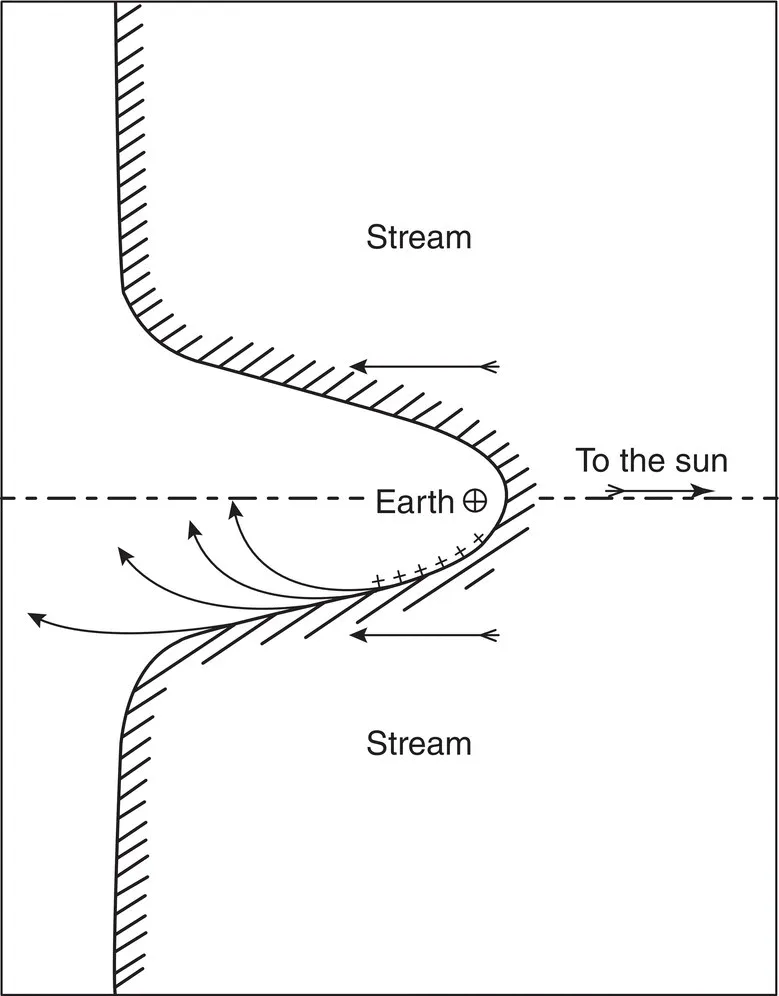
Based on a charge neutral, ideally conducting solar stream Chapman and Ferraro presented a new theory of magnetic storms where the geomagnetic field is compressed facing the stream and extended in its wake (Chapman & Ferraro, 1931) somewhat similar to our picture of the magnetosphere (Figure 1.1). They called this a magnetic hollow where solar wind particles could access the upper atmosphere only through “two horns” at the location of the cusps of the magnetic field. This model presented for the first time the concept of a magnetopause as the boundary between the solar plasma and the Earth's closed magnetosphere, and this model dominated the view in the science community for decades. The model agreed qualitatively with most magnetic storm properties particularly for the initial increase of the magnetic field (sudden commencement), however, it was not convincing for the main phase magnetic depression. Chapman and Bartels (1940, p. 810) remarked that a more efficient particle entry and energization were needed than provided in the closed magnetic field model. A different model for magnetic storms and plasma entry in the form of clouds was suggested by Hannes AlfvĂ©n (1940) that generated an ongoing controversy for two decades (e.g., AlfvĂ©n, 1958).
Illustration of the “magnetic hollow” (magnetic cavity) exposed to the ideally conducting solar plasma having a horizontal dashed line at the center for Earth and arrows indicating the direction of the Stream and to the sun.
Figure 1.1 Illustration of the “magnetic hollow” (magnetic cavity) exposed to the ideally conducting solar plasma.
Source: From Chapman and Ferraro (1931).
It should be noted that, at the time, the stream of solar plasma was generally assumed to be transient and localized although Biermann (1951) demonstrated through cometary tail observations that the stream of solar material must, in fact, be continuous. However, Chapman shared the view with some in the community of an invisible solar corona that extended beyond Earth's orbit and expanded at a low velocity of a few 10 km s−1 (Parker, 1997). Eugene Parker realized that not both views on the stream of solar plasma could be true, and, almost coincident with the launch of the first satellites, and Parker (1958) published his famous theory of the solar wind and coined the name. Somewhat typical of this time is an episode arou...

Table of contents

  1. Cover
  2. Table of Contents
  3. CONTRIBUTORS
  4. PREFACE
  5. 1 A Brief History of Dayside Magnetospheric Physics
  6. Part I: Physics of Dayside Magnetospheric Response to Solar Wind Discontinuities
  7. Part II: Structure and Dynamics of Dayside Boundaries
  8. Part III: The Roles of Solar Wind Sources on Wave Generations and Dynamic Processes in the Inner Magnetosphere
  9. Part IV: Cold Plasmas of Ionospheric Origin and Their Role in Coupling Different Regions in Geospace
  10. INDEX
  11. End User License Agreement