eBook - ePub
Knowledge Management in Innovative Companies 2
Understanding and Deploying a KM Plan within a Learning Organization
- English
- ePUB (mobile friendly)
- Available on iOS & Android
eBook - ePub
Knowledge Management in Innovative Companies 2
Understanding and Deploying a KM Plan within a Learning Organization
About this book
The status of knowledge management (KM) as a mature science has long been recognized in the academic world. However, in the economic arena, its connection with companies and organizations has been more gradual. Jean-Louis Ermine established a theoretical and practical framework for KM in Knowledge Management: The Creative Loop, which was also published by Wiley. In this second volume, practical examples are illustrated with real case studies. Modeled on the four-step operational approach inspired by ?the creative loop?, this book includes four sets of real case studies – each one following the basic presentation of the fundamental material. Knowledge Management in Innovative Companies 2 is especially useful for practitioners, as there are numerous illustrations based on best practices for each specific KM step and for global project implementation. Indeed, the last chapter is dedicated to the implementation of a global KM corporate project.
Information
1
Knowledge Transfer and Knowledge Sharing
1.1. Articulation of Chapter 1
The purpose of this chapter is to explore conceptually and practically the third step in the virtuous cycle of knowledge management. described in Volume 1, Chapter 1, which is dedicated to the transfer and sharing of the organization’s knowledge.
In section 1.2, we recall the main concepts of transfer and sharing operations that are sufficient to fully understand the case studies.
The practical exploration of knowledge transfer and sharing will then be done through case studies, respectively of a banking company (section 1.3), Sonatrach (section 1.4), Hydro-Québec (section 1.5), analysis of the choice of a knowledge transfer method (section 1.6) and an agricultural field (section 1.7).
Section 1.8 summarizes the lessons learned from these five case studies on knowledge transfer and sharing.
1.2. Introduction to knowledge transfer and sharing
This paragraph is based on the study written by Thierno Tounkara [TOU 13] (sections 1.2.1 to 1.2.5) and that written by Jean-Louis Ermine [ERM 10].
1.2.1. Introduction
The concept of knowledge transfer was introduced by [TEE 77] in the classic case of technology transfer. It can be defined as the process by which an organization regenerates and maintains a complex, causal and ambiguous set of routines in a new context [SZU 96]. This process is a key element of the knowledge management cycle and allows organizations to absorb and make optimal use of critical knowledge. We are interested here in this process as an intra-organizational transfer of knowledge.
Knowledge transfer (or sharing) is an exchange process based on a binary relationship that depends on the contexts in which the actors operate. A knowledge transfer action is therefore characterized by the target audience (receivers), by the source that provides the content and participates in the transfer, by the characteristics of the knowledge that is transferred and by description of the environment (technical, social, organizational, cultural, etc.) in which this transfer takes place. A transfer process is easily described by a model (Figure 1.1) and thus provides the reference model for transfer or sharing operations (see Volume 1, Chapter 1). It is not a priori a unidirectional model from the holders to the receivers, because many crossinfluences and retro-adjustments are implemented in its implementation.
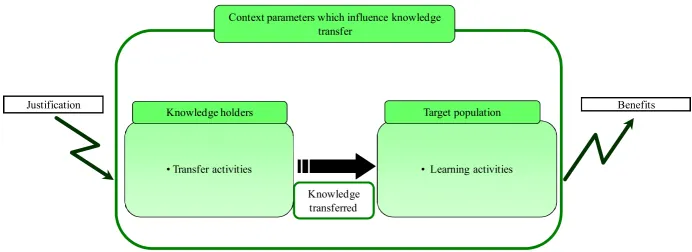
Figure 1.1. Model of the knowledge transfer process
This model makes it possible, for any transfer action, to specify in detail which elements are to be taken into account in the implementation. It is extremely useful for the success of the transfer. A large number of criteria can be established that can be used to characterize these processes. This is the purpose of this paragraph.
Research on knowledge transfer in general focuses on three themes [HAR 12, DAL 11, GUP 00, ZAC 99, SIM 99, SZU 96, ZAN 95]:
- – factors that affect knowledge transfer: these are parameters to measure the degree to which knowledge can be easily communicated, understood and transferred;
- – knowledge transfer modes or processes that address the respective transformation between tacit and explicit knowledge;
- – evaluation and measurement of the performance of knowledge transfer, with the aim of developing indicators to measure the effectiveness of knowledge transfer.
We deal here with the first two themes. We focus here on knowledge transfer where knowledge codification is a possible step in knowledge sharing and transfer, including the use of knowledge engineering techniques for knowledge codification and the development of organizational memories. We can thus observe the effects of codification on the factors that affect knowledge transfer. We then propose an approach that provides optimal continuity between knowledge capture using knowledge engineering methods and knowledge transfer at the individual and organizational levels.
1.2.2. Factors influencing knowledge transfer
We can group the factors influencing knowledge transfer into four dimensions:
- – characteristics of knowledge;
- – knowledge transfer mechanisms;
- – the absorption capacity of the receptors;
- – cultural and organizational contexts.
1.2.2.1. Characteristics of knowledge
With the characteristics of knowledge, we can measure different aspects that can be facilitators or barriers to knowledge transfer.
The work of [ZAN 95] and [SIM 99] highlights th...
Table of contents
- Cover
- Table of Contents
- Preface
- 1 Knowledge Transfer and Knowledge Sharing
- 2 Innovation from the Knowledge Base
- 3 Case Study of a Global KM Project
- References
- Index
- End User License Agreement
Trusted by 375,005 students
Access to over 1.5 million titles for a fair monthly price.
Study more efficiently using our study tools.
Frequently asked questions
Yes, you can cancel anytime from the Subscription tab in your account settings on the Perlego website. Your subscription will stay active until the end of your current billing period. Learn how to cancel your subscription
No, books cannot be downloaded as external files, such as PDFs, for use outside of Perlego. However, you can download books within the Perlego app for offline reading on mobile or tablet. Learn how to download books offline
Perlego offers two plans: Essential and Complete
- Essential is ideal for learners and professionals who enjoy exploring a wide range of subjects. Access the Essential Library with 800,000+ trusted titles and best-sellers across business, personal growth, and the humanities. Includes unlimited reading time and Standard Read Aloud voice.
- Complete: Perfect for advanced learners and researchers needing full, unrestricted access. Unlock 1.5M+ books across hundreds of subjects, including academic and specialized titles. The Complete Plan also includes advanced features like Premium Read Aloud and Research Assistant.
We are an online textbook subscription service, where you can get access to an entire online library for less than the price of a single book per month. With over 1.5 million books across 990+ topics, we’ve got you covered! Learn about our mission
Look out for the read-aloud symbol on your next book to see if you can listen to it. The read-aloud tool reads text aloud for you, highlighting the text as it is being read. You can pause it, speed it up and slow it down. Learn more about Read Aloud
Yes! You can use the Perlego app on both iOS and Android devices to read anytime, anywhere — even offline. Perfect for commutes or when you’re on the go.
Please note we cannot support devices running on iOS 13 and Android 7 or earlier. Learn more about using the app
Please note we cannot support devices running on iOS 13 and Android 7 or earlier. Learn more about using the app
Yes, you can access Knowledge Management in Innovative Companies 2 by Pierre Saulais,Jean-Louis Ermine in PDF and/or ePUB format, as well as other popular books in Business & Management. We have over 1.5 million books available in our catalogue for you to explore.