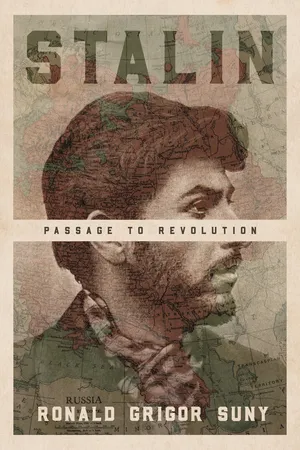
A spellbinding new biography of Stalin in his formative years
This is the definitive biography of Joseph Stalin from his birth to the October Revolution of 1917, a panoramic and often chilling account of how an impoverished, idealistic youth from the provinces of tsarist Russia was transformed into a cunning and fearsome outlaw who would one day become one of the twentieth century's most ruthless dictators.
In this monumental book, Ronald Grigor Suny sheds light on the least understood years of Stalin's career, bringing to life the turbulent world in which he lived and the extraordinary historical events that shaped him. Suny draws on a wealth of new archival evidence from Stalin's early years in the Caucasus to chart the psychological metamorphosis of the young Stalin, taking readers from his boyhood as a Georgian nationalist and romantic poet, through his harsh years of schooling, to his commitment to violent engagement in the underground movement to topple the tsarist autocracy. Stalin emerges as an ambitious climber within the Bolshevik ranks, a resourceful leader of a small terrorist band, and a writer and thinker who was deeply engaged with some of the most incendiary debates of his time.
A landmark achievement, Stalin paints an unforgettable portrait of a driven young man who abandoned his religious faith to become a skilled political operative and a single-minded and ruthless rebel.
- English
- ePUB (mobile friendly)
- Available on iOS & Android
eBook - ePub
About this book
Information
Publisher
Princeton University PressYear
2020Print ISBN
9780691202716
9780691182032
eBook ISBN
9780691185934
NOTES
INTRODUCTION: FORTUNE’S NAVE
- 1. Leon Trotsky, Stalin: An Appraisal of the Man and His Influence, ed. and trans. Charles Malamuth (New York: Harper & Brothers, 1941; paperback edition: New York: Grosset & Dunlap, no date), pp. 392–393.
- 2. Aleksandr Solzhenitsyn, V kruge pervom (New York: Harper & Row, 1968); The First Circle, trans. Thomas P. Whitney (New York: Harper & Row, 1968); Vasilii Grossman, Zhizn’ i sud’ba (Moscow: Knizhnaia palata, 1988); Life and Fate, trans. Robert Chandler (New York: Harper & Row, 1985). See also Anatolii Rybakov, Deti Arbata (Moscow: Sovetskii pisatel’, 1987); Children of the Arbat, trans. Howard Shukman (Boston: Little, Brown, and Co., 1988).
- 3. One of the first psychoanalytic discussions of Stalin was by Gustav Bychowski, “Joseph V. Stalin: Paranoia and the Dictatorship of the Proletariat,” in Benjamin B. Wolman (ed.), The Psychoanalytic Interpretation of History (New York and London: Basic Books, 1971), pp. 115–149. For the theory that Stalin was a police agent before the revolution, see Isaac Don Levine, Stalin’s Great Secret (New York: Coward-McCann, 1956); Edward Ellis Smith, The Young Stalin: The Early Years of an Elusive Revolutionary (New York: Farrar, Straus, and Giroux, 1967); and H. Montgomery Hyde, Stalin: The History of a Dictator (New York: Farrar, Straus, and Giroux, 1972). For a fuller discussion of psychohistorical and other approaches to Stalin, see Ronald Grigor Suny, “Making Sense of Stalin: Some Recent and Not-So-Recent Biographies,” Russian History, XVI, 2–4 (1989), pp. 435–448; expanded as “Making Sense of Stalin: His Biographers,” in Red Flag Wounded: Stalinism and the Fate of the Soviet Experiment (London and New York: Verso Books, 2020); and the historiographical appendix to this volume, “Historians Look at Stalin: A Historiographical Discussion.”
- 4. I. V. Stalin, Sochineniia (Moscow: Gosudarstvennoe izdatel’stvo politicishekoi literatury, 1946–1952), XIII, p. 113.
- 5. For an account that emphasizes the centrality of an essentialized Georgian identity, particularly its purported romanticism and chronic violence, to Stalin’s formation, see Simon Sebag Montefiore, Young Stalin (London: Weidenfeld & Nicolson, 2007; New York: Alfred A. Knopf, 2007), p. 11.
CHAPTER 1. THE GEORGIAN
- 1. The Hungarian historian Miklós Kun gives the birth date for Keke Geladze as February 5, 1860, based on the archival record of her death on June 4, 1937, in the former archives of the Communist Party of the Soviet Union. [Miklós Kun, Stalin: An Unknown Portrait (Budapest, New York: Central European University Press, 2003), p. 35; RGASPI, f. 558, op. 11, d. 1549]; Aleksandr Ostrovskii gives the date 1856 for her birth, which he took from the obituary in Zaria vostoka, June 8, 1937 [A. Ostrovskii, Kto stoial za spinoi Stalina (Saint Petersburg: Neva; Moscow: OLMA-PRESSA, 2002), p. 88]. This valuable work is a close review of archival materials on Stalin’s early life, primarily organized to show that he was not a police agent. Much of the material in Ostrovskii comes from his research in the Georgian party archives in Tbilisi [SShSSA] and the Stalin Museum in Gori [SSM], where he read through Russian-language memoirs of people who knew the young Stalin and his family. Soviet archivists collected dozens of memoirs of young Stalin in the 1930s and 1940s, only a few of which have been published. While such sources must always be approached with caution and a few are suspect in their schematic and hagiographic character, many others contribute details and stories that are corroborated in other sources and appear to this researcher to be reliable.
- 2. SShSA, f. 440, op. 2, d. 38, l. 12; I. Kitaev, L. Moshkov, and A. Chernev, “Kogda rodilsia I. V. Stalin,” Izvestiia TsK KPSS, no. 11 (310) (November 1990), pp. 132–134; Edvard Radzinskii, Stalin (Moscow: Vagrius, 1997), pp. 17–18 [translation: Edvard Radzinsky, Stalin, trans. H. T. Willets (New York: Doubleday, 1996); references will be from the English translation unless otherwise noted]. In her collection of documents on the young Stalin, archivist Ol’ga Edel’man demonstrates that Stalin was aware of the true date of his birth. [Ol’ga Edel’man, Stalin: Biografiia v dokumentakh (unpublished manuscript), p. 2; page numbers in my citations refer to the manuscript that Ms. Edel’man allowed me to read and cite before the actual publication, which occurred too late for inclusion here.]
- 3. From a conversation between Edvard Radzinskii and Elena Sergeevna Bulgakova, the playwright’s widow, cited in Radzinsky, Stalin, p. 11.
- 4. Joseph Iremaschwili, Stalin und die Tragödie Georgiens: Erinnerungen (Berlin: Verfasser, 1932); V. Kaminskii a...
Table of contents
- Cover Page
- Title Page
- Copyright Page
- Dedication
- Contents
- Acknowledgments
- A Note on Dating and Spelling
- A Note on Archives
- Maps
- Introduction: Fortune’s Knave
- Growing Up Georgian
- Breaking Left
- The Making of a Bolshevik
- Revolutionary Underground
- Staying the Course
- From Outside In
- The Steep Path to Power
- Conclusion: The Road Traveled
- Historians Look at Stalin: A Historiographical Discussion
- Notes
- Index
Trusted by 375,005 students
Access to over 1.5 million titles for a fair monthly price.
Study more efficiently using our study tools.
Frequently asked questions
Yes, you can cancel anytime from the Subscription tab in your account settings on the Perlego website. Your subscription will stay active until the end of your current billing period. Learn how to cancel your subscription
No, books cannot be downloaded as external files, such as PDFs, for use outside of Perlego. However, you can download books within the Perlego app for offline reading on mobile or tablet. Learn how to download books offline
Perlego offers two plans: Essential and Complete
- Essential is ideal for learners and professionals who enjoy exploring a wide range of subjects. Access the Essential Library with 800,000+ trusted titles and best-sellers across business, personal growth, and the humanities. Includes unlimited reading time and Standard Read Aloud voice.
- Complete: Perfect for advanced learners and researchers needing full, unrestricted access. Unlock 1.5M+ books across hundreds of subjects, including academic and specialized titles. The Complete Plan also includes advanced features like Premium Read Aloud and Research Assistant.
We are an online textbook subscription service, where you can get access to an entire online library for less than the price of a single book per month. With over 1.5 million books across 990+ topics, we’ve got you covered! Learn about our mission
Look out for the read-aloud symbol on your next book to see if you can listen to it. The read-aloud tool reads text aloud for you, highlighting the text as it is being read. You can pause it, speed it up and slow it down. Learn more about Read Aloud
Yes! You can use the Perlego app on both iOS and Android devices to read anytime, anywhere — even offline. Perfect for commutes or when you’re on the go.
Please note we cannot support devices running on iOS 13 and Android 7 or earlier. Learn more about using the app
Please note we cannot support devices running on iOS 13 and Android 7 or earlier. Learn more about using the app
Yes, you can access Stalin by Ronald Grigor Suny in PDF and/or ePUB format, as well as other popular books in Politics & International Relations & Political Biographies. We have over 1.5 million books available in our catalogue for you to explore.