eBook - ePub
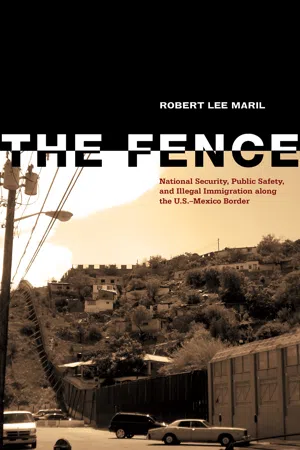
The Fence
National Security, Public Safety, and Illegal Immigration along the U.S.–Mexico Border
- 384 pages
- English
- ePUB (mobile friendly)
- Available on iOS & Android
eBook - ePub
The Fence
National Security, Public Safety, and Illegal Immigration along the U.S.–Mexico Border
About this book
To the American public it's a 2,000-mile-long project to keep illegal immigrants, narcotics, and terrorists on the other side of the U.S.–Mexico border. In the deserts of Arizona, it's a "virtual fence" of high-tech electronic sensors, cameras, and radar. In some border stretches it's a huge concrete-and-steel wall; in others it's a series of solitary posts designed to stop drug runners; in still others it's rusted barbed-wire cattle fences. For two-thirds of the international boundary it's nonexistent. Just what is this entity known as "the fence"? And more important, is it working? Through first-person interviews with defense contractors, border residents, American military, Minutemen, county officials, Customs and Border Protection agents, environmental activists, and others whose voices have never been heard, Robert Lee Maril examines the project's human and financial costs. Along with Maril's site visits, his rigorous analysis of government documents from 1999 to the present uncovers fiscal mismanagement by Congress, wasteful defense contracts, and unkept political promises. As drug violence mounts in border cities and increasing numbers of illegal migrants die from heat exhaustion in the Arizona desert, Maril argues how the fence may even be making an incendiary situation worse. Avoiding preconceived conclusions, he proposes new public policies that take into consideration human issues, political negotiation, and the need for compromise. Maril's lucid study shows the fence to be a symbol in concrete, steel, microchips, and fiber optics for the crucible of contemporary immigration policy, national security, and public safety.
Information
Subtopic
National SecurityPart One
A Virtual American Dream
Chapter 1
A Simple Solution
Perhaps the core implications of Time do not occur until, straining to hear the unintelligible ramblings of the youthful radiation oncologist, we are forced to face down the possibility of our own death. Or perhaps Time’s reminder is the inevitable passing of a parent or beloved friend, or even the family pet, one second romping with the kids, another inexplicably expiring on the freshly cut front lawn, legs jerking among the roots of the bermuda as unspoken words collect on the tongues of the gathering children. The vapid democracy of illness and death produces in the living an understanding of Time as the distillate of life.
Time can be particularly cruel to those residing in the U.S.-Mexico borderlands. Those living along the northern banks of the Rio Grande, the Big River, as well as those on the Mexican side of the Río Bravo, the Fierce River, may experience Time in very different and more direct ways than those in the interior of border states and those in nonborder states. The countenance of Time may be far different in the South Texas border towns of La Paloma, Relampago, Blue Town, Mercedes, San Benito, Brownsville, Harlingen, Santa Rosa, McAllen, Donna, Pharr, Rio Grande City, Santa Maria, Progresso, Zapata, Granjeno, Sullivan City, and San Juan than in Dallas, Dubuque, and Washington, D.C.1
For undocumented workers along the border, Time may be counted in units of mesmerizing panic while crossing the Río Bravo on inflated inner tubes linked by lines of thin, wet twine, one eye fixed on a six-year-old child, the other on the coyote, the human smuggler.2 Traversing a dangerous river is followed by a crazed dash toward a new life, beginning with a wild ride in a fifteen-year-old Ford van, motor revving, the coyote sweating in the vehicle’s air-conditioned interior as his passengers pray out loud to their patron saint. Illegal entry also may be an attempt to rejoin an abandoned life in the United States after the abuela, the grandmother, has died and the sons have rushed back home to the funeral in San Luís Potosí. How then will these same sons get back safely to their families and jobs in Des Moines, Iowa?
If there is not a dangerous river to cross along some parts of the border, there may be an even more hostile desert in locales such as Nogales, where thousands have already died illegally crossing the borderline.
For a Latino Border Patrol agent sworn to apprehend these workers and their families, Time’s foreshortened memory may end in uncounted bravery or a coward’s desperation when shadowy figures suddenly emerge from the banks of the Rio Grande or the deep canyons south of San Diego. Anonymous to the public in his or her green nylon uniform, often despised by local residents for a history of other agents’ transgressions, this federal law enforcer must immediately decide what action to take.3 Are these human outlines heavily armed cocaine smugglers, or are they nameless men, women, and children looking for work in a new land? Alone in the desert under a dark moon, the agent knows that, whatever decision he or she makes, backup cannot arrive in less than forty-five minutes.
For those on both sides of this international boundary—whether community residents, undocumented workers, law enforcement officers, or tourists— personal safety cannot be assumed or taken for granted. The borderlands have always been a very dangerous place in which to live.4
In the border villages, towns, and cities from Brownsville to San Diego, from Matamoros to Tijuana, Time is also sensed as centuries of family, community, and regional history unique to the American experience. Those who live in Nogales, Arizona, may have as much or more in common with those residing in Nogales, Sonora, than with those of nearby Tucson.
Although Time reigns supreme in the borderlands, geography and topography cannot be ignored. Isolated from mainstream Mexican and American culture and politics, these borderlands form nothing less than a slim wedge between two very different nations, one first-world, one in the third-.5 The rural landscape ranges from rich delta farmland with two growing seasons to high Sonoran desert. Neither entirely Mexican nor entirely American, the people of the border, sui generis, and the landscape in which they are embedded are perpetually misunderstood, underestimated, and even distrusted by federal officials in the distant capitals of México, D.F., and Washington, D.C.
Arbitrary but binding decisions made in the two national capitals have the ability to directly form, shape, and change the lives of residents on both sides of the border—and, more tellingly but in ways less understood, the lives of those far from these borderlands. The prevalent supposition that residents on both sides of this international boundary are passive recipients of their respective nation’s laws and policies arrogantly disregards history. Repeatedly these people of the borderlands have negotiated, mitigated, ignored, stalled, passively tolerated, blunted, changed, or fought to the bitter end laws, regulations, and policies they deemed unacceptable. They also repelled invading armies, armed bands of outlaws, and bureaucrats with MBAs and law degrees. The complexities of life in the borderlands are frequently far too intricate to be understood or appreciated in federal offices in Washington and Mexico City.6
Olga Rivera graduated from Brownsville’s Porter High School in the spring of 1978. Her life across Time plays out in edited closeups and broad pans of the camera’s eye, first as a novice eighteen-year-old field researcher, then a part-time assistant and secretary, then later a full-time college employee at the University of Texas, Brownsville–Texas Southmost College (UTB-TSC), less than a city block from the bridge to Matamoros, Tamaulipas, Mexico.7 Just over five feet tall, with long, black hair framing her dark eyes, Olga dressed in crisp blue jeans and a white blouse little different from those of the other Latinas roaming the academic halls of UTB-TSC.
Beneath my office window amid a verdant patio formed by what was once the juncture of the morgue at Fort Brown and the officers’ infirmary, I saw Olga return from lunch with her boyfriend Carlos, kiss him quickly, then skip up the stairs to greet me with a smile. Looking down through the royal palms, bougainvillea, and acacia, I saw Carlos, his steps falling silently on the terra cotta tile, walk briskly in the direction of Olin Library.
From the very beginning Olga was the star of a summer research program funded by Washington dollars siphoned through Brownsville City Hall. Antonio “Tony” Zavaleta, one of my colleagues at UTB-TSC, had recruited a group of ten high school graduates who badly needed summer jobs in a region in which systemic poverty is pervasive. Tony and I sent Olga and our other high school interviewers to selected households in Brownsville neighborhoods, where they introduced themselves, as they had been trained to do, then conducted a twenty-minute interview before exiting gracefully. This survey questionnaire was no easy matter, a tough sell to barrio residents with many other things to do than answer questions from an unknown teenager who had appeared uninvited on their doorstep. A tireless but cheerful motivator, Olga was both the best interviewer and the best leader among the recruits.8
I regularly dropped off Olga and the other teens in neighborhoods they had never before seen, then picked them up at a certain street corner at an arranged time. As I drove up, Olga always stood patiently under the slim shade of a tall palm, her stack of completed interviews clutched to her chest. The others students huddled in the shade to avoid the stifling heat, heads down, often worn out and dispirited. For every one interview her fellow high school graduates completed, Olga completed three.
In later years, Olga married her high school boyfriend Carlos Garcia, raised two daughters, worked full time, and took college classes. Graduating in 1981, she was immediately hired by her alma mater as a data entry operator in the new Department of Information Technology. Thriving on staff training and professional development workshops, Olga also tried her hand at teaching in the classroom and, over the years, moved in and out of various positions and titles. Again and again Olga demonstrated a steadfast competency along with a disdain for academic laziness in all its forms and shapes.
Stumbling into law enforcement, Carlos worked first for the Brownsville Police Department, then with the Cameron County sheriff’s office before finally landing a coveted job with the Immigration and Naturalization Service as a customs officer at Brownsville’s bridges to Matamoros. Such employment was coveted because job security and a federal pension speak loudly when the most common local work is picking grapefruit, oranges, cabbages, and onions at a piece rate in Rio Grande Valley orchards and fields. Carlos’s job was to scrutinize all those leaving and entering the territorial boundaries of the United States, allowing only those with the proper legal documents and goods to pass. His brothers and brothers-in-law soon followed him into federal law enforcement.
Born and raised in Brownsville, Carlos is a second-generation citizen of the United States. Olga, Carlos, and their two daughters reside in a two-bedroom wood-framed house on a quiet street in a Brownsville barrio. Carlos’s parents live barely two miles distant from them in another Brownsville neighborhood. Covered in dust and poinsettias, Olga and Carlos’s house is a stone’s throw from the banks of the Rio Grande.
Unlike Carlos, Olga was born in Matamoros, en el otro lado, on the other side, of the Rio Grande. After Olga married Carlos, she became an American citizen. But she was not one before. For more than ten years Olga and certain members of her family lived illegally in Brownsville. When first brought to this country by her parents, Olga did not speak a word of English and was thrown into public school in Brownsville with no formal preparation. She recalls, “They put me on the back row of all my classes. I had no idea what was going on. I got no help in English.” By high school graduation, Olga spoke fluent English.
Border Time is transnational, unhindered in South Texas by a political line of demarcation assigned to the Rio Grande/Río Bravo. Olga and Carlos’s story is only one among many; on the border, each individual and place can be very distinct from another. Twenty miles upriver from Olga and Carlos’s neighborhood, at Anzalduas County Park, coyotes smuggle in thousands of workers each year while narcotrafficantes, drug smugglers, find this particular bend in the river an excellent site at which to cross tons of marijuana and cocaine. Part of a Spanish land grant awarded to the original colonists in 1767, a centuries-old Oblate chapel next to the park has morphed into a staging area for illegal aliens and drugs.9
Olga Rivera Garcia’s singular transnational story is also typical: lives of new immigrants to the United States often reveal a complexity not easily circumscribed within the popular Horatio Alger myth of success guaranteed by hard work. One, two, or more generations removed from their families’ immigration experiences, Americans may forget or selectively disremember the joys and tragedies of their immigrant status—or whether they entered legally or sin papeles, without documents.
Olga, Carlos, and their kids live geographically less than five miles from Olga’s place of birth. Yet the distance economically from Olga’s Mexican family in the poorest sections of Matamoros is much greater. In this border city, third-world poverty prevails behind the broad avenues, a tourist curtain of prosperity masking the economic status of the majority of Mexican citizens who, if fortunate enough to be employed, work hard for several dollars a day. Those who are the most fortunate work in the twin plants, the Mexican- and American-owned maquiladoras, where they earn the exceptional wage of several dollars an hour.10
This pervasive poverty often goes unseen by the average American tourist to Matamoros or other cities of the Mexican border, such as Juárez or Tijuana, or the Mexican communities more modest in size. It is partially invisible; you have to know where to look. For example, throwaway cardboard salvaged from the back alleys of my former Brownsville neighborhood on a Monday can, by Tuesday, become exterior building material for one-room shacks in Matamoros. Cinder blocks purchased at Walmart, Lowe’s, or Home Depot are the preferred building material but far too expensive when the average Matamoros job pays so little. Those who can afford cinder-block houses on both sides of the river often build them one wall at a time. In the poorest neighborhoods of Matamoros extension cords from one structure to the next serve as the only source of electricity, and clean water is scarce for drinking, cooking, or bathing. When it rains, the narrow pathways flood, the dirt floors turn to mud, and the cardboard, tin, and cinder-block constructions that are the homes of many residents frequently collapse.11
Oklahomans I grew up with in the 1960s would call Olga and Carlos Garcia “wetbacks.” For me, born and raised in Oklahoma City suburbs, where wetbacks were uncommon but not unheard of on the nearby farms and ranches, this derogatory term held no real substance or meaning. In a state founded as recently as 1907, my own family ignored its immigrant roots. Only much later in my adult life did I learn one side of my family were fourth-generation Americans, land-poor Okie “Boomers” from England by way of Arkansas, and the other side were only second-generation Americans descended from Lithuanian peasants. In Oklahoma, which recently celebrated its centennial, country of origin and date of citizenship can frequently be trumped by land, oil, cattle, and other sources of wealth. Intentionally ignorant of the specifics of their own state history, including the exodus of many impoverished Okies to California during the Great Depression, my fellow Oklahomans have long held personal wealth and its accoutrements to be the ticket to social acceptance and prominence.12
Labeling based on perceived notions of race, class, nativity, or other markers can be tricky within certain regions and histories. Definitions of race and ethnicity, whether in Oklahoma or on the Mexican border, are far more elusive than many Americans would like, or want, to believe. In the Lower Rio Grande Valley, often called simply the Valley, Olga Rivera Garcia, not unjustifiably, considers herself no more or less a Mexican national than she did before she married Carlos. During this same time Carlos, in contrast, identified himself as Mexican American or, less frequently, Hispanic, even though those in other parts of Texas, New Mexico, Arizona, and California may have selected other labels. At one time the term Chicano was used in the Valley to refer to college-educated young adults who were also politically active or Hispanics living in far-away Austin, 350 miles to the north, or in San Antonio, Dallas, Houston, or Los Angeles. Most recently, while I was living in the Valley border city of McAllen, it became clear that the label Mexican American had been replaced by the more common Hispanic or Latino.13
In the 1970s and 1980s in Brownsville, Texas, Olga and Carlos, like the three Valley teenagers my wife and I welcomed into our home, or our neighbors, campus colleagues, and friends throughout Brownsville, were individuals about whom I cared rather than labels, people first rather than Mexican American, Mexican national, Chicano, or Anglo. Certainly I never thought of...
Table of contents
- Cover
- Title Page
- Copyright
- Dedication
- Epigraph
- Contents
- Illustrations
- Part One: A Virtual American Dream
- Part Two: Crossing to Safety
- Epilogue
- Notes
- Bibliography
- Acknowledgments
- Index
- About the Author
Trusted by 375,005 students
Access to over 1.5 million titles for a fair monthly price.
Study more efficiently using our study tools.
Frequently asked questions
Yes, you can cancel anytime from the Subscription tab in your account settings on the Perlego website. Your subscription will stay active until the end of your current billing period. Learn how to cancel your subscription
No, books cannot be downloaded as external files, such as PDFs, for use outside of Perlego. However, you can download books within the Perlego app for offline reading on mobile or tablet. Learn how to download books offline
Perlego offers two plans: Essential and Complete
- Essential is ideal for learners and professionals who enjoy exploring a wide range of subjects. Access the Essential Library with 800,000+ trusted titles and best-sellers across business, personal growth, and the humanities. Includes unlimited reading time and Standard Read Aloud voice.
- Complete: Perfect for advanced learners and researchers needing full, unrestricted access. Unlock 1.5M+ books across hundreds of subjects, including academic and specialized titles. The Complete Plan also includes advanced features like Premium Read Aloud and Research Assistant.
We are an online textbook subscription service, where you can get access to an entire online library for less than the price of a single book per month. With over 1.5 million books across 990+ topics, we’ve got you covered! Learn about our mission
Look out for the read-aloud symbol on your next book to see if you can listen to it. The read-aloud tool reads text aloud for you, highlighting the text as it is being read. You can pause it, speed it up and slow it down. Learn more about Read Aloud
Yes! You can use the Perlego app on both iOS and Android devices to read anytime, anywhere — even offline. Perfect for commutes or when you’re on the go.
Please note we cannot support devices running on iOS 13 and Android 7 or earlier. Learn more about using the app
Please note we cannot support devices running on iOS 13 and Android 7 or earlier. Learn more about using the app
Yes, you can access The Fence by Robert Lee Maril in PDF and/or ePUB format, as well as other popular books in Politics & International Relations & National Security. We have over 1.5 million books available in our catalogue for you to explore.