- 400 pages
- English
- ePUB (mobile friendly)
- Available on iOS & Android
eBook - ePub
About this book
The combat history of the 1st Battalion, 5th Marines--or "One Five" (1/5)--is long and illustrious, but there are many periods of their combat operations during the Vietnam War about which there is little in print. This history is drawn from many years of research, from the author's personal memories, and from careful study of the battalion's Command Chronologies and Combat After-action Reports and other historical records. Most importantly it includes a collection of true stories told to the author by dozens of U.S. Marines who served in and fought with 1/5 during the Vietnam War, at all levels of the Chain of Command. This book hunkers down with the "Mud Marines" of Charlie One Five, a small but determined band of American fighting men, and their very human and often painful stories of combat cover a wide range of scenarios and situations. Follow the Marines of 1/5 as they are lulled by the exotic and beautiful countryside, trudge through swamps, jungles, mountains, and rice paddies for seemingly endless days, and struggle to stay alert during their cautious passage through the extreme terrain and weather conditions of this incredibly scenic but deceptive land, only to be shattered by sudden and deadly attacks from Viet Cong snipers, ambushes, and command-detonated bombs. Despite the overwhelming odds against them, the Marines of Charlie One Five always emerge victorious in every battle they fight.
Information
Subtopic
Military BiographiesIndex
History1: The Early Days and Operation Jackstay, December 1965–Early 1966
1st Lt. Marshall Buckingham “Buck” Darling arrived in South Vietnam in early 1965 as one of the three platoon commanders serving in C Company, 1st Battalion, 5th Marines (Charlie 1/5). The battalion was afloat at the time, serving as a Marine expeditionary unit (MEU) off the coast of South Vietnam.
Buck Darling had graduated from the University of California at Santa Barbara in June 1963. Buck had then lived and worked on a ranch until he learned that the Marine Corps, in his words, “gave away weapons and paid guys to hunt full time.” He liked the whole military idea. Inspired by a local recruiter in Barstow, California, he joined the US Marines.
Darling graduated from the Basic School with a regular commission because he had done well in the Platoon Leaders Course (PLC), which he had taken during the summers before his junior and senior years in college, and in the Basic School. Buck requested an infantry MOS (military occupational specialty) and received orders to the 1st Battalion, 5th Marines.
Although 1/5 was based at Camp Pendleton, California, when Buck joined the battalion, it soon received orders to join the other units of the 1st Marine Division already in Vietnam. Once they arrived in WestPac (the Western Pacific) in 1965 and took responsibility as the infantry component of the MEU, 1/5 became responsible for special landing force (SLF) missions and remained afloat for about seven months. The Marines of 1/5 acted as the reserve force for virtually every combat operation in I Corps during that period because they had embarked with a full load of equipment, ammunition, and supplies and they even had raid gear. They had every thing necessary for rapid reaction to virtually any combat situation. For example, 1/5 acted as one of the reserve forces for Operation Starlite, the first major American combat operation in South Vietnam, conducted by the 7th Marines shortly after the landings in Da Nang in early 1965.
For several long months, 1/5 sailed up and down the coast of South Vietnam. If something happened in Da Nang, they would go there as fast as possible. They might move rapidly north to Cap Ferrer, south to Cap Saint Jacques, and then back to Cap Ferrer. To Buck Darling, it seemed like every morning when they woke up they had a new “deal,” as he called it.
In late spring of 1965 the battalion boarded a troop ship bound for Hawaii. They stayed in Hawaii, spent several weeks training, and then boarded the USS Princeton, sailing from Hawaii with a squadron of Frogs (CH-46 helicopters). In Da Nang they traded the Frogs in for a squadron of CH-34s. Shortly thereafter, in Subic Bay, a huge US Navy base in the Philippines, a large group of new people joined 1/5 as advisors. Once 1/5 put out to sea, the advisors revealed to the battalion’s officers their destination: the infamous Rung Sat Special Zone (RSSZ) down around Saigon. The operation was to be called Jackstay.
Lt. Col. H. L. “Al” Coffman, the battalion commander, launched Operation Jack-stay with the mission to conduct search-and-destroy operations to find and eliminate Viet Cong (VC) installations and to capture or destroy VC personnel in the RSSZ, a densely covered mangrove swamp area of approximately four hundred square miles. The native population of approximately fifteen thousand people lived in nine villages located on the relatively few dry islands in the area. The only road in the zone crossed the Long Thanh Peninsula. An extensive waterway system provided the only real transportation for the locals, by boat. Dense vegetation severely limited access to interior areas, and extensive flooding at high tide impeded the movement of foot troops, who had to cut paths through the soggy vegetation. The shallow water of the relatively few navigable channels forming the main shipping route upriver to Saigon, about twenty-five miles to the north, provided the only approaches to the RSSZ from the sea.
Although several VC installations had been identified in the RSSZ, their organization and strength varied considerably from day to day. Bunkers, ammunition and gun factories, caches, and VC units of company size populated the area. In addition, VC engineer units operated in the area on a regular basis in an attempt to block the shipping channel to Saigon. During late February and early March, the VC attacked shipping in the channel on several occasions.
Operation Jackstay, an amphibious operation, launched surface-borne and helicopter-borne assault forces on 26 March 1966. The initial phase of the operation focused on securing three objectives within approximately two days. Phase One dictated that a provisional rifle company, accompanied by an artillery battery, land over Red Beach and establish blocking positions. At the same time, the Marines of Charlie Company helilifted into LZ Sparrow and established blocking positions. Alpha Company landed at LZ Robin to secure the LZ and provide a defensive perimeter for subsequent landings. Bravo, Delta, and Headquarters and Service (H&S) Companies and other combat support and service support elements followed Alpha Company into LZ Robin. Phase Two operations largely depended on the situation as it developed, the availability of helicopters and surface craft, and the time and space factors dictated by the terrain and weather.
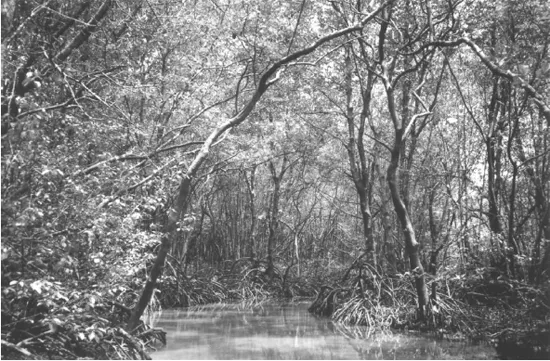
The swamps of the Rung Sat Special Zone; photo taken in 2004. Courtesy of Mike Mavar.
Cpl. Keith Vollendorf from Wisconsin had served in Charlie 1/5 for over two years when the battalion arrived aboard ship off the coast of Vietnam. Keith had made squad leader (a billet that normally carries the rank of sergeant, E-5) a few months before, while afloat. Although Keith served in a different platoon from the one Buck Darling commanded, they knew each other well, because they had both been in Charlie Company for over a year.
Buck Darling loved his job as a leader of Marines in combat, and he took every aspect of it very seriously. Known as a ferocious fighter, Buck believed in thorough planning and determined execution. Keith Vollendorf proved also to be a natural-born leader who men would listen to and follow without argument or discussion under extreme conditions.
Keith wrote home regularly, sending several detailed letters to his family about his adventures, his fears, his plans, and his dreams. These letters home provide an excellent snapshot of the life of a US Marine in combat during this period of the Vietnam War. One of his earliest letters home contained a brief but thorough diary of events during Operation Jackstay:
March 24, 1966,Dear Family, It’s about time I get busy and write a letter. This will be the last letter for approximately 3 weeks. Our operation starts on Saturday, March 26th. The name of the operation is jackstay. Don’t know if it will be in the papers or not, but imagine it will. We’ve got about 3 reporters aboard the ship right now.My Platoon will be the first one to land in Vietnam. So, I’ll be in the 1st wave of choppers to land. We don’t expect too much resistance when we land, but then we’re not sure. We’re going to set up ambushes and then Bravo Company is going to push the Viet Cong towards us. It’s going to be like a deer hunt; we’ll watch them being pushed right into our positions. I just wish it was as easy as that.This operation is taking place about 40 miles south of Saigon, on a peninsula just east of the Saigon River. The only extra gear we’re taking along for ourselves, besides what we have on, is 3 pairs of socks and a toothbrush. So we’re going to be some dirty and cruddy people in 3 weeks.Just came back from chow. Tastes just as bad as it always does. Just got myself a haircut. Heard that tomorrow night they are having some sort of a celebration for us. Don’t know what it will be though, probably a bunch of food and stuff. Right now we’re sitting about 200 yards off the coast, but I don’t know exactly where it’s at.If anything should happen to me, they will send you a telegram. I’ll write as soon as I get back and let you know I’m okay. Just don’t worry yourself about me, I’ll be okay. We’ve got the best hospital ship in the world with us and our medical facilities are real good, so no sweat there.6 April 1966Dear Family, Well, here I am and still all in one piece! The operation just got over today. It lasted for about 12 days and they were the most miserable days I’ve ever spent in my life. I suppose you’ve been reading about it and watching it on TV. They told us it was really making the headlines back in the states.Today when we got back aboard the ship, General Westmoreland came and talked to us all and congratulated us. We really screwed up the VC. My company is the one that found the hospital. It was really neat the way they had it set up in the jungle. We just wrecked the shit out of the whole place. It was a real big [enemy] hospital.Right now I don’t feel much like going into details about the operation ’cause I’m dead tired and just want to sleep. I’ll explain it to you when I feel a little better. One man in my squad was killed the first night we went out. He was only about 20 yards from me and he got shot through the neck. We kept him alive for about 45 minutes but he died before the chopper could get there. I didn’t lose any more people after that. Anyway, it’s all over for a while and I’m damned happy to be here. Sure hope I don’t have to go through that for quite a long time. Right now we’re heading for Subic Bay and 2 weeks of R & R. So when I get there I’m going to do plenty of party timing!!8 April 1966Dear Family, Today we went to Chu Lai and dropped off a helicopter squadron and are now en route to Subic Bay. Here’s a little breakdown about Operation jackstay.1st day—We got up at 0300 and drew our ammo. My squad had about 3,000 rounds and we each had 2 grenades, plus rifle grenades, smoke grenades, and I had a radio. We also had armored vests, helmets and packs. They really had us loaded down. 0600 rolled around and they called my team up on the flight deck and we got into a chopper. Everybody was scared. We were ready to go and it started to rain so they held it off for a while. By then everyone was getting a little jumpy. It cleared up in about 10 minutes and we were on our way. It took us about 15 minutes to get to the LZ (Landing Zone). We came in and I was the first one out. I ran across the opening and into some bushes. Nobody was firing at us so we set up around the LZ and waited. About 2 hours later I got the word to take my squad out and set up an ambush on the river. The rest of the company stayed at the LZ. We waded through mud that was waist deep and everybody was dead tired. We made it to the river and I set my men in. Everything went good for the rest of the afternoon, but then something bad happened—night came! It was just about everybody’s first time in combat and we were all jumpy. Then the firing started—all I could hear was bullets whizzing over my head. It would stop for a while, then start all over again. Most of the fire we were receiving was from our own men back at the LZ. We weren’t too far away. At 8:30, Hill was shot, so I called in on the radio to have a chopper get out there real fast. The choppers were out on the ship and they couldn’t make it in time. Pfc. Richard K. Hill of Seaford, Delaware, was dead. I didn’t tell the rest of the men that he had been shot. A few of them knew it. Then at 0300 all hell broke loose again ’cause they thought they saw something on the river. All I did was pray that daylight would come. It finally came at 0700. I swear to God it’s the longest night I’ve ever spent in my life and ever will be. We made a litter and carried Hill’s body back to the LZ. Sweeney said I looked like a ghost when I came in.2nd day—Then they told me that two more men had been killed, Lance Corporal Anthony G. Velardo, from Wakefield, Massachusetts, and Lance Corporal David Colvin, from Indianapolis, Indiana, had been killed at the LZ. There were 4 men on a machine gun and one rolled over in his sleep and hit a land mine. It blew him in half and tore the hell out of the guy beside him. He got it in the back and in the head. He died aboard the ship that night. Another one got hit in the knee. The 4th one was lucky; all he got was a hole in the eardrum. He’s in the Saigon hospital. He is a real good friend of mine. We crapped out for the rest of the day. Then they flew in choppers and we were lifted out to Red Beach. It had already been secured. We then caught boats to an LST (a type of ship). We stayed there that night. They finally got wise and we left our packs, helmets, armored vests and anything else we didn’t need aboard the LST. We were going to travel real light.3rd day—We boarded boats and headed for Blue Beach—we had to take this one. An NBC reporter was on my boat, a reporter with a camera, taking pictures. We hit the beach but received no fire. We ran into about 40 booby traps and we had to disarm them. Progress was real slow and the mud was waist deep. We moved inland for about a mile and stayed for the night. Still no contact with the VC.4th day—We moved out again and headed for a big river where we were supposed to pick up boats. We walked all day long and finally came to a VC hut. All we did was blow it up. We finally came to the river. We were then informed that we would not be picked up until the next day. So we went out on an ambush patrol and 30 minutes later all hell broke loose. We got 4 VC in a sampan. The VC didn’t even know what hit them. One was a doctor ’cause we got all his surgical equipment. We hung the body on a pole like a deer and brought him to our camp to show everybody our first VC. A chopper came in and dropped us 11 cans of beer for about 300 men (one of the goo...
Table of contents
- Cover
- Copyright
- Contents
- Illustrations
- Map
- About the Maps
- Foreword
- Preface
- Acknowledgments
- Prologue
- 1: The Early Days and Operation Jackstay, December 1965–Early 1966
- 2: Sparrow Hawk and Operation Colorado, June–December 1966
- 3: Changes of Command, November 1966–March 1967
- 4: Changes of Weaponry, April 1967
- 5: Operation Union I, 21 April–9 May 1967
- 6: The Battle for Hill 110, 10 May 1967
- 7: Dying Delta and the Move to Hill 51, 11–17 May 1967
- 8: Operation Union II, 26 May–5 June 1967
- 9: Operation Swift, 4–15 September 1967
- 10: Hoi An Days, 1 October–25 December 1967
- 11: Incoming! Phu Loc 6 Combat Base, December 1967–March 1968
- 12: Lang Co Village and the Phantom Mortar Crew, 16 January–10 February 1968
- Afterword
- Appendices
- Notes
- Index
- About the Author
- Back Cover
Trusted by 375,005 students
Access to over 1.5 million titles for a fair monthly price.
Study more efficiently using our study tools.
Frequently asked questions
Yes, you can cancel anytime from the Subscription tab in your account settings on the Perlego website. Your subscription will stay active until the end of your current billing period. Learn how to cancel your subscription
No, books cannot be downloaded as external files, such as PDFs, for use outside of Perlego. However, you can download books within the Perlego app for offline reading on mobile or tablet. Learn how to download books offline
Perlego offers two plans: Essential and Complete
- Essential is ideal for learners and professionals who enjoy exploring a wide range of subjects. Access the Essential Library with 800,000+ trusted titles and best-sellers across business, personal growth, and the humanities. Includes unlimited reading time and Standard Read Aloud voice.
- Complete: Perfect for advanced learners and researchers needing full, unrestricted access. Unlock 1.5M+ books across hundreds of subjects, including academic and specialized titles. The Complete Plan also includes advanced features like Premium Read Aloud and Research Assistant.
We are an online textbook subscription service, where you can get access to an entire online library for less than the price of a single book per month. With over 1.5 million books across 990+ topics, we’ve got you covered! Learn about our mission
Look out for the read-aloud symbol on your next book to see if you can listen to it. The read-aloud tool reads text aloud for you, highlighting the text as it is being read. You can pause it, speed it up and slow it down. Learn more about Read Aloud
Yes! You can use the Perlego app on both iOS and Android devices to read anytime, anywhere — even offline. Perfect for commutes or when you’re on the go.
Please note we cannot support devices running on iOS 13 and Android 7 or earlier. Learn more about using the app
Please note we cannot support devices running on iOS 13 and Android 7 or earlier. Learn more about using the app
Yes, you can access Charlie One Five by Nicholas Warr in PDF and/or ePUB format, as well as other popular books in History & Military Biographies. We have over 1.5 million books available in our catalogue for you to explore.