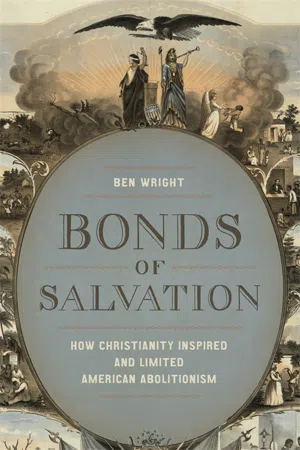
Ben Wright's Bonds of Salvation demonstrates how religion structured the possibilities and limitations of American abolitionism during the early years of the republic. From the American Revolution through the eruption of schisms in the three largest Protestant denominations in the 1840s, this comprehensive work lays bare the social and religious divides that culminated in secession and civil war. Historians often emphasize status anxieties, market changes, biracial cooperation, and political maneuvering as primary forces in the evolution of slavery in the United States. Wright instead foregrounds the pivotal role religion played in shaping the ideological contours of the early abolitionist movement. Wright first examines the ideological distinctions between religious conversion and purification in the aftermath of the Revolution, when a small number of white Christians contended that the nation must purify itself from slavery before it could fulfill its religious destiny. Most white Christians disagreed, focusing on visions of spiritual salvation over the practical goal of emancipation. To expand salvation to all, they created new denominations equipped to carry the gospel across the American continent and eventually all over the globe. These denominations established numerous reform organizations, collectively known as the "benevolent empire, " to reckon with the problem of slavery. One affiliated group, the American Colonization Society (ACS), worked to end slavery and secure white supremacy by promising salvation for Africa and redemption for the United States. Yet the ACS and its efforts drew strong objections. Proslavery prophets transformed expectations of expanded salvation into a formidable antiabolitionist weapon, framing the ACS's proponents as enemies of national unity. Abolitionist assertions that enslavers could not serve as agents of salvation sapped the most potent force in American nationalism—Christianity—and led to schisms within the Presbyterian, Baptist, and Methodist churches. These divides exacerbated sectional hostilities and sent the nation farther down the path to secession and war. Wright's provocative analysis reveals that visions of salvation both created and almost destroyed the American nation.
eBook - ePub
Bonds of Salvation
How Christianity Inspired and Limited American Abolitionism
- 280 pages
- English
- ePUB (mobile friendly)
- Available on iOS & Android
eBook - ePub
About this book
Information
Subtopic
North American HistoryIndex
Social Sciences1
Conversionist and Purificationist Antislavery, 1776–1800
VIRGINIA BAPTISTS SOUGHT TO purify their state of slavery in 1789. John Leland, a locally respected minister who claimed to have baptized seven hundred souls and preached three thousand sermons, took up the charge of his nascent denomination to denounce slaving and call for emancipation.1 The ministries of Leland and many of his fellow Baptists challenged racial hierarchies in Virginia, by seeking to promote salvation among both white and Black, free and enslaved. Of the seven hundred baptisms Leland performed, many involved enslaved men and women. From his experience spreading the gospel in Virginia, Leland believed that “the whole scene of slavery is pregnant with enormous evils,” and he emphatically prayed that “would to heaven” the new government “liberate them at once.”2 Unlike Joshua Marsden, however, he was willing, at least for now, to turn his ideas into actual abolitionist action.
Through Leland’s pen, Virginia Baptists lambasted slavery as “a violent deprivation of the rights of nature.” For these southern Christians, the spirit of the American Revolution, fought under the authority of the rights of man and the will of God, left slavery “inconsistent with a republican government.” God’s plan for universal salvation was underway, and the American state was part of that plan. Yet to fulfill its destiny, the nation had to purify itself of the sins of the British. Due in part to Leland’s own activism, the United States was already overcoming the sin of established religion. Slavery was the next abomination to conquer. Leland and his Baptist allies called on all Virginians “to make use of every legal measure to extirpate this horrid evil from the land,” particularly “our honorable legislature,” who “may have it in their power to proclaim the great Jubilee.”3
Virginia did not proclaim a jubilee, great or otherwise, but partly owing to the success of evangelical revivals and revolutionary rhetoric, manumissions increased in the aftermath of the Revolution. Slavery, however, endured and gained new life when the rise of cotton exploded the demand for enslaved labor. Black Virginians sought their own emancipation, but after a failed attempt at rebellion, Virginia abolished abolition rather than slavery. By 1806, it became impossible for enslavers in Virginia to repent and free their enslaved laborers unless they could send them out of the state. Rather than restoring liberty to its captives, the Old Dominion instead enriched itself, shattering families by selling human chattel into the cotton kingdom’s engine of death.
The abolitionist southern evangelical moment soon passed as well. Leland left Virginia two years after penning the Baptist antislavery petition. For the remainder of his life, he reverted to the same conversionism of Joshua Marsden and in fact went even further, devoting more energy and ink combating what he saw as the sin of abolitionism rather than maintaining his witness against the sin of slaving. The purificationist attempt to purge the new nation of slavery had failed, but ideologies of conversionism enabled antislavery Christians like John Leland to remain confident that slavery would eventually dissolve through a divinely ordained expansion of salvation.
Prioritizing salvation meant shunning Black Christians who refused to wait on God. The majority of white antislavery Christians largely ignored the Black activists who consistently campaigned against slavery. Throughout both his purificationist and his conversionist phases, Leland was more concerned with the purity of white Christian souls than with the very real suffering of Black Americans. In fact, when addressing enslaved men and women in 1791, he discouraged them from taking any action to undermine the institution that was destroying their families, telling Black Baptists that there was nothing they could do “to move God to send you deliverance so effectually as to obey those who have the rule over you.”4
Salvation for Leland, and for the vast majority of late eighteenth-century white Americans, had to begin with the soul and not with the exploited bodies of the enslaved. Bodily liberation would ensue, but damned souls required spiritual salvation first. Anything, especially Black activism, that distracted from the orderly conversion of the nation threatened the safety and salvation of all. By prioritizing the salvation of the soul over the liberation of the body, antislavery evangelicals like John Leland entrenched white supremacy and sowed the seeds for what would later blossom into both the abolitionist and proslavery movements.
To understand Leland and his fellow white Christians, we must begin to uncover an intellectual world very different than our own. In the late eighteenth century, theological understandings of causation redirected early Americans away from the coercive action required to destroy slavery. Yet Americans, including those opposed to slavery, remained optimistic. After the defeat of Great Britain, nothing seemed impossible. Surely God was behind this miraculous event. Through the expansion of salvation in the newly independent United States, God would redeem the world.
Historian David Brion Davis begins his foundational study of Revolutionary-era abolitionism by considering “what the abolitionists were up against.”5 Davis chronicles the centuries of Western thought and legal precedent, as well as the powerful, entrenched economic interests defending slavery in the Atlantic World. But a close look at eighteenth-century ideologies of progress, rooted in both the Enlightenment and nascent evangelicalism, adds another obstacle to abolition.
Abolitionists in the 1780s and 1790s confronted a widely shared cosmology of progress that hindered the recognition of Black suffering and discouraged the actions required to eliminate American slavery. Intellectual currents privileging either head or spirit led to the same optimistic expectation that the world would inevitably improve without resorting to coercive purification. In the minds of most white Christians of all political persuasions, nothing would do more to improve the nation and the world than expanding opportunities for salvation. However, some Americans refused to rest in the confidence of inevitable improvement and instead labored to purify their communities of slavery. Conversionism and purificationism sometimes overlapped, but when it came time for direct action against the problem of slavery, Americans usually selected one or the other, and by 1800, conversionism dominated religious responses to the powerful American system of slavery.
As purificationists and conversionists offered their own spiritual solutions to the problem of slaving, the brutality and suffering of the peculiar institution only grew. Black activists did not sit passively amid this oppression, but white Americans trained their eyes to the heavens, drowning out their Black coreligionists with an imagined angelic chorus of global redemption. Understanding the development, limitations, and consequences of conversionism and purificationism exposes how Christianity inspired and limited American abolitionism.
This chapter begins by unfolding the expectation of progress that suffused the intellectual world of the late eighteenth century. These expectations of progress enabled white Christians to ignore the activism of their Black coreligionists and instead focus their efforts on expanding salvation. The chapter then considers three case studies that merged purificationism with confrontational abolitionist action, offering both an emancipatory moment in the late eighteenth century and presaging the radicalism of later antebellum abolitionists: the Quakers in the 1750s and beyond, Samuel Hopkins in the 1770s, and southern evangelicals in the 1780s. The third case study merges the worldviews of purificationism and conversionism, for in the aborted abolitionism of southern evangelicals like John Leland, we see how by the first decade of the nineteenth century, conversionism conquered purificationism and in turn muted the antislavery witness among these former radicals.
Americans, evangelical and otherwise, venerated the sovereignty of conscience and looked with suspicion on all methods of coercion. This veneration drew on wider intellectual currents to create understandings of causation that discouraged the kinds of coercive reform required to root out the institution of slavery. And so, in the early nineteenth century, American Christians busied themselves with launching campaigns of conversion to bring salvation to all corners of the new nation. These endeavors required the construction of new denominational structures, which in turn fostered new understandings of causation and new opportunities for reform that together eventually enabled a new white abolitionist movement to recognize the activism of Black Christians and together confront slavery in more effective ways. But all of this began with a preoccupation with conversions and the anticipated revolutions they were sure to bring.
Inevitable, Imminent Progress
American slavery could only be eradicated through coercion applied by the force of law. Slavery depended on the state, and so too would abolition. Indeed, there was not a single instance of slavery’s disappearance in the modern world without the intervention of the state.6 Moral suasion was only useful in that it generated support for political action. This principle proved true in both the gradual emancipation laws of the 1780s and 1790s and the so-called age of emancipations in the nineteenth century.
This realization was not so obvious, however. Slavery appeared to be in retreat. The chaos of the Revolutionary War brought liberty to tens of thousands of men and women who emancipated themselves.7 Virginia passed legislation easing manumissions in 1782. For reasons of religious awakening and revolutionary political conviction, the peaceful granting of freedom to formerly enslaved persons began to rise in this largest and most wealthy slave state.8 Dropping tobacco yields appeared to foretell a decline in demand for enslaved laborers.9 Gradual abolition laws beginning in 1780 and culminating in 1804 marked the beginning of the end of slavery in the North.10 More importantly, intellectual trends of the time placed considerable faith in the citizenry to commit itself to the cause of justice without the use of governmental power. God was working in the world, and the church had a role to play in extending the gospel.
Early antislavery existed in a world filled with both anxiety and hope. Many Americans believed that the conversion and enlightenment of hearts and minds would soon reform the world. The overturning of time-honored authorities and the dangers of revolutions alarmed Americans, yet many of these same processes promised a new era of salvation. Disestablishment and the achievement of religious liberty radicalized evangelicals during the Revolution, but the defense of religious liberty also created discourses that discouraged aggressive, political reform. Anxieties only increased with the violent terror of the French Revolution and the radicalism of the Haitian Revolution.
As Americans moved further from their own revolutionary moment, white Christians grew increasingly suspicious of political upheaval. More importantly, in the late eighteenth century, evangelicals, particularly Baptists, believed that simply securing religious liberty would unshackle American souls. Without the corrupting influence of false religion, the inevitable progress of salvation and virtue would transform the world. This confidence in progress undergirded conversionism, and evangelicals were not alone in their confidence. The expectation of inevitable progress formed the seedbed that allowed revivalism to sprout into conversionism. Put another way, evangelical revivals tapped into Enlightenment expectations of progress in order to create confidence that conversions would continue and soon remake the world. In this way, conversionism stemmed both from evangelical assurances and the Enlightenment philosophy echoing throughout the American Revolution and its aftermath.
Moral optimism suffused intellectual currents in the eighteenth-century Anglo-Atlantic World. The decline of Hobbesian pessimism in the first half of the century was followed by increased interest in the work of Scottish moral philosophers such as Henry Homes (Lord Kames), Francis Hutcheson, and Adam Smith. These thinkers fueled confidence in the progressive triumph of virtue. Francis Hutcheson built on Anthony Ashley Cooper’s (Lord Shaftesbury) Inquiry into the Original of Our Ideas of Beauty and Virtue to argue for an independent, innate “moral sense” in all of humanity.11
These assurances provided powerful balms for Christians in colonial North America who anguished over the state of their souls and their safety in an age of revolutions. This anxiety transcended theological boundaries and extended both to Calvinists, convinced of their total depravity and the irresistibility of grace, and to Methodists, who strove for spirit-led sanctification and perfection. Denominational identities created rivalries and anxieties between Christians, but nearly all Americans remained convinced that the spread of their religious tradition would offer the surest and most effective means of social improvement.12 For white Christians, governmental action could never compete with the redemptive power of the cross.
Conversion was a rigorous process but regardless of the sincerity of one’s conversion experience, the true evidence of salvation manifested in righteous living. Moral philosophy, then, became a way of understanding and evaluating the evidence of conversion. Christian piety encouraged a constant, rigorous level of introspection. Diaries from the eighteenth century are riddled with intense, anguished self-evaluation.13 Moral philosophy sought to externalize this process with rational laws about human behavior. Deference to the authority of tradition declined. The world was being made anew, and American Christians needed evidence of their salvation and assurance that God was advancing his cause in the new nation. The optimism of Scottish common sense moral philosophy offered both.14
By reading moral philosophy, accepting academic instruction, or simply attending church services, Americans absorbed ideological expectations of progressive social improvement. Americans celebrated Scottish common sense philosophy mostly because it served their religious purposes. In the dedication to his Inquiry into the Human Mind on the Principles of Common Sense, Thomas Reid attacked David Hume’s Treatise of Human Nature by labeling it “a system of scepticism which leaves no ground to believe any one thing rather than its contrary.”15 American Christians needed to believe things, and they needed to believe that those things were true. Hume’s work called everything into question, but Reid’s brought clarity and, more importantly, assurance.
Reid’s work reached the United States primarily through his student Dugald Stewart’s Elements of the Philosophy of the Human Mind. This work formed a key component of American education, particularly in the curriculum of influential Presbyterian educator John Witherspoon. Both as an individual teacher and as president of Princeton from 1768 to 1794, Witherspoon did more than anyone else to spread Scottish moral philosophy in the United States. His students then carried the same curriculum to Presbyterian schools across the nation, both North and South. From Reid through Stewart and Witherspoon, Americans gained intellectual confidence in the reasonableness of their faith and the expected progress of virtue.16
Few Americans had heard of, much less read, these thinkers. However, historian Sarah Knott has convincingly argued that the development of sensibility was an active process of identity creation, particularly for middling Americans, and through this process Enlightenment ideals suffused several strata of society. Knott also demonstrates how women likewise consumed and perpetuated expectations of progress, particularly through accessible works designed for both sexes.17
Whether through an expansion of the Enlightenment or through the fires of revival, Americans remained optimistic that the world was on the cusp of rapturous change. The kinds of coercive agitation required to destroy slavery threatened to divide white Christians and interrupt these inevitable, liberatory processes with distracting division. The fear of these divisions led many white Christians to willfully ignore the Black activists that constructed abolitionist movements. Other white Christians sympathetic to the Black freedom struggle simply could not risk sidetracking their missions of salvation.
The very same intellectual currents that challenged the morality of slavery also contained optimistic expectations of progress that discouraged the kind of agitation required to end the institution in the United States. Confidence in progress coexisted with pessimism about the dangers and challenges of the human condition. Scottish moral philosophy maintained its grip on Americans for a century after its apex in the mid-eighteenth century.18 This body of thought merged head and heart, reason and piety, and it did so by reinforcing confidence in the progressive triumph of virtue, enlightenment, and salvation. Faith in the future coexisted with beliefs in human depravity. Enlightenment notions of progress meshed well with evangelical confidence in the spread of salvation. God was at work in America, and his work would save souls and remake the world in his image.
Optimism accelerated during the American Revoluti...
Table of contents
- Cover
- Title Page
- Copyright Page
- Contents
- Acknowledgments
- Introduction: Salvation and Slavery
- 1 Conversionist and Purificationist Antislavery, 1776–1800
- 2 National Churches and National Reform, 1800–1815
- 3 Saving Africa and Redeeming the United States, 1815–1825
- 4 Missionary Dreams and Anti-Colonization Movements, 1825–1830
- 5 Shattering the Conversionist Consensus, 1830–1837
- 6 Slavery and Schism, 1837–1845
- Conclusion: Secession and Salvation
- Notes
- Index
Trusted by 375,005 students
Access to over 1.5 million titles for a fair monthly price.
Study more efficiently using our study tools.
Frequently asked questions
Yes, you can cancel anytime from the Subscription tab in your account settings on the Perlego website. Your subscription will stay active until the end of your current billing period. Learn how to cancel your subscription
No, books cannot be downloaded as external files, such as PDFs, for use outside of Perlego. However, you can download books within the Perlego app for offline reading on mobile or tablet. Learn how to download books offline
Perlego offers two plans: Essential and Complete
- Essential is ideal for learners and professionals who enjoy exploring a wide range of subjects. Access the Essential Library with 800,000+ trusted titles and best-sellers across business, personal growth, and the humanities. Includes unlimited reading time and Standard Read Aloud voice.
- Complete: Perfect for advanced learners and researchers needing full, unrestricted access. Unlock 1.5M+ books across hundreds of subjects, including academic and specialized titles. The Complete Plan also includes advanced features like Premium Read Aloud and Research Assistant.
We are an online textbook subscription service, where you can get access to an entire online library for less than the price of a single book per month. With over 1.5 million books across 990+ topics, we’ve got you covered! Learn about our mission
Look out for the read-aloud symbol on your next book to see if you can listen to it. The read-aloud tool reads text aloud for you, highlighting the text as it is being read. You can pause it, speed it up and slow it down. Learn more about Read Aloud
Yes! You can use the Perlego app on both iOS and Android devices to read anytime, anywhere — even offline. Perfect for commutes or when you’re on the go.
Please note we cannot support devices running on iOS 13 and Android 7 or earlier. Learn more about using the app
Please note we cannot support devices running on iOS 13 and Android 7 or earlier. Learn more about using the app
Yes, you can access Bonds of Salvation by Ben Wright in PDF and/or ePUB format, as well as other popular books in Social Sciences & North American History. We have over 1.5 million books available in our catalogue for you to explore.