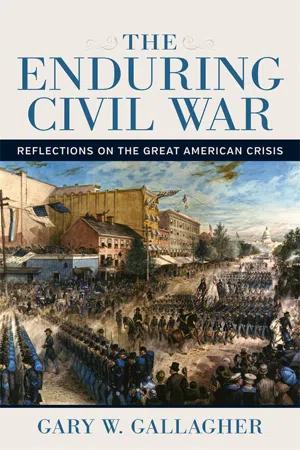
In the seventy-three succinct essays gathered in The Enduring Civil War, celebrated historian Gary W. Gallagher highlights the complexity and richness of the war, from its origins to its memory, as topics for study, contemplation, and dispute. He places contemporary understanding of the Civil War, both academic and general, in conversation with testimony from those in the Union and the Confederacy who experienced and described it, investigating how mid-nineteenth-century perceptions align with, or deviate from, current ideas regarding the origins, conduct, and aftermath of the war. The tension between history and memory forms a theme throughout the essays, underscoring how later perceptions about the war often took precedence over historical reality in the minds of many Americans.
The array of topics Gallagher addresses is striking. He examines notable books and authors, both Union and Confederate, military and civilian, famous and lesser known. He discusses historians who, though their names have receded with time, produced works that remain pertinent in terms of analysis or information. He comments on conventional interpretations of events and personalities, challenging, among other things, commonly held notions about Gettysburg and Vicksburg as decisive turning points, Ulysses S. Grant as a general who profligately wasted Union manpower, the Gettysburg Address as a watershed that turned the war from a fight for Union into one for Union and emancipation, and Robert E. Lee as an old-fashioned general ill-suited to waging a modern mid-nineteenth-century war. Gallagher interrogates recent scholarly trends on the evolving nature of Civil War studies, addressing crucial questions about chronology, history, memory, and the new revisionist literature. The format of this provocative and timely collection lends itself to sampling, and readers might start in any of the subject groupings and go where their interests take them.
- 288 pages
- English
- ePUB (mobile friendly)
- Available on iOS & Android
eBook - ePub
About this book
Information
Subtopic
American Civil War HistoryIndex
HistoryI
FRAMING THE WAR
Americans have understood the Civil War, its antecedents, and its aftermath in many ways. This speaks to the interpretive richness of the era, as well as to how each generation’s political and cultural concerns can spill over into historical investigation. For example, publications, commemorative programs, and media coverage during the sesquicentennial era of 2011 to 2015 reflected the preoccupation with race in contemporary American society and the impact of U.S. military involvement in the Middle East over the past quarter century.
This section explores some of the ways historians and the public have framed the four years of large-scale military conflict between the United States and the Confederacy. The first three essays deal with chronological boundaries, identifying comparative dimensions of the Civil War and the American Revolution as well as probing the relationship between history and memory. Two essays deal with the West and Indians, the second of the pair a much-expanded version of a piece titled “A Conflict Apart” that inspired spirited reactions from readers of Civil War Times. The next five essays take up topics that have received considerable recent attention from scholars—guerrilla operations, the dark side of the Civil War (including desertion), the degree to which the loyal citizenry exhibited militarism at war’s end, and how best to interpret Lincoln’s Gettysburg Address. The section closes with a look at the environmental impact of military campaigning.
LINKING AMERICA’S TWO MOST IMPORTANT WARS
The American Revolution and the Civil War rank as our most important and destructive conflicts. Unequaled in terms of impact on the populations that experienced them, they also wielded unmatched influence on our history by establishing a fragile new republic and then subjecting it to a profoundly disruptive test of national resilience. Myriad ideological and historical ties connected the two wars, and as a pair they offer significant potential for scholarship. Yet only a few historians have pursued what seem to be obvious comparative frameworks—perhaps because each of the wars, immense in size and importance, yields apparently limitless topics.
Both sides during the Civil War looked to the founding generation and the Revolution. Confederates often compared themselves to colonists who claimed the right of self-determination, while the loyal population of the United States insisted they sought to safeguard what the founders bequeathed to ordinary citizens regarding self-governance and the opportunity to rise economically. Politicians and diplomats, whether in Washington or in Richmond, accepted the French alliance of 1778 as proof that Europe might tip the balance of power during the Civil War.
The example of sacrifice during the Revolution proved irresistible to leaders hoping to galvanize support for the respective war efforts in 1861 to 1865. During the hard winter of 1863 to 1864, for example, R. E. Lee evoked the suffering of George Washington’s Continentals. The history of the Army of Northern Virginia, he told his veterans, “has shown that the country can require no sacrifice too great for its patriotic devotion.” Then he compared their travails to those of an earlier generation: “Soldiers! You tread with no unequal step the road by which your fathers marched through suffering, privations, and blood, to independence.” If those in the Confederate army continued to emulate the Revolutionary soldiery’s disinterested service, prophesied Lee, “be assured that the just God who crowned their efforts with success will, in His own good time, send down His blessing upon yours.”1
Robert Gould Shaw, then a member of the Seventh New York State Militia, also referred to the Revolutionary War in a letter to his mother on April 18, 1861. “The Massachusetts men passed through N. York this morning. . . .” he wrote from Staten Island just before leaving for Washington. “Won’t it be grand to meet the men from all the States, East and West, down there, ready to fight for the country, as the old fellows did in the Revolution?”2
Perhaps most famously, Abraham Lincoln turned to what he considered the most sacred document in American history in his brief remarks at Gettysburg on November 19, 1863. “Four score and seven years ago our fathers brought forth on this continent, a new nation,” declared Lincoln, in reference to the Declaration of Independence, “conceived in Liberty, and dedicated to the proposition that all men are created equal.” Only by following through on the “unfinished work” of the soldiers who “gave the last full measure of devotion” at Gettysburg could loyal citizens sustain the vision, and give full meaning to the toll in military dead and wounded, of revolutionary political leaders and soldiers who had created a unique democratic republic.3
Many aspects of the two wars deserve comparative examination—none more so than the story of Loyalists who retained their allegiance to Great Britain in the Revolution and of Unionists in the Confederacy. Loyalists aided the war against the American rebels in many ways. Variously estimated at between a fifth and a third of the colonial population, they held political positions, contributed money, served in all military theaters, and composed the bulk of British forces on some battlefields. The notorious Lieutenant Colonel Banastre Tarleton’s British Legion, which operated most famously in the southern campaigns, was a Loyalist unit. Because Britain relied heavily on Loyalists in the South between 1778 and 1783, fighting in the Carolinas and Georgia took on the character of a vicious civil war.
Southern Unionists similarly supported United States military efforts in the Confederacy. A small but significant minority of the overall Confederate population, more prevalent in the upper tier of states than in the Deep South, their numbers cannot be established with precision. They formed guerrilla bands in mountainous regions, supplied intelligence to Union armies, and assisted prisoners of war who escaped from Rebel captivity. At least one hundred thousand joined regiments recruited from the white Unionist populace (some of these troops were executed, along with black soldiers, by Nathan Bedford Forrest’s forces at Fort Pillow on April 12, 1864). Elizabeth Van Lew of Richmond, the most famous woman among Unionists in the Confederacy, rendered undeniably valuable service to the United States. The landmark success for Unionists came in Virginia, where they engineered creation of the new loyal state of West Virginia in 1863.
The British government and the Lincoln administration tended to overestimate numbers of Loyalists and Unionists. The British most obviously expected too much from southern Loyalists in the last several years of the war. As for Lincoln, he initially believed that a mass of Unionists would step forward to oppose secession; in fact, Unionists in the Confederacy never provided a decisive edge to the United States on any battlefield and, though a source of considerable friction that aggravated political and military leaders, failed to compromise the Confederate war effort in a serious way. The major difference between Loyalists and Unionists lies in their postwar situations: the former supported a failed cause, lost much of their property, and emigrated in large numbers; the latter stood with the winners and often participated in the Reconstruction state governments.
An examination of Loyalists and southern Unionists would make a good start toward expanding the comparative literature on the Revolution and the Civil War. An exploration of how British and Union armies weakened the institution of slavery in the southern colonies and the Confederacy would be equally illuminating, as would a consideration of the importance of national armies in countering state and local sentiment among citizen-soldiers. With luck, scholars already may be hard at work on these and other topics.4
ANTEBELLUM
No person in the United States from the 1830s through the 1850s thought in terms of an “antebellum” era. Latin for “before the war,” the word came into use only after the Civil War ended and participants, and then historians and other writers, sought to label the decades preceding the outbreak of fighting at Fort Sumter. A commonplace in the historical literature for many generations, it summons thoughts of a young republic lurching toward political collapse. Deployment of “antebellum” can create an impression of inevitability, of citizens increasingly obsessed with sectional differences, and of time ticking inexorably toward bloodshed on a massive scale. Indeed, the word can drain all meaning, except as prelude to four years of war, from a thirty-year swath of national events and trends.
We should be wary of such retrospective historical framing. As always with the past, America’s prewar decades present an immensely complicated story rather than one pointing clearly toward secession and military conflict. An observer seeking interpretive themes between 1830 and 1860 could craft a narrative largely devoid of sectional issues. One theme involved a revolution in communications and transportation that dramatically shrank time and space. The electrical telegraph, first demonstrated by Samuel F. B. Morse in 1844, opened breathtaking possibilities. By 1861, Western Union’s lines connected the Eastern seaboard and California. Railroads expanded exponentially, from slightly fewer than three thousand miles of track in 1840 to more than thirty thousand in 1860. The telegraph and trains allowed information, goods, and passengers to move much faster, increasing the pace of life and commerce in ways that left observers somewhat flabbergasted. A second theme centered on demographics. Population growth maintained a dizzying pace, averaging more than 33 percent per decade between 1830, when Americans numbered just more than 12,800,000, and 1860, when the total approached 31,500,000. Of the latter figure, more than four million were foreign born and approximately 10 percent were Catholic—major increases as percentages of the whole population and due largely to German and Irish immigration.
The observer similarly could focus on headlines dealing with significant events unconnected to sectional disputes. Toward the end of the prewar period, for example, the Panic of 1857 and the Colorado gold rush of 1858 to 1859 garnered massive attention throughout the nation. Part of a wider world economic crisis, the panic hit the North much harder than the South and caused considerable dislocation in the railroad industry, agricultural markets, and the banking sector for more than year. For many caught in its pernicious grasp, the panic far exceeded in importance the Supreme Court’s Dred Scott decision of the same year. The discovery of precious metals in Colorado, which inspired the cry “Pike’s Peak or Bust,” lu...
Table of contents
- Cover
- Title Page
- Copyright Page
- Dedication
- Contents
- Illustrations
- Acknowledgments
- Introduction
- PART I. FRAMING THE WAR
- PART II. GENERALS AND BATTLES
- PART III. CONTROVERSIES
- PART IV. HISTORIANS AND BOOKS
- PART V. TESTIMONY FROM PARTICIPANTS
- PART VI. PLACES AND PUBLIC CULTURE
- Appendix: Roster of Essays
- Notes
- Index
Trusted by 375,005 students
Access to over 1.5 million titles for a fair monthly price.
Study more efficiently using our study tools.
Frequently asked questions
Yes, you can cancel anytime from the Subscription tab in your account settings on the Perlego website. Your subscription will stay active until the end of your current billing period. Learn how to cancel your subscription
No, books cannot be downloaded as external files, such as PDFs, for use outside of Perlego. However, you can download books within the Perlego app for offline reading on mobile or tablet. Learn how to download books offline
Perlego offers two plans: Essential and Complete
- Essential is ideal for learners and professionals who enjoy exploring a wide range of subjects. Access the Essential Library with 800,000+ trusted titles and best-sellers across business, personal growth, and the humanities. Includes unlimited reading time and Standard Read Aloud voice.
- Complete: Perfect for advanced learners and researchers needing full, unrestricted access. Unlock 1.5M+ books across hundreds of subjects, including academic and specialized titles. The Complete Plan also includes advanced features like Premium Read Aloud and Research Assistant.
We are an online textbook subscription service, where you can get access to an entire online library for less than the price of a single book per month. With over 1.5 million books across 990+ topics, we’ve got you covered! Learn about our mission
Look out for the read-aloud symbol on your next book to see if you can listen to it. The read-aloud tool reads text aloud for you, highlighting the text as it is being read. You can pause it, speed it up and slow it down. Learn more about Read Aloud
Yes! You can use the Perlego app on both iOS and Android devices to read anytime, anywhere — even offline. Perfect for commutes or when you’re on the go.
Please note we cannot support devices running on iOS 13 and Android 7 or earlier. Learn more about using the app
Please note we cannot support devices running on iOS 13 and Android 7 or earlier. Learn more about using the app
Yes, you can access The Enduring Civil War by Gary W. Gallagher in PDF and/or ePUB format, as well as other popular books in History & American Civil War History. We have over 1.5 million books available in our catalogue for you to explore.