- 208 pages
- English
- ePUB (mobile friendly)
- Available on iOS & Android
eBook - ePub
About this book
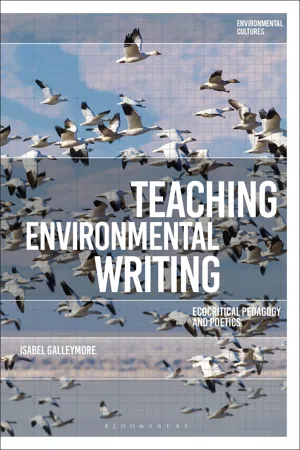
Environmental writing is an increasingly popular literary genre, and a multifaceted genre at that. Recently dominated by works of 'new nature writing', environmental writing includes works of poetry and fiction about the world around us. In the last two decades, universities have begun to offer environmental writing modules and courses with the intention of teaching students skills in the field of writing inspired by the natural world. This book asks how students are being guided into writing about environments. Informed by independently conducted interviews with educators, and a review of existing pedagogical guides, it explores recurring instructions given to students for writing about the environment and compares these pedagogical approaches to the current theory and practice of ecocriticism by scholars such as Ursula Heise and Timothy Morton. Proposing a set of original pedagogical exercises influenced by ecocriticism, the book draws on a number of self-reflexive, environmentally-conscious poets, including Juliana Spahr, Jorie Graham and Les Murray, as creative and stimulating models for teachers and students.
Information
Table of contents
- Cover
- Half-title Page
- Series Page
- Title Page
- Contents
- Acknowledgements
- Introduction
- 1 ‘Where you are’: Place writing
- 2 The ‘I-me-my voice’: The first-person in environmental writing
- 3 ‘I am not a swift’: Approaching non-humans
- 4 Writing ‘more in the world’: Fact and figuration
- 5 ‘On the world’s terms and not my own’:
- Afterword
- Notes
- Bibliography
- Index
- Copyright Page
Trusted by 375,005 students
Access to over 1.5 million titles for a fair monthly price.
Study more efficiently using our study tools.
Frequently asked questions
Yes, you can cancel anytime from the Subscription tab in your account settings on the Perlego website. Your subscription will stay active until the end of your current billing period. Learn how to cancel your subscription
No, books cannot be downloaded as external files, such as PDFs, for use outside of Perlego. However, you can download books within the Perlego app for offline reading on mobile or tablet. Learn how to download books offline
Perlego offers two plans: Essential and Complete
- Essential is ideal for learners and professionals who enjoy exploring a wide range of subjects. Access the Essential Library with 800,000+ trusted titles and best-sellers across business, personal growth, and the humanities. Includes unlimited reading time and Standard Read Aloud voice.
- Complete: Perfect for advanced learners and researchers needing full, unrestricted access. Unlock 1.5M+ books across hundreds of subjects, including academic and specialized titles. The Complete Plan also includes advanced features like Premium Read Aloud and Research Assistant.
We are an online textbook subscription service, where you can get access to an entire online library for less than the price of a single book per month. With over 1.5 million books across 990+ topics, we’ve got you covered! Learn about our mission
Look out for the read-aloud symbol on your next book to see if you can listen to it. The read-aloud tool reads text aloud for you, highlighting the text as it is being read. You can pause it, speed it up and slow it down. Learn more about Read Aloud
Yes! You can use the Perlego app on both iOS and Android devices to read anytime, anywhere — even offline. Perfect for commutes or when you’re on the go.
Please note we cannot support devices running on iOS 13 and Android 7 or earlier. Learn more about using the app
Please note we cannot support devices running on iOS 13 and Android 7 or earlier. Learn more about using the app
Yes, you can access Teaching Environmental Writing by Isabel Galleymore in PDF and/or ePUB format, as well as other popular books in Literature & Creative Writing. We have over 1.5 million books available in our catalogue for you to explore.