The Japanese Cinema Book provides a new and comprehensive survey of one of the world's most fascinating and widely admired filmmaking regions. In terms of its historical coverage, broad thematic approach and the significant international range of its authors, it is the largest and most wide-ranging publication of its kind to date.
Ranging from renowned directors such as Akira Kurosawa to neglected popular genres such as the film musical and encompassing topics such as ecology, spectatorship, home-movies, colonial history and relations with Hollywood and Europe, The Japanese Cinema Book presents a set of new, and often surprising, perspectives on Japanese film.
With its plural range of interdisciplinary perspectives based on the expertise of established and emerging scholars and critics, The Japanese Cinema Book provides a groundbreaking picture of the different ways in which Japanese cinema may be understood as a local, regional, national, transnational and global phenomenon.
The book's innovative structure combines general surveys of a particular historical topic or critical approach with various micro-level case studies. It argues there is no single fixed Japanese cinema, but instead a fluid and varied field of Japanese filmmaking cultures that continue to exist in a dynamic relationship with other cinemas, media and regions.
The Japanese Cinema Book is divided into seven inter-related sections:
· Theories and Approaches
· * Institutions and Industry
· * Film Style
· * Genre
· * Times and Spaces of Representation
· * Social Contexts
· * Flows and Interactions
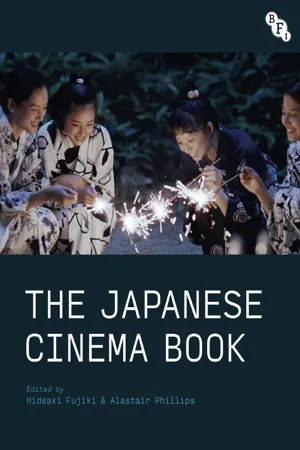
eBook - ePub
The Japanese Cinema Book
- 624 pages
- English
- ePUB (mobile friendly)
- Available on iOS & Android
eBook - ePub
The Japanese Cinema Book
About this book
Information
PART 1
THEORIES AND APPROACHES
1
EARLY CINEMA
Difference, definition and Japanese film studies
Research on the early cinema of Japan has played a core, but often complicated, role in defining Japanese film studies, especially in terms of the nature of its object and its relation to the classical Hollywood mode. If the value of Japanese film, both domestically and abroad, has often been claimed in terms of its difference from other cinemas, the assertion that the first Japanese films were even more different has served as further evidence of that unique value. The extent and the nature of that difference, however, has been a long-standing topic of debate, one that has made research on early film a privileged space for negotiating and complicating the notion of difference in Japanese film studies, particularly as it relates to issues of nation, identity and the position of the scholar. This chapter will review the history of, and major debates within, studies of early Japanese cinema, focusing in particular on how the field has confronted the problem of difference.
THE DIFFERENCE OF EARLY CINEMA
For many years, the difference of early cinema was itself seen as a problem, so defined because the first works did not fit supposedly universal narratives of cinematic or cultural development. Early films in the 1910s that were described as mere long-take recordings of kabuki or shinpa plays,1 lacking cinematic forms of narration and incomprehensible to anyone who did not previously know the play or had a benshi narrator on hand to explain the text, would conceivably be the most ‘different’ and ‘Japanese’, but as such they were not acclaimed by historians. Donald Richie and Joseph Anderson’s groundbreaking history of Japanese film in English, The Japanese Film: Art and Industry, for instance, less celebrated than criticised these films for being ‘simple illustrations for the benshi’.2 Even Japanese authors such as Iijima Tadashi or Satō Tadao provide a tale of cinematic evolution that describes early films as backward and premodern.3 Japanese cinema could be different only after it had moved beyond primitive forms of cinema, evolving to a filmic mode of narration seen as universal – but often defined by classical Hollywood cinema. As Mitsuhiro Yoshimoto has argued, the celebration of difference in the first histories of Japanese cinema were always framed within a universalist discourse of humanism that valorised ‘national character’ as that ‘through which the humanistic ideals of universal significance are said to be represented concretely’.4
As such, many initial histories of Japanese film denigrated early films as theatrical, deviating too much from the core of cinema. They criticised the benshi for hampering the development of cinematic forms by eliminating the incentive for film-makers to find visual means to solve narrative problems. Histories thus focused on the transformations of the late 1910s and early 1920s, loosely termed the Pure Film Movement, which were begun by young reformers such as Kaeriyama Norimasa, Thomas Kurihara and Henry Kotani. Reformers and critics – led, in part, by Kaeriyama – expounded on such transformations in print, arguing that reform was necessary to make Japanese production more cinematic. Beyond arguing for the elimination of such theatrical trappings as the onnagata (men playing women’s roles) and proscenium staging, they called for the use of screenplays to shift the origin of cinematic meaning from the theatre to the studio; or of editing to make the film itself speak, not the benshi. Most subsequent histories of Japanese cinema in effect adopted the critical perspective of the Pure Film Movement towards early film.
Film historiography in Europe and North America shared a similar objection to early cinema in the West until a crucial shift occurred in the late 1970s. Instead of picturing them as a primitive form of film, less important because they were only a preliminary stage in an evolution towards a more cinematic cinema, early films came to be seen as simply a different cinema, one that embodied different sociopolitical or cultural values. The shift towards the classical Hollywood style was then not the result of the inevitable evolution of the medium but rather a deeply historical process, where contingent factors both internal and external to the film world promoted some forms of cinema while suppressing others. Within media archaeology, the historical factors behind these selections become as important as the content of the change in cinematic practice, because they could indicate the cultural or ideological valences of those practices.
In the American and European contexts, this shift in early cinema research fostered explorations of the differences of the first films, from Charles Musser’s research on the role of exhibitors in constructing cinematic meaning to Ben Singer’s re-evaluation of such seemingly obvious terms as melodrama.5 André Gaudreault and Tom Gunning explored the difference of early film narration, with Gaudreault seeing a form of ‘monstration’ (of showing) over narration (of telling), and Gunning famously describing a ‘cinema of attractions’, in which the shocks of tricks and new sights took precedence over narrative.6 These sparked debates, but the results expanded the field of cinema studies into considerations that took on the history of perception (painting, magic, optics), pre-cinematic apparatuses (the magic lantern), theatre (phantasmagoria), geography (entertainment districts, amusement parks), transportation, commerce, capitalism, media, urbanism, gender, race and modernity in general, in order to understand cinema through a larger cultural history. Gunning was not alone in arguing that discovering these different forms was not an antiquarian endeavour, but helped reveal the parallels between the cinema of attractions and later experimental or modernist cinema. One could argue that the rise in early cinema studies was in part prompted by the decline of the classical mode and the need to understand the forms that were appearing as an alternative, from MTV to digital media.
Much of early cinema studies was shaped by politically informed theoretical models, from Marxism to feminism, from Frankfurt School cultural theory to semiotics. Early cinema became attractive in part because it offered an historical alternative to hegemonic forms of culture formed later in the twentieth century. Noël Burch’s Marxist argument was a prominent example, as he saw ‘Primitive Cinema’ as embodying turn-of-the-century urban working-class culture, and the shift to the ‘Institutional Mode of Production’ as the ‘embourgeoisement’ of cinema, where the medium developed new forms of narration in an effort to reflect the values of the capitalist middle class.7 Not all scholars agreed with this approach, but it was an example of how early cinema was being understood in terms of broader concepts of class, economy and power.
Burch helped make Japanese film central to this debate. For a time in the 1970s and 1980s, Japanese cinema was one of the primary fields of interest for North American and European film studies. Major figures in the field, from Stephen Heath to David Bordwell, pursued analyses of Japanese film, in part as a means to further the critique and understanding of the classical Hollywood mode and its alternatives. Burch’s book To the Distant Observer, published in 1979, was a provocative yet problematic work that argued for the difference of Japanese cinema precisely by portraying its early cinema in a positive light. While identifying some stylistic elements shared between the early cinemas of Japan and the West, Burch wrote extensively on the Japanese example because of its unique characteristics: firstly, it lasted significantly longer than in the West, possibly up until World War II; secondly, it remained radically different from the classical mode even after being exposed to it; and thirdly, it was backed by a cultural tradition that accepted forms of signification and textuality on a mass level that in the West would be appreciated only by the avant-garde few. Burch was particularly intrigued by directors such as Ozu Yasujirō and Mizoguchi Kenji whom he saw clearly mastering the classical mode, yet still consciously opting for cinematic forms rooted in early cinema that deviated from Hollywood methods. He could cite a wide variety of stylistic differences, from the lack of close-ups or analytical narrative editing in Mizoguchi, to Ozu’s breaking of the 180-degree rule, to the chaotic discontinuity of Itō Daisuke’s camera movements, and ultimately tie them to attitudes towards the sign that he considered largely unchanged since the Heian era (794–1185).
Burch argued that Japanese cultural production features a unique intertextuality in which all film texts purposively refer to and rely on other texts to be understood, thus foregrounding their textuality. While modern Western texts hid their intertextuality in myths of originality and the individual author, presenting the text as a transparent window onto a world, Japanese culture, Burch claimed, made the intertexts a visible aspect of both signification and reader/viewer pleasure. Japanese cinema was supposedly like kabuki: more presentational than representational, more intertextual than diegetic. The benshi became emblematic to Burch of Japanese cinema’s resistance to the colonisation of Japanese film by Western definitions of the cinematic. He felt the benshi split the fictional source of enunciation by assuming the role of narration; the film, or, more specifically, the illusory world viewed in the text, no longer spoke for itself but rather it was spoken for by an external figure. Not only was the system of representation fragmented, the signs that made up the text ceased to transparently transmit a seemingly pre-existing world. They were now read by the benshi as independently existing signs that must compete with the words the benshi produced. Spectators were unable to enter the world of the diegesis because they remained aware of the film as only a text. Burch contends Japanese prewar filmgoers did not succumb to the fictional effect of the film but instead treated spectatorship as the simultaneous viewing of the spectacle of the text and the reading of the film.8
Burch and the trends he represented were influential, even in the critiques they generated. Such shifts in perspectives on the benshi, in part sustained by revivals of benshi performances in Japan, led even established scholars such as Satō Tadao to write more positive histories of these narrators.9 J.L. Anderson’s work emphasising benshi narration (to him, the katsuben) as a continuation of the tradition of ‘commingled media’ in the Japanese arts, echoed Burch’s arguments in claiming that,
To most audiences, the film was an open text and one element in a complex, multi-media, live entertainment …. Indeed, the presence of the katsuben attacked the ontological status of the film. Was truth in the photographic images or in what the katsuben said?10
Jeffrey Dym’s book on the benshi celebrated their art of ‘explanation’ (setsumei), even if he did not pursue the theoretical implications Burch or Anderson did.11 Other scholars, such as Iwamoto Kenji, echoed some of Burch’s claims about the deviations between prewar Japanese film style – for Iwamoto, the paucity of close-ups – and classical Hollywood cinema.12 One could argue that Burch’s work even helped inspire research on benshi-like figures in other cinemas, such as the bonimenteur in Quebec.13
Burch’s argument, however, met with much criticism, even among those who sided with his efforts to re-evaluate Japanese early cinema. He was influenced by Roland Barthes’s post-structuralist evaluation of Japan, The Empire of Signs,14 so To the Distant Observer might also be seen as a similarly powerful intellectual exercise, imagining at a time when film studies was critiquing the Hollywood mode, a form of cinema that could be both critical of that mode and popular. Burch’s celebration of a cinema based on an unchanging cultural tradition, however, was not only insufficiently Marxist but aligned with Orientalist visions of Japan.15 His formalist analyses of films could often be insightful, but not all agreed with them. Scholars such as David Bordwell, for instance, countered his claims about the formal differences between prewar Japanese fi...
Table of contents
- Cover
- Halftitle Page
- Title Page
- Contents
- List of Illustrations
- Notes on Contributors
- Acknowledgements
- Introduction Japanese cinema and its multiple perspectives Hideaki Fujiki and Alastair Phillips
- PART 1 THEORIES AND APPROACHES
- PART 2 INSTITUTIONS AND INDUSTRY
- PART 3 FILM STYLE
- PART 4 GENRE
- PART 5 TIME AND SPACES OF REPRESENTATION
- PART 6 SOCIAL CONTEXTS
- PART 7 FLOWS AND INTERACTIONS
- Select Bibliography
- Index
- Imprint
Trusted by 375,005 students
Access to over 1.5 million titles for a fair monthly price.
Study more efficiently using our study tools.
Frequently asked questions
Yes, you can cancel anytime from the Subscription tab in your account settings on the Perlego website. Your subscription will stay active until the end of your current billing period. Learn how to cancel your subscription
No, books cannot be downloaded as external files, such as PDFs, for use outside of Perlego. However, you can download books within the Perlego app for offline reading on mobile or tablet. Learn how to download books offline
Perlego offers two plans: Essential and Complete
- Essential is ideal for learners and professionals who enjoy exploring a wide range of subjects. Access the Essential Library with 800,000+ trusted titles and best-sellers across business, personal growth, and the humanities. Includes unlimited reading time and Standard Read Aloud voice.
- Complete: Perfect for advanced learners and researchers needing full, unrestricted access. Unlock 1.5M+ books across hundreds of subjects, including academic and specialized titles. The Complete Plan also includes advanced features like Premium Read Aloud and Research Assistant.
We are an online textbook subscription service, where you can get access to an entire online library for less than the price of a single book per month. With over 1.5 million books across 990+ topics, we’ve got you covered! Learn about our mission
Look out for the read-aloud symbol on your next book to see if you can listen to it. The read-aloud tool reads text aloud for you, highlighting the text as it is being read. You can pause it, speed it up and slow it down. Learn more about Read Aloud
Yes! You can use the Perlego app on both iOS and Android devices to read anytime, anywhere — even offline. Perfect for commutes or when you’re on the go.
Please note we cannot support devices running on iOS 13 and Android 7 or earlier. Learn more about using the app
Please note we cannot support devices running on iOS 13 and Android 7 or earlier. Learn more about using the app
Yes, you can access The Japanese Cinema Book by Hideaki Fujiki, Alastair Phillips, Hideaki Fujiki,Alastair Phillips in PDF and/or ePUB format, as well as other popular books in Media & Performing Arts & Japanese History. We have over 1.5 million books available in our catalogue for you to explore.