A unique play anthology featuring five gripping docudramas originally commissioned by L.A. Theatre Works that each explore pivotal moments in 20th century U.S history.
With ensemble casts and innovative staging potential these plays are perfect for theatre companies, schools and educational groups looking to stage familiar historical stories in new and original ways. Each play is accompanied by dramaturgical notes that help contextualize and analyze both the events themselves and the dramatic form in which they are presented.
The scripts included are:
The Great Tennessee Monkey Trial by Peter Goodchild
The Real Dr. Strangelove by Peter Goodchild
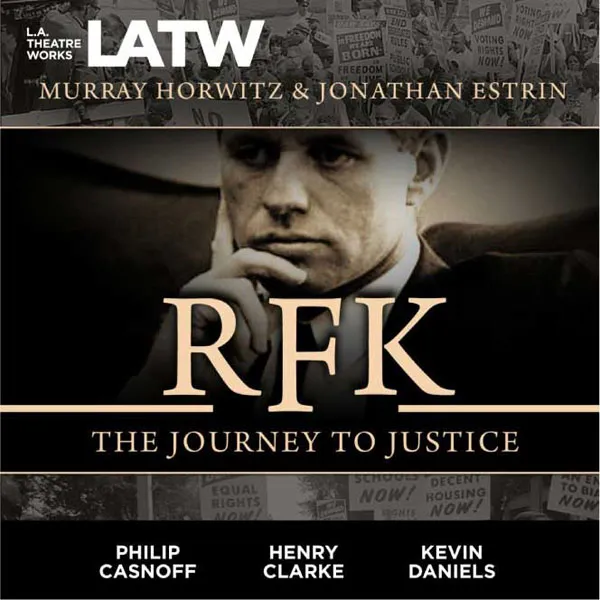
RFK: The Journey to Justice by Murray Horwitz and Jonathan Estrin
The Chicago Conspiracy Trial by Peter Goodchild
Top Secret: The Battle for the Pentagon Papers by Geoffrey Cowan and Leroy Aarons (Winner of the
Corporation for Public Broadcasting Best Live Entertainment Award, 1992)
As well as five scripts this anthology includes a foreword by Professor Michael Hackett, professor of directing and theatre history at UCLA School of Theater, Film and Television.
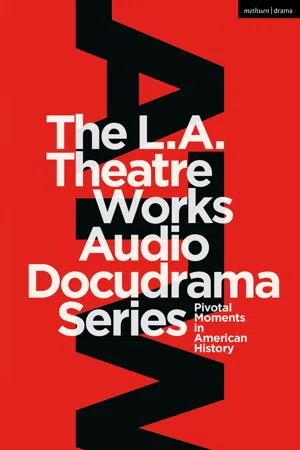
eBook - ePub
The L.A. Theatre Works Audio Docudrama Series
Pivotal Moments in American History
- 312 pages
- English
- ePUB (mobile friendly)
- Available on iOS & Android
eBook - ePub
The L.A. Theatre Works Audio Docudrama Series
Pivotal Moments in American History
About this book
Information
Setting
1959–68
Original Live Theatre Production
RFK: The Journey to Justice by Murray Horwitz and Jonathan Estrin was originally commissioned and produced by L.A. Theatre Works, with generous support from the DeBartolo Performing Arts Center at the University of Notre Dame, the Clarice Smith Performing Arts Center at the University of Maryland, Stanford Lively Arts at Stanford University, and the Modlin Center for the Arts at the University of Richmond. Following an L.A. Theatre Works national tour, it was recorded before a live audience at the Skirball Cultural Center, Los Angeles in March 2010. It was directed by John Rubinstein. The cast was as follows:
| Burke Marshall/Others | Michael Leydon Campbell |
| John F. Kennedy/Others | Philip Casnoff |
| Robert F. Kennedy | Henry Clarke |
| Byron White/Others | Kyle Colerider-Krugh |
| Martin Luther King, Jr. | Kevin Daniels |
| Harris Wofford/Others | Ross Hellwig |
| John Seigenthaler/Others | Thomas Vincent Kelly |
| Coretta Scott King/Others | Sheilynn Wactor |
| Louis Martin/Others | John Wesley |
Producing Director Notes
Susan Loewenberg
When we received the offer to create an original L.A. Theatre Works docudrama from four of our outstanding and longtime presenters, the University of Notre Dame, Stanford, the University of Maryland, and the University of Richmond, we were elated and then challenged by the formidable task of choosing just the right subject. Despite the many ideas offered by our staff and the writers and academics we consulted, one subject kept coming back to me, perhaps because it also haunted me. I had unfinished business with Robert Kennedy.
As a graduate student in the history department at UCLA, I was, in 1968, taking a seminar on biography, taught by the late Fawn Brodie, whose biographies of Thomas Jefferson, Joseph Smith, and Richard Nixon, among others, were both well known and controversial, informed as they were by psychoanalytic theory and concepts.
For my seminar paper, I had chosen Robert Kennedy as my subject, and the intent of the paper was “to examine the major forces that have shaped Robert Kennedy’s personality and determined his pattern of behavior.” In short, under the influence of my professor, I had set myself the goal of “psychoanalyzing” RFK. Leaving aside the merits of this method as well as the merits or shortcomings of the paper, here is what happened.
It is June 4, 1968. I am sitting in front of the television, watching the post-presidential primary election party in the ballroom of the Ambassador Hotel in downtown Los Angeles. Robert Kennedy is giving a rousing victory speech and I am putting the finishing touches to my paper. I am literally on the last page. A little after midnight, as I am writing the final paragraph, sleepy yet exhilarated, Kennedy’s aides decide to take him through the kitchen and we see them leaving the ballroom. I can hear the local anchor announcing the entourage’s movements as they enter the kitchen. Then I watched in horror as chaos and confusion erupted on the screen and learned that the person I had intimately come to know had been gunned down. I struggled over the next few days to find an ending to the paper, but nothing seemed right. I had lost my objectivity, and I was in despair over the senselessness of his death. I ended the paper with this sentence: “But with the death of his brother John, the spotlight turned on him, and drawn to it like a moth to a flame, he didn’t have a chance.”
History and my own maturity have tempered those sentiments and given me a less simplistic perspective, as will this play.
Following Robert F. Kennedy’s Path to Justice
Elizabeth Bennett, Dramaturg and Researcher
In the spring of 1963, U.S. Attorney General Robert F. Kennedy, concerned about rising racial tensions in the North and South, and looking for fresh ideas on how to cope with civil rights problems, convened two meetings with African-American writer James Baldwin. Baldwin had been sharply critical of President John F. Kennedy for not being more forceful about the civil rights struggle gripping the United States. At the conclusion of the first meeting (held at Kennedy’s home in Virginia), Kennedy asked Baldwin to put together some of his “best people in New York” to “talk this whole thing over.” The group that met with Kennedy at his New York City apartment included Baldwin and his actor brother David, Pulitzer Prize-winning playwright Lorraine Hansberry, singers Harry Belafonte and Lena Horne, psychologist Dr. Kenneth B. Clark, consul to the Gandhi Society Clarence B. Jones, and Freedom Rider Jerome Smith. The result was unexpected for both sides. Kennedy—publicly tight-lipped about the meeting—expressed privately his shock that his brother’s administration wasn’t lauded by blacks for its efforts, who told him that if this is the best he could do, then the best was not enough. Kennedy was humiliated by the group’s desperate laughter and surprised by so much anger. “We were a little shocked by the extent of his naïveté,” James Baldwin explained afterwards. Baldwin noted that he and his friends left the meeting convinced that Kennedy didn’t understand the full extent of the growing racial struggles in the North.
From this footnote to history comes the play that you will read. L.A. Theatre Works Producing Director Susan Loewe...
Table of contents
- Cover
- Half Title
- Title Page
- Contents
- Introduction Michael Hackett
- The Great Tennessee Monkey Trial Peter Goodchild
- The Real Dr. Strangelove Peter Goodchild
- RFK: The Journey to Justice Murray Horwitz and Jonathan Estrin
- The Chicago Conspiracy Trial Peter Goodchild
- Top Secret: The Battle for the Pentagon Papers Geoffrey Cowan and Leroy Aarons
- Copyright
Trusted by 375,005 students
Access to over 1.5 million titles for a fair monthly price.
Study more efficiently using our study tools.
Frequently asked questions
Yes, you can cancel anytime from the Subscription tab in your account settings on the Perlego website. Your subscription will stay active until the end of your current billing period. Learn how to cancel your subscription
No, books cannot be downloaded as external files, such as PDFs, for use outside of Perlego. However, you can download books within the Perlego app for offline reading on mobile or tablet. Learn how to download books offline
Perlego offers two plans: Essential and Complete
- Essential is ideal for learners and professionals who enjoy exploring a wide range of subjects. Access the Essential Library with 800,000+ trusted titles and best-sellers across business, personal growth, and the humanities. Includes unlimited reading time and Standard Read Aloud voice.
- Complete: Perfect for advanced learners and researchers needing full, unrestricted access. Unlock 1.5M+ books across hundreds of subjects, including academic and specialized titles. The Complete Plan also includes advanced features like Premium Read Aloud and Research Assistant.
We are an online textbook subscription service, where you can get access to an entire online library for less than the price of a single book per month. With over 1.5 million books across 990+ topics, we’ve got you covered! Learn about our mission
Look out for the read-aloud symbol on your next book to see if you can listen to it. The read-aloud tool reads text aloud for you, highlighting the text as it is being read. You can pause it, speed it up and slow it down. Learn more about Read Aloud
Yes! You can use the Perlego app on both iOS and Android devices to read anytime, anywhere — even offline. Perfect for commutes or when you’re on the go.
Please note we cannot support devices running on iOS 13 and Android 7 or earlier. Learn more about using the app
Please note we cannot support devices running on iOS 13 and Android 7 or earlier. Learn more about using the app
Yes, you can access The L.A. Theatre Works Audio Docudrama Series by Peter Goodchild,Murray Horowitz,Jonathan Estrin,Geoffrey Cowan,Leroy Aarons,Bloomsbury Publishing in PDF and/or ePUB format, as well as other popular books in Mezzi di comunicazione e arti performative & Teatro americano. We have over 1.5 million books available in our catalogue for you to explore.