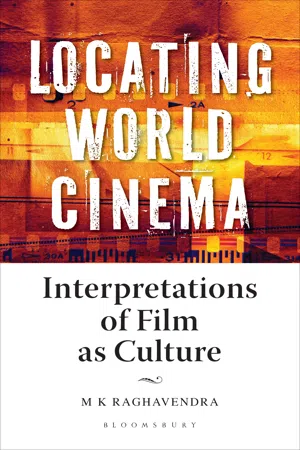
Locating World Cinema argues for the importance of understanding the local context of a film's creation and the nuances that it conveys to the spectator. It examines the sociocultural contexts intrinsic to cinema from milieus like the USSR/Russia, China, Japan, France, the US, Iran and India. The book analyses the works of some of the more celebrated but, at times, less than fully understood auteurs, such as Kenji Mizoguchi from Japan; Robert Bresson, Jacques Rivette and Éric Rohmer from France; Abbas Kiarostami from Iran; Martin Scorsese from the US; Zhang Yimou from China and Aleksei German from Russia.
Further, it examines how the conditions of exhibition for art house cinema has transformed into the 'global art film' that attempts to bypass the local by addressing international audiences.
The book deals with complex ideas but is lucidly written, making it accessible to film students and lay persons alike.
- 320 pages
- English
- ePUB (mobile friendly)
- Available on iOS & Android
eBook - ePub
About this book
Trusted by 375,005 students
Access to over 1.5 million titles for a fair monthly price.
Study more efficiently using our study tools.
Information
Subtopic
Film & Video1
The Engineered Look
The Film Festival Circuit and the Aesthetics of the Global Art Film
Academic film history has come some distance since the 1980s when film history was largely a matter of determining teleology based on existing/expected technological advances, the notion of national cinemas, the compilation of canons of great masters and masterpieces. This change has come about due to the arrival of New Film Historicism. New Film Historicism, among other things, has tried to put an end to the special pedestal upon which masterworks are placed, and instead draws attention to the context in which films are made.1 When film history was being compiled in the post-Second World War era, and understood in terms of masterpieces and masterworks, film historians began to depend on festivals, and the most important film movements like Italian neorealism, the Nouvelle Vague and New German Cinema were registered by film historians when the early works of each movement won prizes.2 It has been, for instance, demonstrated that the films of New German Cinema became part of the national film canon after they won recognition abroad at festivals.3 The exclusion of Soviet cinema from Western film festivals4 may have been the reason for cinema from the Soviet Union in the Khrushchev and Brezhnev eras not finding the place that they merit in film history.
Much of the initial research by New Historicists concentrated on early cinema and aimed to trace its development by examining the specific circumstances of early film viewing, production and distribution. Instead of understanding cinema in terms of the genius of filmmakers, attention shifted to conditions in the milieu that prompted the development of film aesthetics. The same approach can be followed now since film aesthetics may continue to be determined by the registering of individual films at film festivals, which are devised as spaces in which new tendencies are tested out:
…film festivals are temporary events of short duration, where films are shown in an atmosphere of heightened expectation and festivity…. The creation of the international film festival circuit has further strengthened its resemblance to the early cinema context as many films now travel from festival to festival in anticipation of (or preparation for) access to distribution in permanent cinemas.5
The emphasis on the conditions of viewership determining the nature of film art makes it appear that authorship and art in cinema are more doubtful concepts than they were once thought to be. A work of art is no longer an untainted object, the significance of which is to be speculated about, but the product of a set of manipulations undertaken6 before what is ‘art’ in cinema is determined. Moreover, economic developments in the international movie industry influence the shape of the ‘normative’ in film art.7 Still, there is a gap between developments in theory—trends in the academic realm—and the way films are received by the public. It is this public reception that often determines the way films are written about, or decides what films will be written about academically. Moreover, the reception of a film at a major film festival has consequences not only on the future of the director and the film, which finds distribution through the permanent cinemas easier, but also affects the fortunes of a national cinema, and its global reception—an effect which cannot be wished away.8 The kind of films promoted at the biggest festivals today, through important prizes, could, hence, reinforce aesthetic tendencies in world cinema; and the proposition here is that the new tendencies can be understood through an examination of film texts.
This chapter tries to look at three international films that are not alike thematically but exhibit comparable characteristics. All of them won top awards on a large number of platforms. The films are Michael Haneke’s French film Amour (2012) and Nuri Bilge Ceylan’s Turkish film Winter Sleep (2014), which won the Palme d’Or at Cannes in 2012 and 2014 respectively; and Richard Linklater’s American film Boyhood (2014), which won the Silver Berlin Bear for Best Director as well as the FIPRESCI Grand Prix in 2014. The films are from different milieus and have been deliberately selected to identify some late traits in art cinema and speculate about their significance. This is expected to help us understand some aesthetic characteristics of a category broadly identifiable as the ‘global art film’. Before I go on to examine the three films, however, it is necessary to understand how film festivals developed and where they stand. In Cinema Studies, critical reflections have generally taken the form of textual analyses, such as the formalistic readings of a body of selected films; or consisted of quantitative–empirical research using film industry statistics; or concentrated on representations of the power relations of race, gender, class and ethnicity; or tried to grasp the ontology of the cinematic image.9 My tool—as with other chapters in this book—is textual analysis, since my purpose is to understand film art and its changed meaning because of the transformation of the sites where the value of each film is initially registered, that is, film festivals. The factor of importance is that the process of awarding prizes to films by impartial juries constituted from across the world assumes that the only issue of pertinence in the entire process is the film text, which is nominally insulated from all considerations/demands except that of being ‘artistic’.
Film Festivals and Their Development
Film festivals as a phenomenon cannot be grasped without a reference to Europe, where it emerged largely as a way of combating the reach of Hollywood. In fact, the film-going public across the world generally regarded Hollywood and European art cinema as representing polar opposites—Hollywood is understood as mass entertainment heightened by thrills, stars, studios, private enterprise and public exhibition; in contrast, European cinema is identified in terms of elite audiences, auteurs and personal expression, state sponsorship and film festivals. To be sure, the European film festivals arose out of conflict within the continent: The Cannes Film Festival emerged as a joint initiative between France, Britain and the US and a reaction to the Fascist domination of the Venice Film Festival of 1932, the year that also delineates the end of the transition period from the silent to the sound era. This transition is important because it has been used in film history to explain the demise of the European avant-garde.
A fundamental aspect of the avant-garde,10 apart from its political radicalism, was its cosmopolitanism. When sound arrived, the presence of spoken language made cinema more hospitable to nationalist agendas. The Venice Film Festival of 1932 was international, but it played up to nationalism by inviting countries to exhibit their best works, which was contrary to the communist-inspired internationalism of the avant-garde. Where the avant-garde, with its subversive agenda, agitated against the commercial film system and Hollywood’s hegemony, matching its political utopianism with alternative aesthetics, the Venice Film Festival exhibited contrary sides. On the one hand Hollywood was embraced, its trade organisation the Motion Picture Producers and Distributors of America (MPPDA) accepted as America’s national representative alongside various national film funds of participating countries, and Hollywood stars invited to the events to make glamour an integral part of the festival formula. On the other, films were not treated as mass-produced commodities but as national accomplishments, conveyors of local cultural identity and as artistic creations. If the festival had one foot planted in the model of avant-garde cinema and valorising creativity, the other kept pace with market forces within the cultural economy—a compromise that the avant-garde had rejected.11 The film festival model also chose (nostalgically) spots like spas and beach resorts where an elitist/aristocratic culture had flourished before culture was ‘democratised’ by American commercialism, and the choice continues to this day when festivals are held in Cannes, Venice and Karlovy Vary rather than in cities like Paris and Rome, which is where film culture actually thrives.12 Seen in another way, film festivals were also a development of film clubs and societies founded in the 1920s by the avant-garde to directly interfere in film production by contesting the commercialisation of cinema and to develop it for radical purposes. Film festivals took over this function by providing spaces or platforms—like the ‘Forum’ at the Berlinale—as specialised thematic programming for the avant-garde.
The growth of film festivals produced, in the post-Second World War era after 1954, art cinema made for international audiences.13 The characteristics of post-war art cinema have been studied and their particularities identified—particularities that show them to be quite different from cinema of the pre-war years. It has been shown that much of post-war art cinema has common traits, the chief of which is the foregrounding of the author as formal component in the narrative through the notion of ‘ambiguity’. What the film is ‘trying to say’ is then directed towards authorial expressivity14 and this can be associated with the way the European film festival positioned itself against the dominant Hollywood mode in which films were marked by the ‘invisible style’, that is, the delivery of the narrative with the greatest clarity without authorial interference. One must not take this to mean that ‘ambiguity’ cannot be associated with cinema before the war, or with non-European cinema. Complexity and ambiguity are kin, but post-war art cinema, in foregrounding the author, made itself ‘puzzling’ in a way that complex/ambiguous works like Renoir’s The Rules of the Game (1939) or Mizoguchi’s Sansho the Bailiff (1954) do not.
This notion of art cinema as a single identifiable category will perhaps be contested by the reader. Art cinema has been described as an ‘impure’ category because of the variety it encompasses15—and this is undeniable. Still, the term ‘auteur’, as it was used in the 1950s and 1960s, demanded an interpretive role from the critic, and ‘ambiguity’ was the characteristic that led the critic to interpret the film text. It is likely that the valourisation of cinema as personal expression through the post-war film festival produced the auteur.16 The 1950s and the 1960s may be regarded as the greatest period for art cinema around the world because of the number of filmmakers (as auteurs) flourishing in the period and making their best-regarded works: Ingmar Bergman, Federico Fellini, Michelangelo Antonioni and the directors of the Nouvelle Vague; Satyajit Ray from India and Kurosawa from Japan reaching the highpoints of their careers in these two decades. But if these filmmakers were ‘international’ in their reach, they still contributed enormously to national culture and were held up as icons in their home countries; and this could hardly have happened if their films had not addressed local issues and contributed to local culture. Where the pre-war avant-garde had been utopian, with the realisation of their ideals mainly projected into the future, the post-war art film, which was promoted primarily as national cinema, was sensitive both to the cultural past and the political present.17 Art cinema fed on resistance to two ‘evils’ represented by Hollywood and indigenous commercial cinemas18 of the countries from which individual art films came; therefore, it valourised a high local tradition debased by commercial cinema. This may explain the literariness of European films like those of the Nouvelle Vague, as well as the tendency of art cinema to adapt literary classics. An important factor here is that since national culture is often preoccupied with carrying forward a past, dealing with the burden of the past while negotiating/contending with the political/personal present is manifested in narratives as motifs.19 This attribute may be too broad to identify a category of films by, but it becomes significant when we deal with the contemporary films that this chapter is focused upon.
Alongside the growth of film festivals and the rise of the art film largely in Europe, the avant-garde relocated from Paris to New York in the 1950s and 1960s because of America’s economic boom, its newly found cultural confidence and desire to emerge from Europe’s shadow after European modernism had been absorbed by America. This was the time in which radical movements like Abstract Expressionism in painting also emerged. The American underground film movement of the 1950s and 1960s challenged not only Hollywood but also the European art film. The avant-garde filmmakers who emerged in this period include Maya Deren (who had already made Meshes of the Afternoon in 1943), Stan Brakhage (Anticipation of the Night, 1958) and Jonas Mekas (The Brig, 1964). Amos Vogel was a co-founder of the New York Film Festival in 1963 and The Museum of Modern Art (MoMA) also began to collect and exhibit avant-garde films.
But between the mid-1960s and the mid-1970s cinema became implicated in a series of political projects initiated by the opposition to the Vietnam War. Film festivals were effective means within the political struggle to make underrepresented cinemas visible and Third World filmmakers heard. In Northern Africa, the biannual Carthage Film Festival (Tunisia) was established in 1966. The Pan-African Film and Television Festival, known by its French acronym FESPACO, in Ouagadougou (Burkina Faso), followed in 1969. In addition, from the late 1960s onwards, Third World filmmakers and their critical political cinema slowly found representation and received their first critical praise at the established European festivals. It was in this period that Jean-Luc Godard turned to radical politics. Godard’s left-wing ideas culminated in activist interventions in 1968, when he heralded the protests against the dismissal of Cinémathèque director Henri Langlois. The shutting down of the Cannes Film Festival in 1968, in which Godard also participated, influenced the position of the Pesaro Film Festival, which had been a major platform for both feature and documentary films of an experim...
Table of contents
- Cover Page
- Half Title
- Title Page
- Copyright
- Dedication
- Contents
- Acknowledgements
- Introduction: Between Meaning and Significance
- 1. The Engineered Look: The Film Festival Circuit and the Aesthetics of the Global Art Film1
- 2. A Fallible Tradition: Kenji Mizoguchi and the Post-War Transformation of Japan35
- 3. World and Text: Interpreting Jacques Rivette65
- 4. Unattainable Women: Sexual Anxiety and Location—Scorsese, Rohmer and Kiarostami93
- 5. Beyond Religion: The Spiritual Cinema of Robert Bresson113
- 6. Nation and Transgression: Ideology and the Horror Film in India and Pakistan147
- 7 A Trajectory of Form: The Development of Soviet/Russian Cinema (1910–2010)165
- 8 History as Polyphony: Understanding Aleksei German211
- 9 Utopia and the Patriarchal Order: Zhang Yimou as a Chinese National Artist239
- Bibliography
- Film Index
- Index
- About the Author
Frequently asked questions
Yes, you can cancel anytime from the Subscription tab in your account settings on the Perlego website. Your subscription will stay active until the end of your current billing period. Learn how to cancel your subscription
No, books cannot be downloaded as external files, such as PDFs, for use outside of Perlego. However, you can download books within the Perlego app for offline reading on mobile or tablet. Learn how to download books offline
Perlego offers two plans: Essential and Complete
- Essential is ideal for learners and professionals who enjoy exploring a wide range of subjects. Access the Essential Library with 800,000+ trusted titles and best-sellers across business, personal growth, and the humanities. Includes unlimited reading time and Standard Read Aloud voice.
- Complete: Perfect for advanced learners and researchers needing full, unrestricted access. Unlock 1.5M+ books across hundreds of subjects, including academic and specialized titles. The Complete Plan also includes advanced features like Premium Read Aloud and Research Assistant.
We are an online textbook subscription service, where you can get access to an entire online library for less than the price of a single book per month. With over 1.5 million books across 990+ topics, we’ve got you covered! Learn about our mission
Look out for the read-aloud symbol on your next book to see if you can listen to it. The read-aloud tool reads text aloud for you, highlighting the text as it is being read. You can pause it, speed it up and slow it down. Learn more about Read Aloud
Yes! You can use the Perlego app on both iOS and Android devices to read anytime, anywhere — even offline. Perfect for commutes or when you’re on the go.
Please note we cannot support devices running on iOS 13 and Android 7 or earlier. Learn more about using the app
Please note we cannot support devices running on iOS 13 and Android 7 or earlier. Learn more about using the app
Yes, you can access Locating World Cinema by M K Raghavendra in PDF and/or ePUB format, as well as other popular books in Media & Performing Arts & Film & Video. We have over 1.5 million books available in our catalogue for you to explore.