Offering a unique perspective on an overlooked subject – the relationship between time, change, and lawmaking – this edited collection brings together world-leading experts to consider how time considerations and social, political and technological change affect the legislative process, the interpretation of laws, the definition of the powers of the government and the ability of legal orders to promote innovation.
Divided into four parts, each part considers a different form of interaction between time and law, and change. The first part offers legal, theoretical and historical perspectives on the relationship between time and law, and how time shaped law and influences legal interpretation and constitutional change.
The second part offers the reader an analysis of the different ways in which courts approach the impact of time on law, as well as theoretical and empirical reflections upon the meaning of the principle of legal certainty, legitimate expectations and the influence of law over time.
The third part of the book analyses how legislation and the legislative process addresses time and change, and the various challenges they create to the legal order.
The fourth and final part addresses the complex relationship between fast-paced technological change and the regulation of innovations.
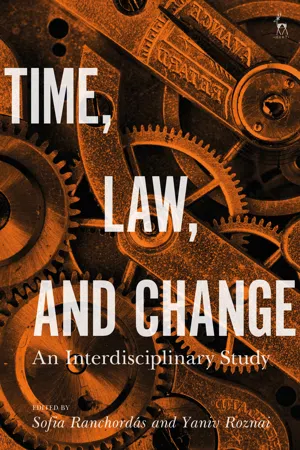
eBook - ePub
Time, Law, and Change
An Interdisciplinary Study
- 320 pages
- English
- ePUB (mobile friendly)
- Available on iOS & Android
eBook - ePub
Time, Law, and Change
An Interdisciplinary Study
PART I
Historical, Comparative and Theoretical Perspectives on Law and Time
1
Interpretation and the Legal Fabrication of Time
LIOR BARSHACK
Dworkin’s account of interpretation is cast in mythological terms, with Judge Hercules as its protagonist. For Dworkin, judges are bound exclusively by the past, they speak in the name of the dead. The object of interpretation is the entire history of the legal system, seen as a single text written by a single fictional enunciator.1 The dead, then, are not so much the individual drafters of laws and constitutions, but rather a big ‘Other’ who looms large behind the historical accumulation of legal texts. Judges have to decipher the moral message treasured in the mass of old legal documents, a message that is so evasive that it is bound to be misunderstood by many, possibly most, judges. In addition to being controversial and elusive, the message of the dead can be interpreted differently at any moment because the one right answer is right only for the moment in which it is given. The violence of the law can be legitimate if it is based on principles that can be attributed to the legal system from its foundation. The mythical dimension of Dworkin’s account is enhanced by his theoretical preference to speak about interpretative practices from the perspective of their own internal self-understanding, the influence of Gadamer’s account of the authority of tradition in the self-understanding of interpreters, and Dworkin’s own somewhat metaphysical concept of ‘community of principle’.2 In fact, Dworkin’s theory anticipated the contemporary interest in political theology and in the theological foundations of the constitution. Dworkin articulates the theological premises of interpretation, which include commitment to a fictional, retrospectively projected, unity of the legal system from its foundational moment onwards, and denial of society’s ability to ascertain the content of the system’s everlasting principles.
I would like to support Dworkin’s claims about law’s continuity/perpetuity, contestability and legitimacy on the basis of an account of the relations between law and time that I have outlined in earlier work.3 The following argument remains in an outline form. Its purpose is to draw the implications of a certain view of the legal construction of time on the theory of interpretation. I will argue that the law fabricates historical time by propagating representations of corporate perpetuity, of historical changes and of the contestability of the system’s everlasting principles. Alongside representations of legal permanence and change, the law represents controversy over what is and what is not changeable. Dworkin’s accounts of interpretation and essentially contested concepts foreground and knit together these basic elements of society’s representation of time. The same threefold representation – of perpetuity through change, and of the unknowability of the message transmitted from generation to generation – can also be found in other practices, such as art, that play a role in the fabrication of historical time. As part of their representation of time, interpretive practices such as law and art separate the figures of historically situated authors (artists, lawmakers, and so on) from those of immortal collective bodies that author eternal principles. At the same time, they entangle these two authorial instances – the historically situated and the immortal/corporate – in a way that complicates in each practice the interpretive task of sorting out the changeable and the unchangeable. My account of the legal construction of time will draw on some concepts and ideas of Hannah Arendt and on insights from art history and social anthropology. I would like to illustrate in particular the enduring relevance of anthropological theories of descent to theories of social time.
I.The Collapse of Social Space and Social Time in Constitutional Moments
My starting point is the idea of constitutional moments as moments in which the flow of historical time is interrupted. Constitutional moments bring us back to the moment of foundation. They approximate to the state of nature, because they are moments in which the rule of law and the separation of powers are relaxed. From the perspective of modern social thought, such moments are no longer perceived as they were by the philosophers of the social contract. Even Hobbes’s account of the state of nature seems benign in comparison to modern accounts. For Hobbes, the self-preserving rationality that governs social life is perfectly in place in the state of nature. In the aftermath of the atrocities of the twentieth century, states of lawlessness, which are not always identifiable, are conceived in more sinister and apocalyptic terms. In Hannah Arendt’s accounts of totalitarianism, such moments of bare life seem as breakdowns of law, space, time, language, work – not only action – and plurality. In other words, the very existence of the human world is at stake when the rule of law breaks down. Sociological and psychoanalytic theories of atrocities echo of course numerous myths that invoke the recurrence of apocalyptic destruction at the beginning, end, and occasional breakdowns of historical time. Arendt, however, does not endorse a view of constitutional moments as cyclical breakdowns of historical time. For Arendt, constitutional beginnings and transformations need not involve collapse of the human world and interruptions of time. In On Revolution, Arendt seeks to demythologise constitutional beginnings and place them within historical time. While her notion of a ‘gap between past and future’ suggests an interruption of time that is akin to mythical time,4 Arendt seems to resist any sharp and easy contrast between continuity and beginning, at least in the life of institutions.
In a similar vein, oppositions that have been drawn between ordinary, continuous time and the sanctity and intensity of mythical time can be either moderated or viewed as inevitable paradoxes. An important example is Victor Turner’s distinction between social structure and communitas, which readily suggests itself as a theoretical framework for elucidating the social dynamics of constitutional moments.5 If constitutional moments are more or less intense re-enactments of the moment of foundation, then theories of ritual are likely to shed light on their nature. For Turner, communitas and social structure are two modalities of social life between which every society alternates. Communitas is characterised by dissolution of social roles and statuses; reversal of hierarchies; the collapse of fundamental social dichotomies between private and public, the local and the universal, the human and the animal, the sacred and the profane; passage from traditional to charismatic authority, and from pragmatic to symbolic use of language; violation of the most fundamental social prohibitions; and collapse of social space and social time. These are just some of the main aspects of communitas. There are multiple types of communitas, including carnivals, happenings, wars, natural disasters, economic crises, official rituals and a variety of new ‘media events’ and constitutional moments. Bakhtin’s work on carnival and ethnographic studies of different kinds of liminal events fit into and enrich the general account proposed by Turner.6
In earlier work, I have characterised communitas and social structure respectively in terms of the place that the collective body occupies in them. In communitas, the collective body of the group is enacted in a way that brings about the dissolution of interpersonal boundaries. The individual disappears in the collective body. I refer to the collective body as it is incarnated in constitutional moments as the communal body. When society returns from communitas to social structure, the collective body is projected outside of the social, and assumes the form of an absent, transcendent body to which I refer as the corporate body. The collective body assembles not only the individuals that make up society in a particular moment, but all generations. It is a multigenerational body. In the corporate body, generations succeed each other in time and temporal distances between them are observed. In moments of communitas all the generations assemble as the horizons of past and future collapse into an everlasting present.7 Communitas is experienced as an arrest of time because it occasions the simultaneous presence of all generations. Lawless regimes aspire to enact the communal body because its presence liberates the living from the authority of the dead. By contrast, Dworkin’s concept of community of principle subordinates the living to the authority of the dead and arguably evokes the image of a corporate subject/body. The arrest of time in communitas can also be couched in terms of repetition. The temporal experience in communitas is one of repetition because it involves the dissolution of individual agency, and because it consists in the re-enactment of founding, mythical events. As a reenactment of something that assumes the character of an origin, repetition shapes both dramatic historical moments and the everyday satisfaction of the necessities of life. The separation between everyday life and the realm of great historical events makes room for linear historical time between the repetitive cycles of private life and those of political beginnings and transformations.
In his celebrated book, The Nuer, Evans-Pritchard characterised time in terms of ‘constant structural relationship between two points, the first and last persons in a line of agnatic descent’. Time is equated by Evans-Pritchard with intergenerational distance. Evans-Pritchard referred to time-reckoning of that sort as ‘structural time’, as opposed to deep historical time, because it always serves to explain and legitimise actual structural relations between different contemporary groups in terms of their genealogical origins. As Evans-Pritchard notes, ‘… time-reckoning is a conceptualization of the social structure, and the points of reference are a projection into the past of actual relations between groups of persons’. Before the beginning of the genealogical line, lies the realm of mythical time. As Evans-Pritchard writes, ‘Beyond tradition lies the horizon of pure myth …’8
Evans-Pritchard’s notion of structural time as an ordering of past generations along a temporal axis by means of projected temporal distances applies, in its general outline, also to modern notions and institutions of historical time. Despite the fact that historical time is longer than structural time and in principle unlimited in length, linear historical time also places generations – past, present and future – in imagined relations to each other, in ways that structure distances and relations among the living. Like structural time, historical time is bracketed and interrupted by episodes of mythical time in which all generations become simultaneously present. When the generations assemble in constitutional moments to take momentous decisions, and in other instances of mythical time, historical time stands still.
In order to return from communitas to social structure, spatial/horizontal boundaries among the living, and temporal/vertical distances between the generations, have to be re-established. Social statuses, roles, categories and hierarchies are reaffirmed. Fundamental dichotomies between spheres of life and basic prohibitions are enforced. In Arendt’s terms, the passage from communitas to social structure amounts to a construction of a world...
Table of contents
- Cover
- Dedication
- Title Page
- Acknowledgements
- Table of Contents
- List of Contributors
- Introduction
- PART I: HISTORICAL, COMPARATIVE AND THEORETICAL PERSPECTIVES ON LAW AND TIME
- PART II: COURTS AND TIME
- PART III: LEGISLATORS AND TIME
- PART IV: TECHNOLOGY AND TIME
- Concluding Remarks: Time, Law and Change: It Takes Three to Tango
- Index
- Copyright Page
Trusted by 375,005 students
Access to over 1.5 million titles for a fair monthly price.
Study more efficiently using our study tools.
Frequently asked questions
Yes, you can cancel anytime from the Subscription tab in your account settings on the Perlego website. Your subscription will stay active until the end of your current billing period. Learn how to cancel your subscription
No, books cannot be downloaded as external files, such as PDFs, for use outside of Perlego. However, you can download books within the Perlego app for offline reading on mobile or tablet. Learn how to download books offline
Perlego offers two plans: Essential and Complete
- Essential is ideal for learners and professionals who enjoy exploring a wide range of subjects. Access the Essential Library with 800,000+ trusted titles and best-sellers across business, personal growth, and the humanities. Includes unlimited reading time and Standard Read Aloud voice.
- Complete: Perfect for advanced learners and researchers needing full, unrestricted access. Unlock 1.5M+ books across hundreds of subjects, including academic and specialized titles. The Complete Plan also includes advanced features like Premium Read Aloud and Research Assistant.
We are an online textbook subscription service, where you can get access to an entire online library for less than the price of a single book per month. With over 1.5 million books across 990+ topics, we’ve got you covered! Learn about our mission
Look out for the read-aloud symbol on your next book to see if you can listen to it. The read-aloud tool reads text aloud for you, highlighting the text as it is being read. You can pause it, speed it up and slow it down. Learn more about Read Aloud
Yes! You can use the Perlego app on both iOS and Android devices to read anytime, anywhere — even offline. Perfect for commutes or when you’re on the go.
Please note we cannot support devices running on iOS 13 and Android 7 or earlier. Learn more about using the app
Please note we cannot support devices running on iOS 13 and Android 7 or earlier. Learn more about using the app
Yes, you can access Time, Law, and Change by Sofia Ranchordás, Yaniv Roznai, Sofia Ranchordás,Yaniv Roznai in PDF and/or ePUB format, as well as other popular books in Law & Courts. We have over 1.5 million books available in our catalogue for you to explore.