Resurrecting the Shark
eBook - ePub

Resurrecting the Shark

A Scientific Obsession and the Mavericks Who Solved the Mystery of a 270-Million-Year-Old Fossil

  1. 368 pages
  2. English
  3. ePUB (mobile friendly)
  4. Available on iOS & Android
eBook - ePub

Resurrecting the Shark

A Scientific Obsession and the Mavericks Who Solved the Mystery of a 270-Million-Year-Old Fossil

About this book

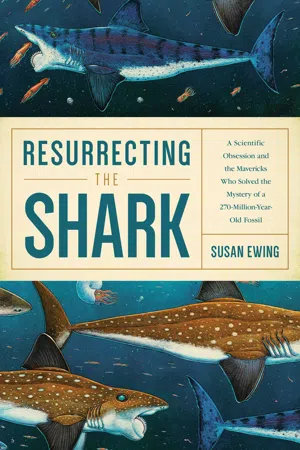
A prehistoric mystery. A fossil so mesmerizing that it boggled the minds of scientists for more than a century—until a motley crew of modern day shark fanatics decided to try to bring the monster-predator back to life. In 1993, Alaskan artist and paleo-fish freak Ray Troll stumbled upon the weirdest fossil he had ever seen—a platter-sized spiral of tightly wound shark teeth. This chance encounter in the basement of the Natural History Museum of Los Angeles County sparked Troll's obsession with Helicoprion, a mysterious monster shark from deep time.In 2010, tattooed amateur strongman and returning Iraq War veteran Jesse Pruitt was also severely smitten by a Helicoprion fossil in a museum basement in Idaho. These two bizarre-shark disciples found each other, and an unconventional band of collaborators grew serendipitously around them, determined to solve the puzzle of the tooth whorl once and for all. Helicoprion was a Paleozoic chondrichthyan about the size of a modern great white shark, with a circular saw of teeth centered in its lower jaw—a feature unseen in the shark world before or since. For some ten million years, long before the Age of Dinosaurs, Helicoprion patrolled the shallow seas around the supercontinent Pangaea as the apex predator of its time.Just a few tumultuous years after Pruitt and Troll met, imagination, passion, scientific process, and state-of-the-art technology merged into an unstoppable force that reanimated the remarkable creature—and made important new discoveries.In this groundbreaking book, Susan Ewing reveals these revolutionary insights into what Helicoprion looked like and how the tooth whorl functioned—pushing this dazzling and awe-inspiring beast into the spotlight of modern science
Frequently asked questions

Yes, you can cancel anytime from the Subscription tab in your account settings on the Perlego website. Your subscription will stay active until the end of your current billing period. Learn how to cancel your subscription.
No, books cannot be downloaded as external files, such as PDFs, for use outside of Perlego. However, you can download books within the Perlego app for offline reading on mobile or tablet. Learn more here.
Perlego offers two plans: Essential and Complete
  • Essential is ideal for learners and professionals who enjoy exploring a wide range of subjects. Access the Essential Library with 800,000+ trusted titles and best-sellers across business, personal growth, and the humanities. Includes unlimited reading time and Standard Read Aloud voice.
  • Complete: Perfect for advanced learners and researchers needing full, unrestricted access. Unlock 1.4M+ books across hundreds of subjects, including academic and specialized titles. The Complete Plan also includes advanced features like Premium Read Aloud and Research Assistant.
Both plans are available with monthly, semester, or annual billing cycles.
We are an online textbook subscription service, where you can get access to an entire online library for less than the price of a single book per month. With over 1 million books across 1000+ topics, we’ve got you covered! Learn more here.
Look out for the read-aloud symbol on your next book to see if you can listen to it. The read-aloud tool reads text aloud for you, highlighting the text as it is being read. You can pause it, speed it up and slow it down. Learn more here.
Yes! You can use the Perlego app on both iOS or Android devices to read anytime, anywhere — even offline. Perfect for commutes or when you’re on the go.
Please note we cannot support devices running on iOS 13 and Android 7 or earlier. Learn more about using the app.
Yes, you can access Resurrecting the Shark by Susan Ewing in PDF and/or ePUB format, as well as other popular books in Physical Sciences & Marine Biology. We have over one million books available in our catalogue for you to explore.

Information

1
Images
LASTING IMPRESSIONS
Whilst this planet has gone cycling on according to the fixed law of gravity, from so simple a beginning endless forms most beautiful and most wonderful have been, and are being, evolved.
—Charles Darwin, On the Origin of Species, 1859
SCIENTISTS ESTIMATE THAT 99.9 PERCENT OF ALL SPECIES EVER TO SLINK, SWIM, FLY, fight, wail, or warble on this earth are now extinct. It’s hard enough to pin down the number of species living today (one recent study pegged the wildly varying number at 8.7 million), but the number of extinct species is thought to be somewhere between five and fifty billion. Billion. Species. Extinct. Some of those billions made their exit in one of the five calamitous mass extinctions our planet has experienced to date. Others quietly faded away, outcompeted or unable to adapt to earth’s shifting terms and conditions, long before humans arrived to give them an extra push toward the cliff. Of those estimated extinguished billions, a random few percent are chronicled in the fossil record. This is the story of one of those few—the one-in-a-billion buzz saw shark, Helicoprion, a species that survived over a span of some ten million years, between about 270 and 280 million years ago, long before the dinosaurs.
The world’s first Helicoprion fossil was a curved fragment of fourteen teeth found in Western Australia in the latter part of the nineteenth century. We only know the bare-bones outline of that discovery, as none of the fleshy particulars were preserved, in either the fossil or human narrative. And there you have the maddening norm in paleontology. So much is missing. Evidence may be the scientific engine of paleontology, but we would be hard-pressed to get out of the driveway without artful reconstruction, whether the subject at hand is a scavenger-strewn fossil fish, an ancient ecosystem, an operatic museum diorama, or a set of historic circumstances.
We know the last name of the first person to stumble upon that prefatory Helicoprion fossil: Davis. It was definitely Mr. Davis. But his first name is lost to history, and we are left to imagine the details leading to that happenstance moment when the first human hand touched the first whorl-toothed shark, raised up from a lost world. It might well have gone like this….
___________
An old prospector too bent for the outback himself told Mr. Davis to look for Swan River blackbutt trees. Old-timers believed the trees, a species of tall eucalyptus with creamy white flowers, signaled the presence of gold. In his weeks of looking, Mr. Davis had found an assortment of tough-barked gums, a bit of beryl, and some quartz. That was it. Still, somehow, he felt lucky as he kicked out his breakfast fire, saddled his horse, and loaded his pack mule as dawn rose over an austere landscape the color of terra-cotta. He could get in a few good hours of scouting before the heat drove shimmering waves into the bone-dry air.
On this particular day in the early 1880s, Mr. Davis was poking up the valley of the Arthur River, a tributary of the Gascoyne River. The Gascoyne was what locals called an “upside-down” river, in that it only ran aboveground for about four months of the year and maintained a sort of hibernation flow below the dried-up riverbed the rest of the time. As Mr. Davis was about to discover, water and gold were not the only treasures the taciturn country held dear in its rocks.
The morning had been disappointing. Mr. Davis was riding slowly over the hard ground, his mind wandering perhaps to a good meal back at the pub, and perhaps some female companionship, when something caught his eye and knocked for attention: an anomalous shape, an orderly pattern, a play of light across an incised form. Squinting, he dismounted and bent to examine a split nodule of sedimentary rock that looked to him like clay ironstone. Furrowed into the exposed surface of the nodule was a gracefully curved fossil impression—fourteen serrated points fanned into an arc about the size of a woman’s hand.
As a gold prospector, and therefore at the very least an amateur geologist, Mr. Davis would have known he was looking at a fossil. In the crowning years of the late nineteenth century, fossils had established themselves in the public imagination in a big way. The first life-size models of extinct animals, including dinosaurs, had been installed in 1854 with great fanfare in an exhibit at London’s Crystal Palace Park. English sculptor Benjamin Waterhouse Hawkins built the models under the scientific direction of Sir Richard Owen. It was Owen who had coined the term dinosauria, terrible lizard, a dozen years earlier. He was a controversial figure who resembled Dickens’s Scrooge in appearance and temperament, but Owen was among the leading paleontologists of the day, considered to be a brilliant naturalist and anatomist. Before the Crystal Palace Dinosaur Court exhibit opened, a posh New Year’s Eve dinner party (gentlemen only) was held inside the mold for the Iguanodon. The eight-course meal included mock turtle soup, raised pigeon pie, and French plums. A story in the Illustrated London News, complete with an engraved picture of the event, reported the party as boisterous. The masses responded by flocking to the exhibit and snapping up the world’s first dinosaur souvenir sets.
Steamrolling scientific progress over the next four decades would reveal how inaccurate Owen’s models were and spur American paleontologist Othniel Charles Marsh to angrily deride the Crystal Palace models and scorn anyone associated with the exhibit. Of course by then, the 1890s, Marsh had plenty to be angry about. He had been ruined financially and socially, along with his bitter rival paleontologist Edward Drinker Cope, by their very public and wantonly antagonistic “Bone Wars,” waged from about 1877 to 1892. As destructive, underhanded, and just plain nasty as the competitive fossil hunting and scientific feuding was, the so-called Great Dinosaur Rush that Marsh and Cope unleashed was a shot of steroids to the young science of paleontology. Before the Bone Wars, the world had a meager nine named species of dinosaurs. After the American West had been scoured by hired fossil mercenaries and the dust had settled, there were thirty-two species. Or rather, thirty-two species were eventually proven valid from the 140 species Marsh and Cope originally claimed between them from their embarrassment of specimen riches. They (mostly Marsh) named some of our most familiar and beloved dinos, like Triceratops, Stegosaurus, and Allosaurus—as well as Brontosaurus, which was one of the species that washed out. In 1903, paleontologist Elmer Riggs determined that Marsh’s Brontosaurus was really Marsh’s Apatosaurus, although the highly appealing Thunder Lizard persisted in dinosaur iconography for decades. But wait! In 2015, scientists released a three-hundred-page study suggesting that there really is a Brontosaurus, distinct from the Apatosaurus. That’s paleontology for you. Don’t write anything down in ink, or at least keep a store of asterisks handy. Remember that, especially in the context of ancient sharks.
But back to Mr. Davis, who probably knew about fossils and could have even seen some in his own enterprises. He might have deciphered the distinctive serrated points in the rock as shark teeth, despite the fact that the nearest tidewater was 130 miles west from where he crouched. The Gascoyne River, the longest river in Western Australia, emptied into the aptly named Shark Bay, with its mother lode of sharks and rays, along with its whales, dolphins, dugongs, turtles, and odd underwater stumps (which in 1956 would astonishingly be identified as living stromatolites, 3.5-billion-year-old life-forms to which we largely owe our oxygen atmosphere). Whatever Mr. Davis knew, or thought he knew, about the sun-warmed rock he held in his hands, he almost certainly didn’t know that his fossil teeth came from a time long before dinosaurs, and were some 120 million years older than Marsh’s Apatosaurus.
Mr. Davis’s fossil-bearing nodule had heft, and the mule already carried a load, but the specimen was entrancing and possibly worth something. Maybe the mule reached his head past Mr. Davis’s ear to snuffle the rock, sealing the decision to take it.
He didn’t know it then, and perhaps he never did, but Mr. Davis had struck paleontological gold. Tucked in with the rest of his swag as he made his way back toward the coast was the first Helicoprion fossil ever collected—the initial unearthing of a prehistoric whorl-toothed shark that would vex paleontologists for more than a hundred years.
___________
In the winter of 1993, residents of Los Angeles County were talking about building arks. The year had opened with a deluge that dumped nearly twelve inches of rain in less than a week. But the heavens were at rest and it was a pleasant if cloudy January day when Alaskan artist Ray Troll and his writer friend Brad Matsen pushed through the heavy glass doors of the Natural History Museum of Los Angeles County. The building’s façade still bore gunshot holes from the previous spring’s riots that followed the Rodney King verdict, but down in the subterranean collections, the museum was an ocean of calm under flickering fluorescent lights.
Troll and Matsen were collaborating on a book about ancient oceans and had come to see fossil fish expert J. D. Stewart. Stewart hailed from Kansas, and Troll had gone to junior high, high school, and college in Wichita, which was connection enough for Troll to cold-call him and wangle an invitation to come nose around the museum’s collections. This proclivity for picking up the phone and calling scientists out of the blue was about to send Troll down a path deep into an atlas obscura of real sea monsters.
Troll’s current path, walking down the stairs to the collections with Matsen and Stewart, had already meandered through its share of foggy valleys, surprise turns, and sidetracks. In 1977, after getting his bachelor of fine arts in printmaking from Bethany College in Lindsborg, Kansas, Troll beat it out of the heartland to Seattle, where he grazed his way through a few government-funded art jobs, waited tables, worked at an IRS call center, and put his college degree to work as a silk screen tech, pulling thousands of T-shirts with messages like KISW ROCK! After a few years of that, he started graduate school at Washington State University, set in the Palouse wheat country with its undulating dunes of ancient soil and amber waves of grain.
In 1981, Troll dragged his newly minted master of fine arts degree to a gig teaching art workshops at a remote Coast Guard LORAN radar station on the Bering Sea north of Nome, Alaska. His brother and two sisters were living in Alaska by then, so it was a great way to see the place for himself. His sister didn’t have to ask him twice to come to Ketchikan, in Southeast Alaska, and work in her seafood shop.
In the 1980s, Ketchikan was a small logging and fishing town with fewer than nine thousand residents and an average rainfall of 153 inches per year. Moss grew on the rooftops, and down at the commercial harbor, working boats creaked and jingled in the wakes of other working boats coming and going, in a lifeblood scent of diesel fuel, fish, and salt water. When Troll showed up, his sister put him to work peddling the catch of the day from a kiosk on the docks, which allowed him to exercise his natural talent for schmoozing and fed his affection for fish. Fish first caught Troll’s attention as a child watching bluegills circle in a bucket in upstate New York, where he was born. Fish were his connecting narrative thread through a series of Air Force postings, until his father left the service and resettled the family in Kansas. In a transcendental moment as a moody, preteen military dependent in Puerto Rico, young Troll was sitting alone on a rock, staring out at the Caribbean, when a giant stingray surfaced and skimmed past. He took it as a sign, a sure messenger from the underwater world that he belonged with them, the fish tribe.
As the mustachioed hippie with the soulful eyes slung seafood on the Ketchikan docks, he befriended chapped-face commercial fishermen and rubber-booted fisheries biologists who told him stories, took him out on their boats, and showed him fish. Whenever he came upon a new species, he wanted to know more about it, like the first really big fish he caught, a giant red snapper. Only it wasn’t a snapper, he learned, but a yelloweye rockfish (Sebastes ruberrimus), which he further learned has one of the longest life spans of any fish on the planet. His dead ruberrimus could have been a hundred years old, and was probably a female. The experience of catching that big, beautiful fish, then discovering the details of its life, sent him over the waterfall in a barrel of pride and shame. His artistic subject matter shifted from nudes, apocalyptic cityscapes, frogs in jars, and a few scattered fish, to fish. Fish, fish, fish.
Brushing off his printmaking skills, he and a friend silk-screened two hundred T-shirts with the cheeky message LET’S SPAWN to hawk at a summer seafood festival, and sold out in two days. That fall he met another artist, Michelle, who gave him a new focus, along with, in due time, a daughter and a son. Artist dads have to make a living, and since the T-shirts had proven to be such a hit, he designed some more, and he and Michelle, as full partners, dove into retailing, then wholesaling. In 1987, he created the image that would raise him to cult status in Alaska and beyond: a human skull over a crossbones of salmon, with little naked men and women forming the side borders, and the slogan SPAWN TIL YOU DIE. In 1992, the Trolls opened the Soho Coho Gallery (“Better Living Through Difficult Art”) in a historic brothel perched over a salmon-spawning stream on Ketchikan’s Creek Street. He released a riptide of new T-shirt and poster designs, most with a punny fish theme.
Salted here and there among the fish were dinosaur images. Before Alaska, before fish—before even first grade—there were dinosaurs, at least in Troll’s personal stratigraphy. The first drawing he remembers was of a dinosaur, when he was four years old and living on an Air Force base in Japan. “Dinosaur” was one of the first words he learned to spell, latching on from there to multisyllabic magic words like “Triceratops” and “Stegosaurus.” From Japan, the family transferred to Olmsted Air Force Base in Middletown, Pennsylvania. In his elementary classroom at the Seven Sorrows of the Blessed Virgin Mary, little Ray raised his hand when Sister Mary James was teaching about Noah and the Flood. “What about the dinosaurs?” he asked. The sister explained that dinosaurs were not part of God’s plan. Oh. “Well, how about the plesiosaurs?” Other boys played baseball, Ray and his only brother, Tim, played museum, encouraged by their history-buff grandfather.
Now here he was, almost forty years later, playing museum with Brad and J. D. at the Natural History Museum of Los Angeles County. The NHM vertebrate paleontology department has more than 150,000 cataloged vertebrate fossil specimens spanning 450 million years of evolution. Which is a rockin’ lot of evolution. In that 450 million years, animals with backbones branched out and diversified with such innovative and consequential developments as jaws, teeth, internal skeletons, limbs, lungs, hips, wings, and, for better and worse, big brains and opposable thumbs. Near the end of the day, after hours of scavenging through drawers and shelves and crates, Stewart was showing Troll and Matsen a Dolichorhynchops, a Cretaceous plesiosaur that lived about seventy-five million years ago. In an afterthought that would wobble the orbit of Troll’s world, Stewart hunkered down and wrestled one last fossil-bearing boulder from the shadows of the bottom shelf. “Check this out,” said one Kansas boy to the other.
At first glance it looked like an ammonite, an extinct subclass of spiral-shelled cephalopod—cephalo meaning “head,” and pod meaning “feet,” a nod to the way their arms are attached directly to their heads. Cephalopods have eight or more arms, and sometimes an additional two or more tentacles for grasping prey. The living classmates of this long-surviving group of intriguing invertebrates includes squid, octopi, and nautiloids. What was it doing in with the vertebrates?
Then Stewart said, “Look closer. Those are teeth, man! It’s a coil of teeth, from a bizarre extinct shark that has blown paleontologists’ minds for a century. You never see it in exhibits because nobody knows how to reconstruct the freaking thing.”
Troll was smitten. Spellbound. Embedded in the chocolate-brown chunk of stone was not only a very unusual fossil but also a set of elements irresistible to a curious fine artist increasingly infatuated with the fantastical side of science. First, there was the spiral, that mystical, foundational pattern repeated across nature, culture, and the cosmos from snails to petroglyphs to galaxies. (This particular fossil had a full spiral, not just a partial arc of teeth like Mr. Davis’s specimen.) And, yikes—look at those teeth! They started small in the center of the spiral and became progressively larger as they wound to the outer perimeter, where they were nearly as long as Troll’s index finger. Finally there was the sheer mystery, the heavy curtain of time that no one had managed to draw back. Where did that buzz saw of teeth fit on the animal? How did it work? What sort of mega predator would have chompers like that?
Stewart was able to tell Troll and Matsen the genus of this whorl-toothed beast: Helicoprion. A smattering of such fossils had been found around the world. He could tell them that Helicoprion hunted the primeval oceans long before dinosaurs walked the earth—something like 270 to 280 million years ago, during the Permian period of the Paleozoic era. That was all Stewart, or anyone else, could say with ...

Table of contents

  1. Cover
  2. Title
  3. Disclaimer
  4. Table of Contents
  5. Introduction
  6. 1: Lasting Impressions
  7. 2: The Shark Bites
  8. 3: Right Shark, Wrong Name
  9. 4: First, Cousins
  10. 5: Whorl of Fortune
  11. 6: Karpinsky Makes the Call: Helicoprion
  12. 7: A Shiver of Sharks
  13. 8: Signs of Life
  14. 9: The Art of Obsession
  15. 10: The New Guard
  16. 11: Resurrection, One Slice at a Time
  17. 12: Coming to Terms
  18. 13: To the Summit and Beyond
  19. 14: Shark is a Verb
  20. Epilogue
  21. Illustrations
  22. Acknowledgments
  23. Endnotes
  24. Index
  25. Copyright