Slavery and Islam
eBook - ePub

Slavery and Islam

  1. 448 pages
  2. English
  3. ePUB (mobile friendly)
  4. Available on iOS & Android
eBook - ePub

Slavery and Islam

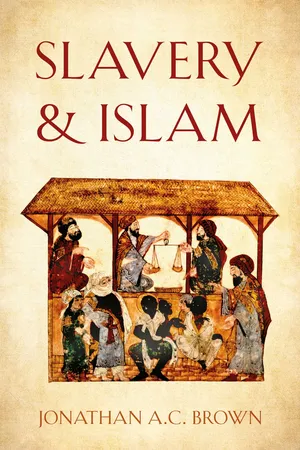
About this book

What happens when authorities you venerate condone something you know is wrong?

Every major religion and philosophy once condoned or approved of slavery, but in modern times nothing is seen as more evil. Americans confront this crisis of authority when they erect statues of Founding Fathers who slept with their slaves. And Muslims faced it when ISIS revived sex slavery, justifying it with verses from the Quran and the practice of Muhammad.

Exploring the moral and ultimately theological problem of slavery, Jonathan A.C. Brown traces how the Christian, Jewish and Islamic traditions have tried to reconcile modern moral certainties with the infallibility of God’s message. He lays out how Islam viewed slavery in theory, and the reality of how it was practiced across Islamic civilization. Finally, Brown carefully examines arguments put forward by Muslims for the abolition of slavery.
Frequently asked questions

Yes, you can cancel anytime from the Subscription tab in your account settings on the Perlego website. Your subscription will stay active until the end of your current billing period. Learn how to cancel your subscription.
No, books cannot be downloaded as external files, such as PDFs, for use outside of Perlego. However, you can download books within the Perlego app for offline reading on mobile or tablet. Learn more here.
Perlego offers two plans: Essential and Complete
  • Essential is ideal for learners and professionals who enjoy exploring a wide range of subjects. Access the Essential Library with 800,000+ trusted titles and best-sellers across business, personal growth, and the humanities. Includes unlimited reading time and Standard Read Aloud voice.
  • Complete: Perfect for advanced learners and researchers needing full, unrestricted access. Unlock 1.4M+ books across hundreds of subjects, including academic and specialized titles. The Complete Plan also includes advanced features like Premium Read Aloud and Research Assistant.
Both plans are available with monthly, semester, or annual billing cycles.
We are an online textbook subscription service, where you can get access to an entire online library for less than the price of a single book per month. With over 1 million books across 1000+ topics, we’ve got you covered! Learn more here.
Look out for the read-aloud symbol on your next book to see if you can listen to it. The read-aloud tool reads text aloud for you, highlighting the text as it is being read. You can pause it, speed it up and slow it down. Learn more here.
Yes! You can use the Perlego app on both iOS or Android devices to read anytime, anywhere — even offline. Perfect for commutes or when you’re on the go.
Please note we cannot support devices running on iOS 13 and Android 7 or earlier. Learn more about using the app.
Yes, you can access Slavery and Islam by Jonathan A.C. Brown in PDF and/or ePUB format, as well as other popular books in Theology & Religion & Islamic Theology. We have over one million books available in our catalogue for you to explore.

Information

1
Does ‘Slavery’ Exist?
The Problem of Definition
Auda: The Arabs? What tribe is that?
Lawrence: They’re a tribe of slaves. They serve the Turks.
Auda: Well, they are nothing to me.
Lawrence of Arabia (1962)
So goes the fictionalized conversation between the historical figures T. E. Lawrence and Auda Abu Tayi, the great Arab chieftain. A similar cinematic pronouncement was made nearly forty years later, when the protagonist of the science fiction classic The Matrix (1999) learns that humans are living in a computer-generated virtual reality while their bodies generate power for machines. ‘You are a slave,’ our hero is told, ‘like everyone else, born into bondage.’1
These films raise an intriguing question: can one be a slave and not know it? Or, better put, is slavery in the eye of the beholder? Ben-Hur (1959), another blockbuster, had similarly touched on the nature of slavery. The young master Judah Ben-Hur welcomes home his family’s skilled old slave, Simonides. ‘My life belongs to the House of Hur,’ Simonides coos sincerely before asking his master’s permission for his daughter to marry. She too was Judah’s property, Simonides reminds him, ‘born the daughter of your slave.’ ‘When I inherited you,’ Judah rejoins, ‘I inherited a friend, not a slave.’2 The question here is more controversial: can one be a slave and be happy about it?
In 1917, around the same time that Lawrence’s admittedly absurd exchange with Auda would have taken place, the Ottoman wartime government issued a new family law. It introduced restrictions on marriage age that were unprecedented in Islamic law. A particularly outspoken and conservative Muslim jurist named Sadreddin Efendi (d. 1931) wrote a livid response. Muslims should know, he wrote, that this law would deprive them of their God-given rights under the Shariah and make them slaves (köleler) of the state.3 This was an ironic complaint. Through the late 1800s, the upper administration of the Ottoman Empire had been in the hands of a bureaucratic class who were actually called ‘slaves’ (kullar).4 But these ‘slave’ bureaucrats were ‘slaves’ in name only. Their title was merely a vestige of earlier times, when the master–slave relationship had been how the Ottoman rulers expressed and maintained loyalty and sovereignty. In fact, earlier Ottoman political writings had often used the phrase kul (slave) to convey what European authors after the sixteenth century expressed as citizen or subject.5
The Ottoman Empire was not alone in relying on the idiom of slavery. The soldiers and administrators of China’s Manchu Qing dynasty (1644–1912) were also technically slaves (aha) of the dynasty and proudly referred to themselves as such. By the later Qing period, the title of slave was applied to anyone of Manchu descent in imperial China. But neither Ottoman subjects nor Qing Manchus lived in any servile condition.6 Here we face a third, thorny question about slavery: what makes one a slave? Is it a label or a reflection of one’s actual conditions?
Writing at the twilight of the Victorian era, of the Ottoman and the Qing empires alike, the Irish polymath John Kells Ingram (d. 1907) complained that ‘careless or rhetorical writers use the words “slave” and “slavery” in a very lax way.’ Tacking this complaint to the end of his influential 1895 history of slavery, Ingram did not have in mind Ottoman or Manchu lexical laxity. He was objecting to activists in Britain who were railing against the ‘subjection of women’ by equating it to slavery or protesting over workers toiling as ‘wage-slaves.’7 This was preposterous, he scoffed. Neither wives nor workers were subjected to serious mistreatment.8
A century later, in Fight Club (1999), the charismatic Tyler Durden disagreed. We are all ‘slaves with white collars,’ he tells his disgruntled disciples in the film, laboring for a capitalist system, pacified and driven mad simultaneously by our quest to buy ‘shit [we] don’t need.’9 A British labor rights activist could not have described the situation better. Ingram and Durden pose our fourth and final question: who gets to decide when the word ‘slave’ is used, who counts as a slave and who does not?
Slavery is the ritual dictum of power. It is the metaphor and reality of domination, subordination and dependence. In practice, the word and its trove of connected images can be applied anywhere there is an asymmetry of power. Like an incantation, it can be directed upwards in reverence to pledge loyalty and assure belonging, as Simonides did with Ben-Hur. It can be invoked to critique domination or the usurpation of control, as with Sadreddin Efendi’s objections. It can be used to alert others to their own powerlessness, as in the case of Lawrence and Auda. Or it can be shouted to protest one’s own exploitation, as done by the activists who so annoyed Ingram. ‘Slavery’ can be deployed and inverted to communicate dominance and indomitability, having right or having being wronged. The final chorus ‘Rule, Britannia! Britannia, rule the waves! Britons never, never, never shall be slaves’ still reverberates with imperial pride. But it was first sung in 1740 in artistic opposition to the misguided policies of Britain’s own government.10 It became the rallying cry of an empire that helped bring the power imbalance of global slavery to its acme all while celebrating the imperial nation’s impunity from subservience.
From ancient times through the heyday of the British Empire, the power of slavery was the very undeniability of domination and control. Yet before ‘Rule, Britannia!’ was a century old, influential voices within the British elite had turned ‘slavery’ from an index of power to a signifier of the ultimate injustice. Since the tipping point into abolition in the mid-nineteenth century, the power of ‘slavery’ has been the moral force of the word. It comes not from exploiting labor but from labeling specific practices and institutions with the mark of moral barbarism. Whoever controls its application determines whose suffering and subjugation matters enough to merit the brand of absolute moral condemnation that ‘slavery’ carries.
As our above examples from films, legal writing and social criticism all show, ‘slavery’ is a word that is easy to use but very hard to define. This difficulty stems from the very function and history of the word itself. For many centuries defining slavery was unimportant. When a person or a group manifestly dominated another person or group, there was little need to define what was happening. Definitions of slavery in Roman law were both brief and sparse because Roman jurists assumed it was an obvious reality that needed only to have its details described at times. It did not need to be theorized.11 Similarly, as far as I know, there are no legal definitions of slavery offered by Muslim jurists within the first three centuries of Islam.12 Defining ‘slavery’ becomes important only when the reality of its domination begins chaffing at important moral or, in the Islamic case, theological principles. It is contested only when the word acquires a moral force separate from the reality of domination, as occurred after the victory of abolitionism in the nineteenth century. Since then, to invoke ‘slavery,’ to call something ‘slavery,’ is to make a powerful moral claim about the nature of reality. We cannot understand this without investigating what lies behind and within this process of definition and contestation.
The Main Argument
In this chapter I argue that there is no definition of slavery that covers everything we scholars in the West want to call slavery while excluding those things we do not want to call slavery. This is because the notion of ‘slavery’ as a transhistorical, global reality spanning centuries and civilizations is a projection of Western scholarship, which often seeks to fit the great variety of human experiences into its own categories, along with their accompanying judgments. The contemporary notion of ‘modern-day’ slavery is ethically admirable and aids the present and future pursuit of justice. But when projected backwards into history, its shadow is anachronistically all-encompassing. And its use in the present suffers from the same political biases and blindness as the study of slavery in the transhistorical past.
This does not mean, of course, that slavery did not or does not exist. Slavery as we understand it existed in Western civilization, and institutions similar to it have existed elsewhere. There have been in various times and places in history phenomena that have borne some degree or another of similarity to what we understand as slavery. But though they might resemble our understanding of slavery, they were not by any means the same thing. To place them in a category we have shaped according to our own historical memory and to brand them with the same moral judgment is inaccurate and imposing. More importantly, deploying the term ‘slavery’ is an eminently political act, meaning that it turns on certain communities deciding whose suffering or exploitation is worth marking out as unconscionable, whose exploitation or abuses are called out and whose remain anonymous.
Definition: A Creative Process
The other day my wife asked me if I had cleaned the tables in the kitchen. I responded, ‘What do you mean by tables?’ (we don’t have tables in our kitchen). ‘The countertops,’ she replied with a smile. ‘Well, that depends what you mean by “cleaned”,’ I answered, deploying air quotes. That was not a wise response.
This short exchange presented two challenges. First, since my wife grew up speaking Arabic at home, sometimes when she talks about domestic matters she translates in her head from Arabic into English. The Arabic dialect she grew up speaking does not have a distinct word for countertop. It is just a ‘table’ (āwila). So, when I asked her to define what she meant by that, she had to reconsider the linguistic equation that had gone through her head. ‘Tawila = table’ had to be refined (and redefined) as ‘tawila in this case = countertop.’ This is an instance of nominal definition, or defining words and what they mean, which we do when we write dictionaries but also when we translate from one language to another. As the case of tawila/countertop shows, there is often not a one-to-one equivalency between words in different languages. This has consequences. If my wife had asked me to clean all the ‘tables’ in the house before guests came over, I would not have understood that as applying to countertops. It would mean tables in the dining room, etc.
The second challenge in this exchange was a matter of real definition, or of defining things that we consider to be real outside of language and expression, either in the sense of a tangible, material reality or in the sense of a real concept or idea. Certainly, languages differ in their words for ‘clean.’ But that was not what was at issue in my second question or my wife’s distinct displeasure with it. The issue was that my definition of ‘clean’ for kitchen counters is that all the food, etc., has been put away and that there are no visible spills or noticeable chunks of food on the countertops. For my wife, ‘clean’ countertops have been sprayed with cleaner and wiped down. My wife was (justifiably) annoyed by my response because this was not a problem of translation. For her ‘cleanliness’ was a reality that should be grasped by any reasonable, well-adjusted person.
Yet, of course, ‘cleanliness’ is not a distinct reality, existing ‘out there’ in the world and graspable by all. It is a concept defined by groups of people and, more appropriately, by different cultures and subcultures. American travelers in Japan find that US standards for a ‘clean’ restaur...

Table of contents

  1. Cover
  2. Title Page
  3. Contents
  4. Preface
  5. Acknowledgments
  6. Notes on Transliteration, Dates and Citation
  7. Dedication
  8. Epigraph
  9. Introduction
  10. 1 Does ‘Slavery’ Exist? The Problem of Definition
  11. 2 Slavery in the Shariah
  12. 3 Slavery in Islamic Civilization
  13. 4 The Slavery Conundrum
  14. 5 Abolishing Slavery in Islam
  15. 6 The Prophet & ISIS: Evaluating Muslim Abolition
  16. 7 Concubines and Consent: Can We Solve the Moral Problem of Slavery?
  17. Appendix 1
  18. Appendix 2
  19. Appendix 3
  20. Appendix 4
  21. Appendix 5
  22. Appendix 6
  23. Image Section
  24. Select Bibliography
  25. Notes
  26. Imprint Page