eBook - ePub
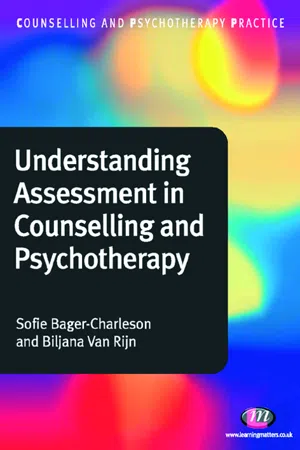
Understanding Assessment in Counselling and Psychotherapy
- 152 pages
- English
- ePUB (mobile friendly)
- Available on iOS & Android
eBook - ePub
Understanding Assessment in Counselling and Psychotherapy
About this book
This book offers students and trainees a thorough guide to clinical assessment. It covers different types of clinical assessment and explores the implications of the alternative views on clients? needs and treatment. It explores clinical assessment as an ?art and science? and brings the reader up to date with new requirements placed on therapists in both organisational and clinical practice based settings. In addition to outlining models for clinical assessment, it looks at the use of evidence-based practice in assessments. There are sections on doing assessments within organisations as well as from private practice.
Information
CHAPTER 1
The role of the assessor in private practice
CORE KNOWLEDGE
- Our first encounters with clients will be explored in the context of ethical and morally binding guidelines for assessment. We will explore the meaning of ‘doing no harm’ and the aim of setting realistic targets.
- What do we think of when seeing clients alone in our homes? This chapter will look at expectations, contracts and the importance of mutual consent.
- How do we assess ‘readiness’ for therapy? Is therapy always the answer? If not, what happens next? We will look at the importance of respecting the clients’ defences and consider if and when a client may be likely to benefit from other forms of support.
- The only ‘tool’ that the therapist brings into the room is themselves, which makes self-awareness such an important part of clinical practice. The term ‘double-loop assessment’ is introduced to help us understand how we can develop a ‘reflexive awareness’ in our practice. Reflexive awareness involves considering how our own underlying personal theoretical and cultural assumptions can affect assessment.
INTRODUCTION
As counsellors and psychotherapists we are expected to notice many things on different levels. Each encounter with a new client is full of competing impressions. Body language, clothing, tone of voice and facial expressions can be as important to a client’s story as their actual verbal account of events. The case study below highlights how our first meeting with a client involves a multitude of messages.
Case study 1.1
There is the sound of a faint cough outside the door.
‘Hmm, have I got the right house?’ asks the man, as the therapist opens the door.
‘Mr Mott?’
The short, rather stocky man in his mid-thirties nods in reply and continues talking while entering the room.
‘Have any of your clients ever gone into the wrong building by mistake?’ he chuckles.
‘Have a seat . . .’
‘Anyway, yes, I am Mr Mott. Call me Jack, by all means.’
Jack is wearing a suit and keeps flicking at some invisible dust on his left thigh. He looks well attended to, with a crisp white shirt and a tie. He sits with his legs wide apart. As he opens his mouth to speak again, tears begin to roll down his cheeks. He looks out of the window and speaks fast, while crying as if the tears have got nothing to do with him – as if they are not there.
‘As I said on the phone, I’ve got a couple of issues at work that I’d like to discuss. There’s been a promotion . . . and, well, I’m also thinking about getting married. It’s the second time around. My first wife attacked me with her high-heeled shoes on our wedding night, so I’d rather avoid going down that route again!’ He chuckles through his tears.
At this stage, the therapist decides to . . .
COMMENT
What would you do at this stage? Would you, for instance, choose to let Jack develop his narratives further, uninterrupted – perhaps hoping to gain information that way about how Jack deals with new situations and people? Or would this be a good moment to change tack and maybe bring out an assessment sheet or address some standard questions, perhaps with a view to considering mutual aims and objectives at the earliest possible stage?
Or is it perhaps likely that a different scenario would have emerged, had you been at the door to meet Jack? Some therapists start their first interview with an assessment questionnaire. Others aim for things to develop more ‘organically’. Some may argue that a relatively unstructured beginning allows valuable information about the client’s way of relating to new situations to be revealed. The way clients choose to address issues such as personal problems, work and relationships may help the therapist gauge how the client relates to priorities and how they organise their lives. Others would argue that this kind of information will come out anyway, and that the first interview is primarily concerned with addressing aims and objectives, reaching a mutual consent and being transparent.
The way we approach our clients varies depending on our modality, personality and general approach to practice. It also varies depending on the setting in which we work. The case study above was written with a middle-aged female private practitioner with a psychodynamic background in mind. It is possible that meeting a middle-aged woman has a particular significance for the client. Perhaps the first moments of the meeting would have developed differently if the therapist had been a thirty-year-old male? Factors such as age, gender, ethnicity and social background affect practice in different ways – not only in the way that the practitioner might pay attention to, and interpret, information but also in the way the client will react. The first impression is important for both parties. Green asserts:
As a counsellor you need to give considerable thought to the client’s perception of you and how it might impact upon the work . . .(Green, 2010, p16)
Regular supervision and personal therapy will help us to explore and monitor what we, as therapists, bring into the sessions. This book is written with that kind of self-awareness in mind. We hope that you will read the book from the perspective of both yourself and your clients, and with consideration to some of the following questions.
- What are you looking for in your first meeting with clients? Why?
- What are your clients likely to encounter (see, hear, feel) during their first interview with you, in your particular practice? Why?
DO WE NEED ASSESSMENT IN PRIVATE PRACTICE?
Working independently and separately from agencies and organisations brings a degree of flexibility. Certainly, private practice can, as Withers (2007, p52) puts it, offer a highly targeted and confidential service tailored to the specific choices, details and dilemmas with which each client presents. Some would argue that there is less need for assessment in private practice in light of the fact that both therapist and client are often prepared for moving straight on to therapy, provided that mutual terms can be negotiated. Withers writes:
It could be argued that there is no need for assessment in private practice as, unlike statutory or agency work, the therapist tends to be assessing those clients whom he or she will continue to see.(2007, p53)
FINANCIAL DYNAMICS
Yet, continues Withers, assessment is inevitable. Any new social encounter involves a mutual scrutiny, and a first encounter in private practice is obviously no different. The notion of choice in private practice can, in fact, as Withers (2007, p50) suggests, involve far greater challenges than those posed for the therapist working within a statutory service. Withers refers to financial dynamics:
For the therapist, decisions made via the assessment process may look as if they are based solely on experienced clinical judgement. However, it is inevitable that the fundamental financial dynamics at the heart of private practice suggest that these will contain unconscious invitations to collude and anxieties about much they can be confronted . . . [O]ur client has actual purchasing power with attendant ability to shop around – and crucially to assess not just trustworthiness but desirability of the therapist as partner in the whole enterprise.(2007, pp52, 50)
LIABILITY
Linked to what Withers refers to as his shadows of the freedom to be vulnerable to mutually seductive and even delusional thinking about what the therapist can offer is the issue of liability in case of client disappointment. It is important, asserts Jenkins (2007), for therapists to be familiar with the difference between personal and vicarious liability. Employers have got a common law duty to protect employees. Jenkins writes:
Employment relationships are key factors in deciding where liability for negligence lies. Where a therapist is employed, or working as if employed by [for instance a] GP practice, then the practice would hold vicarious liability for any mistakes or poor practice. Where the therapist is self-employed . . . then the therapist would be liable for any action brought by a dissatisfied client.(2007, p35)
There are, in other words, both practical issues and arbitrary concerns that rear their heads in private practice. On what basis do I reach consent and form contracts with my clients? How do I frame my decisions ethically, professionally and personally? What happens if the client is disappointed with the outcome? How can good practice and safety for both clients and the therapist be catered for, when we work in isolation, often from home?
THE DOUBLE-LOOP ASSESSOR – ASSESSING OUTSIDE THE BOX
As the Jungian analyst Guggenbühl-Craig (2009) points out, the only actual ‘tool’ that the therapist brings into the room is themselves. In the light of this, Guggenbühl-Craig stresses the importance of honesty and self-awareness:
We work with our own psyche, our own person, without instruments, methods of technology. Our tools are ourselves, our honesty, our own personal contact with the unconscious and the irrational . . .(2009, p73)
In private practice we are often free to choose peers and supervisors. The invaluable input from others can sometimes be reduced to feedback from a group of people who think and feel like ourselves.
ACTIVITY 1.1
The term ‘critical friend’ is a concept often used in reflective practice. Beverly Taylor defines ‘critical friend’ thus:
A critical friend . . . is someone you tr...
Table of contents
- Cover
- Title
- Copyright
- Contents
- Foreword
- Acknowledgements
- About the authors
- Introduction
- Chapter 1 The role of the assessor in private practice
- Chapter 2 ‘Diagnosing’ problems
- Chapter 3 Treatment – illuminating shaded areas?
- Chapter 4 Assessment in organisations: an overview
- Chapter 5 Conducting an assessment
- Chapter 6 Assessment skills
- Appendix 1 Initial assessment form used by the Metanoia Counselling and Psychotherapy Service
- References
- Index
Trusted by 375,005 students
Access to over 1.5 million titles for a fair monthly price.
Study more efficiently using our study tools.
Frequently asked questions
Yes, you can cancel anytime from the Subscription tab in your account settings on the Perlego website. Your subscription will stay active until the end of your current billing period. Learn how to cancel your subscription
No, books cannot be downloaded as external files, such as PDFs, for use outside of Perlego. However, you can download books within the Perlego app for offline reading on mobile or tablet. Learn how to download books offline
Perlego offers two plans: Essential and Complete
- Essential is ideal for learners and professionals who enjoy exploring a wide range of subjects. Access the Essential Library with 800,000+ trusted titles and best-sellers across business, personal growth, and the humanities. Includes unlimited reading time and Standard Read Aloud voice.
- Complete: Perfect for advanced learners and researchers needing full, unrestricted access. Unlock 1.5M+ books across hundreds of subjects, including academic and specialized titles. The Complete Plan also includes advanced features like Premium Read Aloud and Research Assistant.
We are an online textbook subscription service, where you can get access to an entire online library for less than the price of a single book per month. With over 1.5 million books across 990+ topics, we’ve got you covered! Learn about our mission
Look out for the read-aloud symbol on your next book to see if you can listen to it. The read-aloud tool reads text aloud for you, highlighting the text as it is being read. You can pause it, speed it up and slow it down. Learn more about Read Aloud
Yes! You can use the Perlego app on both iOS and Android devices to read anytime, anywhere — even offline. Perfect for commutes or when you’re on the go.
Please note we cannot support devices running on iOS 13 and Android 7 or earlier. Learn more about using the app
Please note we cannot support devices running on iOS 13 and Android 7 or earlier. Learn more about using the app
Yes, you can access Understanding Assessment in Counselling and Psychotherapy by Sofie Bager-Charleson,Biljana van Rijn in PDF and/or ePUB format, as well as other popular books in Psychology & Psychotherapy Counselling. We have over 1.5 million books available in our catalogue for you to explore.