- 184 pages
- English
- ePUB (mobile friendly)
- Available on iOS & Android
eBook - ePub
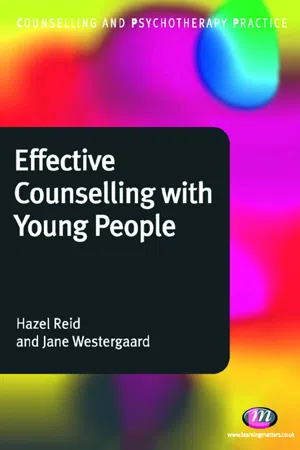
Effective Counselling with Young People
About this book
This book examines key theoretical counselling perspectives and applies these specifically to work with young people. It establishes how to build counselling relationships in order to support young people and enable them to achieve positive outcomes and to manage their lives effectively. It also identifies the key counselling skills needed to engage in purposeful, helping conversations. There are sections on understanding adolescent development, exploring person-centred principles and understanding and using motivational interviewing - all of which help to blend academic theory with the realities of practice.
Information
CHAPTER 1
Understanding adolescent development
CORE KNOWLEDGE
By the end of this chapter you will have the opportunity to:
- identify the key stages of physical development in adolescence;
- explain the significance of cognitive development in adolescence;
- consider the impact of a range of psychological and emotional factors during adolescence;
- reflect on the implications of adolescent development when counselling young people.
INTRODUCTION
The period known as ‘adolescence’ is perhaps one of the most turbulent, unsettling, yet exciting that we experience in our lives. The gradual move from a state of dependence on parental and authority figures and the relative ‘safety’ of childhood, to separation and the independence and autonomy of adulthood can be an uncertain journey. This journey can be fraught with hidden dangers, pitfalls and challenges. Significant changes are taking place, and the consequences of these physical, cognitive and emotional developments during adolescence are likely to have an impact on the decisions that young people make about the way in which they live their lives. It is, therefore, important that counsellors working with young people gain an understanding of the key factors that have an impact on the physical, cognitive and psychological development of the young people with whom they engage.
So, before this book moves on to examine specific approaches to counselling practice in detail, this chapter provides a brief introduction to those key elements of adolescent development identified above. As might be expected, there is a plethora of texts which investigate this fascinating and complex area in some depth (Piaget, 1954; Bowlby, 1969; Kohlberg, 1984; Steinberg, 1996; Coleman and Hendry, 1999; Kaplan, 2004; Christie and Viner, 2005; Allen and Sheeber, 2008; Boyd and Bee, 2009). It is simply not possible to explore the subject in the same depth here. But what is provided, it is hoped, is a helpful ‘overview’ which could act as a starting point for more detailed investigation into the subject of adolescent growth and development. In addition, the chapter offers some insight into how these physical, cognitive and emotional developments through adolescence are a powerful and significant feature affecting the lives of all young people. The changes that happen at this time will often play a part in influencing and underpinning the issues that young people present in the counselling room.
This chapter starts by identifying the features of physical development which take place in adolescence. It goes on to detail key cognitive changes and finally the chapter examines aspects of adolescent emotional and psychological development. The chapter (like all those in this book) invites you to reflect on how your understanding of adolescent development illuminates and informs your counselling practice.
ACTIVITY 1.1
First, let us take a moment to try to recall what was happening to us in our own adolescence. Reflect on and note down your thoughts under the following headings.
- Between what ages would you say your ‘adolescence’ took place?
- How long did your adolescence last?
- What physical changes took place, and at what age?
- How did your thinking about things change?
- What were the most important events in your life at this time?
- Who were the most significant people in your life?
- Write down five key words to sum up your overriding feelings about yourself during this time.
Of course, for every individual who undertakes this activity, there will be a different response. For some, reflections on adolescence may be painful; for others, recalling that time may engender a warm, hazy glow. For most of us, this period of our lives is likely to produce ambivalent feelings – some positive, others less so. What will almost certainly be true for all is that our adolescence was a distinct and significant time in our lives.
PHYSICAL DEVELOPMENT
During adolescence, our bodies develop and change more visibly perhaps than at any other point in our lives. This can be a welcome and exciting change, but is nonetheless daunting at times. The changes we experience in body shape and a move towards sexual maturity suggest that ‘I am now an adult’ when, for many young people, their emotional and cognitive processes are yet to develop fully. Furthermore, for some young people, adolescence (in terms of physical development) can take place in as little as 18 months, while for others, the process can last up to five years. For numbers of young people this can be unsettling. They see their peers showing the distinctive signs of adulthood, while they still, to all intents and purposes, feel as though they inhabit the body of a child.
Christie and Viner (2005) suggest key biological ‘tasks of adolescence’ through which all young people should develop. The tasks are summarised in Table 1.1.
As this table shows, the pituitary gland is responsible for ‘kick-starting’ these physical changes and its significance should not be underestimated. Indeed, McMaster and Kusumakar (2004) suggest that there is a link between depression in adolescence and dysfunction in the pituitary gland. This is not the sole reason that 18–30 per cent of adolescents experience depression (Saluja et al., 2004); a range of complex issues play a part, but it is a contributing physical factor. As can also be seen from the table above, although both boys and girls experience a growth spurt in adolescence, there is a difference between the sexes in terms of when this growth takes place. In most cases, girls experience their growth spurt earlier (on average by two years) than their male peers. Tanner (1970) suggests that girls in early adolescence are likely to be both taller and heavier than boys of the same age. However, usually by the age of 13 or 14, boys will be ‘catching up’ with their female peers while ‘adult height’ is normally reached between the ages of 15 and 16 for girls, and 16 and 18 for boys (Brooks-Gunn and Petersen, 1984).
| Stage | Boys | Girls |
| Early adolescence (11–12) | Growth of genitals, triggered by the pituitary gland secreting the testosterone hormone. | Development of breast buds and growth of pubic hair, onset of growth spurt, triggered by the pituitary gland secreting the hormone estradiol (a form of oestrogen). |
| Mid-adolescence (13–14) | Onset of growth spurt, first experiences of ejaculation (spermarche), voice breaks, growth of pubic and facial hair. | End of growth spurt, onset of periods (menarche), more rounded body shape as fat is deposited. |
| Late adolescence (15+) | End of body spurt, changes in body shape, increased muscle, body and facial hair continuing to grow. | Puberty normally at an end. |
Table 1.1 Physical development in adolescence
What is clear is that significant physical change takes place over a relatively short time for both boys and girls. This, of course, is likely to have an emotional and psychological impact on young people and this will be examined later in the chapter. It is important to recognise that these changes will also have practical consequences. For example, the period of the growth spurt uses up significant amounts of energy. Ideally, at this time, young people should be sleeping for at least nine hours a night. However, many young people do not sleep for as long as they need. This is an increasing worry, particularly with the advent of computer games, social networking sites and so on, which are often nocturnal activities. In addition, girls starting their periods will need to prepare for and ‘manage’ their monthly bleeding. This can be a difficult and sometimes embarrassing experience as the menstrual cycle can take time to establish, and the regularity and severity of bleeding may change from month to month. Boys will also have to deal with the practical consequences of nocturnal emissions (more commonly known as wet dreams). Kaplan makes an interesting point concerning this particular physical development:
Psychologists know little about the meaning of puberty to boys. Is the occurrence of ejaculation, the expulsion of semen from the penis, as significant for boys as menarche is for girls? Boys receive little information about ejaculation from any source. In fact, boys may actually know more about menarche than about ejaculation.(2004, p65)
Kaplan goes on to suggest that:
Boys are very reluctant to discuss the experience with parents or even friends, and when they do, it is in the form of humour.(2004, p65)
REFLECTION POINT
- Think about the young people you have been working with recently. What kind of issues have they brought to counselling, which, on reflection, are underpinned or influenced by the physical changes that are taking place?
It is likely that, even if at first glance, presenting problems do not appear to be directly connected to the physical changes that take place in adolescence, on closer examination a link can often be found. Geldard and Geldard summarise this point neatly:
These physiological changes occur over a period of time. They happen at different ages and different rates for different young people. Consequently there may be issues for the adolescent who may feel embarrassed, self-conscious, awkward and out of step with their peers who are developing at a different rate. It is therefore not surprising that many adolescents become very anxious about their appearance.(2004, p5)
They go on to explain further:
Biological changes clearly present the adolescent with major challenges. The adolescent has to cope with body changes, which may be disturbing and worrying, and with the emergence of sexual urges tha...
Table of contents
- Cover
- Title
- Copyright
- Contents
- Foreword
- About the authors
- Introduction
- Chapter 1 Understanding adolescent development
- Chapter 2 Examining an integrative approach to counselling young people
- Chapter 3 Exploring person-centred principles and developing counselling skills
- Chapter 4 Embedding multicultural principles and skills into counselling work with young people
- Chapter 5 Using transactional analysis to develop effective communication in counselling young people
- Chapter 6 Understanding how cognitive behavioural approaches can inform counselling practice with young people
- Chapter 7 Using motivational interviewing to engage young people in timely interventions
- Chapter 8 Working with solution-focused approaches for counselling young people
- Chapter 9 Engaging young people through the use of a narrative approach to counselling
- Conclusion
- References
- Index
Trusted by 375,005 students
Access to over 1.5 million titles for a fair monthly price.
Study more efficiently using our study tools.
Frequently asked questions
Yes, you can cancel anytime from the Subscription tab in your account settings on the Perlego website. Your subscription will stay active until the end of your current billing period. Learn how to cancel your subscription
No, books cannot be downloaded as external files, such as PDFs, for use outside of Perlego. However, you can download books within the Perlego app for offline reading on mobile or tablet. Learn how to download books offline
Perlego offers two plans: Essential and Complete
- Essential is ideal for learners and professionals who enjoy exploring a wide range of subjects. Access the Essential Library with 800,000+ trusted titles and best-sellers across business, personal growth, and the humanities. Includes unlimited reading time and Standard Read Aloud voice.
- Complete: Perfect for advanced learners and researchers needing full, unrestricted access. Unlock 1.5M+ books across hundreds of subjects, including academic and specialized titles. The Complete Plan also includes advanced features like Premium Read Aloud and Research Assistant.
We are an online textbook subscription service, where you can get access to an entire online library for less than the price of a single book per month. With over 1.5 million books across 990+ topics, we’ve got you covered! Learn about our mission
Look out for the read-aloud symbol on your next book to see if you can listen to it. The read-aloud tool reads text aloud for you, highlighting the text as it is being read. You can pause it, speed it up and slow it down. Learn more about Read Aloud
Yes! You can use the Perlego app on both iOS and Android devices to read anytime, anywhere — even offline. Perfect for commutes or when you’re on the go.
Please note we cannot support devices running on iOS 13 and Android 7 or earlier. Learn more about using the app
Please note we cannot support devices running on iOS 13 and Android 7 or earlier. Learn more about using the app
Yes, you can access Effective Counselling with Young People by Hazel Reid,Jane Westergaard in PDF and/or ePUB format, as well as other popular books in Psychology & Psychotherapy Counselling. We have over 1.5 million books available in our catalogue for you to explore.