- 176 pages
- English
- ePUB (mobile friendly)
- Available on iOS & Android
eBook - ePub
Supporting Pedagogy and Practice in Early Years Settings
About this book
To achieve EYPS, candidates must understand the Early Years Foundation stage (EYFS), and how to put it into practice. This text supports those on all EYPS pathways to extend their knowledge and understanding of effective pedagogy within the context of the EYFS. It begins by looking at effective practice in the EYFS and how research has informed recent initiatives. It goes on to cover children?s learning and development, safe and stimulating environments and the role of the adult. The text considers how EYPs can support others in their practice to improve the delivery of learning throughout their setting.
Information
1 Introduction
CHAPTER OBJECTIVES
This chapter provides a rationale for the book and introduces the key themes to be addressed within it. ‘Effectiveness’ within Early Years practice, particularly in the delivery of the Early Years Foundation Stage (EYFS) Statutory Framework (DCSF, 2008a) is the central theme. Definitions of Early Years pedagogy are offered within the contemporary context in England and the role of Early Years Professional (EYP) is discussed alongside concepts of ‘effectiveness’ and ‘quality practice’. Reflective tasks are included to support the gathering of evidence required to achieve Early Years Professional Status.
After reading this chapter you should be able to:
- critically appraise the role of the pedagogue and its potential as a model for the role of Early Years Professional in leading delivery of the Early Years Foundation Stage Framework;
- explore concepts of ‘effectiveness’ and ‘high quality’ in the context of Early Years pedagogy and practice;
- begin to apply an understanding of the Early Years Professional Standards to your own role and practice.
Introduction
The role of Early Years Professional is fundamental to the government’s agenda to develop high quality leadership and a high quality workforce . . . [which are] essential for children to get the best possible start from Early Years provision (DCSF, 2008b, p111) Candidates seeking validation for Early Years Professional Status (EYPS) are required to demonstrate that they can meet all 39 Standards through their own personal practice, and also provide evidence that they can lead and support others to do so (CWDC, 2008). This chapter introduces the themes to be addressed in the book and will help you to reflect on your understanding of Early Years pedagogy; it has broad relevance to most of the EYP Standards.
What do we mean by ‘effectiveness’ in EYFS delivery?
This book focuses on practice in the Early Years Foundation Stage (EYFS) and, in particular, what constitutes effective practice. The intention is that EYPs will model the skills and behaviours that promote good outcomes for children, and support and mentor other practitioners in doing so (CWDC, 2009a). The new understanding of Early Years leadership that is embedded in the EYP role has been explored previously (Whalley et al., 2008) and applies directly to supporting effective practice. As an EYP, you will demonstrate:
- reflective and reflexive practice in your own role;
- skills in decision making;
- sound knowledge and understanding of Early Years pedagogy – the holistic needs of all children from birth to five and competence in planning, implementing and monitoring within the framework of the Early Years Foundation Stage framework (DCSF, 2008a);
- strong values of the intrinsic worth of each child and all those in her/his world;
- the ability to role model, lead and support others in high-quality practice;
- the ability to define a vision for practice within a setting;
- competence as an agent of change.
(Whalley et al., 2008, p13)
Indeed, the government recognises that leadership is crucial to effectiveness through its stated commitment to strengthening leadership for learning in the Early Years – focusing on the key role of leaders in building capacity and ensuring high quality learning and development (DCSF, 2008c, p6) This book, then, aims to focus on the challenges and opportunities faced by EYPs in ensuring effective delivery of the EYFS. This assumes an understanding of Early Years pedagogy.
The focus of this book is EYP Standards 7–24, which are clustered under the heading ‘Effective Practice’ (CWDC, 2008), and encompass planning, resourcing, enabling and assessing learning within the EYFS for all the children in the setting:
This group of Standards . . . describes the different facets of EYPs’ practice that promote all children’s well-being, and support and extend their learning and development.(CWDC, 2008: 21)
In this group of Standards, a number of aspects of ‘effectiveness’ are described that are interrelated and link equally to the requirements of the EYFS (DCSF, 2008a). These include values held by practitioners about the children for whom they are responsible and the expectations they have for them (S7); commitment to a safe, stimulating and accessible environment (S8, 17, 19, 20); provision for equality of opportunity (S12, 18); planning and provision of learning experiences (S9, 11, 12, 14, 15 and 16); differentiating provision to meet individual needs (S13, 23); and reviewing and evaluating children’s well-being, learning and development (S10, 21, 22 and 24) (based on CWDC, 2008, p22). Each of these facets of ‘effective practice’ is explored more fully in this book. Reflective tasks and practical tasks are included in each chapter to encourage your engagement with the different aspects of pedagogy covered.
Within the EYFS documentation, you will find a number of direct references to ‘effective practice’ and ‘quality provision’. In the Practice Guidance Sections 1.23–1.29 (DCSF, 2008d) there is a helpful focus on quality improvement, which is characterised by strong, well-qualified leadership promoting inclusive, personalised practice within a safe and stimulating environment. The concept of ‘quality’ is addressed a little later. The Principles into Practice (PiP) Cards (DCSF, 2008e) also include references to ‘effective practice’ that affirm the fundamental beliefs that underpin good Early Years practice. The CD-ROM that accompanies the EYFS pack (DCSF, 2008f) is a rich resource indeed. Make sure you access the additional documentation on ‘effective practice’ provided within this, as this offers valuable supporting guidance for you in building your evidence against the EYP Standards.
PRACTICAL TASK
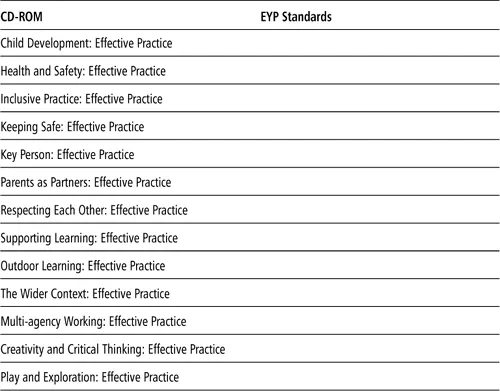
Search for the following ‘Effective Practice’ documents on the EYFS CD-ROM under ‘Resources’ (DCFS, 2008e) and then match them to the relevant EYPS Standards in the table below.
Contemporary understanding of Early Years pedagogy
The title for this book did not come readily or easily to the authors. Early Years pedagogy and the role of ‘pedagogue’ are not words yet in common parlance among practitioners across the majority of Early Years settings. Yet, these are important concepts that have direct relevance to the EYP role and ultimately to the child’s experience within the EYFS. ‘Pedagogy’ (the art or science of teaching) is, at root, a Greek word meaning ‘to lead the child’. McShane (2007, p1) reflects on the implications of this and suggests that the educational process, therefore, is about supporting, walking beside and leading the child. Such imagery is particularly apt for Early Years practice.
Two studies have broadened contemporary understanding of pedagogy within Early Years practice and provision. The outcomes of the Study of Pedagogical Effectiveness in Early Learning (SPEEL), (Moyles et al., 2002a) and Researching Effective Pedagogy in the Early Years (Siraj-Blatchford et al., 2002a) have been highly influential in the development of EYPS. There is opportunity to reflect further on the findings of the SPEEL and REPEY reports in Chapter 2, and to engage with the concept of the role of ‘social pedagogue’, commonly used in parts of Scandinavia, with which the EYP role bears comparison.
Stewart and Pugh (2007) suggest that Early Years pedagogy is:
. . . the understanding of how children learn and develop, and the practices through which we can enhance that process. It is rooted in values and beliefs about what we want for children, and supported by knowledge, theory and experience.(Stewart and Pugh, 2007, cited in DCSF, 2009a, p4)
REFLECTIVE TASK
Begin to think about your understanding of ‘pedagogy’ and use the definition above to reflect on how you view your role as an EYP.
In the next chapter, findings from key national and international research studies are presented to provide the theoretical background to – and empirical evidence for – contemporary understanding of effective pedagogy in the Early Years. There are also reflective tasks to help you see the significance of these for your own role as an EYP.
Children’s learning and development
Over the past decade or so, there has been an almost constant stream of high-quality writing about young children’s learning and development (DCSF, 2009b). Contemporary Early Years practice is indebted to a range of writers who have highlighted the unique significance of the first five years of a child’s life and of providing theoretical underpinning for provision for young children. One of the EYFS themes focuses on ‘Learning and Development’, acknowledging the interconnectedness of these, affirming the key commitments to play-based learning, to children learning actively through physical and mental challenges – including the opportunity to discover connections, and to think critically and ask questions (DCFS, 2008d, 4.1, 4.2, 4.3). Growing understanding of the place of schemas – a pattern of repeatable behaviour into which experiences are assimilated and that are gradually coordinated (Athey, 2007, p38) – in early childhood learning and development has been hugely significant in effective practice, and provides a clear window for practitioners to observe how young children learn.
Standard 2 relates to the EYPs’ detailed knowledge and understanding of the broad developmental stages of children from birth to the end of the EYFS (CWDC, 2008, p15) and is based on the premise that young children are competent learners from birth. So it is important that, as EYPs, you are knowledgeable about normative development from birth to five (and beyond), and about the major supporting theories that underpin this. Equally, it is important that you have a clear grasp that there are significant factors that can affect development: biological, social, cultural and environmental. You will also be required to demonstrate your understanding that children develop at different speeds in different competencies and that you can take account of children who experience developmental delay or who develop in a different way.
In Chapter 3, in particular, the place of play in early learning and development is examined. Few practitioners would question that play and exploration have a central role in early childhood and this is supported by a wealth of research (e.g. Broadhead, 2004; Wood and Atfield, 2005; Broadhead, Howard and Wood, 2010). Indeed, play is a fundamental commitment within the EYFS (DCSF, 2009a). But, what does ‘learning through play’ really mean? What does it look like in practice? And – as EYPs – what is your role in enabling, supporting and resourcing playful learning? Closely linked to these aspects of the EYP role are those of observing, listening to and assessing ...
Table of contents
- Cover
- Title
- Copyright
- Contents
- Foreword from the series editors
- About the authors and series editors
- Acknowledgements
- 1 Introduction
- 2 Perspectives on Early Years pedagogy
- 3 Children’s learning and development
- 4 Meeting the needs of all children
- 5 A safe and stimulating environment
- 6 The role of the EYP in supporting children’s learning
- 7 Sustained shared thinking
- 8 Evaluating effective practice
- 9 Continuing professional development
- Appendix 1: Piaget’s stages of cognitive development
- Appendix 2: Further Piagetian concepts
- References
- Index
Trusted by 375,005 students
Access to over 1.5 million titles for a fair monthly price.
Study more efficiently using our study tools.
Frequently asked questions
Yes, you can cancel anytime from the Subscription tab in your account settings on the Perlego website. Your subscription will stay active until the end of your current billing period. Learn how to cancel your subscription
No, books cannot be downloaded as external files, such as PDFs, for use outside of Perlego. However, you can download books within the Perlego app for offline reading on mobile or tablet. Learn how to download books offline
Perlego offers two plans: Essential and Complete
- Essential is ideal for learners and professionals who enjoy exploring a wide range of subjects. Access the Essential Library with 800,000+ trusted titles and best-sellers across business, personal growth, and the humanities. Includes unlimited reading time and Standard Read Aloud voice.
- Complete: Perfect for advanced learners and researchers needing full, unrestricted access. Unlock 1.5M+ books across hundreds of subjects, including academic and specialized titles. The Complete Plan also includes advanced features like Premium Read Aloud and Research Assistant.
We are an online textbook subscription service, where you can get access to an entire online library for less than the price of a single book per month. With over 1.5 million books across 990+ topics, we’ve got you covered! Learn about our mission
Look out for the read-aloud symbol on your next book to see if you can listen to it. The read-aloud tool reads text aloud for you, highlighting the text as it is being read. You can pause it, speed it up and slow it down. Learn more about Read Aloud
Yes! You can use the Perlego app on both iOS and Android devices to read anytime, anywhere — even offline. Perfect for commutes or when you’re on the go.
Please note we cannot support devices running on iOS 13 and Android 7 or earlier. Learn more about using the app
Please note we cannot support devices running on iOS 13 and Android 7 or earlier. Learn more about using the app
Yes, you can access Supporting Pedagogy and Practice in Early Years Settings by Shirley Allen,Mary E Whalley in PDF and/or ePUB format, as well as other popular books in Education & Early Childhood Education. We have over 1.5 million books available in our catalogue for you to explore.