Understanding the law is now a more important part of youth work practice than ever before, and all successful youth work professionals need to understand the way that law and policy supports good ethical practice.
This book provides a coherent overview of the legal processes and requirements encountered by today's youth work professionals, helping readers learn how to make informed ethical judgements and offer appropriate advice to young people. It offers an insight into how laws are made, explains major legal requirements for safe youth work practice and details a range of guidance on the current frameworks and legislation students and practitioners need to be aware of. Using real world scenarios, case studies, and reflective questions, it helps the reader to engage critically with the current legal context of youth work, and develop their thinking, skills and practice.
This is essential reading for all students working towards professional recognition in work with young people.
- 216 pages
- English
- ePUB (mobile friendly)
- Available on iOS & Android
eBook - ePub
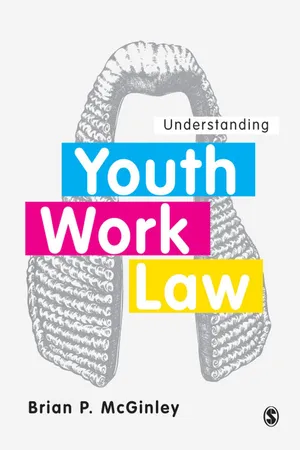
Understanding Youth Work Law
About this book
Information
Publisher
SAGE Publications LtdYear
2014Print ISBN
9781446201862
9781446201855
Edition
1eBook ISBN
9781446297995
PART 1
THE PRINCIPLE OF LAW AND YOUTH WORK
1
LAW, YOUTH WORK AND ETHICS
Chapter Aims
• Introduce the notion of law, youth work practice and ethics
• Discuss the contested nature and different dimensions of youth work
• Demonstrate an understanding of the social and legal interpretation of childhood
• Outline the legal context and operational guidance for the enactment of police powers
• Identify the age restrictions placed on children and young people
• Detail the importance of personal and professional values to developing ethical practice
INTRODUCTION
In simple terms, laws are the rules devised by government and enforced by an administration of justice to keep public order, outline and protect individual freedoms, regulate relationships, detail acceptable standards, and arbitrate on legal disputes. Although there are international laws, which are applicable to all countries in the world, each nation state devises its own laws which are socially and culturally bound. In Europe, for example, citizens are guaranteed the right of liberty, freedom of movement and freedom from discrimination. In England and Wales, there are different classifications of laws: international and national; public (including constitutional, administrative and criminal); and private/civil (including contract, family law, company law and tort).
THE CONNECTION BETWEEN LAW AND YOUTH WORK
At first glance, it may be difficult to see the connection between law and youth work practice other than the need for this social practice to comply with the law of the land in which it operates. However, there is another connection in that both practices provide a distinct societal function which operates along the same continuum. The main aim of the law is to provide for human protection while youth work exists to advocate for human development. The former practice, given its protective task, provides a framework and view that require both case law and new legislation to reflect current and emerging social circumstances, whereas the latter operates best in a developmental creative space which necessarily grapples with the real-life everyday circumstances of the young people it serves. Both practices optimally serve society, in the service of justice and social justice, and work best together when the rules are enriched and integrated with a human developmental understanding.
However, for our purpose here, the law provides an operational context for professional practice with young people. Although youth work is a non-statutory service, it is regulated and directed by a range of legislation, government reports and policies. Work with young people is subject to international and UK national laws, European legislation and policy directives, and shaped by organisational policies and procedures. While all laws will be relevant in particular situations, the main legislative focus for work with young people includes the areas of human rights, social welfare, youth justice, organisational law, management systems, and operational practice. These laws aim to ensure that the right attitudes, protections and procedures are built into the operational planning and practice for safe and enjoyable learning. However, it is also worth noting that the increase in recent legislation around children and young people is, at least in part, due to western societies becoming more risk averse and further aware of people’s rights that are inherent in their understanding of citizenship in a particular society. It is also the case that laws do not always provide sufficient guidance when the principles are translated into reality through youth work practice.
SOCIAL CONTEXT FOR YOUTH WORK AND LAW
It could be asserted that a main rationale for the existence of youth work is that it is a practice which is aimed at a group of people who do not yet have full citizen rights and who need time and space with a significant adult, other than their parents, in which to explore their circumstances and come to a fuller understanding of themselves within the society in which they live. It is also a period of life where young people experience difference and seek the company of peers (Savage, 2007). However, in legal terms, there is not a clear age at which childhood ends and adulthood begins. In fact the laws concerning the rights and responsibilities of children and young people ‘present a complex array of definitions which have been developed by the different institutions of the state, for different purposes and at different moments in history’ (Cole, 1995: 7).
RESTRICTIONS BY AGE
In spite of the law’s increasing recognition of the rights of children over the past fifty years or more, all people under the age of 18 years are legally regarded as children and are restricted by age in the type of actions that they can take. However, discriminating against adults, post 18, on the basis of age restrictions is prohibited by law except in defined circumstances: ‘a proportionate means of achieving a legitimate aim’ (Employment Equality (Age) Regulations 2006). However, it is still deemed appropriate by the state to pay a young person, over 16, less money than the minimum wage for adults and to receive no or reduced levels of social security rates when unemployed.
INCREASED LEGISLATION
In addition, over the past thirty years there has been a significant increase in specific types of legislation aimed at children: for example; the Children Act 1989, 2004; the Protection of Children Act 1999; the Crime and Disorder Act 1998; and the Youth Justice & Criminal Evidence Act 1999. This means that there is increased protection for children’s rights and stricter requirements on local and other authorities to ensure that they are working together and sharing information for the protection of everyone’s rights. In terms of law enforcement, parliament also provides guidance on how members of the public should be treated when an investigation is taking place to determine if a law has been broken.
LANGUAGE USED
At this point, it may be useful to point out that the language we adopt to describe what youth workers do reveals a set of expectations and assumptions which sets the operational position and determines the extent to which we can understand another’s view and practice. This social discourse also affects the ability to reach out and effectively enter into dialogue with the other person and people. This interactive practice is inevitably framed within a societal framework which shapes the values, intentions and judgements that construct a legal, ethical and purposeful practice. It is useful to realise that language is not neutral and that it can be used to maintain unequal power relationships which will be to the detriment or benefit of particular groups (Spender, 1980).
It is important at the outset to be clear that while we would seek practice simplicity and clarity, the operational reality is often more opaque, diverse and complex. It is only by recognising the importance of personal and social development through reading, thinking, acting, reflecting and believing that we may develop experience, further understanding and a useful interpretation of what is perceivably occurring in practice.
Reflective Challenge – Questions
• Do you think that the law is supportive of children and young people?
• With increased legislation, nationally and internationally, over the past fifty years, do you think that children and young people are better protected now than in the past?
Comment
It is clear to me that young people are not prioritised in terms of legislation. Much of the law that related directly to young people in particular is now outdated. Young people would especially benefit from a fresh look at legislation around their status and rights through the development of laws based on capacity rather than age. Obviously, for children, it is vital that they are protected from harm, but evidence suggests that these laws are usually retrospectively based on reviews of cases and that safeguarding policies and procedures are not as effective as they could be.
WHAT IS YOUTH WORK?
In this section the first question which we may usefully consider is this: what is youth work? The answer to this important question will allow us to identify to what we are referring and will provide a framework for our discussion throughout the book. Unfortunately or fortunately, depending on how you view it, there are many different definitions and explanations of what constitutes the practice of youth work. This could be regarded as unfortunate if you are looking for a simple operational definition that will provide a security blanket for practice. On the other hand, you may see this as fortunate if you are a youth worker who finds pre-determined definitions restrictive and is liberated by defining the practice through creative meaningful interactions with young people. However, in spite of your perspective and preference there is an operational context to working with young people which is influenced by the current, dominant views of adults in society as expressed through laws, policies, and acceptable ethical judgements.
DIFFERENT PERSPECTIVES
The nature, extent and purpose of youth work have long been debated and rightly so, because at its best it is a dynamic developmental practice which is both highly disciplined and flexible in the moment. It is a practice which is defined by historical traditions and through legal, social, ethical, economic and political demands (Jeffs and Smith, 2010: 1–3) that delineate the key elements which define youth work: voluntary participation; education and welfare; young people; association, relationship and community; and being friendly, accessible and responsive while acting with integrity. Spence (2006: 48) suggests that youth work has a ‘particular set of difficulties for the status, visibility and naming of the reality of youth practice’. Martin (2006) also holds that there is no generally accepted definition of what the term ‘youth work’ actually means, but advocates for the nature of the youth work relationship as its defining feature. Notably, Merton (2004: 29) identifies that youth work does not operate in a political vacuum, or a neutral social context, which means that ‘its purposes and principal forms of practice will differ as that context changes’ and this provides the flexibility to meet young peoples’ needs. In addition, Banks (2010) helpfully recognises three senses of youth work: as activities with young people; as a specialist profession; and as an academic discipline.
TEN KEY ELEMENTS
Davies (2010a: 1-6), drawing on historical and current sources, identifies ten key elements of youth work which help to define it. These are: voluntary involvement; starting from where young people are at; developing trusting relationships; tipping the balance of power and control in favour of young people; working with diversity and responding equally; promoting equality of opportunity and diversity; working through friendship groups; youth work as process; reflective practice; and disciplined improvisation. However, while this recognition of various aspirations and actions is helpful in articulating that youth work is not a singular practice, it does not recognise the broader human developmental and jurisdictional aspects of the practice.
Davies (2010b) is writing mainly for a UK audience that would recognise youth work in terms of informal education, which explains why the practice identified elicits educative intent through its voluntary nature, personal attributes for personal development, and a flexible approach to meet learning needs. In other parts of the world, youth work has a different purpose and perspective. For example, within the European Union, youth practice is tied up with an understanding of social pedagogy, and in the USA, youth work is largely synonymous with youth development which can be more interventionist and programme-focused with a remedial orientation. What is common to all these practices, across the world, is that they are shaped within a context and operate within the parameters of statutory laws and the implementation of policies.
FLEXIBLE INTERPRETATIONS
Youth work approaches need to transcend such definitional limits: these attempt to define the boundaries of practice because the circumstances and needs change over time, and youth policy in particular has articulated a range of contradictory expectations and requirements over the past century. We need a description of youth work practice which analyses the different types of practises generated that not only explains different elements but also places the practice in a historical, socially and politically aligned setting tied to a defined purpose.
For example, Coburn and Wallace (2011) identify three different practice traditions that represent a type of youth work: functional youth work, which essentially performs a socialisation function by working with young people who need to be fixed in some way; liberal youth work, which is open and developmental with negotiated activities and longer-term relationships with the location and the youth workers; and critical youth work, which recognises and builds on the capacities of young people, recognising the inherent injustices in society and encouraging them to participate in that society as part of their democratic and human rights. These are useful distinctions because each type is closely aligned to a purpose and set...
Table of contents
- Cover
- Halftitle
- Advertisement
- Title
- Copyright
- Contents
- Dedication
- About the author
- Part 1 The Principle of Law and Youth Work
- Part 2 The Application of Law in Youth Work
- Appendix 1 Draft Example – Health and Safety Induction Checklist
- Appendix 2 Record of Drug/Medication Administration Form
- Appendix 3 Accommodation Risk Assessment Checklist
- Index
Trusted by 375,005 students
Access to over 1.5 million titles for a fair monthly price.
Study more efficiently using our study tools.
Frequently asked questions
Yes, you can cancel anytime from the Subscription tab in your account settings on the Perlego website. Your subscription will stay active until the end of your current billing period. Learn how to cancel your subscription
No, books cannot be downloaded as external files, such as PDFs, for use outside of Perlego. However, you can download books within the Perlego app for offline reading on mobile or tablet. Learn how to download books offline
Perlego offers two plans: Essential and Complete
- Essential is ideal for learners and professionals who enjoy exploring a wide range of subjects. Access the Essential Library with 800,000+ trusted titles and best-sellers across business, personal growth, and the humanities. Includes unlimited reading time and Standard Read Aloud voice.
- Complete: Perfect for advanced learners and researchers needing full, unrestricted access. Unlock 1.5M+ books across hundreds of subjects, including academic and specialized titles. The Complete Plan also includes advanced features like Premium Read Aloud and Research Assistant.
We are an online textbook subscription service, where you can get access to an entire online library for less than the price of a single book per month. With over 1.5 million books across 990+ topics, we’ve got you covered! Learn about our mission
Look out for the read-aloud symbol on your next book to see if you can listen to it. The read-aloud tool reads text aloud for you, highlighting the text as it is being read. You can pause it, speed it up and slow it down. Learn more about Read Aloud
Yes! You can use the Perlego app on both iOS and Android devices to read anytime, anywhere — even offline. Perfect for commutes or when you’re on the go.
Please note we cannot support devices running on iOS 13 and Android 7 or earlier. Learn more about using the app
Please note we cannot support devices running on iOS 13 and Android 7 or earlier. Learn more about using the app
Yes, you can access Understanding Youth Work Law by Brian P. McGinley,Author in PDF and/or ePUB format, as well as other popular books in Social Sciences & Social Work. We have over 1.5 million books available in our catalogue for you to explore.