Statistical Methods for the Social and Behavioural Sciences
eBook - ePub

Statistical Methods for the Social and Behavioural Sciences

A Model-Based Approach

  1. 472 pages
  2. English
  3. ePUB (mobile friendly)
  4. Available on iOS & Android
eBook - ePub

Statistical Methods for the Social and Behavioural Sciences

A Model-Based Approach

About this book

Statistical methods in modern research increasingly entail developing, estimating and testing models for data. Rather than rigid methods of data analysis, the need today is for more flexible methods for modelling data.

In this logical, easy-to-follow and exceptionally clear book, David Flora provides a comprehensive survey of the major statistical procedures currently used. His innovative model-based approach teaches you how to:

  • Understand and choose the right statistical model to fit your data
  • Match substantive theory and statistical models
  • Apply statistical procedures hands-on, with example data analyses
  • Develop and use graphs to understand data and fit models to data
  • Work with statistical modeling principles using any software package
  • Learn by applying, with input and output files for R, SAS, SPSS, and Mplus.

Statistical Methods for the Social and Behavioural Sciences: A Model Based Approach is the essential guide for those looking to extend their understanding of the principles of statistics, and begin using the right statistical modeling method for their own data. It is particularly suited tosecond or advanced courses in statistical methods across the social and behavioural sciences.

Tools to learn more effectively

Saving Books

Saving Books

Keyword Search

Keyword Search

Annotating Text

Annotating Text

Listen to it instead

Listen to it instead

1 Foundations of Statistical Modeling Demonstrated with Simple Regression

Chapter overview

The major objective of this chapter is to develop an understanding of the principles of statistical modeling in general and the simple linear regression model in particular. These principles provide a conceptual foundation for the remainder of the text. The main topics of this chapter include:
  • Definition and description of statistical modeling as a guiding theme for the text
  • Perspective on effect-size meaning and significance testing used in this book
  • Orientation toward the simple linear regression model
  • The intercept-only model as a model against which to compare the simple linear regression model
  • Foundational principles for simple linear regression
  • Specification and estimation of the simple linear regression model
  • Statistical inference with the simple linear regression model
  • Dichotomous variables in simple linear regression
  • Basic concepts for regression diagnostics as they pertain to simple linear regression
  • Outliers and unusual cases from the perspective of simple linear regression
Table 1.0
Table 1

What is a statistical model?

A trivial example

Before formally defining statistical model, I will begin with a trivial example model that demonstrates some of the fundamental ideas about models. Growing up in the United States, I became accustomed to thinking about temperature on the Fahrenheit scale. I know how chilly 40°F is, and I know how warm 75°F is. In Canada, where I now live, temperature is usually reported on the Celsius scale. Unfortunately, I do not automatically have a good sense of what a temperature such as 13°C feels like (should I wear a jacket if I go outside?), so I find that I am constantly converting temperatures reported in Celsius into the approximate Fahrenheit temperature in my head. Of course, there is a known, precise relation between °F and °C, but the conversion isn’t always easy for me to calculate in my head, so I use an approximation that I can calculate quickly. Specifically, I multiply the temperature in °C by two and add 30 to arrive at a value that I know is at least near the temperature in °F.
This approximation is my model for °F given the reported °C, and it can be expressed using the following mathematical equation:
Equation 1
The hat symbol (^) over F on the left-hand side of the equation indicates that the formula produces a predicted value for °F given a particular value for °C. That is, the value for °C is known, or observed, whereas the value for
Equation 2
is unobserved. (The predicted value is also known as the model-implied or fitted value.) So if I am told that it is 13°C outside and I am wondering whether I should wear a jacket, then I can quickly calculate
Equation 3
Thus, my predicted value for the temperature on the Fahrenheit scale is
Equation 4
= 56, which is not terribly cold but chilly enough that I will probably put on a jacket.
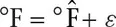
Now, I know that my model does not usually produce the actual, precise value for °F given some temperature in °C. That is, deriving the true °F using this approximation is error-prone, and so another way I can write the model is
Equation 5
where ε is the error term representing the inaccuracy involved in reproducing the true °F using this formula. Next, with some simple algebra, we see that we can substitute Equation 1.1 into Equation 1.2 such that
Equation 6
or
Equation 7
Thus, the error, ε, gives the difference between the true temperature on the Fahrenheit scale (°F) and the temperature on the Fahrenheit scale predicted by the model (
Equation 8
). Equations 1.1 and 1.2 are different ways of expressing the same model for the relation between °C and °F.
All statistical models are like my temperature model in Equation 1.1 in that they generate predicted values for some outcomes but do so with error. Of course there is an established, true relation between the Fahrenheit and Celsius scales, specifically
Equation 9
Note that Equation 1.4 is not really a model because there is no error term; given a value for °C, we can use Equation 1.4 to calculate the exact, true value for °F.
We can also use Equation 1.4 to evaluate the quality of the model expressed in Equations 1.1 and 1.2. That is, we can use Equation 1.4 to calculate values for the model’s error term, ε, across different values of °C; in other words, we can use Equation 1.4 to find out how well our predicted values,
Equation 10
, reproduce the true values, °F. For example, if it is 0°C outside (i.e., the temperature at which water freezes), the true °F is 1.8(0) + 32 = 32°F, but the model’s predicted value is 2(0) + 30 = 30°
Equation 11
. Thus, the model is inaccurate by 2°F, or using Equation 1.3, we have ε = 32 − 30 = 2. So although it’s not precise, the model does a reasonably good job of predicting °F when °C is 0, or freezing. But how well does the model do when, for example, it’s 13°C? Will the model lead to me being too warm in a light jacket, or will I wish that I had put on something heavier? Again, using Equation 1.4, the true °F corresponding to 13°C is 55.4°F, and now ε = −0.6, which is reasonably accurate given the model’s purpose; that is, I am unlikely to regret my decision to wear a jacket.
To get a more complete picture of how good the model is across a wider range of values for °C, we can plot Equations 1.1 and 1.4 in the same graph, as shown in Figure 1.1. I have chosen a range of −15°C to 45°C for the x-axis to represent the wide range of outside temperatures experienced in a given year in North America (having lived in Phoenix, Arizona, and Toronto, I am familiar with both extremes). Clearly, Equations 1.1 and 1.4 are both equations for straight lines but with different intercept and slope values. But in the figure, we see that the lines cross above 10°C, where both the predicted value
Equation 12
and the true value °F equal 50. Thus, for 10°C, the model perfectly reproduces the true °F (i.e., ε = 0). To the left of 10°C, the line for the predicted values is below the line for the true values, indicating that when the temperature is below 10°C, the model underestimates the true °F and the corresponding values for the error term ε are all positive. To the right of 10°C, the predicted line is above the true line, indicating th...
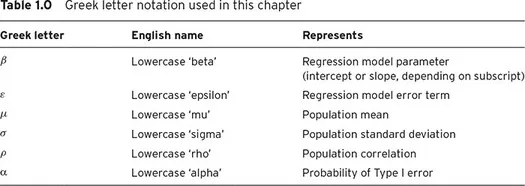
Table of contents

  1. Cover
  2. Half Title
  3. Publisher Note
  4. Title Page
  5. Copyright Page
  6. Acknowledgements
  7. Contents
  8. Online Resources
  9. About the Author
  10. Acknowledgements
  11. Preface
  12. 1 Foundations of Statistical Modeling Demonstrated with Simple Regression
  13. 2 Multiple Regression with Continuous Predictors
  14. 3 Regression with Categorical Predictors
  15. 4 Interactions in Multiple Regression: Models for Moderation
  16. 5 Using Multiple Regression to Model Mediation and Other Indirect Effects
  17. 6 Introduction to Multilevel Modeling
  18. 7 Basic Matrix Algebra for Statistical Modeling
  19. 8 Exploratory Factor Analysis
  20. 9 Structural Equation Modeling I: Path Analysis
  21. 10 Structural Equation Modeling II: Latent Variable Models
  22. 11 Growth Curve Modeling
  23. References
  24. Index

Frequently asked questions

Yes, you can cancel anytime from the Subscription tab in your account settings on the Perlego website. Your subscription will stay active until the end of your current billing period. Learn how to cancel your subscription
No, books cannot be downloaded as external files, such as PDFs, for use outside of Perlego. However, you can download books within the Perlego app for offline reading on mobile or tablet. Learn how to download books offline
Perlego offers two plans: Essential and Complete
  • Essential is ideal for learners and professionals who enjoy exploring a wide range of subjects. Access the Essential Library with 800,000+ trusted titles and best-sellers across business, personal growth, and the humanities. Includes unlimited reading time and Standard Read Aloud voice.
  • Complete: Perfect for advanced learners and researchers needing full, unrestricted access. Unlock 1.4M+ books across hundreds of subjects, including academic and specialized titles. The Complete Plan also includes advanced features like Premium Read Aloud and Research Assistant.
Both plans are available with monthly, semester, or annual billing cycles.
We are an online textbook subscription service, where you can get access to an entire online library for less than the price of a single book per month. With over 1 million books across 990+ topics, we’ve got you covered! Learn about our mission
Look out for the read-aloud symbol on your next book to see if you can listen to it. The read-aloud tool reads text aloud for you, highlighting the text as it is being read. You can pause it, speed it up and slow it down. Learn more about Read Aloud
Yes! You can use the Perlego app on both iOS and Android devices to read anytime, anywhere — even offline. Perfect for commutes or when you’re on the go.
Please note we cannot support devices running on iOS 13 and Android 7 or earlier. Learn more about using the app
Yes, you can access Statistical Methods for the Social and Behavioural Sciences by David B. Flora in PDF and/or ePUB format, as well as other popular books in Social Sciences & Social Science Research & Methodology. We have over one million books available in our catalogue for you to explore.