eBook - ePub
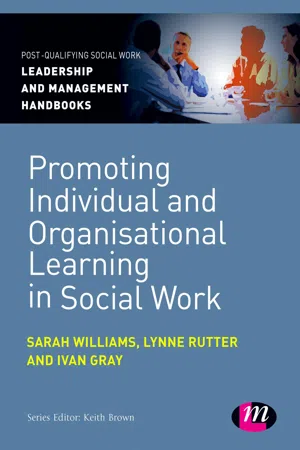
Promoting Individual and Organisational Learning in Social Work
- 136 pages
- English
- ePUB (mobile friendly)
- Available on iOS & Android
eBook - ePub
Promoting Individual and Organisational Learning in Social Work
About this book
In today?s performance driven environment, maintaining service quality in social work is more important than ever. This book will help social work leaders and managers to understand the role that personal and organisational learning plays in the provision of services that are effective and responsive to the needs of service users, carers and the communities. Recent national policy drivers such as the Munro Review into Child Protection (2011) and the recommendations of the Social Work Reform Board (2010) have strengthened the need to embed and enable learning within the workplace. This book is part of a Leadership and Management series which enables managers to understand this need, and respond in a timely and effective way.
Information
Publisher
Learning MattersYear
2012Print ISBN
9781446266915
9781446266908
Edition
1eBook ISBN
9781446281291
Chapter 5
Communities
of practice
Engagement in social practice is the fundamental process through which we learn and become who we are.
(Wenger, 1998)
In Section One we established the importance of learning that moves beyond the individual and impacts on the way that organisations and, indeed, groups of organisations function. In this chapter we will look at how social learning supports and enhances opportunities for individuals to learn and provides an effective vehicle for improving wider learning and communication within and across organisational boundaries.
By exploring and evaluating a form of social learning – a community of practice (Lave and Wenger, 1991) – we will consider your role as a manager or leader in enabling professionals to learn through engagement with others who have shared interests and/or common experiences. This could be through involvement in setting up a new community of practice to meet an identified learning need or by improving the way that an existing community functions. Although social learning happens naturally in most organisations, modern working practices can act as barriers to the process. Before we move on to look at some of the key ideas and methods that you can adopt to enable learning through communities of practice, it may be helpful for you to take a few moments to reflect on your work environment and the impact that the following may have on your organisation’s capacity to enable social learning to occur.
- The culture for learning within the organisation. Note: managerialist, top-down and risk-averse cultures tend to stifle critical reflection, limit engagement from workers with creativity and block learning (Beddoe, 2009).
- Opportunities to meet people with shared interests and experiences within own organisation. Note: increased home working, shift working and high caseloads are decreasing regular face-to-face contact between workers in some organisations.
- Opportunities to meet people with shared interests and experiences outside own organisation. Note: budget constraints and restrictions on travel in some organisations are reducing opportunities for wider networking.
- The focus and style of contact between individuals – is there a forum for open discussion, critical analysis and evaluation, or are all meetings task-and target-oriented?
- The learning skills, motivation and openness to learning of individual workers.
- The support given by managers and supervisors to value, embed and reinforce learning achieved (Gray et al., 2010a).
- The use of internet-based technology to connect people virtually to supplement, augment or replace face-to-face contact.
Why is social learning important?
If you think back to your first professional job you will be able to list several ways in which you learnt what you were expected to do. An important source of learning was almost certainly the people in your team and a great deal of your initial professional development was probably supported by observation and discussion with colleagues. Although this form of social learning is particularly important in the early stages of our working lives, it continues to be a significant influence at all stages of our careers. In 1991, Lave and Wenger used the term ‘community of practice’ to explain how social (or situated) learning can occur within a work arena when people come together.
Lave and Wenger’s ideas on communities of practice were based on social learning theories (e.g. Vygotsky, 1986) which provided new ways of understanding how people learn. Rather than thinking of knowledge as a fixed entity that could be transferred from one individual to another, social learning theories were based on the premise that knowledge is socially constructed. In other words, what we know is not fixed and certain, but evolves over time and is influenced by the experiences that we have along the way. Exposure to new ideas, experiences and different perspectives changes the way we think and the inherent beliefs of the communities in which we live and work influence our understanding and our values. Lave and Wenger used these ideas to explain why learning from other members of a professional community is such a fundamental part of individual growth. They believed that their model could help people to understand how and why learning takes place and how professional knowledge and capability develop over time. Their work helps us to appreciate just how important it is to provide appropriate social learning opportunities to support the development of social workers’ professional capability and also to strengthen the knowledge and skills base of the organisations that employ them.
What is a community of practice?
Most of us already belong to a number of communities of practice – usually without knowing that we do so! This is because many communities of practice are not explicitly labelled as such and are either informal and naturally occurring, or part of an existing structure such as a team or professional grouping.
According to Wenger et al. (2002), communities of practice are formed by people who are engaged in the process of collective learning in a shared domain of human endeavour.
To be defined as a community of practice the members must:
- have a shared interest or domain;
- interact purposefully together as a community, helping each other and sharing information;
- use their involvement to improve their practice.
Using the above definition you will be able to identify some meetings and other points of contact between individuals in your organisation that could be functioning as communities of practice. Although we don’t normally think of routine meetings and everyday contacts in terms of the learning that can be achieved, it could be argued that they all should be constructed not only to achieve service outcomes but also to maximise opportunities for social learning to occur. Unfortunately, social work’s dominant managerial culture tends to force us to think about meetings primarily as places to pass on information and get tasks done. Although these ‘business objectives’ will justifiably remain a priority in the majority of meetings we attend, focusing some of our attention on the way that people in groups learn together will help us to create a culture for learning and improve the overall quality of the learning that takes place.
Communities of practice offer rich learning opportunities and members can benefit in a number of ways, such as:
- support with problem solving;
- opportunities to discuss approaches to practice;
- opportunities to discuss and evaluate new developments;
- information exchange (top-down, bottom-up and side-to-side);
- recycling and sharing of assets;
- co-ordination and synergy;
- mapping of knowledge and gaps in knowledge;
- opportunities to observe other practitioners or other organisations with a similar role or
Communities can be large or small, confined within organisational boundaries or extended beyond them. As we have already seen, they are not necessarily groups deliberately convened for structured learning (their stated function could be, for example, networking or information exchange or management); they don’t need to be formally constituted, have a fixed membership or even meet face to face. For example, a multi-professional group from a mental health team who meet weekly for a case review meeting or a group of colleagues from different children and families teams who meet informally for coffee quarterly to discuss developments in their field, or even the members of a team who meet up at the end of a day to debrief and share experiences could all be considered to be communities of practice. A group of practice educators who participate in an internet-based chat room to exchange hints and tips about working with students or a monthly drop-in journal club at which workers can share interesting new pieces of research would also meet the definition. Although many communities of practice are naturally occurring with a fluid membership and evolving concerns and remits, others can be more actively set up and managed, e.g. a team meeting, a regional practice educators forum, a monthly interprofessional case review group or an internet-based national community of practice for public sector workers.
As we think about what could be defined as a community of practice we can see that in most workplaces there are multiple opportunities for people to meet with others and learn from the experience. However, we need to question whether all situations in which people work together in groups are functioning as communities of practice and indeed whether appropriate social learning is always an outcome of this type of group membership. Think back to the last team meeting that you attended. What agenda items were covered and what was the nature of the discussion that took place? How much time was spent in open discussion and critical reflection? How did the dynamics and relationships between people in the team impact on the engagement of team members in the discussion and the extent to which individual voices were heard?
Work teams and project groups that are primarily brought together to give and receive information or to get a job done using predetermined strategies and goals may not be functioning as communities of practice. Communication in such groups may be almost exclusively top-down and individual members may feel disempowered and left without a voice. Opportunities for social learning are limited when there is no scope for members to share their experiences and develop their ideas through discussion and debate. At this point it may be worth reflecting on the way that meetings are structured in your organisation and considering whether aspects of those meetings could be developed to support more opportunities for learning and development for both individual participants and the organisation as a whole (e.g. by including more interactive agenda items, slots for people to talk about new ideas and initiatives and by supporting all members to participate in discussions and decision making).
What are the advantages of taking a ‘communities of practice’ approach to learning and development?
In the business world, communities of practice are often seen as ways of increasing productivity by capturing and sharing tacit knowledge and increasing responsiveness to market demands (Wenger et al., 2002). Although in social work we use a different language, effective communities of practice can help organisations achieve similar objectives by enabling them to respond quickly to change. They do this by shortening ‘learning curves’ for individual workers through the sharing of knowledge and experience. They can also improve communication across and between organisations and increase employees’ engagement, motivation and job satisfaction. Because communities of practice foster an open approach to new ideas, they provide increased opportunities for the voice of service users and carers to be heard and for messages about their needs and wishes to be communicated more widely (Gray et al., 2010a). Finally, because there is a focus on critical learning in communities of practice, they provide excellent scaffolding for the development of professional capability, peer learning and networking – seen by the Social Work Reform Board as essential elements of a comprehensive continuing professional development framework (SWRB, 2010).
How do communities of practice arise?
As we have already seen, some communities of practice can be by-products of structures set up for other purposes. Team meetings are a good example of this. Although learning is not the primary purpose of this type of forum, good leadership can support the creation of a culture in which opportunities for social learning are maximised. Other communities of practice arise because individuals or groups recognise that benefits will be gained from linking with other people. Sometimes this recognition will lead to formal efforts being made to establish a community (which may even be labelled as a community of practice) but more often groupings evolve naturally as the need to learn together arises.
Wenger et al. (2002) believe that it is wrong to think in terms of purposefully creating a community of practice; they suggest that a community of practice exists naturally wherever there is a task that involves more than one person. However, these authors acknowledge that the existence of a community per se does not ensure that it provides an effective environment for learning and development – links between individuals can be weak and factors may be in operation, such as individualistic cultures and unequal power, that prevent co-operation and information sharing (Beddoe, 2009). Addressing this issue, Plaskoff (2006) suggests that community-building activities are critical if the potential for communities of practice to support learning within organisations is to be realised. He identified a number of factors which were fundamental to the successful operation of a community of practice, including trust, a sense of belonging, equality and thriving relationships between group members. He pointed out that in traditional hierarchical organisations trust can be undermined by the way that power is distributed and community building blocked by a lack of commitment to joint working. This is supported by a study by Beddoe (2009) which highlighted the fact that practitioners felt that cultures within social care organisations did not support learning effectively. As with learning organisations, communities of practice seem to require new approaches to management and leadership, with democratic and distributed approaches to leadership fitting most appropriately.
What does community building mean?
So, if the simple act of bringing people together does not necessarily result in a successful community of practice, how can a group of people be turned into a community in which learning thrives? Like Plaskoff, Wenger (2006) recognises the importance of community building and suggests an approach which includes the following features.
- Education – helping people understand why communities of practice are important to their work and how they can contribute.
- S...
Table of contents
- Cover Page
- Title
- List of illustrations and activities
- About the authors
- Foreword
- Introduction
- How to use this book
- SECTION ONE
- SECTION TWO
- References
- Index
Trusted by 375,005 students
Access to over 1.5 million titles for a fair monthly price.
Study more efficiently using our study tools.
Frequently asked questions
Yes, you can cancel anytime from the Subscription tab in your account settings on the Perlego website. Your subscription will stay active until the end of your current billing period. Learn how to cancel your subscription
No, books cannot be downloaded as external files, such as PDFs, for use outside of Perlego. However, you can download books within the Perlego app for offline reading on mobile or tablet. Learn how to download books offline
Perlego offers two plans: Essential and Complete
- Essential is ideal for learners and professionals who enjoy exploring a wide range of subjects. Access the Essential Library with 800,000+ trusted titles and best-sellers across business, personal growth, and the humanities. Includes unlimited reading time and Standard Read Aloud voice.
- Complete: Perfect for advanced learners and researchers needing full, unrestricted access. Unlock 1.5M+ books across hundreds of subjects, including academic and specialized titles. The Complete Plan also includes advanced features like Premium Read Aloud and Research Assistant.
We are an online textbook subscription service, where you can get access to an entire online library for less than the price of a single book per month. With over 1.5 million books across 990+ topics, we’ve got you covered! Learn about our mission
Look out for the read-aloud symbol on your next book to see if you can listen to it. The read-aloud tool reads text aloud for you, highlighting the text as it is being read. You can pause it, speed it up and slow it down. Learn more about Read Aloud
Yes! You can use the Perlego app on both iOS and Android devices to read anytime, anywhere — even offline. Perfect for commutes or when you’re on the go.
Please note we cannot support devices running on iOS 13 and Android 7 or earlier. Learn more about using the app
Please note we cannot support devices running on iOS 13 and Android 7 or earlier. Learn more about using the app
Yes, you can access Promoting Individual and Organisational Learning in Social Work by Sarah Williams,Lynne Rutter,Ivan Gray in PDF and/or ePUB format, as well as other popular books in Social Sciences & Social Work. We have over 1.5 million books available in our catalogue for you to explore.