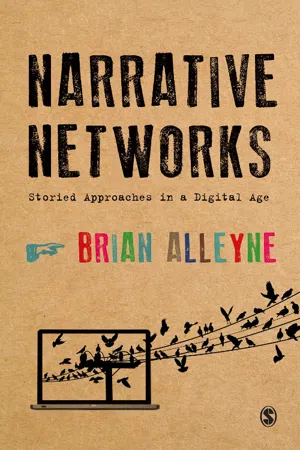
Narrative Networks
eBook - ePub

Narrative Networks

Storied Approaches in a Digital Age

  1. 224 pages
  2. English
  3. ePUB (mobile friendly)
  4. Available on iOS & Android
eBook - ePub

Narrative Networks

Storied Approaches in a Digital Age

About this book

"We are invited to think about the now ubiquitous everyday practices of interpreting and producing narratives across a range of modalities. The result is a text that inspires readers to think in new ways about narratives, invites them to analyse narrative texts available on the Web and, for those who wish, suggests how best to employ specialist software."
- Ann Phoenix, Institute of Education, University of London

"It's high time we have a book like this. Brian Alleyne has managed to produce the best, clearest, and most comprehensive overview of narrative theory for social scientists I have yet to see. I wish I'd had access to a book like this when I was a student. It would have made my life so much easier. It will surely become the universally recognised go-to book on the subject."
- David Graeber, London School of Economics & Political Science

Narrative is a fundamental means whereby we make sense of our own lives and of the world around us. The stories we tell, and are being told, shape our identities, relationships and world-views. In a rapidly changing digital society where blogging and social networking have become fundamental communication channels, the platforms for the creation and exchange of all kinds of narratives have greatly expanded.

This book responds to the dynamic production and consumption of stories of all kinds in popular and academic cultures. It offers a comprehensive discussion of the underlying philosophical and methodological issues of narrative and personal narrative research as well as applying these to the current digital landscape. The book provides practical guidance on data management and use of software for the narrative researcher.

Illustrated with examples from a range of fields and disciplines as well as the author's own work on hacking cultures and cultural activism, this title is a must for anyone wanting to learn about narrative approaches in social research and how to conduct successful narrative research in a digital age.

Trusted by 375,005 students

Access to over 1.5 million titles for a fair monthly price.

Study more efficiently using our study tools.

Information

Year
2014
Print ISBN
9780857027849
9780857027832
Edition
1
eBook ISBN
9781473911376

1 In the Beginning there was the Social Explorer

Overview

Figure 1.1 Chapter Map
Figure 1.1

Key Learning Objectives

  • To survey the use of narrative in late nineteenth- and early twentieth-century sociology and anthropology.
  • To introduce work that shows how social realism influenced journalism and policies of social reform in the nineteenth century.
  • To introduce several pioneers in social research who used narrative in their work.

Introduction

In this first chapter I discuss some of the pioneers of narrative use in the social sciences. Modern sociology and anthropology can be said to have begun as forms of writing. The discoveries, by Europeans it must be stressed, of exotic places and peoples abroad, and of exotic people ‘at home’, were discoveries on paper (Thornton, 1983), by which I mean that these were made as much as they were reported in the texts of the nineteenth-century social surveys and ethnographies that were at the heart of early sociology and social/cultural anthropology. Growing quantities of travel writing and missionary reports met together with the growth of the reading public among the newly expanding middle class in England. The scene was thus set for the emergence of a readership for ethnographic writing. Pioneering ethnographers drew upon existing conventions of realist writing in shaping their accounts of others – other places, other people and other cultures. As with their colleagues in what became social anthropology, the British pioneer social surveyors drew upon realist conventions in shaping their accounts of the lives of the urban underclass. That urban underclass was textually constructed as offering a kind of ‘close to home’ contemporary parallel to the exotic others in colonial spaces. The audiences were again the educated middle classes whose often liberal and reformist worldviews and expectations formed the normative basis on which social surveys were written. Liberal reformers saw a need to generate accounts of the lives of the working class in order to have some empirical basis for social reform.

Sociological Imagination

For C. Wright Mills (1916–1962), the mark of good social science writing was that it sought to understand how the individual biography was related to social and historical forces (Mills, 1959). Of the three elements, two (biography and history) are defining forms of narrative. In order to understand the social, the sociologist must find a way to blend research findings about people, institutions and social change with narratives about individual lives and historical processes. Mills's programme is in a sense humanist in its concern with the individual biography, but it avoids the voluntarism of some forms of humanism by taking into account the way that history and social structures enable and constrain people to different degrees. Mills was broadly on the Left, combining a wide ranging radical standpoint with a suspicion of orthodox Marxism. He was a public intellectual who believed that scholarly work must advance critical understanding of society in order to improve people's lives. The vision of sociology that Mills developed in the course of a relatively short but exceptionally productive career was one which was interdisciplinary long before that term became fashionable in the academy, and well before the cultural turn in the social sciences that emerged in the wake of the cultural revolutions of 1968 (Aronowitz, 2012).
Writing the kind of social study that Mills advocated required social scientists to be mindful of both the technical requirements of communicating their work – The Sociological Imagination is rich with advice on the craft of writing – and the importance of sociologists reflecting on their own biographies, goals, development and place in society. That for Mills sociology was in large measure a textual practice is further seen in his advice that the scholar should keep a journal (see the appendix to Mills, 1959), which is standard in social/cultural anthropology but not in sociology. That journal, as an ever-growing account of the sociologist's intellectual development, was for Mills an essential tool for the craft of research, whatever the methodological perspective of the researcher. Indeed, for Mills the choice of this or that methodological prescription was far less important than the cultivation of the skill of writing because it was the writing that mattered. Writing well, which for Mills was largely a matter of writing clearly, was one of the main means whereby the public service role of the intellectual could be fulfilled. That his work is still popular today is largely explained by his ability to craft work that was theoretically sophisticated, empirically rich, and above all accessible. I believe it was his emphasis on taking seriously the narrative texture of social life that gave his work its analytical and communicative power.

The Narrative of Reform

Let us now consider literary realism in the nineteenth century. This development in letters was linked in complex ways to the coming to prominence of the bourgeoisie in western societies (Morris, 2003; Walder, 1996). I have in mind here principally Britain, the United States, and France: three places where literary realism is seen to have emerged and taken hold most significantly in the nineteenth century. This is not to say that I believe realism was not a characteristic of literature elsewhere in the western or for that matter non-western world at this time, but my focus here is mainly on Britain, and to a lesser extent the USA. Economic growth and the expansion of the middle class led to an expanded reading public, which in turn provided a market that spurred the growth of print culture both in Britain and the United States (Claybaugh, 2007). A virtuous cycle was then set in train in which a steadily expanding class of persons with the desire and means to read brought forth an increasing supply of reading material which in turn fed the expansion of the market that it served. The gradual expansion of education in this period meant that an ever-increasing proportion of the wider population, and not just the middle classes, became literate.
Another important element of this period was the rise of reform movements in Britain and the USA. In Britain, in particular, movements for social reform were in part a reaction to revolutionary developments coming from the continent, most notably France. Fear of revolution motivated the English ruling classes to make some concessions to the working classes. Movements for reform were fed by two streams: the first broadly coming out of a greater acceptance of the possibility of realising the Enlightenment ideals of social progress through science and technology; and the second fed by a revival of evangelical Christianity with its doctrine that individual salvation was available in principle to all believers. Both of these currents made possible the questioning and rejection of the long-established notion of charity, going back to the Middle Ages and before, which constructed notions of the inevitability of poverty and enjoined those who were well-off to alleviate that poverty through charitable giving (Brown, 2014). This notion of charity saw the poor as a part of the social fabric whose very existence was itself part of a divine order and which it would be futile to attempt to eliminate or even alter in any fundamental way. The new reform movements, by contrast, took the view that scientifically and rationally shaped public policy could understand, alleviate and eventually eliminate a whole swathe of social problems that plagued nineteenth-century Britain, most notably the appalling conditions under which the newly urbanised working classes were forced to live in cities such as Manchester and London (Haggard, 2001).
Social reform produced vast quantities of representation in the forms of official reports, statistics, journalistic accounts, sensationalist accounts, and more. Claybaugh (1997) writes that the ‘Novel of purpose’ – a work of fiction with a reforming theme – was a fundamental part of that outpouring of representation that was produced as reform expanded. The survey reports that were arguably the characteristic documentary representation that emerged in the wake of and in support of social reform drew upon narrative techniques developed in the novel of purpose in order to constitute the documentation of social ills. There was a feedback loop between the novel of purpose and the contemporaneous social survey report in that not only did typical social survey reports draw upon realist narrative techniques as used in novels of purpose, but many novels of purpose, especially those with explicit campaigning intent, as in the work of Charles Dickens (1812–1870), were also informed by findings reported in social survey reports of that period.
At the same time as social problems were being invented, represented and politicised in the novel of purpose, another textual discovery was taking place in the far-flung corners of the British Empire. Africa was in a very real sense ‘discovered’ by European travellers’ accounts, missionary documentation, and ethnographies produced throughout the nineteenth century (Thornton, 1983). This exploration of exotic (for Europeans) others and colonial spaces was paralleled by the exploration of exotic others ‘at home’ in London, Manchester and Paris. In most cases the typical explorer was a middle-class educated man driven by an urge to discover and civilise.

Pioneers

The latter half of the nineteenth century was a period when the pioneers of what would become modern sociology and anthropology developed textual forms (ethnographies and survey reports) that employed narrative techniques from realist fiction writing, biography, journalism, travellers’ accounts and missionaries tales. These new ways of representing social reality were employed by the pioneering anthropologists and sociologists in order to open space for their new disciplines in the university. As that space opened these textual pioneers addressed existing audiences and created new ones for their writing. Let us take two early urban explorers: Henry Mayhew (1812–1887) and Frederich Engels (1820–1895), both of whom were active around the middle of the nineteenth century. These two did not intend to carve out a disciplinary space in either sociology or anthropology; neither was an academic, though academics would later be influenced by their work. They used their accounts of urban social problems in London and Manchester to raise public awareness of the darker side of urbanisation, with a view to agitating for gradual social reform (Mayhew) or for revolutionary social change (Engels). Mayhew was a trained journalist and satirist and used these skills to produce a multivolume book, London Labour and the London Poor (2008), which displayed many of the features of social realism to be found in the fiction of for example Dickens: a detailed description of scenes, character sketches, and quotations of overheard speech, to name just a few. In a similar vein Engels, in his Condition of the Working Class in England (1993) employed literary techniques that had much in common with those of the nineteenth-century realist novel: again we have detailed descriptions of places and textual sketches of ordinary people. If narrative was the answer though, then what was the question? What was the problem to which texts such as those produced by Mayhew or Engels were intended to be an answer?
In exploring these questions we have to begin with an overview of the context of industrialising Britain in the mid nineteenth century. In no particular order here are some of the points which are salient to the discussion:
  • The latter half of the century saw the emergence of the social sciences and by the end of that period the beginnings of their institutionalisation within the academy.
  • The latter decades of the century would witness the consolidation of the European colonial and imperial enterprise which would see much of the world come under the political and economic, if not always a social and cultural, domination of a handful of the most powerful Western European nation states.
  • This was also the period which saw the consolidation of nationalism at the capitalist core of the world system.
A vivid account of how Western Europeans saw themselves experiencing modernity is rendered in Marx and Engels's The Communist Manifesto, a text that derived much of its impact from narrative technique. Marx and Engels wrote in the middle of the nineteenth century; all around them the Industrial Revolution was changing the physical and human landscape. They vividly evoke the elements which were shaping the emergent modern Europe: greatly increased trade between European nations; the emergence of a world market created by European colonial expansion and supplied by European products; decisive technological advances such as the invention of the steam engine; the expansion of communication and transport; and institutional changes in politics and social organisation. But there was a dark aide to the upheavals of modernity, as Marx and Engels together and separately were to analyse and document in great detail.
Detailed documentation of the problems of modernity that preceded the writing of these two, however, began in the work of ‘political arithmetic’ (Hacking, 1990) of the early political economists, most notable of whom was Adam Smith (1723–1790). The new science of statistics was developed as a way of supplying ‘hard’ data on the development of modernising societies (Hacking, 1990). The first modern census of population took place in England in 1801. By the middle of the nineteenth century we have a number of persons going out to survey the social scene in the industrial heartland of England, often, but not always, with a patronising view of those they observed, as many of these pioneering social explorers had a deep commitment to understanding the transformations wrought by the Industrial Revolution in order to develop appropriate social policy with a view to bettering the liv...

Table of contents

  1. Cover
  2. Half Title
  3. Publisher Note
  4. Title Page
  5. Copyright Page
  6. Acknowledgements
  7. Contents
  8. Illustration List
  9. Illustration List
  10. About the Author
  11. Acknowledgements
  12. Introduction
  13. 1 In the Beginning there was the Social Explorer
  14. 2 Narrative Ways of Knowing
  15. 3 Analysing Narrative
  16. 4 Narrative at Work in the World
  17. 5 Constructing Narrative
  18. 6 Techniques and Tools for the Narrative Researcher
  19. Coda
  20. References
  21. Index

Frequently asked questions

Yes, you can cancel anytime from the Subscription tab in your account settings on the Perlego website. Your subscription will stay active until the end of your current billing period. Learn how to cancel your subscription
No, books cannot be downloaded as external files, such as PDFs, for use outside of Perlego. However, you can download books within the Perlego app for offline reading on mobile or tablet. Learn how to download books offline
Perlego offers two plans: Essential and Complete
  • Essential is ideal for learners and professionals who enjoy exploring a wide range of subjects. Access the Essential Library with 800,000+ trusted titles and best-sellers across business, personal growth, and the humanities. Includes unlimited reading time and Standard Read Aloud voice.
  • Complete: Perfect for advanced learners and researchers needing full, unrestricted access. Unlock 1.5M+ books across hundreds of subjects, including academic and specialized titles. The Complete Plan also includes advanced features like Premium Read Aloud and Research Assistant.
Both plans are available with monthly, semester, or annual billing cycles.
We are an online textbook subscription service, where you can get access to an entire online library for less than the price of a single book per month. With over 1.5 million books across 990+ topics, we’ve got you covered! Learn about our mission
Look out for the read-aloud symbol on your next book to see if you can listen to it. The read-aloud tool reads text aloud for you, highlighting the text as it is being read. You can pause it, speed it up and slow it down. Learn more about Read Aloud
Yes! You can use the Perlego app on both iOS and Android devices to read anytime, anywhere — even offline. Perfect for commutes or when you’re on the go.
Please note we cannot support devices running on iOS 13 and Android 7 or earlier. Learn more about using the app
Yes, you can access Narrative Networks by Brian Alleyne in PDF and/or ePUB format, as well as other popular books in Social Sciences & Social Science Research & Methodology. We have over 1.5 million books available in our catalogue for you to explore.