![]()
| UNDERSTANDING THE NUMBER SYSTEM | 1 |
OBJECTIVES
The practitioner should be able to:
- understand the place-value principle in our number system for both whole numbers and decimal numbers
- use and interpret powers of 10
- recognize the positions of whole numbers or decimal numbers on a section of a number line
- appreciate where zeros are needed in decimal numbers
- express a decimal number as tenths, hundredths or thousandths
Our mission throughout this book is to increase your understanding of mathematics, because we know that this will help to make you a more confident and competent healthcare practitioner. So, we begin with refreshing your understanding of numbers! The purpose of this chapter is to remind you of some fundamental ideas about whole numbers and decimals and to ensure that you have a clearer grasp of how our base-ten place-value number system works. The practitioner will need to be able to apply this understanding of the number system in the context of their healthcare practice, especially when the numbers are used in measurement. Various aspects of measurement are not explained until Chapters 4–7 of this book, so it is from those chapters on that we will illustrate and apply mathematical ideas more specifically in healthcare contexts.
SPOT THE ERRORS
Identify any obvious mathematical errors in the following ten statements.
| 1 | The digit 7 in the number 87 654 represents seven thousand. |
| 2 | Counting in ones, the next number after three thousand and ninety-nine is four thousand. |
| 3 | On a number line 8050 lies halfway between 8000 and 8100. |
| 4 | To calculate the cost per day of a 28-day course of medicine costing £75.60, a pharmacist enters 75.60 ÷ 28 on a calculator and gets the result 2.7; this means the cost per day is two pounds and seven pence. |
| 5 | The number 0.0008 is ‘eight ten-thousandths’. |
| 6 | The number halfway between 0.007 and 0.008 is 0.075. |
| 7 | The number 4567 is equal to (4 × 10³) + (5 × 10²) + (6 × 101) + (7 × 100). |
| 8 | The number 0.067 is equal to (6 × 10⁻²) + (7 × 10⁻³). |
| 9 | In this set {0.09, 0.8, 0.084, 0.18, 0.48}, the greatest number is 0.8 and the smallest number is 0.084. |
| 10 | 1.275 is equal to 1 unit and 275 thousandths, which is 1275 thousandths. |
(errors identified on page 4)
How does place value work?
Over history there have been many systems for representing numbers. The system used internationally today is essentially a Hindu-Arabic system that has ten as its base and uses the principle of place value. This principle means that, for example, the symbol ‘5’ occurring in a numeral might sometimes mean ‘five’ (as in 65), but it could mean ‘fifty’ (as in 56) or ‘five thousand’, as in (5678), or ‘five hundredths’ (as in 2.75), and so on, depending on the place in which it is written. Most ancient number systems did not use this principle. For example, in Roman numerals the symbol ‘V’ wherever it is written, for example in XV or in CLXVIII, means ‘five’.
Numeral and number
A numeral is a symbol used to represent a number. For example, the number of teeth that an adult should have is represented by the numeral 32.
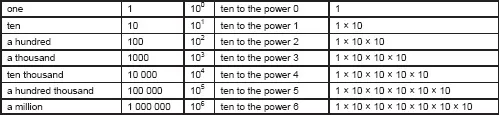
The place-value system for numbers is based on powers of ten. These are: one, ten, a hundred, a thousand, ten thousand, a hundred thousand, a million, and so on, getting ten times bigger each time. These powers of ten can be expressed symbolically and in words in a number of ways as shown in the table in Figure 1.1.
| Figure 1.1 | A table showing increasing powers of 10 |
There are a few things to note here. In general, ten to the power n (10n) means 1 multiplied by 10, n times, and this is equal to a number written as 1 followed by n zeros. For example, 109 would be 1 multiplied by 9 tens: 1 × 10 × 10 × 10 × 10 × 10 × 10 × 10 × 10 × 10; written out in full as a numeral this number (a billion) is 1 followed by 9 zeros.
The expression 102 (ten to the power 2) is also read as ‘ten squared’; and 103 (ten to the power 3) is also read as ‘ten cubed’.
We have included ‘ten to the power zero’ at the top of the table above, as a way of writing the number 1. Although this might seem a bit weird, you should at least be able to see how it fits into the pattern of the table. This use of ‘to the power zero’ is a mathematical convention adopted for the sake of completeness; it also provides a bridge for extending the place-value system from whole numbers to decimal numbers (see below). Think of it as meaning ‘1 not multiplied by any tens’ or ‘1 followed by no zeros’.
This table could go on for ever, continuing with ten million, a hundred million, a billion, ten billion, and so on. But the larger the power of ten the less useful becomes the actual name. For example, ‘a trillion’ might not convey much to us, until someone tells us that it actually stands for 1012 (1 followed by 12 zeros). An important (and very large) number in science that we will mention in Chapter 14 involves 1023; written like this, as a power of ten, this is much easier to grasp than referring to it as ‘a hundred sextillion’!
ERRORS IDENTIFIED
The obvious errors are in Statements 2, 4 and 6.
Statement 2
The next number after three thousand and ninety-nine (3099) is three thousand one hundred (3100). We hope this is obvious now you see the numbers written as numerals.
Statement 4
The cost is two pounds and seventy pence (£2.70) per day. The numbers 2.7, 2.70, 2.700, 2.7000, and so on, all represent the same quantity, since the zeros simply tell us that there are no tenths, no hundredths, no thousandths, and so on. Calculators usually d...