- 176 pages
- English
- ePUB (mobile friendly)
- Available on iOS & Android
eBook - ePub
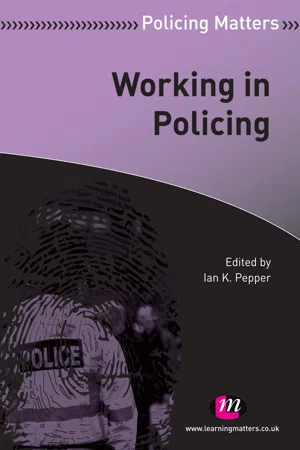
Working in Policing
About this book
Aimed at new recruits or HE students thinking about a career in policing, this book provides a clear overview of and insight into the many and varied roles available. From a neighbourhood police officer or a detective, to a crime scene investigator gathering evidence or an analyst collating intelligence, the book examines what each role entails, the skills required, and the best pathway to securing the job. An extended case study runs through the book, demonstrating how the different roles are involved in and contribute to a single investigation, and self-assessment questions relating to each role check the reader?s understanding.
Information
1 | Initial report of an incident: the role of the call taker/control room dispatcher |
CHAPTER OBJECTIVES
By the end of this chapter you will have:
- developed an understanding of the recruitment, training, role and progression of the call taker and control room dispatcher;
- understood the complexities involved in working within a control room.
Introduction
This chapter primarily explores two roles within the emergency control room (CR).
- Call taker.
- CR dispatcher.
Originally these two roles were seen as one, with the automatic expectation that an experienced call taker would eventually move onto the dispatching role once they had demonstrated a high level of service and ability in the call taking arena. In some forces, this is no longer the case, with differing job and person specifications and varying salary scales. Therefore, this chapter looks at both the role of the call taker and the dispatching role in order to highlight differential tasks, with a discussion on how both roles can progress.
What is a call taker or control room dispatcher?
Since 1937, police forces across the United Kingdom have implemented and utilised the 999 emergency services system (Her Majesty’s Inspectorate of Constabulary [HMIC], 2001). The way in which calls have been handled during that period has differed between regions, with some forces utilising force intelligence rooms which only dealt with emergency incidents and managed radio channels (Clarke et al., 2003), while other forces commandeered the all-encompassing CRs which would also deal with general advice, information and non-emergency calls.
Since its inception, the level of calls received by the CR has increased, with approximately 67 million calls made to the 999 service every year in the United Kingdom, and recent figures quoted at nearly 80 million (HMIC, 2007). The acknowledgement of the need for more effective communication (HMIC, 2002), the requirement for consistency for incident grading and performance indicators and uniformity throughout force CRs (Bain et al., 2005) have all been continually stressed by governmental agencies and the criminal justice system with studies conducted, and White papers and reports subsequently released, to address areas that were falling below acceptable levels.
The implementation of the National Standards for Incident Recording (NSIR) sought to improve the way in which incidents were recorded and dealt with on a national level, with the aim of producing a clearer picture. In 2003 the Police Skills and Standards Organisation noted that approximately 12,000 police staff were employed within the communications centres. The importance of this is highlighted by Bain et al. (2005) who point out that the first contact that a witness or victim has with the police can often be via the telephone.
The initial contact that a member of the public makes to the police is via a police call taker (sometimes called a control room operator), and this is often the first time a member of the public has had any dealings with the police. It has been recognised by the HMIC (2005) that this can be a very unnerving experience for many. The response the caller gets from the person on the other end of the line can not only determine the effectiveness of the outcome of the incident and the quality of the information that is attained but can also shape the perception of the police service as a whole (Skogan, 1996). It is, therefore, imperative that the person chosen for the role has a variety of skills, attributes, appropriate previous experience in a similar role and the ability to portray the air of professionalism at all times, in highly difficult and distressing situations.
Job description
Below is a generic job description for a call taker. This gives some idea of what the police would look for in a potential employee.
Job purpose
- To undertake the role of CR call taker, ensuring callers are routed correctly, giving quality help and advice to callers and using innovative ideas to deal with the community’s problems.
- To promote equality of opportunity and treat all individuals fairly with dignity and respect.
- To provide a high-quality, customer-focused service, in accordance with the Staff Charter.
Core work areas
Answer all emergency 999 calls and non-emergency calls within force and national targets, have the ability to operate computerised systems accurately and treat all callers with respect and courtesy while obtaining accurate information promptly.
Create incident logs in line with NSIR and ensure that all information is accurate and complies with national legislation.
Use problem-solving skills and attempt to resolve queries in a professional and timely manner, which is acceptable to both the caller and the force.
When advising a caller, ensure a sufficient level of knowledge to advise the party appropriately. An incident log should be created and updated with all of the information given.
Inform the control inspector, sergeant and supervisor promptly of any serious incidents and any other matter requiring a supervisor’s attention, that is, serious road traffic collisions (RTCs), firearms incidents or pursuits.
Understand and enforce corporate policy as regards the use and abuse of the 999 emergency phone system, recording all misuse accordingly.
Other duties
The post holder will be required to carry out such other duties as may be determined from time to time within the general scope of the post. Duties and responsibilities outside the general scope of the post will only be required with the further consent of the post holder.
What does the role involve?
A 999 call will come to the CR via a direct emergency line. In some CRs, this will flash up on the computer screens of the call taker to alert them to the call and may be accompanied by an audible signal (Dowling, 2010). It is expected that the call will be answered within ten seconds (Caless, 2010). The majority of calls that come through the emergency CRs tend to be of a non-emergency nature and will be directed to the CR via alternative extension lines. This is due to the fact that the call taker will need to ascertain what the call is about and how it should be graded (Diez, 1995). A call will be graded depending upon the seriousness of the information passed from the caller to the call taker and could vary between a zero priority (which should have come in via the 999 system) and a priority three.
A zero priority would be an emergency situation and would generally mean the call for assistance involves danger to life or property, a violent or serious crime in progress or an RTC with serious injuries (Diez, 1995). It would also be appropriate to assign a zero priority if a suspect is still on scene or if there is a high probability that the suspects will be arrested if police attend the scene rapidly (Houghton et al., 2006). This type of call is sent via computer by the call taker direct to the CR dispatcher who must assign the job to an appropriate police unit within two minutes to hit the required dispatching target. The available unit can be identified via the dispatcher’s computer screen, by asking over the radio system for assistance, and in some forces an Automatic Vehicle Location Systems (ALVS) and Automatic Person Location Systems (APLS) will advise the CR of which police unit is closest to the scene (Jane’s Police Product Review, 2009, p 4). This process is assisted by the use of effective and more available mobile technologies (Sorensen and Pica, 2005; Mason, 2010) and integrated CRs (Lampard, 2009). The police unit on the ground then have up to eight minutes to attend/arrive at the incident, in order for the response time to equate to a total of ten minutes or less in an urban area, which is increased to 20 minutes in more rural locations. What must be highlighted is that the times given are the maximum, with zero priority calls generally being attended at a much more rapid rate.
Incident Example – level 0: A call is received from a male who has just been involved in an RTC. The car has plummeted into a deep ditch. The male describes his injuries, and it is rapidly evident that the male is seriously injured and the car is potentially in a position which will make it difficult to gain access to the victim. The male can also see he is badly injured and is becoming weak and incoherent. The call taker needs to keep the injured man talking and alert as much as possible while waiting for the paramedics and informing the ambulance service, the fire brigade and the dispatchers of the location.
A level 1 incident is where the incident is still of a serious nature, but the perpetrator is no longer on the scene and there is no threat to life (Table 1.1). The current requirement is that incidents graded at level 1 will be dispatched within 30 minutes with the response officers also attending within 30 minutes for attendance to be within one hour of reporting (Dowling, 2010).
A level 2 incident needs to be dealt with within an acceptable time frame for both the police service and the victim (or injured party, also known as the IP), and an estimated time of arrival would be given to the person reporting, but would not exceed 24 hours.
A level 3 incident is where a response time would be agreed with the IP or victim of the crime. The current situation in relation to attendance at a crime is that everything reported receives a visit from a police officer or unit. There are, of course, exceptions with each call evaluated on an individual basis identifying vulnerability or distress levels of the victims and responding accordingly, as well as the actual details of the crime/incident itself (Caless, 2010).
Table 1.1 Incident level guide
| Incident levels at a glance | To meet the grade requirements |
| Level 0 | Danger to life Violence used or threatened |
| Especially vulnerable victim | |
| Suspect of a serious crime in the immediate vicinity | |
| Serious crime in progress | |
| RTC involving serious personal injury | |
| Give target arrival time | |
| Level 1 | Serious incident but no perpetrator on scene and no threat to life |
| Give target arrival time | |
| Level 2 | Crime has occurred but does not fit level 0 or level 1 criteria; attendance must be within 24 hours. Estimated time of arrival to be given to the victim |
| Level 3 | Minor crime or complaint. Estimated time of arrival to be agreed with the victim or complainant |
Recruitment into the role
Initially, recruitment into the role of call taker is advertised within the local media, within force orders and internally throughout the service. You cannot become a dispatcher without first working as a call taker within the police service. This is owing to the fact that the candidate needs to gain experience and demonstrate numerous abilities and qualities prior to moving into the dispatcher’s chair. The role of the call taker and the dispatcher is very complex. The ability to multi-task, utilise highly technical equipment and manage your well-being in a very high-stress environment while still delivering accurate, timely and quality service to the general public and your police colleagues does not suit all and cannot be achieved by just anyone. The person specification is separated into a number of areas, which are stated as desirable qualities or essential qualities. A desirable quality would be closely-related experience or working within the public sector, with the ability to communicate with people from diverse backgrounds. An essential quality relates to skills or qualities that can be proven. These may include:
- good verbal, communication and problem-solving skills;
- good attendance within previous employment roles;
- an ability to work autonomously when required;
- an ability to confidently use numerous computerised packages.
The candidate can be assessed in a number of ways for the role. These may include the completion of an application form and supporting statement giving reasons for wanting to work within policing, psychometric testing after shortlisting and/or through more in-depth probing during the interview process.
Incident Example – level 0: A very early morning call is received, in which the call taker can hear the whisper of a fe...
Table of contents
- Cover Page
- Title Page
- Copyright
- Contents
- Contributors
- Introduction and context
- 1 Initial report of an incident: the role of the call taker/control room dispatcher
- 2 First police response: police officers, special constables and community support officers
- 3 The forensic investigation
- 4 The investigation evolves
- 5 Using alternative tools for investigating crime
- 6 The RPU officer, ANPR operator, road death/collision investigator and AFO
- 7 The custody suite
- Appendix: police services websites
- Index
Trusted by 375,005 students
Access to over 1.5 million titles for a fair monthly price.
Study more efficiently using our study tools.
Frequently asked questions
Yes, you can cancel anytime from the Subscription tab in your account settings on the Perlego website. Your subscription will stay active until the end of your current billing period. Learn how to cancel your subscription
No, books cannot be downloaded as external files, such as PDFs, for use outside of Perlego. However, you can download books within the Perlego app for offline reading on mobile or tablet. Learn how to download books offline
Perlego offers two plans: Essential and Complete
- Essential is ideal for learners and professionals who enjoy exploring a wide range of subjects. Access the Essential Library with 800,000+ trusted titles and best-sellers across business, personal growth, and the humanities. Includes unlimited reading time and Standard Read Aloud voice.
- Complete: Perfect for advanced learners and researchers needing full, unrestricted access. Unlock 1.5M+ books across hundreds of subjects, including academic and specialized titles. The Complete Plan also includes advanced features like Premium Read Aloud and Research Assistant.
We are an online textbook subscription service, where you can get access to an entire online library for less than the price of a single book per month. With over 1.5 million books across 990+ topics, we’ve got you covered! Learn about our mission
Look out for the read-aloud symbol on your next book to see if you can listen to it. The read-aloud tool reads text aloud for you, highlighting the text as it is being read. You can pause it, speed it up and slow it down. Learn more about Read Aloud
Yes! You can use the Perlego app on both iOS and Android devices to read anytime, anywhere — even offline. Perfect for commutes or when you’re on the go.
Please note we cannot support devices running on iOS 13 and Android 7 or earlier. Learn more about using the app
Please note we cannot support devices running on iOS 13 and Android 7 or earlier. Learn more about using the app
Yes, you can access Working in Policing by Ian Pepper in PDF and/or ePUB format, as well as other popular books in Social Sciences & Criminology. We have over 1.5 million books available in our catalogue for you to explore.