![]()
PART B
WORKING TOGETHER
Working Together has four chapters examining working with groups of young people. Chapter 5 looks at forming groups that address basic needs and stated interests and enable young people to learn from each other. Chapter 6 examines examples of enjoyable group activities and the importance of developing positive experiences in young people’s lives. Chapter 7 focuses on work with young people in relation to some of the issues that they face through individual circumstances, development needs and societal discrimination. Chapter 8 explores ways to establish good relationships within groups and to address issues arising. Chapter 9 examines how youth work provides opportunities for young people to participate in decision making.
![]()
5
BRINGING YOUNG PEOPLE TOGETHER
This chapter examines the benefits of group work and some of the stages required to develop groups based on genuine need, such as identifying resource requirements, considering barriers to participation and prioritising conflicting demands.
Shared activities enable young people with similar circumstances, identities or experiences to develop positive relationships, learn from each other and have a voice in issues that affect them. Collectively, young people identify and articulate their own experiences in discussions with others who have a genuine understanding of their perspectives and can provide the support and/or direction to develop realistic plans for change. A youth worker brings young people together through organising contacts, creating warm environments for meetings and working with groups to acquire resources. Young people gain confidence through collective decisions and develop an appreciation of the consequences of various actions to inform future social action.
RECOGNISING YOUNG PEOPLE’S INTERESTS
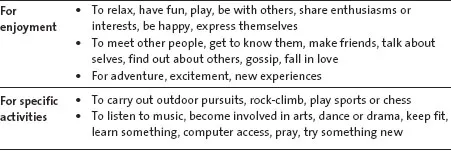
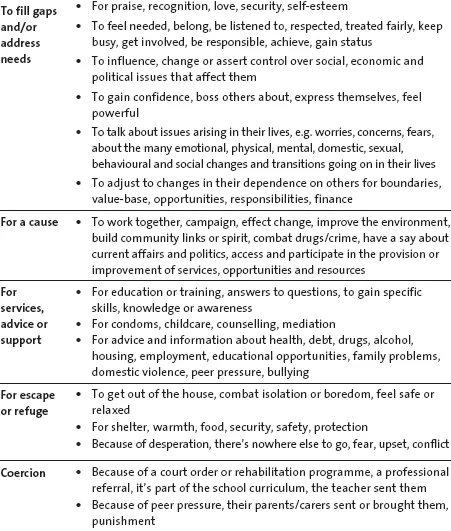
Understanding what may motivate young people to join a group or make changes in their lives can provide direction for the development of viable youth work. Developing one-off activities and programmes of work, whether fixed term projects or ongoing groups, requires youth workers and young people to work with each other so that genuine motivations and interests are addressed. Some of the reasons that young people join groups are obvious: the activities on offer, such as socialising, drama or sports, are attractive to the individuals. Typical reasons for joining could include having an interest in activities that are either more exciting and creative or more safe and secure than other available options at home or on the streets. Others may join to access specific resources, such as specialised information and advice. However, other, more hidden reasons may prompt young people’s attendance and stated interests may not encompass the full story. The table in Box 5.1 lists some examples of young people’s motivation for attendance or participation in youth work activities that may or may not be revealed to others, or themselves. Applying the ‘Johari Window’ (see Box 4.4 in the previous chapter) may assist the development of an understanding of these motivations.
Identifying genuine and compatible interests is not always a straightforward procedure. Some young people may not identify or articulate their needs clearly. While in some situations, several young people may have compatible reasons for coming together or joining a group, others may have conflicting interests. Evaluating levels of enthusiasm for activities is often based on expressed interests as these are the most obvious reasons for a young person choosing to participate. Other motivations may also play a part and can affect participation. Some young people have or express more rigid preferences and will only attend youth work for a specific activity. Such specific and overt reasons may be easily identified yet subject to change. For example, a young person’s aspirations to be an actor may provide an impetus for joining a drama project, but not sustain sufficient interest if only a small role is offered. Another young person may attend the same sessions with a more hidden, unarticulated need for refuge from an oppressive or abusive domestic situation. This motive may provide rich sustenance for hard work. Young people who have a general desire to become part of a group and have a good time may be inspired by a group to perform. On the other hand, this group may prefer less demanding activities. Reflection on these possible influences on group development is essential to good group work practice.
Box 5.1 Motivations for participation
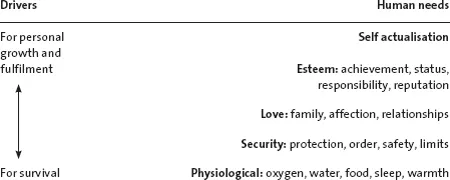
Pringle (1986) suggests that the significant needs during young people’s development are love, security and new experiences, as well as praise, recognition and responsibility. Youth workers often prioritise work with young people who have ‘fallen through the net’ often provided by other social structures, such as the family or education services, and whose development needs are not being met. Maslow’s (1943) hierarchy of human motivation (see the figure in Box 5.2), often depicted as a triangle rather than the rather dynamic situation he defines, recognises that most people are only partially satisfied in relation to their needs. This dissatisfaction can provide a motivation, or ‘driver’, for change through attempts to address unmet needs or to compensate for them. Youth work can be significant in relation to young people addressing their needs to survive, as well as for personal growth and development, by balancing provision that supports such activities with opportunities that enable young people to ‘do it for themselves’. Working in groups can provide individual young people with the support to address their needs and the opportunity to work with others to create changes in their lives.
Box 5.2 Maslow’s (1943) hierarchy of human motivation
According to Maslow (1943), the survival needs at the bottom of the hierarchy generally take priority over the other more intellectual desires for achievement. Different perspectives, however, due to interest, age or circumstance can affect how an individual prioritises. For example, someone interested in power may value their reputation over their need for love, sacrificing friendship for other benefits, such as finance or access to other more dominant allies. Individuals whose needs are not met in one area may find satisfaction through addressing another. For example, musical expression may compensate somewhat for a lack of love and security. (For an alternative look at human needs, see Max-Neef [1991], discussed in Chapter 9.)
Youth workers’ knowledge of young people’s development needs often informs their understanding of what might be relevant activities for groups. An awareness of the degree to which young people’s needs are being met can also inform practice. For example, a youth worker who is aware that young people are hungry and unwelcome at home will provide a comfortable and accessible environment with refreshments in recognition of these basic physiological needs. The need for love can be addressed by bringing young people together for shared activities where they can develop friendships and other loving relationships. Recognising their need for security, youth workers address issues in relationships between group members so the young people can feel some safety in the group. Bringing young people together to broaden their understanding of possible life choices by going to new places and trying out new skills offers new experiences. Adventurous excursions to new environments enable young people to build confidence and further extend their assertiveness and survival skills. Involving young people in planning and organising such activities and sharing in decision making enables them to experience taking on responsibilities and leadership roles and addresses a need for esteem. Throughout, feedback and recognition of achievements support young people in personal growth.
General knowledge about human needs, and young people in particular, assists the development of relevant youth work, but young people’s motivations are the ‘drivers’ for making any changes in their lives. By offering choices, voluntary participation and group involvement in deciding how needs will be addressed, young people retain their motivation and control. Youth workers facilitate opportunities for young people to explore their options with others, so that they can identify any changes that they wish to make.
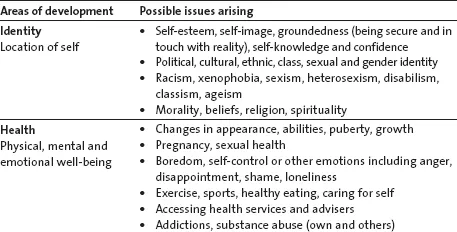
As a general rule, youth workers respond positively to young people’s expressed needs rather than diagnose deficiencies in their plans. For example, a young person expressing an interest in music would be signposted to relevant opportunities rather than judged in relation to their musical abilities or potential for success. Discussion could include what could be involved in pursuing a musical interest, particularly if the individual has no role models or other access to such information. Drawing upon available resources and networks and involving the young person in research to identify ways to find out more, a youth worker would assist the individual in pursuing the expressed interest. If the young person appears to lack the self-esteem necessary to pursue available options, activities that could widen opportunities for social relationships and feelings of self-worth would also be discussed. The table in Box 5.3 lists some examples of issues that may impede a young person in pursuing their options and which youth work would attempt to address.
Box 5.3 Issues related to young people’s development
HAVING A PLANNED APPROACH FOR BRINGING YOUNG PEOPLE TOGETHER
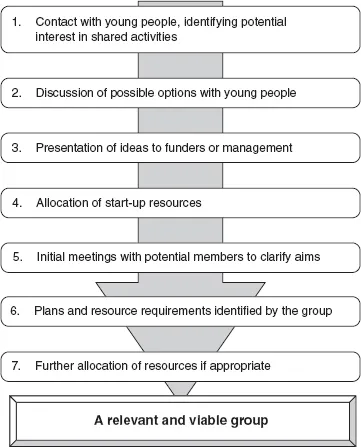
Bringing young people together may take place during a single session or over many months. Having established communication with an existing group, large assembly or various isolated individuals, a youth worker may be able to identify some genuine needs and interests for a group. With reflection on basic human and development needs, but mostly on young people’s expressed interests in comparison with available resources, ideas for activities can begin to be formed. Possible options can be discussed with potential members so that they are involved in planning and developing viable activities and sustainable services. Depending on the evidence and level of interest, initial meetings of members may take place to discuss the aims before a more extensive resource allocation is made.
Youth work activities need to be of interest and accessible to the target group. If young people need employment, improved park facilities may not attract them. If they are not able to attend a centre, arranging sessions there would be ill-advised. Although preferences and ideas may change through exposure to new experiences or finding out that a friend is involved in an activity that was previously rejected, the starting point for planning is expressed interests. Involving interested young people in programme planning, applying for and allocating resources can develop their careful consideration of choices. The planned approach to establishing a viable group outlined in Box 5.4 should enable a youth worker to put together a case for resource allocation to relevant activities based on genuine interests and needs.
Box 5.4 Establishing a viable group
The common interests of the young people, community, organisation and wider society may come together to develop well-supported and sustainable youth work. However, such congruence is not always the reality. Some gr...