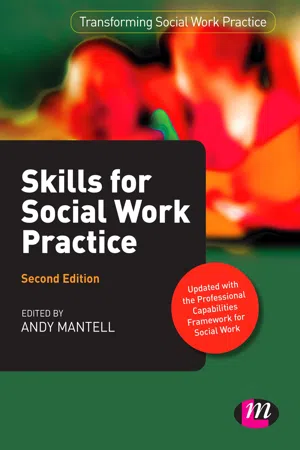
Social work skills are essential to good practice and more important than ever following changes to the social work curriculum. Students must be able to demonstrate knowledge of core skills within policy, law as well as demonstrating empathy and good communication. This fully-revised student guide, previously published as Social Work Skills with Adults, will help to cement these skills and includes chapters on intervention, empowerment and advocacy, skills for collaborative working, self-presentation and much more.
This book will equip social work students with the skills to meet the new and perennial challenges to achieving empowering practice with carers and people who use services.
There are chapters on working with families, communities and individuals and how social policy affects all of these groups. Case studies and reflective exercises are used throughout to explore these issues and help link theory to practice.
- 288 pages
- English
- ePUB (mobile friendly)
- Available on iOS & Android
eBook - ePub
Skills for Social Work Practice
About this book
Information
Publisher
Learning MattersYear
2013Print ISBN
9781446267332
9781446267325
Edition
2eBook ISBN
9781446296004
Part 1
Managing self
Chapter 1
Reflective practice
A C H I E V I N G A S O C I A L W O R K D E G R E E
This chapter will help you to develop the following capabilities from the Professional Capabilities Framework.
• Professionalism. Identify and behave as a professional social worker, committed to professional development.
• Knowledge. Apply knowledge of social science, law and social work practice theory.
• Critical reflection and analysis. Apply critical reflection and analysis to inform and provide a rationale for professional decision-making.
It will also introduce you to the following standards as set out in the 2008 social work subject benchmark statement.
5.5.2 Gathering information
5.5.3 Analysis and synthesis
5.8 Skills in personal and professional development
6.2 Reflection on performance
Introduction
This chapter will introduce you to the concept of reflective practice, which is an essential skill you will need to develop during your social work course. It will also provide definitions of reflective practice and describe its roots and the different techniques that can be adopted to enhance reflection. Examples of how reflective practice can be used are illustrated through activities and case studies, with recent research findings. Particular emphasis is placed on the supervisory relationship, whether with a practice educator or practice supervisor.
What is reflective practice?
Reflective practice has long been seen as an essential part of social work education at qualifying and post-qualifying levels, as it is in other professions such as nursing and teaching. Reflection is formalised in academic assignments and in activities undertaken while on placements, with the intention of enabling you to critically examine your practice. At its most straightforward, reflection plays an important part in helping you learn from the experiences of different interventions and other significant events. This is particularly important in enabling you to make links between what you actually do when you are working with a client and what you hope to achieve by a particular intervention and, importantly, your feelings about yourself in the practitioner role. In making the connection between these aspects and analysing your thoughts, actions and intentions you can, particularly with support from your tutor or supervisor, gain greater understanding of your own performance and refine your future practice. With these foundations reflection can become an integral part of your everyday practice and part of your lifelong learning as a professional social worker.
Definitions of reflective practice
We have seen that reflective practice is an essential part of your development as a student social worker and, to help you understand more fully what this involves, the following two definitions capture the essence of reflective practice:
A general definition by Boud et al. (1985, p43) states that:
Reflection is an important human activity in which people recapture their experience, think about it, mull over and evaluate it. It is this working with experience that is important in learning.
A more recent definition from the Social Work Benchmark Statements, which focus on the activities of the social work student, states that:
Reflection is a process in which a student reflects critically and evaluatively on past experiences, recent performances, and feedback, and applies this information to the process of integrating awareness (including awareness of the impact of self on others) and new understanding, leading to improved performance.
(QAA, 2008)
These definitions help to focus on what are seen as the essential elements of reflective practice: returning to a past experience, thinking about what took place in a particular intervention and reflecting on your thoughts and actions, and identifying what you might do differently in the future. The definitions suggest that reflection is also a process that leads to learning and improved practice.
ACTIVITY 1.1
Think back to an event while you were on placement where you were asked to undertake a particular task for the first time and where you felt uncertain about your ability to complete the task effectively.
Comment
You will probably find yourself thinking about recent experiences, particularly if they were new or novel, or where you were concerned about your ability. These could be described as common-sense reflections and do not necessarily promote learning. On the other hand, if your reflection is structured, through the use of a reflective diary where you record your thoughts and feelings, or through dialogue with your supervisor, then it can be an active and critical process with the potential to improve your performance in the future.
Roots of reflective practice
An early exponent of reflective practice was John Dewey, an educational philosopher. Writing in the twentieth century, he identified in reflective thinking many of the key elements that we still use today in the reflective process. For Dewey, reflection is particularly important when we are confronted by a problem that perplexes us or about which we feel uncomfortable. We then reflect on the problem to develop a fuller understanding of it and its possible solutions. We do this through critical reasoning and testing our understanding in practice (Dewey, 1938). In using this approach Dewey argued that it enabled people to avoid becoming trapped by routine thinking and actions driven by external forces or authorities. We can relate this latter view of Dewey’s to those social work organisations where emphasis is placed on following standardised procedures, which practitioners find stifles creative work with clients.
Dewey’s work laid the foundations for the later seminal work of Donald Schön (1983), who sought to understand how practitioners developed their knowledge bases and then applied this knowledge to their practice. He described the person who consciously thinks about his or her practice as the ‘reflective practitioner’. In exploring the work of different professions he described two types of reflection. The first, reflection in action, is where you think on your feet while you are engaged in an intervention, drawing on experience and theories, and improvise and modify your practice to achieve a better outcome. The second type is reflection on action, where the process is undertaken retrospectively, away from the event, starting with recall, a description of what happened, and leading to the integration of theory and practice to better inform future practice through critical analysis of the event.
Schön’s work demonstrated that practitioners often encountered situations that were complex, messy and challenging – the ‘swampy lowlands of practice’, as he described it – where theory or standard procedures were of little help in making sense of a situation. He recognised that reflecting on their practical experience and applying this learning allowed practitioners to ‘revise, modify and refine their expertise’ (Finlay, 2008, p4). Through this process practitioners developed ‘professional artistry’, with an ability to integrate the knowledge gained through reflection with formal scientific theories.
A missing element in Schön’s work, according to Greenwood (1993), is the important preparatory element of reflective practice where the practitioner pauses to think before acting in order to avoid errors. Reflection for action takes place prior to an intervention, with the practitioner planning what they intend to do and how they will do it. Thompson and Thompson (2008) see value in the practitioner thinking ahead to what they might encounter, and what precautions they need to take (for example, in meeting a client who has a history of unpredictable behaviour), so that they are much better prepared when they meet the client. This stage of reflection is helpful in that the practitioner anticipates potential difficulties, leading to a greater sense of control and confidence, with the consequent positive effect on morale and motivation.
Of course, reflection for action can be helpful at any stage in your development as a student, but it will become more useful as you gain experience of different interventions. You will then be able to look back to previous experiences as your knowledge and understanding grow and you become more confident about what you might anticipate in a particular situation and the steps to consider before you act.
Before we leave the roots of reflective practice it is important to briefly consider the term reflexivity. You may see this term used sometimes interchangeably with reflection, but although they are related terms there are important differences between them. Fook (2002) sees reflexivity as taking into account as many different perspectives in a situation as possible, whereas Jude and Regan (2010) see reflexive thinking as the basis for developing multiple hypotheses, as opposed to a fixed, unchanging view of a situation. According to Finlay (2008), reflexive practitioners engage in critical self-reflection: critically reflecting on the impact of their own background, their assumptions and feelings, as well as wider organisational, ideological and political dimensions. Finlay suggests there are contentious issues about how much practitioners should use reflection to focus on themselves as individuals rather than on the larger social context. Considering the fact that the majority of people who use social work services are in receipt of state benefits it is essential that the wider social and economic context is fully explored when reflecting on work with clients (Walker and Walker, 2009).
Creating conditions for reflection on your practice
In order to develop your skills as a reflective practitioner it is important to have a ‘personal reflective space’ where you can engage with the process of reflection without distractions, focusing on your own thoughts and feelings that you experience during practice interventions and other significant practice events. This means both the physical space and sufficient time to spend on reflective activity. This is where the support of your practice supervisor can be helpful in ensuring you have the facilities and time to use for reflection. You may also need to negotiate for personal reflective space in your personal life, particularly if you are sharing accommodation with others....
Table of contents
- Cover Page
- Halftitle
- Title
- Copyright
- Contents
- Editor and contributors
- Acknowledgements
- Introduction
- Part 1 Managing self
- Part 2 Building relationships
- Part 3 Working with others
- Part 4 Making sense of a complex world
- Conclusion
- Appendix 1 Professional Capabilities Framework
- Appendix 2 Subject benchmark for social work
- Index
Trusted by 375,005 students
Access to over 1.5 million titles for a fair monthly price.
Study more efficiently using our study tools.
Frequently asked questions
Yes, you can cancel anytime from the Subscription tab in your account settings on the Perlego website. Your subscription will stay active until the end of your current billing period. Learn how to cancel your subscription
No, books cannot be downloaded as external files, such as PDFs, for use outside of Perlego. However, you can download books within the Perlego app for offline reading on mobile or tablet. Learn how to download books offline
Perlego offers two plans: Essential and Complete
- Essential is ideal for learners and professionals who enjoy exploring a wide range of subjects. Access the Essential Library with 800,000+ trusted titles and best-sellers across business, personal growth, and the humanities. Includes unlimited reading time and Standard Read Aloud voice.
- Complete: Perfect for advanced learners and researchers needing full, unrestricted access. Unlock 1.5M+ books across hundreds of subjects, including academic and specialized titles. The Complete Plan also includes advanced features like Premium Read Aloud and Research Assistant.
We are an online textbook subscription service, where you can get access to an entire online library for less than the price of a single book per month. With over 1.5 million books across 990+ topics, we’ve got you covered! Learn about our mission
Look out for the read-aloud symbol on your next book to see if you can listen to it. The read-aloud tool reads text aloud for you, highlighting the text as it is being read. You can pause it, speed it up and slow it down. Learn more about Read Aloud
Yes! You can use the Perlego app on both iOS and Android devices to read anytime, anywhere — even offline. Perfect for commutes or when you’re on the go.
Please note we cannot support devices running on iOS 13 and Android 7 or earlier. Learn more about using the app
Please note we cannot support devices running on iOS 13 and Android 7 or earlier. Learn more about using the app
Yes, you can access Skills for Social Work Practice by Andy Mantell in PDF and/or ePUB format, as well as other popular books in Social Sciences & Social Work. We have over 1.5 million books available in our catalogue for you to explore.