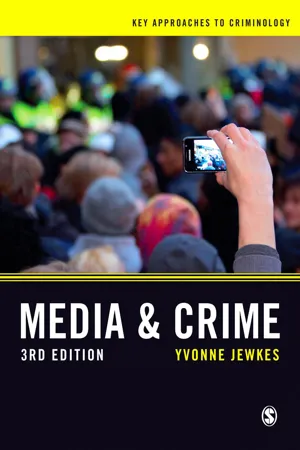
Media and Crime
eBook - ePub

Media and Crime

  1. 352 pages
  2. English
  3. ePUB (mobile friendly)
  4. Available on iOS & Android
eBook - ePub

Media and Crime

About this book

This book critically examines the complex interactions between media and crime.

Ā 

Written with an engaging and authoritative voice, it guides you through all the key issues, ranging from news reporting of crime, media constructions of children and women, moral panics, and media and the police to ?reality? crime shows, surveillance and social control.

Ā 

This third edition:

  • Explores innovations in technology and forms of reporting, including citizen journalism.
  • Examines the impact of new media including mobile, Internet and digital technologies, and social networking sites.
  • Features chapters dedicated to the issues around cybercrime and crime film, along with new content on terrorism and the media.
  • Shows you how to research media and crime.
  • Includes discussion questions, further reading and a glossary.
  • Now features a companion website, complete with links to journal articles, relevant websites and blogs.

This is essential reading for your studies in criminology, media studies, cultural studies and sociology.

The Key Approaches to Criminology series celebrates the removal of traditional barriers between disciplines and, specifically, reflects criminology's interdisciplinary nature and focus.Ā  It brings together some of the leading scholars working at the intersections of criminology and related subjects.Ā  Each book in the series helps readers to make intellectual connections between criminology and other discourses, and to understand the importance of studying crime and criminal justice within the context of broader debates.Ā 

Ā 

The series is intended to have appeal across the entire range of undergraduate and postgraduate studies and beyond, comprising books which offer introductions to the fields as well as advancing ideas and knowledge in their subject areas.Ā 

Frequently asked questions

Yes, you can cancel anytime from the Subscription tab in your account settings on the Perlego website. Your subscription will stay active until the end of your current billing period. Learn how to cancel your subscription.
No, books cannot be downloaded as external files, such as PDFs, for use outside of Perlego. However, you can download books within the Perlego app for offline reading on mobile or tablet. Learn more here.
Perlego offers two plans: Essential and Complete
  • Essential is ideal for learners and professionals who enjoy exploring a wide range of subjects. Access the Essential Library with 800,000+ trusted titles and best-sellers across business, personal growth, and the humanities. Includes unlimited reading time and Standard Read Aloud voice.
  • Complete: Perfect for advanced learners and researchers needing full, unrestricted access. Unlock 1.4M+ books across hundreds of subjects, including academic and specialized titles. The Complete Plan also includes advanced features like Premium Read Aloud and Research Assistant.
Both plans are available with monthly, semester, or annual billing cycles.
We are an online textbook subscription service, where you can get access to an entire online library for less than the price of a single book per month. With over 1 million books across 1000+ topics, we’ve got you covered! Learn more here.
Look out for the read-aloud symbol on your next book to see if you can listen to it. The read-aloud tool reads text aloud for you, highlighting the text as it is being read. You can pause it, speed it up and slow it down. Learn more here.
Yes! You can use the Perlego app on both iOS or Android devices to read anytime, anywhere — even offline. Perfect for commutes or when you’re on the go.
Please note we cannot support devices running on iOS 13 and Android 7 or earlier. Learn more about using the app.
Yes, you can access Media and Crime by Yvonne Jewkes in PDF and/or ePUB format, as well as other popular books in Social Sciences & Criminology. We have over one million books available in our catalogue for you to explore.

References

Aas, K. F. (2005) Sentencing in the Age of Information: From Faust to Macintosh, Glasshouse-Cavendish.
Aas, K. F. (2013) Globalization and Crime 2nd edn, London: Sage.
Agnew, R. (2012) ā€˜The ordinary acts that contribute to ecocide: a criminological analysis’, in N. South and A. Brisman (eds) Routledge International Handbook of Green Criminology, London: Routledge
Alder, C. M. and Polk, K. (1996) ā€˜Masculinity and child homicide’, British Journal of Criminology, 36 (3): 396–411.
Aldridge, M. (2003) ā€˜The ties that divide: regional press campaigns, community and populism’, Media, Culture & Society, 25: 491–509.
Anderson, B. (1983) Imagined Communities: Reflections on the Origins and Spread of Nationalism, London: Verso.
Apted, M. (2009) ā€˜Michael Apted responds’, Ethnography, 10 (3): 359–67.
Ashenden, S. (2002) ā€˜Policing perversion: the contemporary governance of paedophilia’, Cultural Values, 6 (1 and 2): 197–222.
Ball, K. (2003) ā€˜Editorial. The labours of surveillance’, Surveillance and Society, 1 (2): 125–37.
Bannister, J., Fyfe, N. and Kearns, A. (1998) ā€˜Closed circuit television and the city’, in C. Norris, J. Moran and G. Armstrong (eds) Surveillance, Closed Circuit Television and Social Control, Aldershot: Ashgate.
Barak, G. (1994) ā€˜Media, society, and criminology’, in G. Barak (ed.) Media, Process, and the Social Construction of Crime, New York: Garland.
Barker, V. (2009) Politics of Imprisonment: How the Democratic Process Shapes the Way America Punishes Offenders, Oxford: Oxford University Press.
Barthes, R. (1973) Mythologies, London: Paladin.
Bartky, S. L. (1988) ā€˜Foucault, femininity, and the modernization of patriarchal Power’, in I. Diamond and L. Quinby (eds) Feminism and Foucault: Reflections of Resistance, Boston: Northeastern University Press.
Baudrillard, J. (1981) For A Critique of the Political Economy of the Sign, St Louis: Telos.
Baudrillard, J. (1983) Simulations, New York: Semiotext(e).
Bauman, Z. (1992) Intimations of ...

Table of contents

  1. Cover
  2. Table of Contents
  3. Companion Website
  4. Acknowledgements
  5. Introduction
  6. Theorizing Media and Crime
  7. The Construction of Crime News
  8. Media and Moral Panics
  9. Media Constructions of Children: ā€˜Evil Monsters’ and ā€˜Tragic Victims’
  10. Media Misogyny: Monstrous Women
  11. Police, Offenders and Victims in the Media
  12. Crime Films and Prison Films
  13. Crime and the Surveillance Culture
  14. The Role of the Internet in Crime and Deviance
  15. (Re)Conceptualizing the Relationship between Media and Crime
  16. Glossarye