Trainee and beginning teachers often find it hard to plan for and teach good art lessons as there is little guidance on subject knowledge and outstanding practice.
This key text will provide primary trainee teachers with subject knowledge, expert advice and guidance along with practical solutions that are necessary to offer children the best possible experiences in art, craft and design, to ensure that they have access to a broad and balanced curriculum. Through guidance and support it will enable them to develop an understanding of the principles and values that underpin high standards and high expectations, and show good progress in the subject.
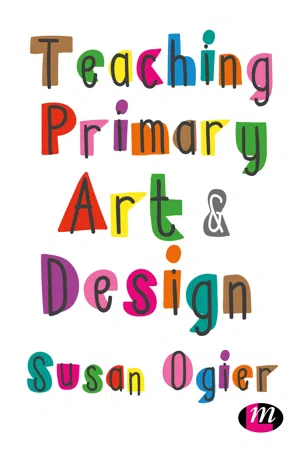
- 264 pages
- English
- ePUB (mobile friendly)
- Available on iOS & Android
eBook - ePub
Teaching Primary Art and Design
About this book
Information
1
Principles and values
Principles and values
The purpose of art is not a rarefied intellectual distillate: it IS life, intensified, brilliant life.
(Alain Arias-Misson)
Chapter objectives
This chapter will help you to:
• Situate your personal values in relation to teaching primary art and design.
• Formulate a principled approach to teaching in this subject.
• Consider art and design in the context of promoting social justice.
• Begin to answer the question, what is good practice in art and design?
The following standards apply within this chapter.
1. Set high expectations which inspire, motivate and challenge pupils.
5. Adapt teaching to respond to the strengths and needs of all pupils.
Introduction
At the beginning of any teacher training course, I ask the students about their personal values: what are the principles by which they lead their lives? How would you answer this question? How many of you would say that the main motivator for living a fulfilling life was being top of the class, gaining wonderful possessions, or becoming famous? Whilst we would all agree that these are nice-to-haves, some circumstances can enable us to reflect that these elements might not be as important as the code of principles by which we can lead a fulfilling life: principles that we can apply whether we have material assets or not. These principles might include things such as enjoying good physical and mental health; being caring and feeling the love of our family and friends; having emotional resilience in difficult situations; being a compassionate citizen, and other fundamental values for living a satisfying life. What has this got to do with art and design education, you might ask? The answer to that is everything. Engaging in artistic practice is essentially an engagement with holistic elements that make it possible to lead a well-rounded and well-balanced existence. The ability to communicate and express emotions and ideas, relate to others, accept feedback, give an opinion, make a comment, agree or disagree are all important, and we start developing those values as children.
What are values?
The Oxford Dictionary (2016) definition of the noun value in English originates from Middle English and from Old French (feminine past participle of valoir (be worth) from Latin valere). It states that it is:
1. The regard that something is held to deserve; the importance, worth, or usefulness of something: your support is of great value.
2. Principles or standards of behaviour; one’s judgement of what is important in life: they internalize their parents’ rules and values.
Reflection point
• Make a list or a mind-map of your top-ten determining personal values. Write them onto separate pieces of paper, or sticky notes, and try to place them in order of importance.
• Do you think these are in a fixed order, or do they move up, down or sideways as your priorities and circumstances change? Try to keep this exercise going over a few days or weeks and see whether your values change or shift in order of priority.
• What have you learnt from doing this exercise?
Analysis
Now there is an emphasis to engage schools with ‘fundamental British values’ as part of the Prevent Strategy, which became law in 2015. These values include democracy, the rule of law, individual liberty, mutual respect, and tolerance of different faiths and beliefs: possibly, you have listed some of these beliefs as values of your own in the Reflection point exercise. The ethical and moral codes that you apply to everything that you do might well have influenced your decision to become a primary school teacher in the first place (Benninga, 2003). It is, after all, simply about remembering your desire to contribute to society in some way, and becoming a participant in the human side of teaching. In this chapter, we shall explore ways that you can keep these values at the heart of your teaching strategies through the subject of art and design, which is, arguably, the most human of all subjects.
Theory focus
Becoming human
One of my favourite texts, that I go back to time and time again, is Becoming Human Through Art (1970) by the American, Edmund Burke Feldman. Humanist principles that underpin the work resonate throughout, and serve to remind us that we should endeavour to keep the child at the heart of the curriculum, and to frequently ask the question, what is education for? The book begins with a preface that states that it was written at a time of great uncertainty within the educational climate, when old assumptions were in the process of being challenged, and new forms of analysis and critique were commonplace. I wonder whether much has changed in all that time? Feldman argues that art in schools should not be about creating artists, which potentially limits its usefulness to the artistically talented alone. On the contrary, he proposes that it contributes to a much broader spectrum of life skills, knowledge and cultural understanding that no other subject can reach. Art and design education can instil in children and young people a sense that life is worth living, a sense that there is a deeper and more meaningful way of engaging in activities that go far beyond the narrow field of school testing regimes. Children, in Feldman’s view, are given a feel for personal satisfaction that arises from creating something of their own, both physically and emotionally. Children are given ‘permission’ to justify their work by articulating the rationale for its existence, and to express their individuality. He makes the case that art is an essential way for us to respond to our world, and notes that every culture, every period in the history of humanity has produced artistic responses to social situations and cultural events. Evidence of this goes back as far as cave drawings, which have been found all around the world. Feldman suggests that children can learn to communicate effectively through unique visual vocabulary that can cross language barriers, enabling them to feel a sense of self-satisfaction in communicating their own individual visual responses. Importantly, by learning about culture and art, and by engaging in art activity, they have ‘the values that permit civilised life to go on’ instilled within them.
What is a principled approach?
So far we have gathered thoughts about your own personal values for living, and considered how teaching and learning in art and design are fundamentally about how we engage, reflect and comment upon aspects of life by using visual language. It is important to be able to ground yourself within a set of principles that are right for you, as much as they are right for the children you will teach. It is necessary, though, to underpin these with solid pedagogical foundations.
Dr John Reece, psychology professor at Melbourne Institute of Technology, puts forward a ‘checklist’ of doctrines, which can be applied to all teaching situations and to all age groups (Hurford, 2012). He suggests key principles that might enable teachers to become reflective and to stand fast in what they know is right for children, no matter what stormy weather the educational landscape throws at them. The 12 principles he suggests are listed here.
1. Recognise, appreciate and foster knowledge and understanding of ‘deep’ learning.
2. Make learning enjoyable, without being trivial or flippant.
3. Remember that enthusiasm and passion on the part of the educator positively influences children’s learning.
4. Educational approaches should be evidence-based and reflective.
5. Teach because you have a genuine love of helping children to learn.
6. Actively involve children in the learning process: empower their learning.
7. Win the ‘battle of hearts and minds’ when teaching challenging material.
8. Foster an appreciation of the real-world relevance of learning.
9. Be reflective and self-critical of your own practice; always strive for improvement.
10. Have respect for children, regardless of how challenging they may be: listen and learn from them; seek and value their input.
11. Incorporate educational technologies that will effectively enhance learning.
12. Self-knowledge: know what you’re teaching and why you’re teaching it.
This list seems like a sensible approach, with intentions that should apply no matter what subject you are teaching. In other subjects we are currently faced with a difficult problem when trying to apply these principles: we are in a time when the curriculum is narrow, and learning within that curriculum is prescriptive. We are, however, rather more fortunate with the subject of art and design in this respect, as we are not bound by prescription. We therefore do have permission to teach with the high degree of interactivity and child-focused methods that Reece suggests. So, how can you apply these principles to the area of art and design? That is the easy part once you fully understand the underlining pedagogical aspect.
Pedagogical perspectives
The Italian ‘Reggio Emilia’ preschool education system is one approach that fits extremely well with education in art and design at all levels – from nursery right through to degree level and beyond. Whilst the pedagogy is essentially an Early Years model, it is easily transferable to older age phases, although the possibilities that this presents is untapped in many schools; possibly for reasons already mentioned in these pages. The approach is established within a pedagogy of both scientific and artistic enquiry, which values children’s personal responses to self-initiated lines of investigation. This mirrors the way that contemporary artists work in their own art practice. It is, therefore, worth investigating this further to develop principles to underpin our work for teaching and learning in art and design.
In 1991, Italy’s Emilia-Romagna region was named by the American magazine, Newsweek, as having one of the best school systems in the world, and the preschools were hailed as examples of excellence (Wingert, 1991). Having been brought to the attention of the world, this educational system has since become an international role model for good practice in learning through creative and expressive mediums, and not just in preschool years. The history of how the methodology for the Reggio schools was formed is also very interesting, especially in relation to the potential for the subject area of art and design to be a platform for social justice and citizenship education principles. We shall return to this a little later in the chapter.
The history of Reggio schools
A young psychologist and pedagogist, ...
Table of contents
- Cover Page
- Halftitle
- Advertisement
- Title
- Copyright
- Contents
- About the Author
- About the Contributors
- Acknowledgements
- Foreword
- Preface
- Introduction
- 1 Principles and Values
- 2 Creative Learning: imagination and expression
- 3 Curriculum and Concepts
- 4 Processes and Practice
- 5 Planning, aSsessment and Progression
- 6 Beyond the Classroom and into the Future
- 7 The Broad and Balanced Curriculum
- References
- Index
Trusted by 375,005 students
Access to over 1.5 million titles for a fair monthly price.
Study more efficiently using our study tools.
Frequently asked questions
Yes, you can cancel anytime from the Subscription tab in your account settings on the Perlego website. Your subscription will stay active until the end of your current billing period. Learn how to cancel your subscription
No, books cannot be downloaded as external files, such as PDFs, for use outside of Perlego. However, you can download books within the Perlego app for offline reading on mobile or tablet. Learn how to download books offline
Perlego offers two plans: Essential and Complete
- Essential is ideal for learners and professionals who enjoy exploring a wide range of subjects. Access the Essential Library with 800,000+ trusted titles and best-sellers across business, personal growth, and the humanities. Includes unlimited reading time and Standard Read Aloud voice.
- Complete: Perfect for advanced learners and researchers needing full, unrestricted access. Unlock 1.5M+ books across hundreds of subjects, including academic and specialized titles. The Complete Plan also includes advanced features like Premium Read Aloud and Research Assistant.
We are an online textbook subscription service, where you can get access to an entire online library for less than the price of a single book per month. With over 1.5 million books across 990+ topics, we’ve got you covered! Learn about our mission
Look out for the read-aloud symbol on your next book to see if you can listen to it. The read-aloud tool reads text aloud for you, highlighting the text as it is being read. You can pause it, speed it up and slow it down. Learn more about Read Aloud
Yes! You can use the Perlego app on both iOS and Android devices to read anytime, anywhere — even offline. Perfect for commutes or when you’re on the go.
Please note we cannot support devices running on iOS 13 and Android 7 or earlier. Learn more about using the app
Please note we cannot support devices running on iOS 13 and Android 7 or earlier. Learn more about using the app
Yes, you can access Teaching Primary Art and Design by Susan Ogier,Author in PDF and/or ePUB format, as well as other popular books in Education & Early Childhood Education. We have over 1.5 million books available in our catalogue for you to explore.