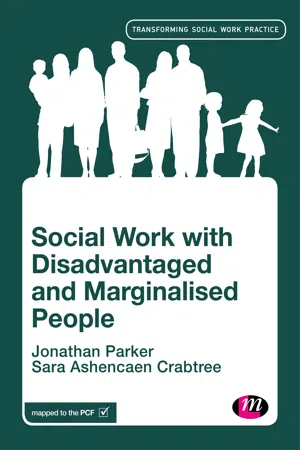
Social workers, whatever their specialism, practise with people at the margins of society. It is therefore essential that all social work students not only understand the powers and processes that lead to disadvantage and marginalisation but develop the knowledge and skills needed to bring about change and uphold social justice in all aspects of their professional practice. Split into three parts, this book considers what is meant by disadvantage and marginalisation, how this can come about and the impact this may have on lives, before unpicking the key knowledge and skills needed to practice effectively with individuals and groups. It then goes on to show what good ethical and reflective practice looks like, going step-by-step through the ins and outs of using the law and policy to bring about change before considering key ethical dilemmas in practice.
eBook - ePub
Social Work with Disadvantaged and Marginalised People
- 216 pages
- English
- ePUB (mobile friendly)
- Available on iOS & Android
eBook - ePub
Social Work with Disadvantaged and Marginalised People
About this book
Information
Publisher
Learning MattersYear
2017Print ISBN
9781473994584
9781473994577
Edition
1eBook ISBN
9781526416643
Part I
Understanding disadvantage and marginalisation
Chapters 1–4 outline the context and environments in which social work is practised with people who are marginalised in and disadvantaged by society. Theoretical models for understanding marginalisation and disadvantage and who may experience such alongside the ways people become marginalised and the impacts of this are discussed.
1: Understanding the concepts
Achieving a social work degree
This chapter will help you to develop the following capabilities, to the appropriate level, from the Professional Capabilities Framework.
Diversity
Understand how an individual’s identity is informed by factors such as culture, economic status, family composition, life experiences and characteristics, and take account of these to understand their experiences, questioning assumptions where necessary.
Rights, justice and economic wellbeing
Understand, identify and apply in practice the principles of social justice, inclusion and equality.
Recognise the impact of poverty and social exclusion and promote enhanced economic status through access to education, work, housing, health services and welfare benefits.
Knowledge
Understand forms of harm and their impact on people, and the implications for practice, drawing on concepts of strength, resilience, vulnerability, risk and resistance, and apply to practice.
It will also introduce you to the following academic standards as set out in the social work subject benchmark statement.
5.2.i, iv, ix Social work theory
5.3.vi Values and ethics
5.4.i–v Service users and carers
Introduction
This chapter will introduce you to the core concepts of disadvantage and marginalisation, exploring their meanings in contemporary society and the bearing they have on people’s lives. The changing and fluid concept of social work is stated in the introduction and some beginning understandings of our core concepts have been outlined. The complexities of disadvantage and marginalisation will be developed in this chapter in more depth using the explanatory concepts of intersectionality and super-diversity to explore the interrelationships between people’s experiences and drawing on the wealth of social work thinking concerning anti-discriminatory and anti-oppressive practice. There will also be some discussion of cognate ideas and terms which expand or refine the definitions that we are using. Throughout the chapter we will illustrate the concepts using specific examples and ask you as the reader to engage with some of the understandings emerging from the discussion.
What is disadvantage?
In tennis a player gains advantage when she or he has won a point, needing only one more to win a game. One might consider the other player to be disadvantaged but would not consider this to have moral, social or political connotations. The concept, when taken apart from sport, is much more complex. Indeed, when we consider the idea of an advantage it may be taken as having more of a certain property, more options and/or resources, and importantly, more legitimation from others. It is multi-faceted and dependent on the context and those who have the power to set the terms of the argument.
Activity 1.1
Think of a time when you believe you were disadvantaged. Make a list of what this disadvantage consisted of, what the effects of it were and how you dealt with it.
Comment
There are many possible ways that this activity can be undertaken and the ways in which you have completed it will say something about you and your understanding of and approach to matters of disadvantage and marginalisation. These will be important to remember and reflect on when practising as a social worker. By way of comment we draw your attention to the following case study of Ann, Jane and Mark, social workers who qualified together and who now work in the same local authority.
Case study
Ann has been qualified as a social worker for six years. She has worked in a number of jobs and roles since qualifying, including working in an intake team and undertaking complex investigations and assessments until moving into a job she has wanted to do since training to become a social worker, working in a fostering and permanence team. She feels lucky to have got this job, although she has been told by older colleagues that it is a dead end for her career, meaning that she is less likely to be considered for management and leadership roles in the future.
Ann qualified alongside two colleagues she works with in the local authority. Jane remains in the intake team in which she started six years previously, having had one period of maternity leave, and is now working half-time. Jane is happy in her position and believes it offers her flexibility in respect of her family but realises that being in a part-time position and having a young child she is unlikely to progress rapidly in career terms. Mark is a team leader in a looked-after children team who is earmarked for area management roles and sometimes stands in for the existing manager when she is unavailable. Mark misses some of the individual and direct work he used to complete with children and young people and their parents but he is pleased with the way his career has progressed.
All three social workers may be seen to be disadvantaged in some way: Ann through her choices of work, although she may not feel so; Mark in respect of losing enjoyable aspects of his role; and Jane through her lifestyle and working choices. An unspoken aspect of disadvantage may be the result of different approaches taken to each person on the basis of their gender and their commitments (Parker and Ashencaen Crabtree, 2014a). This is likely also to have an impact on their earning potential in the future. The personal aspects of choices are influenced by structural assumptions about roles, careers and gender and this type of disadvantage may reinforce positions of power in the future.
In some respects we all try to achieve an advantage in various ways. For instance, if we have more money, greater access to books and more support from family, friends or influential people we may be able to succeed in our studies or careers more easily or more speedily than others. Of course, this requires an unequal system which is also open to conflict and abuse and where advantages are preciously guarded and controlled, being dispensed to those in favour or holding particular beliefs or ways of living. Our society is particularly unequal in this respect (Wilkinson and Pickett, 2010). Differences and inequalities in people’s abilities, wants, wishes and likes are, of course, part of the social world and add richness to it. However, the favouring of certain people or groups above others may add an inequity alongside inequality that begins to disadvantage people on the basis of their position, characteristics and innate qualities rather than the wider social and individual differences that comprise a varied social world.
Activity 1.2
What do you think the differences are between inequity and inequality? Make a list of these.
Comment
You may have listed a range of differences that are partly based on values and questions of morality, those based on economics, heritage and nationality, health status, gender, age, geography and so on. Inequalities might be due to differences between people and their preferences whereas you may have written that inequities concern the intentional or unintentional unfavourable treatment that people experience as a result of their differences. Whatever examples you wrote down, it is clear that the difference between the two terms is important. Inequities result from avoidable differential treatment of characteristics and conditions that are often deliberately continued, although they create unfair disadvantage in favour of or against certain characteristics held by individuals or groups. Inequalities refer to those differences that occur in the distribution of certain characteristics or resources that are beyond immediate control. Schofield (2015) provides examples from health sociology to demonstrate these distinctions. Whilst both create disadvantages and need to be countered, the deliberate creation of unfair disadvantages is something that social workers may more easily identify and challenge.
So there are economic and resource disadvantages that we need to be aware of but there are also disadvantages that are physical, social, political and spatial. Like economic disadvantages, these other types of disadvantage are structurally determined and imposed from normative positions of power. That is, they are set by the existing political structures and social systems that are accepted as the norm in society. These are often unchallenged and simply assumed, and they are organised and promoted by those who have the power to set those norms (although we must recognise this is often unconscious). It must be remembered too that the structures have an influencing effect on those in power and those on the receiving end of it, creating a view of what ‘should be’, or the norm. The following case study provides an example.
Case study
A local community resource centre was seeking funding to make its building accessible to all people wishing to use it. It was a small building, set back from a local playing field, built in the early 1950s and having small doorways and steps up to the main entrance. A campaign had been launched by a disability rights group who wanted to use the building. The community committee worked alongside them to put together a bid to secure development funding from the council. The application was rejected because of reduced financing of social projects resulting from austerity measures and because it was said there was already a council-owned building nearby that people with disabilities and wheelchair users could use. The campaign group and community committee challenged this decision as members of the group wanted to enjoy the same facilities and resources as everyone else in the community.
We are discussing here unfair disadvantages, those which are calculated to have a negative effect on specific people and groups and to favour others. The council’s assumption that, because there is already a building that can be used, there is no need to alter the community resource is founded on the basis of social norms and the ability to exercise power. The disability rights claim challenges these assumptions and demands fair and equal access regardless of personal characteristics. The use of equality legislation (see Chapters 5 and 8) also stresses the centrality of treating all people fairly rather than on the basis of a disability. Social work’s role is to counter such unfair disadvantage, which results in unfair discrimination. The notion of fair play is an important one, which we will come back to when considering legislation and policy, but permeates much of our discussion.
This inequality in treatment may be behaviourally based which, at first glance, may be seen to be something with which most people would agree. Consider the members of a youth football team who offer the reward of a trip to the cinema and a meal for those who score the most goals in a season. This may seem a good thing to do, to celebrate success and achievement. However, such rewards automatically advantage those players in forward and attacking positions and disadvantage goalkeepers, fullbacks and often midfielders. When we explore this more deeply we can see that it sends a clear message that some players and positions within the team are more valued than others and begins to create a distinction between team members of advantage and disadvantage, opening opportunities for some and closing them down for others.
Whilst this relates to a game, similar advantages and disadvantages are created in other areas of society. For instance, a family reliant on benefits is unlikely to be able to afford a school trip to Spain to learn about the culture and language without a great deal of difficulty. This may be more within the reach of a family in which both parents are working in professional jobs. What this means is that the child in the first family is likely to be disadvantaged in his or her education and more likely to repeat those disadvantages later in his or her family whereas the converse is true for the second family (Hills, 2017). The unspoken message given is that people in poverty are worth less than those who are not so. This represents unfair disadvantage that social workers need to keep at the forefront of their mind when working with people. As we know, social workers practise with people who are economically disadvantaged more than others, and those people often experience increased mental illness, drug and alcohol problems, accommodation problems and so on.
The examples we have considered so far give some indication of how the term ‘disadvantage’ is understood and embedded in people’s lives, but there are often very serious consequences resulting from them. The location of the disadvantage and the potential for blame are important. We can take a lead from the social model of disability to recognise that disadvantages are not qualities that are necessarily inherent within an individual, although others may use someone’s particular characteristics to disadvantage them or to create the conditions in which the person with disabilities may experience disadvantage or limitations not endured by others. It is crucial to rehearse the view that disadvantages are imposed structurally, organisationally or interpersonally and that a moral discourse may often be developed at the same time which legitimates the disadvantage and allows those without it to regard themselves as the norm from which other people’s life chances may be judged. So, when we use the term ‘disadvantage’ in this book we are referring to those conditions imposed externally to people which restrict or curtail the potential of those individuals, without there necessarily being any ‘fault’ whatsoever in them. The association with inequity is central to this understanding.
The concept of disadvantage, however, is contested and not without problems. When we were developing the outline for this book we received some very useful feedback concerning the use of the term ‘disadvantage’ and how some people, groups or communities may not view themselves as disadvantaged or, indeed, may regard the application of the label of disadvantage as problematic or wrong. This is important and we need to consider how the impact of such terms can affect the lives and chances of individuals (see the discussion of labelling in Chapter 3). We recognise the problematic aspects of disadvantage but, taken together with marginalisation and the ways in which we have set out its use, believe it to be important for beginning social workers to consider disadvantage and inequity in their work with people and structures. Before we move to a discussion of marginalisation, read the following research summary which sets out some of the ways in which the terms have meaning.
Research summary
The complexity of the expressions used to describe people who are ‘on the margins of society’, ‘excluded’, ‘disadvantaged’ or any of the plethora of terms available is expressed well by Foster (2000) in her study examining the relationship between social exclusion, drugs and crime. She draws upon the important debate between agency and structure, or the relative importance of individual characteristics, personality and faults versus the influence and impact of social structures, thinking and assumptions. Her work was set at the time the then Labour Government of the UK was concerned with social exclusion and developing ways of minimising it in the context of increased neoliberal policies that had reduced the UK’s industrial base and effected profound changes in society. This resulted in the ‘exclusion’ of large numbers of White working-class men, especially in the North of England (see Sibley’s (1995) geographies of exclusion). This largely forgotten, disparate group of people exemplified the intersection of social characteristics and/or divisions and the centrality of aspects of social exclusion.
However, Foster’s (2000) focus on this group brought to the fore questions of disadvantage and individual blame, as well as some of the wider questions. Politically charged as these concepts are, we cannot avoid grappling with them. Disadvantage is a problematic concept and can suggest that the fault lies with the individual rather than outside of the person by focusing on behaviours and characteristics and by association with the US concept of the underclass (Murray, 1994). Foster’s position, using Lewis’s (1968) much-criticised culture of poverty thesis reminds us that, when the structures of society force people into the margins, people’s expectations are affected and a ‘learned helplessness’ can set in that alters their behaviours and attitudes. In this way there is an interaction between the structural and the agency (or individual).
Disadvantage in social, economic and personal life can lead to marginalisation, to which we shall now turn.
What is marginalisation?
We often think of margins in books we are reading or writing in: the spaces at the sides where there is no writing. There is a blankness which can be ignored because we want to concentrate on what is written or where we have to write. In respect of people being marginalised we can take the metaphor further, seeing these individuals as pushed to the side-lines of life, made invisible ...
Table of contents
- Cover Page
- Halftitle
- Advertisement
- Title
- Copyright
- Dedication
- Contents
- Series Editor’s Preface
- Acknowledgements
- Introduction
- Part I: Understanding Disadvantage and Marginalisation
- Part II: Knowledge and Skills
- Part III: Practising Ethically and Reflexively
- References
- Index
Trusted by 375,005 students
Access to over 1.5 million titles for a fair monthly price.
Study more efficiently using our study tools.
Frequently asked questions
Yes, you can cancel anytime from the Subscription tab in your account settings on the Perlego website. Your subscription will stay active until the end of your current billing period. Learn how to cancel your subscription
No, books cannot be downloaded as external files, such as PDFs, for use outside of Perlego. However, you can download books within the Perlego app for offline reading on mobile or tablet. Learn how to download books offline
Perlego offers two plans: Essential and Complete
- Essential is ideal for learners and professionals who enjoy exploring a wide range of subjects. Access the Essential Library with 800,000+ trusted titles and best-sellers across business, personal growth, and the humanities. Includes unlimited reading time and Standard Read Aloud voice.
- Complete: Perfect for advanced learners and researchers needing full, unrestricted access. Unlock 1.5M+ books across hundreds of subjects, including academic and specialized titles. The Complete Plan also includes advanced features like Premium Read Aloud and Research Assistant.
We are an online textbook subscription service, where you can get access to an entire online library for less than the price of a single book per month. With over 1.5 million books across 990+ topics, we’ve got you covered! Learn about our mission
Look out for the read-aloud symbol on your next book to see if you can listen to it. The read-aloud tool reads text aloud for you, highlighting the text as it is being read. You can pause it, speed it up and slow it down. Learn more about Read Aloud
Yes! You can use the Perlego app on both iOS and Android devices to read anytime, anywhere — even offline. Perfect for commutes or when you’re on the go.
Please note we cannot support devices running on iOS 13 and Android 7 or earlier. Learn more about using the app
Please note we cannot support devices running on iOS 13 and Android 7 or earlier. Learn more about using the app
Yes, you can access Social Work with Disadvantaged and Marginalised People by Jonathan Parker,Sara Ashencaen Crabtree,Author in PDF and/or ePUB format, as well as other popular books in Social Sciences & Social Work. We have over 1.5 million books available in our catalogue for you to explore.