1 Media Practice and Employability From Project Skills to Real-World Skills
After reading this chapter you will be able to:
- understand the relationship between your media degree, media-practice projects and transferable employability skills;
- understand the value of media-practice project work to your future employability;
- understand how you might design your career path whilst engaged with media-practice project work;
- examine potential career routes and destinations from your media degree course.
Introduction
This chapter concerns itself with the link between media practice and employability, considering how a range of important skills appropriate to the jobs market can be developed through engaging with media-practice work on your degree course. Media-practice projects can be considered as ongoing work experience. They are more than just making media texts or products for coursework and developing practical or technical skills.
In a sense, we are starting at the end with an exploration of your potential career route upon graduation. This chapter aims to help broaden your horizons and focus on the skillsets you may need for a variety of different routes from your media degree. It will focus on a wide range of transferable skills into a number of career areas in the media, creative and communications industries.
Career/Personal Development Portfolios
It is valuable to keep a record of your media-practice work throughout your degree course in the form of a portfolio. This will help to keep your ideas in one place, it will be useful for your career planning and it may be useful for assessment purposes. You can also refer to it to inform any critical analysis and reflection that may be required of you on your course.
Such a portfolio is essentially a reflective journal. A reflective journal can take any form â written, video or in an audio form. Potential employers recommend keeping a journal or portfolio. A report prepared by the CBI (Confederation of British Industry) and the NUS (National Union of Students) entitled Working Towards Your Future: Making the Most of Your Time in HE (2011) recommends keeping a record of your developing employability skills as you go along. Such a portfolio, sometimes labelled a personal development portfolio (PDP), will ideally reflect your experience and also give evidence of your learning. The CBI/NUS suggest that âthereâs a big difference between asserting that you can learn and change and being able to point to concrete evidence of having done soâ. They recommend you could do this through answering the following questions.
- What went wrong with something you were organising or doing?
- What did you learn from this situation?
- What did you do different the next time round to avoid the same problem arising? (CBI/NUS, 2011: 36)
Exercise: Career/Personal Development Portfolio
This is a good point at which to start a portfolio for yourself. Decide what format you will use for it. A range of apps are available online for building a portfolio. Alternatively, you could produce it in an audio or audio visual form. So, make a start with your portfolio and resolve to keep it updated from now on! You can pick and choose from the exercises in this book to add to it. Hopefully, you will end with a useful tool to assist you in entering your career when you graduate.
Career Routes and Destinations
Letâs start by looking ahead to graduating from your degree and thinking about what your career destination might be. Imagine it is the day after the graduation ceremony and the subsequent celebrations. You are no longer a student, you have your whole future ahead of you, and now it is time to enter the ârealâ world of work! What plans have you got in place? How will you use your degree to enter that rather scary world?
A good starting point is to clarify what characterises the career area into which you might enter on graduation. To consider what transferable skills and knowledge you have developed through your degree as a whole, and through media-practice work in particular that will be useful to the workplace.
Suitable Careers with a Media Degree?
If you use the keyword âmediaâ when searching online for jobs, you will be presented with quite a narrow range of careers, such as in media sales. Try broadening your search terms by looking at the creative industries. By looking at the creative industries as a potential employment field, rather than the narrow field of media careers, you are already broadening your horizons into a wide field of employment areas appropriate to your degree qualification, skills and experience. There are at least three sectors that may be appropriate areas to start your careers search from your media studies degree. These sectors are defined by Prospects.ac.uk as: âCreative Arts and Cultureâ, âMedia and Publishingâ and âMarketing, Advertising and Public Relationsâ.
What Are the Creative Industries?
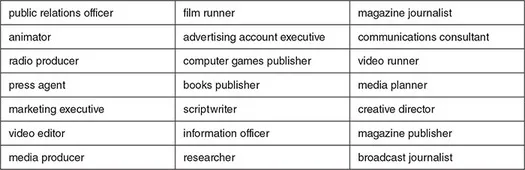
The creative industries are wide-ranging and fast-moving sectors. A search will reveal the following list of just a few of the potential careers that might be suitable for you on graduation, armed with your media degree:
Figure 1.1 Potential careers for media degree graduates
And many more!
So, the creative industry sector is a broad field for potential employment and an appropriate route from a media degree. It is also important to many other employment sectors. For example, marketing and public relations departments exist in most non-media organisations, both large and small, corporate and third sector, so you may end up working in an organisation that has little connection with the media itself, but within the media side of that organisation.
Exercise: Highlighting Potential Jobs/Employment Areas
Look at the list of possible jobs to come out of a media degree in Figure 1.1 above and highlight one of the potential jobs that might be of interest to you, or one that you know little about at the moment. Investigate the following aspects of the role:
- The job description.
- The person specification.
- The location.
- Where the jobs are advertised.
- A live example of a job advertisement.
- The trade press associated with the job.
- The promotion and career structure.
- The salary levels.
Follow this up by finding a case study of someone currently working in the job in focus. Careers case studies can be found on a number of websites online. Start by looking at the websites suggested in the further reading section at the end of this chapter.
Using your research as a basis, create a handout, a presentation, a web page or an infographic poster aimed at your peers on your degree course. Your aim should be to give them all the information they need about the job you chose to focus on. You could add this to your career/personal development portfolio to give you a starting point in your career planning. Repeat this exercise for any other jobs that you think might appeal to you.
What Is It Like to Work in the Creative Industries?
In our experience, graduates go into the creative industries sector due to a passion for the work and lifestyle rather than for just the money. Often, they could earn more in a different area of employment, or have much better job security but they are attracted to working in the creative sector.
In order to start to think about what sort of career would suit you, the following exercise will help you to examine your general aspirations in career terms.
Exercise: Career Pros and Cons
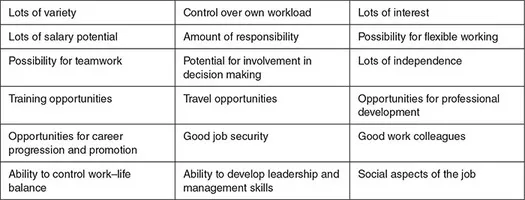
When thinking of which employment area might suit you best, it is worth thinking about what constitutes âgood workâ for you. This will be a very individual thing. To explore this, pick out five features from the table in Figure 1.2 that define what constitutes âgood workâ for you personally. Put these in rank order from 1 to 5 and give a brief explanation of why you have chosen each. This should help you to start to focus on your general needs career wise, rather than being too specific about particular jobs at this stage in your career planning.
Figure 1.2 Career pros and cons
Now, think about how the characteristics of work in the creative industries below chime with your own evaluation of what constitutes a âgood jobâ for you.
- Very creative
- Driven by deadlines
- Driven by targets
- Often includes travel opportunities
- Often involves long hours
- Sometimes involves unsociable hours
- Often freelance and self-employed
- Sometimes part-time work and a portfolio career
- Level of income unpredictable
- Involves lots of teamwork
- Involves a lot of autonomy and need for being proactive
Are you still convinced?
Next, look at each of the characteristics of work in the creative industries above and identify some evidence from your experience so far that suggests that you should pursue this career area further. You could give examples of when you have had to work long and flexible hours, for example, and evaluate how this suits your personality type and your career aspirations.
Add the results of this exercise to your portfolio for future reference. This will help you when thinking about what characterises the sort of work you would like (and not like!) to experience in future.
Degrees, Media Studies and Employability
Having identified some of the key features of the work sector you might enter on graduation, we now turn our attention to thinking about how your university experience in general and your media studies degree in particular will help prepare you for employment in the media and creative industries sector.
Many careers and employability advisory services suggest that almost an...