Work in pre-industrial societies
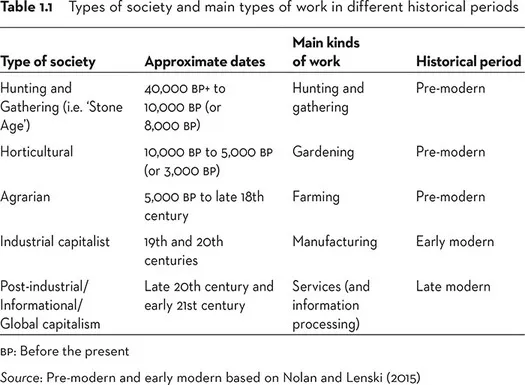
In order to appreciate the revolutionary character of the modern conception of work, it is useful to consider briefly the main features of work in pre-industrial societies before comparing them with work in industrial societies. However, such an exercise is not without its difficulties. First, it implies, wrongly, that change is unilinear, and second, it understates the heterogeneity of work activities in pre-industrial societies. Since the objective here is to contextualize historically in a succinct way the contrast between work in pre-industrial and industrial societies, Table 1.1 summarizes the great variety of human societies by reducing them to four major historical types, based, following Nolan and Lenski (2015: 224–36), on the predominant method of subsistence: (a) hunting and gathering, (b) horticultural, (c) agrarian, and (d) industrial, the latest phase of which is often referred to as the ‘information age’ (Castells 1996–98) or as a new type of ‘information society’, namely a post-industrial society (Bell 1976 [1973]: 467). The growth of information technology has not altered the fundamental principle of the pursuit of profit in a market system, hence continuities with the past abound: ‘It is hard to justify the claim that “information society” takes us beyond industrial capital-ism’ (Lyon 1986: 584; see also Kumar 1978, 1995; Webster 2014), although work has changed in a variety of ways as the following chapters will make clear.
Table 1.1 BP: Before the present
Source: Pre-modern and early modern based on Nolan and Lenski (2015)
Unless otherwise indicated, in the following discussion of pre-industrial societies, we have drawn heavily upon the comparative (historical and cross-cultural) material collated by Nolan and Lenski (2015). In the case of the most recent type of society, the industrial, and the post-industrial phase, two caveats are in order. First, the label ‘industrial capitalism’ is preferred since an essential element of the earliest and subsequently the most economically successful industrial societies which dominate the world economy is that they are capitalist as well as industrial. Second, the development of human societies is ongoing, and there is some debate about to what extent, and in what ways, advanced industrial capitalist societies have become post-industrial. This issue will be discussed in a later section of this chapter.
Hunting and gathering societies
The earliest known human societies were based on hunting and gathering and lasted longer than any other type of society, namely from the beginnings of human society, estimated to be at least 40,000 years ago, to around 10,000 years ago. In these essentially nomadic and small-scale societies, their limited technology, involving the widespread use of stones for tools and weapons, typically did not produce a regular economic surplus or lead to marked inequalities. Yet food resources were sufficiently varied and abundant that few hours were spent working compared with those spent at leisure, economic circumstances that led to the designation as the ‘original affluent society’ (Sahlins 2004 [1972]: 1). Everyone in such societies participated in productive work; the young and old, men and women, even political and religious leaders undertook their roles on a part-time basis. Biological differences between the sexes and age groups led to adult males specializing in hunting and fishing and adult females in gathering and food preparation, with everyone often contributing to the building of shelters. Preparation for the sex-based adult work roles in such a limited division of labour was informal, although formal ceremonies (initiation rites) typically marked the transition to manhood and womanhood. Sharing work and the products of work typified this era, since the survival of the group put a premium on co-operative rather than competitive behaviour. In Veblen’s terminology, they were more peaceable than predatory societies (1964 [1914]).
Horticultural societies
The emergence of semi-nomadic and later settled horticultural societies based on the cultivation of plants and the domestication of animals about 10,000 years ago, combined with the use of metals instead of stone for tools and weapons, led to the creation of a more reliable economic surplus, an increase in the size of the population, and the differentiation of economic activities. Essentially, such societies are dominated by gardening work using a digging stick and hoe, and are characterized by an increase in socio-economic specialization, for example workers and warriors, and a corresponding growth of inequality associated with the beginnings of a stratification system dominated by male warriors. The increase in trade and the conquest of people were not only made possible with technological innovations such as metal working that created superior tools and weapons, but were found to be a viable economic alternative to the ‘conquest of nature’ (Nolan and Lenski 2015: 140). The production of a ‘margin worth fighting for, above the subsistence of those engaged in getting a living’, led Veblen to call this stage the ‘first predatory era’ (1970 [1899]: 32). Therefore, in addition to the by now established pattern of women doing most of the productive work, in the more advanced horticultural societies, the creation of a stable economic surplus by the majority allowed a minority to form an hereditary aristocracy of males who specialized in politics, religion and warfare.
Agrarian societies
The next major stimulus to production occurred sometime around 5,000 years ago, it involved the widespread use of the plough and the harnessing of animal power for agriculture and transport, and heralded the development of agrarian societies. The farming of fields using animals to pull a plough rather than gardening based on human energy to operate tools such as a hoe became the predominant method of cultivation. Following these technological innovations, production expanded markedly, the population grew, and social differentiation increased, especially along class lines, with dominant groups specializing in the ownership of land and people, and subordinate groups specializing in a range of economic activities, including the production, transportation and distribution of everything from food, tools and weapons. Economic growth led to a greater diversity of occupations and the emergence of urban centres in which the use of money became the preferred medium of exchange, which in turn further stimulated trade and therefore production and community specialization. For the vast majority, home and work were still not separated, with the household being the unit of production as well as consumption for its members, not all of whom would have been related, for example, apprentices. The expansion of those engaged in the increasing variety of occupations encouraged the establishment of craft guilds to promote their interests – the pre-industrial equivalent of trade unions.
It was at this historical juncture that the important distinction between a productive class of people who worked for a living and a non-productive, parasitical leisure class reached its fullest development. In Europe, this class prevailed during the feudal era when its members were ‘not only exempt, but by prescriptive custom’ were ‘debarred, from all industrial occupations’ (Veblen 1970 [1899]: 22). This degree of social differentiation involved the emergence of work and leisure as separate spheres of activity for the dominant class, whereas formerly such activities were embedded in other institutions, notably kinship and religion.
Discussion: work in pre-industrial societies
Thus, prior to the rise of industrial capitalism, the main kinds of work were all non-industrial and varied from everyone working co-operatively on a minimally differentiated basis, to a degree of gender, age and class specialization culminating in some social groups being exempt from productive work. Above all, in pre-industrial societies, ‘Work was not a special subject, it was part of the general social and spiritual framework’ (Anthony 1977: 37). Yet, variation in terms of gender was marked in pre-industrial societies, ranging from women taken as trophies and enslaved during wars (Veblen 1970 [1899]), to women owning land and managing the production of beer in agrarian England (Applebaum 1992). Notwithstanding such variations, the development of industrial society tends to enhance the liberation of women (Boserup 1970), although this generalization is not without its complexities and critics (Walby 1990), as will become apparent below.
Occupational specialization was minimal in the earliest known societies whereas in horticultural and agrarian societies ‘occupational specialties numbered in the hundreds, and there was a complex division of labour that often involved specialization by communities and even regions’ (Nolan and Lenski 2015: 212). Yet, compared with the unparalleled degree of economic specialization intrinsic to industrial capitalism, rural pre-industrial societies were characterized by a rudimentary and essentially ascriptive division of labour. The increase in the division of labour was accompanied by a move from learning work roles informally via watching adults work and practical experience, to acquiring specialist knowledge and skills formally in dedicated organizations such as schools and universities. Even in the most advanced agrarian societies, education was not universally available but restricted to the dominant classes in order to prepare them for political, religious and military roles, rather than for economically productive ones.
Variations between the different types of pre-industrial society also relate to beliefs about the meaning of work, although, as in the case of the division of labour, the multiplicity of meanings attached to work in such societies are revealed to be of minor social significance by the radically new and elevated meaning of work occasioned by the onset of industrial capitalism. In pre-industrial societies labour was typically unfree to a greater or lesser extent in the form of slavery, serfdom, indenture, and bonded service, and persisted during the rise of industrial capitalism in Britain, America and elsewhere (Corrigan 1977). It is unsurprising therefore that useful work tended not to be highly valued as an economic activity, despite its indispensability for the survival of everyone. Hence, it has been shown that in pre-industrial societies as different as ancient Greece and medieval Europe, work was regarded negatively, as a necessary evil or as an expiation of sins committed by others in the past (Applebaum 1992; Tilgher 1977 [1930]). Moreover, even such vital activities as farming and craft work received only limited approval from dominant political and religious leaders because, although they were conducive to an independent livelihood and produced goods and services for the parasitic ruling class, they detracted from the ability to engage in politics or spiritual contemplation. Consequently, physical labour, however essential or skilled, did not enjoy the wealth, power and therefore status of non-manual work, such as owning (land and people), governing or praying. It was also considered ceremonially unclean and therefore to be avoided at all costs (Veblen 1970 [1899]).
In the transition to industrial capitalism in Britain and elsewhere, before wage labour became the norm for the vast majority, wage work in agriculture was common but it was typically irregular, and was merely one of a number of economic activities upon which people depended for their survival. For example, in addition to seasonal wage labour, workers could obtain a supply of food via the cultivation of a small parcel of land, make and sell clothes, plus hunting and gathering (Malcomson 1988). Whatever the combination of different forms of work, the family remained the basic productive unit in the sense that all members contributed to its economic survival. This was a pattern which continued in the early development of industrial capitalism (Anderson 1971). So, it was not until the full development of industrial capitalism that a marked contrast between work in this new type of society and work in all pre-industrial societies became apparent.
Work in industrial capitalist societies
Consideration of the many accounts of historical change shows that there is near universal consensus regarding the social significance of the emergence of industrial capitalism, namely that it transformed the work and life of everyone; hence the tendency to focus on the marked contrast between this new type of society and all types of pre-industrial societies. The term ‘Industrial Revolution’ is invariably used to convey the importance of this transformation, one that centres on the nature of work above all else. Such was the scale and intensity of this social change that it is widely thought to have prompted the emergence of sociology as a distinct discipline (e.g. Giddens 1971). The process of capitalist industrialization started in England in the late eighteenth century, developed soon after in America, France and Germany, and subsequently the rest of the world to the point where it is now a global phenomenon in that goods and services are made from materials sourced from many parts of the world and sold around the world.
The first part of the term ‘industrial capitalism’ refers to the use of inanimate energy sources such as electric, gas or nuclear power, and the consequent reorganization of production involving machine technology, which results in the establishment of large-scale specialized workplaces such as factories and the increased time synchronization of labour and technology in an economy based primarily on manufacturing rather than agriculture. ‘Capitalism’ refers to a profit-oriented system based on the private ownership of production, on an individual/family or corporate basis, that operates in a competitive market system in which the owners of capital employ free wage labour on a monetary basis. The apparent clarity of these definitions does not imply, in the case of the word ‘industrial’, any suggestion of technological determinism and, in the case of the word ‘capitalist’, any suggestion of admiration or antagonism. However, the use of the two words in combination does imply that industrialism and capitalism are inextricably linked and have been referred to by Davies and Frink (2014) as the ‘industrial revolution’ and ‘market revolution’ respectively. The former involved the transfer of work out of the home to specialist organizations (factories and offices), whereas the latter redefined work to mean that only activities that earned money were considered work.
An illustration of the interconnectedness of the industrial and capitalist dimensions is afforded by consideration of the experience of workers. The spatial separation of home from work, initiated by the creation of specialist work sites following the introduction of inanimate energy sources to power machine technology, represents the first major change from what had been the norm in all pre-industrial societies: the unity of home and work. In a capitalist system in which making a profit is the priority, workers are recruited on the basis of potential productiveness rather ...