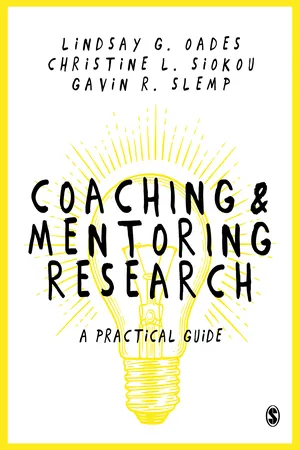
This highly engaging guidebook provides an accessible introduction to research methods and the research process within the coaching and mentoring context. Starting with an introduction to the basic principles of research theory and practice, explaining why we need to do research at all, what it is, why it?s important, and moving on to cover the ins and outs of actually doing research, this book provides students with everything they need to know all in one place.
Packed full of case studies, activities and hints and tips for best practice, this book throws a life belt to all coaching and mentoring trainees and practitioners looking to make the best start in their research career.
Part I Becoming a researcher in
coaching and mentoring
1 Benefits of research: Why do research on coaching and
mentoring?3
2 Impactful research: How do I make my research innovative,
significant and beneficial?9
3 Research teams: Who will be a part of my research team?19
4 Avoiding pitfalls: How do I avoid pitfalls commonly made by
beginner researchers?25
5 Theories of knowledge: How do I know?37
1 Benefits of research Why do research on coaching and mentoring?
Learning Outcomes
In completing this chapter and related exercises, you will be able to:
define types of coaching and mentoring research;
describe the current status of coaching and mentoring research;
state the benefits of conducting research into coaching and mentoring;
describe what other areas of research (theory and evidence) may be beneficial to assisting the development of coaching and mentoring research.
What is the current reality in coaching and mentoring research?
Research and acquiring knowledge go hand in hand. The OECD and UNESCO in 2001 defined research as comprising ‘creative work undertaken on a systematic basis in order to increase the stock of knowledge, including knowledge of humans, culture and society, and the use of this stock of knowledge to devise new applications’. Research uses systematic processes and tools to establish or confirm facts, reaffirm the results of previous work, solve new or existing problems, confirm or disconfirm propositions, or to develop new theories. Research allows us to build on existing work in order to generate new concepts, methodologies or understandings that advance human knowledge.
Why does knowledge advancement matter for coaching and mentoring? Well, without this, there would be no way of really knowing what ‘works’ and what doesn’t with respect to coaching and mentoring, or what outcomes we can expect from particular programmes. There would be no way of understanding the extent to which people change as a result of coaching or mentoring, or how to improve existing coaching and mentoring practices. We would have no understanding of whether current practices contain any unhelpful or harmful side-effects, or whether different people respond differently to different types of programmes, or whether different policies support or inhibit coaching or mentoring practices. Importantly, there would be no way of understanding the changes that take place during the coaching or mentoring process, and how these changes explain observed outcomes to result from the coaching or mentoring experience. Ultimately, without research, there would be no reliable or valid knowledge that we can use to build theory and, in turn, inform practice. Hence, this book is about empowering you with the tools and skills of a researcher, so that you can go about conducting your own coaching and/or mentoring research.
While we clearly recognize that coaching and mentoring are indeed different, from a research perspective they are very similar in the challenges they face. For this reason, they are discussed within this volume side-by-side. Coaching and mentoring may occur in many contexts (e.g., think of the adjective often placed before coaching, such as ‘life’, ‘health’, ‘executive’, ‘performance’), and we remain relatively silent on how coaching and mentoring might differ depending on idiosyncrasies between these different areas. While all represent different domains in which coaching or mentoring could take place, the essential concepts, methodologies and methods we cover will apply across these different contexts. With that in mind, let’s start with some fundamental definitions of coaching and mentoring before moving to research.
Definitions of Coaching and Mentoring
Coaching can be defined as an action-oriented, collaborative process that seeks to facilitate goal-attainment, self-directed learning, and/or enhance performance in the coachee’s personal or professional life (Spence and Grant, 2007). It is a way of thinking, managing, treating people, and a way of being that can lead to transformation in people’s lives.
Mentoring is a process for the informal transmission of knowledge, social capital and the psychosocial support perceived by the recipient as relevant to work, career or professional development; mentoring entails informal communication, usually face-to-face and during a sustained period of time, between a person who is perceived to have greater relevant knowledge, wisdom or experience (the mentor) and a person who is perceived to have less (the protégé) (Bozeman and Feeney, 2007).
To help map out the different types of coaching and mentoring research, we propose the four-part schema summarized in Table 1.1. This can be used to locate four different types of coaching and mentoring research, with the first three types assuming that research is examining an active coaching or mentoring intervention – that is, a coaching or mentoring intervention is actively occurring and participants are currently participating in this programme, either as a coach/mentor or a coachee/protégé.
Table 1.1
Because the fields of mentoring research and, in particular, coaching research are developing endeavours, it is useful and possibly necessary to borrow theories and evidence from other areas in order to inform the research process. This does not mean that coaching and mentoring are not their own areas of investigation, but rather it suggests that each may be informed by existing and related fields. Science is ultimately a cumulative exercise and it is necessary to use knowledge that is developed from related fields to inform the research process. The following box provides an example of this for coaching research.
Challenges in Coaching Research
Coaching is not yet a mature field of study and care should be taken not to overstate what is known from the existing literature. If validation of your research or practice is important and cannot be gained from the existing knowledge base, the Self-Determination Theory literature may be useful to draw upon. There have been relatively few attempts to provide a detailed theoretical account of what happens in coaching or to build our understanding about why coaching works in certain contexts (Spence and Grant, 2012). It is our hope that researchers and practitioners will build on and continue to develop new hypotheses and research studies against the backdrop of the well-established and relevant theories of well-being and human functioning.
Nonetheless, while both coaching and mentoring are developing fields, they are growing and neither can now be considered ‘new’ because consistent research efforts have been pursued in each field for a decade or more. For example, in recent years, comprehensive reviews that synthesize the existing available research are emerging on both coaching (e.g., Theeboom, Beersmam & Fidell, 2014) and mentoring (e.g., Eby et al., 2008, 2013) in the workplace context. This is generally a sign that research is beginning to mature because integrative reviews, such as these, require available research studies to use as inputs. We touch on these later in Chapter 9 as we explore literature review as a research method.
Activity
What is your current reality related to coaching and mentoring research?
To learn more about coaching and mentoring research, it is useful to explore the current reality: in this case, what you already know about coaching and mentoring research.
On a blank page, please answer the following questions.
Why is coaching/mentoring important?
Why is coaching/mentoring research important – that is, why do we need it?
In addition to obvious things such as course requirements, what are you trying to achieve by doing coaching or mentoring research?
What are your options in conducting coaching and mentoring research?
Before leaping into a study, it will be useful to know ‘what type’ of coaching or mentoring research you intend to conduct. This can be done before choosing an exact topic, sample or method, and it can also be done after these stages as well. Table 1.2 builds upon Table 1.1, and is designed to prompt you to identify for yourself different possible advantages and disadvantages of the different types of research. This activity will also be useful in helping you to establish your current level of knowledge across each of these types of research.
Using the four options from Table 1.2, list a one-sentence advantage and a one-sentence disadvantage of each one, explaining why you personally think it would be valuable to do research in that area. For further examples of these types of research, see the Appendix.
Table 1.2
...
Table of contents
Cover
Half Title
Publisher Note
Title Page
Copyright Page
Acknowledgements
Contents
About the Authors
Preface
Part I Becoming a researcher in
coaching and mentoring
1 Benefits of research Why do research on coaching and mentoring?
2 Impactful research How do I make my research innovative, significant and
beneficial?
3 Research teams Who will be a part of my research team?
4 Avoiding pitfalls How do I avoid pitfalls commonly made by beginner
researchers?
5 Theories of knowledge How do I know?
Part II Phases of the research
process
6 Choosing a research methodology
How do I choose a research
methodology?
7 Research scope What is the scope of my research project?
8 Research questions How do I shape a good research question?
9 Reviewing literature How do I do a good literature review in coaching or
mentoring?
10 Research proposals How do I write a research proposal?
11 Research ethics How do I deal with ethics in coaching and mentoring
research?
12 Feasible timelines How do I plan and manage my research time?
13 Data collection and analysis
What are the likely issues I will face during
data collection and analysis?
14 Dissemination of research How should I effectively communicate my research
findings and information?
Part III Quantitative methods for
coaching and mentoring research
15 Choosing quantitative methods
When should I use quantitative
methods?
16 Experimental designs What are the different types of experimental
design?
17 Survey designs What are the different types of cross-sectional survey
design?
18 Common quantitative methods and
analyses What are the common quantitative methods and
analyses for coaching and mentoring research?
19 Developing confidence in
statistics How can I become confident in
statistics?
Part IV Qualitative and mixed methods
for coaching and mentoring research
20 Choosing qualitative methods for
data collection/generation Which method should I use
to generate data?
21 Choosing qualitative methods for
data analysis/interpretation Which method should I
use to make sense of my data?
22 Programme evaluation and action
research What’s the difference between a research
project and a programme evaluation?
23 Case study designs Should I use a case study design?
24 Mixed methods Could or should I use mixed methods?
Appendix
References
Index
Trusted by 375,005 students
Access to over 1.5 million titles for a fair monthly price.
Study more efficiently using our study tools.
Frequently asked questions
Yes, you can cancel anytime from the Subscription tab in your account settings on the Perlego website. Your subscription will stay active until the end of your current billing period. Learn how to cancel your subscription
No, books cannot be downloaded as external files, such as PDFs, for use outside of Perlego. However, you can download books within the Perlego app for offline reading on mobile or tablet. Learn how to download books offline
Perlego offers two plans: Essential and Complete
Essential is ideal for learners and professionals who enjoy exploring a wide range of subjects. Access the Essential Library with 800,000+ trusted titles and best-sellers across business, personal growth, and the humanities. Includes unlimited reading time and Standard Read Aloud voice.
Complete: Perfect for advanced learners and researchers needing full, unrestricted access. Unlock 1.5M+ books across hundreds of subjects, including academic and specialized titles. The Complete Plan also includes advanced features like Premium Read Aloud and Research Assistant.
Both plans are available with monthly, semester, or annual billing cycles.
We are an online textbook subscription service, where you can get access to an entire online library for less than the price of a single book per month. With over 1.5 million books across 990+ topics, we’ve got you covered! Learn about our mission
Look out for the read-aloud symbol on your next book to see if you can listen to it. The read-aloud tool reads text aloud for you, highlighting the text as it is being read. You can pause it, speed it up and slow it down. Learn more about Read Aloud
Yes! You can use the Perlego app on both iOS and Android devices to read anytime, anywhere — even offline. Perfect for commutes or when you’re on the go. Please note we cannot support devices running on iOS 13 and Android 7 or earlier. Learn more about using the app
Yes, you can access Coaching and Mentoring Research by Lindsay Oades,Christine L. Siokou,Gavin Slemp,Author in PDF and/or ePUB format, as well as other popular books in Psychology & Psychotherapy Counselling. We have over 1.5 million books available in our catalogue for you to explore.