Knowledge of the dynamic processes of child development helps create an understanding of the individual which is an essential underpinning of therapeutic work with young people. This knowledge will aid practitioners in understanding their clients and appreciating the origins of their world view. It can be crucial in understanding the developmental needs of young people and the origins of psychological dysfunction, as well as how development might affect the capacity to engage fully in a therapeutic relationship.
The first section of this chapter examines the development of a sense of self. It considers the optimal conditions for this development as well as looking at what happens when those conditions are not provided.
Humanistic theories of growth and development
As explained in the introduction, in line with the BACP (2014) competences framework the central theoretical approach of this manual is humanistic, so it seems appropriate to begin by looking at development from an associated perspective. In 1959, Carl Rogers published a paper outlining his theory of personality development in infancy. Rogers was influenced by two important areas of thinking: those of phenomenology, ‘… which starts from the assumption that human existence can be best understood in terms of how people experience their world’, and that of Humanistic psychology, which held an assumption that, ‘… individuals are propelled forward in the direction of growth or actualization’ (Cooper, 2013a: 119). In Rogers’ (1959) view the infant begins life in an undifferentiated state, i.e. there is no ‘me’ and ‘not me’, no pre-existing core sense of self or of an external, non-subjective reality. As they develop, the infant begins to have ‘self-experiences’, when ‘… a portion of the individual’s experience becomes differentiated and symbolized in an awareness of being, awareness of functioning’ (1959: 223). For Rogers, this marks the beginning of a separate sense of self, or self-concept, which forms the basis of how the infant will experience and make sense of their world. Rogers suggests that next the infant forms a sense of an ‘other’ from whom ‘The infant learns to need love’ (1959: 225), and it is this need for love or positive regard which predominates because of its connection with the need to survive. Without a positive connection to their caregiver, the infant’s survival may be jeopardised and,
Consequently the expression of positive regard by a significant social other can become more compelling than the organismic valuing process, and the individual becomes more adient to the positive regard of such others than toward experiences which are of positive value in actualizing the organism. (Rogers, 1959: 224)
The organismic valuing process referred to here is a concept from humanistic theory that the human organism can be relied upon to lead the individual in the right direction for growth. The need for positive regard can conflict with this process, resulting in the development of ‘conditions of worth’, which arise when an infant is not unconditionally valued by their caregiver. If the child is always wholly ‘prized’ exactly as they are, in other words if they receive unconditional positive regard from the caregiver, then no conditions of worth are arising. If the positive regard of the significant other is viewed as conditional, i.e. the child experiences themselves as prized in some ways and not in others, then a condition of worth will arise, as explained in the following:
Hence, as well as developing an understanding of which self-experiences are worthy of reward by others and those which are not, the infant starts to shape his interactions with others in a manner designed to maximise the positive regard he receives. As a result, he increasingly orientates his attention toward positively regarded self-experiences, such as feelings of happiness and their associated behaviours, attending less to those that invoke less or no positive regard from others. (Gillon, 2007: 31)
Conditions of worth can have a significant impact on the capacity for self-regard as the child begins to prize themselves only in ways in which they have been prized by others (Rogers, 1959). This is crucial in the humanistic theory of psychological wellbeing as it marks the point where the need to obtain positive regard from significant others takes priority over the needs of the organism. This ‘disturbance’ of the valuing process, Rogers argues, ‘… prevents the individual from functioning freely and with maximum effectiveness’ (1959: 210). Humanistic theory views this as where psychological disturbance is most likely to develop and therefore where therapy comes in. For Rogers, the role of the counsellor is to provide a relationship where the client experiences themselves as wholly prized without the imposition of conditions of worth. This enables the reinstating of the organismic valuing process within the individual.
Attachment theory
Rogers’ (1959) view of infant development places the care environment and the relationship with the primary caregiver/s at the centre of the development of the self-structure or self-concept and this, along with genetic predispositions and biological processes, forms the core of contemporary theories of infant development. This is also the approach of Attachment theory, developed by psychologist and psychiatrist John Bowlby during the post-war period of the 1950s and based on the study of infants’ attachment to their caregiver. Attachment theory fits well with Rogers’ view of development and the broadly humanistic theory on which this book is based. From both his earlier ethological studies of animal behaviour, along with work he undertook in 1950 as part of a World Health Organisation (WHO) survey of the mental health of homeless children, Bowlby formulated the idea that, ‘What is believed to be essential for mental health is that the infant and young child should experience a warm, intimate and continuous relationship with his mother (or permanent mother-substitute) in which both find satisfaction and enjoyment’ (1969: xi). Bowlby identified human infants, due to their intense vulnerability at birth, as having an innate need to maintain proximity to someone, ‘… conceived as better able to cope with the world’ (1988: 27). Bowlby (1973) suggested that to develop secure attachments, children require caregivers who are psychologically, physically and emotionally available. According to attachment theory, a child’s early experience of their primary caregiver’s ability to respond appropriately to their needs leads to the development of an ‘internal working model’ (IWM) (Bowlby, 1969) akin to Rogers’ (1959) self-concept or self-structure. The IWM is a set of expectations and beliefs which the child develops experientially about self, others and the world, as well as the relationships between them. For example, if a hungry baby who cries is responded to reasonably promptly by their caregiver in a way which is soothing, this begins to form the basis for an IWM developed out of an understanding that behaviours and needs produce positive behaviour on the part of the caregiver. The infant consequently begins to develop a sense that they are loved and worthy of their basic needs being met. If such experiences continue, they will develop trust in an environment which is basically responsive to their needs. Infants not responded to in this way or similarly are likely to develop an IWM of an environment far less naturally responsive and of themselves and their behaviour as responsible for this lack of response. The IWM becomes a fundamental blueprint for the child, determining to an extent how they experience themselves, their relationships, and the world in general as they grow. It contains expectations and beliefs regarding the behaviour of self and others; whether or not the self is loveable and worthy of love and protection, and whether the self is worthy of another’s interest and availability. The term ‘working’ model is significant here, particularly in the context of therapy, as in line with the optimism of the Humanistic approach in general, it indicates that this ‘working’ model can adapt and change in accordance with new experiences.
In line with Rogers’ development of the ‘self-concept’ or ‘self-structure’, the IWM of attachment theory relates to development of the child’s sense of their basic acceptability and worth, as well as their understanding of how reliably others and the world around them will meet their emotional and physical needs. In Rogers’ (1959) theory, the infant may begin to deny and distort its own needs in order to maintain the positive regard of a parent and prevent the perceived threat of withdrawal of love, just as in attachment theory the child adapts their behaviour to maintain an emotional attachment/physical proximity to their caregiver in an attempt to ensure physical and psychological safety. Bowlby (1969) suggests that children instinctively recognise which behaviours seem to please their caregiver and encourage them to maintain proximity, and which trigger rejection, thus threatening the attachment. This adaptation fits with Rogers’ (1959) theory that the infant adapts behaviour in order to secure necessary positive regard from their caregiver.
Classification of attachment patterns
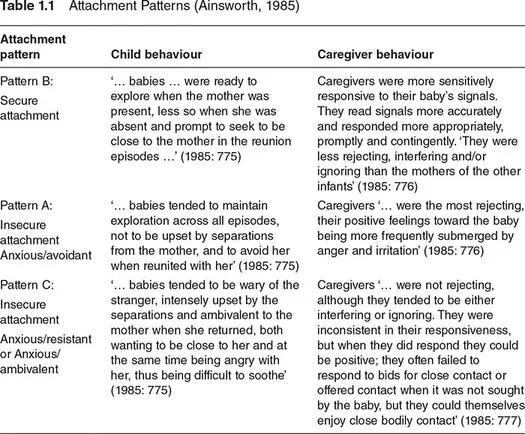
While working alongside Bowlby, psychologist Mary Ainsworth developed the ‘Strange Situation Test’ (Ainsworth et al., 1978) as a way of identifying and categorising children’s attachment patterns. The ‘Strange Situation’ consists of a ‘laboratory situation’ (Ainsworth et al., 1978) which begins with a mother and child aged 12–18 months playing together in a room. A stranger enters and the mother leaves before returning soon after. This experiment was repeated on many different subjects and the observations recorded. The reactions and behaviours of the mother and child throughout the test were monitored and used as the basis for developing classifications of ‘typical’ attachment behaviours. Using the ‘Strange Situation’ on large numbers of mothers and babies in Baltimore, Ainsworth (1985) and her associates arrived at three basic categories of attachment behaviour, as shown in Table 1.1.
A later category of ‘insecure-disorganised’, indicating a confused or traumatised pattern of attachment was arrived at by Main and Solomon (1986), and subsequently included in the patterns of attachment identified by the ‘Strange Situation’.
Relevance of attachment theory for counselling young people
Awareness of attachment patterns and how they originate can be helpful in gaining insight into a client’s world view as well as in understanding their IWMs and how these affect their relationships with self and others.
The following case example demonstrates the potential significance of attachment theory in the case of one individual.
Case Example 1.1: James
James is 15 and has been referred to a voluntary sector young people’s counselling service by a youth worker con...