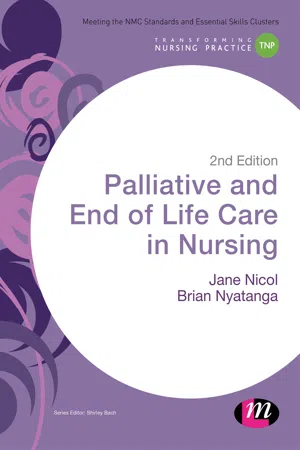
With the number of people requiring palliative and end of life care steadily increasing, it is the responsibility of every nurse, regardless of specialism, to know how to provide high quality care to this group of people. Yet caring for those nearing the end of life can throw up complex issues, including handling bereavement, cultural and ethical issues, delivering care in a wide variety of settings, symptom management and also ensuring your own emotional resilience. This book is specifically designed to equip nursing students and non-specialists with the essential knowledge in relation to the care and management of people nearing the end of life.
- 184 pages
- English
- ePUB (mobile friendly)
- Available on iOS & Android
eBook - ePub
Palliative and End of Life Care in Nursing
About this book
Information
Chapter 1
The idea of living, dying, life and death
Brian Nyatanga
NMC Standards for Pre-registration Nursing Education
This chapter will address the following competencies:
Domain 1: Professional values
2. All nurses must practise in a holistic, non-judgemental, caring and sensitive manner that avoids assumptions, supports social inclusion; recognises and respects individual choice; and acknowledges diversity. Where necessary, they must challenge inequality, discrimination and exclusion from access to care.
Domain 2: Communication and interpersonal skills
1. All nurses must build partnerships and therapeutic relationships through effective and non-discriminatory communication. They must take account of individual differences, capabilities and needs.
Domain 3: Nursing practice and decision-making
4. All nurses must ascertain and respond to the physical, social and psychological needs of people, groups and communities. They must then plan, deliver and evaluate safe, competent, person-centred care in partnership with them, paying special attention to changing health needs during different life stages, including progressive illness and death, loss and bereavement.
NMC Essential Skills Clusters
This chapter will address the following ESCs:
Cluster: care, compassion and communication
3. People can trust the newly registered graduate nurse to respect them as individuals and strive to help them preserve their dignity at all times.
First progression point
1. Demonstrate respect for diversity and individual preference, valuing differences, regardless of personal view.
Entry to the register
4. Acts professionally to ensure that personal judgements, prejudices, values, attitudes and beliefs do not compromise care.
Chapter aims
After reading this chapter, you will be able to:
• understand the connection between living and dying, and then between life and death in the context of palliative care and end of life care;
• appreciate the possible reasons many people fear death, and how you can support patients to achieve a dignified death for them;
• appreciate the role euphemisms play in ‘softening’ the reality of death and the impact this can have on patients and the bereaved;
• understand what palliative and end of life care are and their underlying ethos;
• appreciate the importance of dying in your own home and use this information to support patient-centred palliative and end of life care.
Introduction
Si vis vitam para mortem
If you wish for life, prepare yourself for death
The key message of this saying is that although life and death may present differently, they are part of the same thing. The two realities are perceived as being on a continuum but positioned at two distinct polarities (ends) with life at the beginning and death at the other end. These two realities cannot be separated – we cannot experience one without the other – therefore we need to find a way of reconciling them. The truth is that human beings have no choice between these two realities although the popular belief is that life is always preferable to death. Therefore every effort is made to enjoy life while doing everything possible to delay death. In this paradox, we can also see deep seated conceptual denial of death and an overwhelming but often misplaced optimism about human immortality. Freud summed this up in his 1953 celebrated statement that death was unimaginable and therefore not available:
It is indeed impossible to imagine our own death; and whenever we attempt to do so we can perceive that we are still present as spectators.
In other words, Freud was arguing that at our unconscious level we are all convinced that we are immortal. Looking at this closely we have to ask and wonder whether this is our way of coping with the threat of death and therefore a defence mechanism against the anxiety (death anxiety) that can be experienced.
The saying at the start also identifies some philosophical ideas about the interconnectedness of life and death – which can be experienced through living and which can be realised (reached) through the dying process. It is no secret that most people tend to fear death even though they all know it will happen to them at some point in their life.
The aim of this chapter is to allow you to explore this paradox, and similar conflicting ideas surrounding life and death, and to use this knowledge to enable you to provide person-centred care for patients receiving palliative and end of life care. This chapter will discuss the sources of such fears, expose any conflicts and offer arguments that explain why this remains the case. The discussion will also look at how death has remained a taboo topic throughout many Western societies. The taboo nature of death can be explained by the unfortunate use of euphemisms around most aspects of death and dying. This chapter will ask you to think through whether euphemisms still have a place in our language and if their use is beneficial, or a hindrance, to our attempts to talk openly about death as articulated in the End of Life Care Strategy (DH 2008). It is important that you, and other health care professionals, develop the knowledge and skills necessary to feel confident to care for patients who are receiving palliative and end of life care. In order to do this, you will need to understand the principles that govern the practice of palliative care. The ethos which underpins the delivery of palliative care is central to offering the best care possible to all patients and those deemed important to the patient.
It is true that patients now die in different places, including hospices, hospitals and nursing homes, but most prefer to die in their own home. Why dying in the home is preferred and what could be driving or influencing these decisions will also be discussed. What is important in all aspects of the care and support you offer to patients is that it will improve or enhance their quality of life. Quality of life aims to ensure a dignified and unique death for each patient. There are many reasons why achieving a dignified death is important – one of these is that it helps relatives cope with grief and the bereavement process.
The connection between living and dying
Plants and animals are living things, whereas objects are not: they exist, but are not alive. It is generally thought that only animals (including humans) have consciousness. You are living in the sense that you are thinking, breathing, your heart is pumping blood around your body and your mind is either conscious or unconscious. People are considered to be dying when something threatens their prospect of living, such as terminal illness or acute trauma, but also when they approach old age. When you look closely at this, it is impossible to talk about living without dying and by extension talking about death without considering life as the two are part of the same continuum. Without living, there is no dying and without life there is no death. In addition, life itself is one of those concepts that remains unclearly defined. When does life (living) stop in order for dying to start? Most people would agree that living is the beginning of dying, which in turn signals the end of life. Looking at life and death in this way gives one clue that we cannot separate the two things. In fact one cannot be there without the presence of the other. This cyclical existence only serves to create a complex picture impossible to comprehend. Maybe this could explain why we rarely talk openly about death.
Activity 1.1 Reflection
This activity is to allow you time to reflect on how you view life and death and to think about when both life and death begin.
When people are born we like to think that this is when their living starts.
Write down your thoughts about this and say whether you agree with such thinking.
Now write down when you think dying starts. You can include the legal position on death in your country as well as other perspectives you may think of in your writing.
Brief answers to all activities are given at the end of the chapter, unless otherwise indicated. This activity is based on your own observations, so there is no outline answer given.
Your reflections in Activity 1.1 will be unique to you and this will be the same for your patients. However, there are legal positions about when life starts. In the UK it is when a pregnancy is 22 weeks and in the USA it is 20 weeks. The legal positions are not going to be discussed here; the important point for you to think about is whether we can separate living from dying. Nyatanga and Nyatanga (2011) suggest that these two things tend to happen at the same time. The argument they make is that, as you grow from an infant to an adult (living), you are also gradually dying (ageing). You could argue that what we call living is the same as what we call dying because these two aspects/processes happen at the same time. If you accept this, you can go on to suggest that life is to do with this process (living/dying) and death is in simplistic terms the end of this process.
Most people enjoy their youth and growing up; not many people will consciously think about their dying at the same time. Even people who become ill in their youth rarely consider that they might die. This may in some way explain the absolute horror we feel when a child or young adult dies; our minds are not always prepared for a young person’s death. Parents and grandparents often wish roles were reversed and they died instead, and this illogical death of a child makes it hard to ‘swallow’ for most of us.
This may not be the case in other parts of the world; we see images of death in developing and developed countries, involving both young and old, and due to famine, wars (such as those in South Sudan, Syria or Iraq) and terrorist attacks. We can, wrongly, come to accept their deaths as a consequence of the harsh reality of life through a changing political and environmental landscape. Whether or not it is justifiable, many people find they are more deeply shocked by atrocities involving people they see as being more ‘like’ them – for example, here in Britain people were shaken by the Bataclan massacre in Paris in 2015, and the attack on people celebrating Bastille Day in Nice the following summer (see The Guardian 2016, 15 July). This illustrates a natural tendency to think of disasters as something that happen to ‘other people’, and the greater power to shock when they happen to people who are relatively close to us in some way. Under normal circumstances, many people living in Western nations do not encounter death in their family until they have reached middle age or beyond. The different experiences we have of living and dying shape our perception of death. The point to remember is that, although death may be the same with regard to how we define it, our perception of it will differ according to individual experiences. Equally, the meaning of death will differ depending on individual expectations in life and in some cases beliefs that we hold about life.
Activity 1.2 Reflection
Reflect on your own perception of death, and then respond to the following points:
• What do you think death is? Write down your thoughts.
• Make a note on aspects of your life that have made you view death in this way, such as religious beliefs, previous experience of death.
• How might your perception of death influence the way you care for patients at the end of their life?
The following part of this activity is optional. If it brings back painful emotional memories or reactions, please feel free not to attempt it.
• Cast your mind back to the very first time you witnessed a human death; write down how old you were at the time. Describe how you think the whole experience affected you and influenced how you feel about death now. Of course, the experience will also depend on who it was that died (whether the person was close to you or not), how the individual died and how old this person was at the time.
As this activity is based on your own observations, there is no outline answer at the end of this chapter.
You might have found Activity 1.2 quite difficult to complete as there is a lack of tangible evidence about what death is really like. Nobody has come back from the dead to tell us about their own experience of death. In addition our perceptions are formed from a range of experiences during our day-to-day life and vary from person to person. It is likely that you have arrived at your perception of death using the experiences of your own life so far. Your perceptions are formed by the things you encounter as you grow up, therefore we can conclude that people are not born with a perception of death. If you agree that people are not born with a perception of death, it follows that these perceptions are learned and are formed by each person as they go through life. You learn things which guide your thinking and behaviour and at the same time you can unlearn things or learn new things that can change your original way of thinking and behaving.
What this suggests is that you and your patients are most likely to have different perceptions of death, and therefore of what death is. Therefore if you are going to help patients with their own dying, you need to understand what death means for them. To do this you need to understand how the patient’s history (previous experiences of death) might have shaped the way he or she now views death.
Death as taboo
To delight in talking about death, particularl...
Table of contents
- Cover Page
- Halftitle
- Advertisement
- Title
- Copyright
- Contents
- Transforming Nursing Practice
- About the Authors
- Acknowledgements
- Introduction
- 1 The Idea of Living, Dying, Life and Death
- 2 Communication in Palliative and End of Life Care
- 3 Exploring Loss, Grief and Bereavement
- 4 Understanding Cultural Issues in Palliative and End of Life Care
- 5 Rehabilitation in Palliative and End of Life Care
- 6 Ethical Issues in Palliative and End of Life Care
- 7 Palliative and End of Life Care in a Critical Care Setting
- 8 Legal Aspects of Palliative and End of Life Care
- References
- Index
Trusted by 375,005 students
Access to over 1.5 million titles for a fair monthly price.
Study more efficiently using our study tools.
Frequently asked questions
Yes, you can cancel anytime from the Subscription tab in your account settings on the Perlego website. Your subscription will stay active until the end of your current billing period. Learn how to cancel your subscription
No, books cannot be downloaded as external files, such as PDFs, for use outside of Perlego. However, you can download books within the Perlego app for offline reading on mobile or tablet. Learn how to download books offline
Perlego offers two plans: Essential and Complete
- Essential is ideal for learners and professionals who enjoy exploring a wide range of subjects. Access the Essential Library with 800,000+ trusted titles and best-sellers across business, personal growth, and the humanities. Includes unlimited reading time and Standard Read Aloud voice.
- Complete: Perfect for advanced learners and researchers needing full, unrestricted access. Unlock 1.5M+ books across hundreds of subjects, including academic and specialized titles. The Complete Plan also includes advanced features like Premium Read Aloud and Research Assistant.
We are an online textbook subscription service, where you can get access to an entire online library for less than the price of a single book per month. With over 1.5 million books across 990+ topics, we’ve got you covered! Learn about our mission
Look out for the read-aloud symbol on your next book to see if you can listen to it. The read-aloud tool reads text aloud for you, highlighting the text as it is being read. You can pause it, speed it up and slow it down. Learn more about Read Aloud
Yes! You can use the Perlego app on both iOS and Android devices to read anytime, anywhere — even offline. Perfect for commutes or when you’re on the go.
Please note we cannot support devices running on iOS 13 and Android 7 or earlier. Learn more about using the app
Please note we cannot support devices running on iOS 13 and Android 7 or earlier. Learn more about using the app
Yes, you can access Palliative and End of Life Care in Nursing by Jane Nicol,Brian Nyatanga in PDF and/or ePUB format, as well as other popular books in Medicine & Nursing. We have over 1.5 million books available in our catalogue for you to explore.