- 224 pages
- English
- ePUB (mobile friendly)
- Available on iOS & Android
eBook - ePub
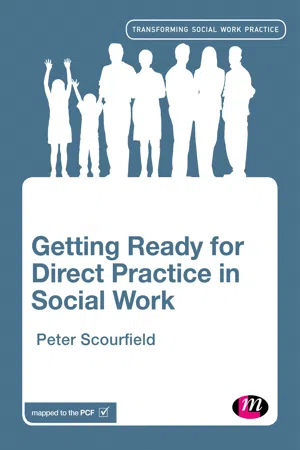
Getting Ready for Direct Practice in Social Work
About this book
This very practical book will support students to meet the requirements of the compulsory Readiness for Direct Practice assessment. Useful for social work students and lecturers alike, it takes each of the 9 domains that students are tested on, breaks them down step-by step and provides a range of interactive activities that enable them to acquire the knowledge, values and skills for practice required at this level. It offers students a foundation to the key areas of knowledge for each of the 9 domains, while also signposting them to other popular books in the Transforming Social Work Practice series for a more detailed discussion as well.
Information
Publisher
Learning MattersYear
2017Print ISBN
9781473989337
9781473989320
Edition
1eBook ISBN
9781526417442
1: Professionalism
Achieving a Social Work Degree
This chapter will help you develop skills in the following domain of the Professional Capabilities Framework:
Professionalism: Identify and behave as a professional social worker committed to professional development.
The Professional Capability Framework states about this domain that:
Social workers are members of an internationally recognised profession, a title protected in UK law. Social workers demonstrate professional commitment by taking responsibility for their conduct, practice and learning, with support through supervision. As representatives of the social work profession they safeguard its reputation and are accountable to the professional regulator. (BASW, Professional Capability Framework – Readiness for Practice Capabilities)
This domain statement goes on to say that, at the point of going out on their first practice placement, social work students need to be able to:
• Describe the role of the social worker
• Describe the mutual roles and responsibilities in supervision
• Describe the importance of professional behaviour
• Describe the importance of personal and professional boundaries
• Demonstrate ability to learn, using a range of approaches
• Describe the importance of emotional resilience in social work
Introduction
As we saw in the Introduction, there are nine ‘domains’ in the Professional Capabilities Framework, all of which link and overlap with each other and all of which students must be able to evidence at different levels throughout their course. The first domain is ‘Professionalism’ which, in many ways, can also be seen as the overarching theme of the whole PCF and that will be the focus of this chapter.
This chapter begins with some initial exploration of what professionalism means in the context of social work. From there, it will provide opportunities for you to think about and demonstrate what each of those requirements means in practice. Following the various activities in this chapter you will also be signposted to further reading which will help further develop your understanding of each concept or theme and help you make links between the domains.
Lastly, it is important to emphasise that the ARDP assessment is not an academic or ‘theory’ exercise where your knowledge is assessed in an essay or some other written assignment. What will decide whether you are ready to go into direct practice will be your ability to ‘be’ professional and to act and behave in acceptably professional ways. However, before we engage with each of the specific requirements of the Domain Descriptors, we start off by considering the bigger picture – what does professionalism in social work mean and what does it actually look like?
Exploring professionalism
Social work in the UK has only relatively recently been regarded as a ‘profession’, at least in comparison to more established professions such as doctors and lawyers. ‘Social worker’ only became a protected occupational title in 2005. Interestingly, there are still some today that don’t accept that social work either can be or should be professional in the same way as other more established occupations (Lymbery, 2005; Parker and Doel, 2013). Therefore, deciding what constitutes being ‘professional’ in social work terms is not always a straightforward exercise. It is something that requires a degree of thought. For example, if by saying that you are a ‘professional’ means that you think that you are a ‘law unto yourself’ in how you act or that your professional knowledge means that you are an ‘expert’ on other people’s lives, then you are going to run into problems. For Davies and Jones (2016), ‘professionalism’ in the context of social work is ‘not an easy subject’ and ‘is best understood through participation in active experiential learning’ (p. 2). This is a useful starting point because it underlines that professionalism is not just something that you learn about, or that you instantly ‘possess’ on passing your course; it is something you have to work at constantly in order to bring it to life in your practice and make it meaningful.
Activity 1.1
Nowadays it is accepted that being ‘professional’ and demonstrating professionalism lies at the core of being an effective social worker. However, we need to think about what this actually means, what it requires from the worker and what it looks like to others. Consider these questions:
1. What are the benefits from social work being a profession? Are there any downsides to social work being a profession? Give reasons.
2. How do social workers demonstrate their professionalism in practice?
Share your thoughts with a colleague.
In answer to the first question, on the benefit side, you might have said that social work being a profession helps the public have confidence that it is a regulated activity and that social workers need to maintain certain standards of professional behaviour. For social workers themselves it helps to have clearly defined codes of ethics and other frameworks for practice. Looked at in a different light, you might have said that being a professional comes with certain responsibilities which, if not discharged properly, can lead to a social worker being disciplined or even deregistered. This view acknowledges that professional social workers are, therefore, accountable to a range of bodies: their employers, their profession, their regulatory body, the HCPC and, most importantly, to the public. On the downside, you might have thought that professionalising social workers enhances their status but also their power and that could lead to an unwanted ‘us and them’ divide opening up between social workers and those with whom they work. There are many faces of professionalism and what this means in practice will need to be thought about and debated throughout your course.
For the second question, you might have said that professional social workers need to be competent in what they do and that they need to have the appropriate knowledge, values and skills in order to do their jobs properly. This might include being knowledgeable about relevant legislation, policy and theories, being mindful of treating people with respect, being aware of the need for confidentiality and to maintain appropriate boundaries and also how to communicate with a diverse range of people. By now, you should be aware that all of these qualities – and more – are set out in the nine domains of the PCF. Therefore, one of the hallmarks of being a professional social worker is the ability to understand and integrate all of the PCF into their practice. A social worker’s professionalism needs to be evident in their everyday interactions with the people with whom they come into contact: service users, carers, colleagues, managers, other professionals and the public at large.
What does professionalism require and what does it look like to service users?
Perhaps a useful starting point is to consider what expectations service users have of social workers. In 1981, Davies wrote that:
Client-perspective studies have greatly helped in the task of defining professionalism in social work. It is clear that the true professional is not someone who is cool, detached, career-minded or disinterested, but is the worker who can display friendliness (not necessarily friendship in the conventional sense), understanding, and a warmth of manner which convinces the client of his active interest in and concern for the client’s plight. And clients are remarkably sophisticated in being able to recognise that such professionalism is part and parcel of the social worker’s formal occupation. ‘With lawyers it’s mainly a professional job for them, they don’t take a personal interest in it. They wouldn’t show any feelings and not really any interest. The social worker didn’t behave as though it was job, even though it was.’ (p. 20)
This is as true today as it was in 1981. Many studies have backed this up when they have asked people who use services what they expect from social workers. For example, when Peter Beresford and his colleagues launched ‘The Standards We Expect’ initiative (Harding and Beresford, 1996), their research indicated strongly that what service users and carers expected and wanted from social workers included qualities like treating people with courtesy, honesty and being reliable. Also highlighted as essential were being a good communicator, being up to date with knowledge about local services and possessing basic practical skills. All of these ‘standards’ of professionalism might seem ‘obvious’ and something that should be taken for granted but they are the very bedrock of professionalism in social work.
Activity 1.2
Harding and Beresford (1996) found that service users and carers expected that, as a minimum, social workers should possess certain qualities. These included the following key areas:
• to be able to listen and communicate well;
• to be able to counsel and understand people’s complex emotions;
• to be knowledgeable about local services, national resources and social security entitlements;
• to be able to negotiate with rather than impose on others;
• to have basic practical skills;
• to have a realistic sense of judgement about risk;
• to be able to treat people as individuals;
• to respect others where respect means taking people’s views seriously and recognising their right to be heard;
• to maintain confidentiality and privacy;
• to be able to treat people with courtesy and empathy;
• to be honest;
• to be reliable and to ensure that there is continuity of service;
• to be able to put their ‘pet theories’ to one side and not impose them on people or look for ‘hidden’ meanings that are not always there.
Task
1. Put yourself in the position of a service user and /or carer. Look through the list. Why do you think that each point is regarded as so important? Explain how you would feel if a social worker did not have that skill or quality in their dealings with you and your family?
2. Now put yourself in the position of a social worker. On a scale of 0 – 10, where 0 = that you do not have the ability at all and 10 = that you are completely proficient, how would you rate yourself? At this stage in your career, it might well be that some of these points prompt further questions, for example because you not fully understand what is required. If so, explain what the...
Table of contents
- Cover Page
- Halftitle
- Advertisement
- Title
- Copyright
- Contents
- About the Author
- Series Editors’ Preface
- Introduction
- 1 Professionalism
- 2 Values and Ethics
- 3 Diversity
- 4 Rights, Justice and Economic Well-Being
- 5 Knowledge
- 6 Critical Reflection and Analysis
- 7 Intervention and Skills
- 8 Contexts and Organisations
- 9 Professional Leadership
- 10 Bringing it all Together, Preparing for the Assessment and Getting Ready for Direct Practice
- References
- Index
Trusted by 375,005 students
Access to over 1.5 million titles for a fair monthly price.
Study more efficiently using our study tools.
Frequently asked questions
Yes, you can cancel anytime from the Subscription tab in your account settings on the Perlego website. Your subscription will stay active until the end of your current billing period. Learn how to cancel your subscription
No, books cannot be downloaded as external files, such as PDFs, for use outside of Perlego. However, you can download books within the Perlego app for offline reading on mobile or tablet. Learn how to download books offline
Perlego offers two plans: Essential and Complete
- Essential is ideal for learners and professionals who enjoy exploring a wide range of subjects. Access the Essential Library with 800,000+ trusted titles and best-sellers across business, personal growth, and the humanities. Includes unlimited reading time and Standard Read Aloud voice.
- Complete: Perfect for advanced learners and researchers needing full, unrestricted access. Unlock 1.5M+ books across hundreds of subjects, including academic and specialized titles. The Complete Plan also includes advanced features like Premium Read Aloud and Research Assistant.
We are an online textbook subscription service, where you can get access to an entire online library for less than the price of a single book per month. With over 1.5 million books across 990+ topics, we’ve got you covered! Learn about our mission
Look out for the read-aloud symbol on your next book to see if you can listen to it. The read-aloud tool reads text aloud for you, highlighting the text as it is being read. You can pause it, speed it up and slow it down. Learn more about Read Aloud
Yes! You can use the Perlego app on both iOS and Android devices to read anytime, anywhere — even offline. Perfect for commutes or when you’re on the go.
Please note we cannot support devices running on iOS 13 and Android 7 or earlier. Learn more about using the app
Please note we cannot support devices running on iOS 13 and Android 7 or earlier. Learn more about using the app
Yes, you can access Getting Ready for Direct Practice in Social Work by Peter Scourfield,Author in PDF and/or ePUB format, as well as other popular books in Social Sciences & Social Work. We have over 1.5 million books available in our catalogue for you to explore.