eBook - ePub
Achieving QTLS status
A guide to demonstrating the Professional Standards
- 184 pages
- English
- ePUB (mobile friendly)
- Available on iOS & Android
eBook - ePub
Achieving QTLS status
A guide to demonstrating the Professional Standards
About this book
This book is appropriate for anyone who wishes to maintain their practice in accordance with the Professional Standards for Teachers and Trainers in Education and Training. However, the process of gaining QTLS was redesigned in 2020 after this book was published.
The content will still prove helpful to anyone working towards QTLS status, however, some of the screenshots in the book now differ to those in the QTLS online workbook.
The book is written in an accessible language and includes information regarding the minimum core, and observed teaching practice.
The content will help practitioners to have a positive impact upon their job role, their learners, their organisation and their career.
Information
1 Background to QTLS
Introduction
This chapter will explore the background to Qualified Teacher Learning and Skills (QTLS) status.
It will introduce you to the Professional Standards for Teachers and Trainers in Education and Training in England (hereinafter called the Professional Standards). As a teacher or trainer, you should demonstrate your commitment to them as part of your professional practice, and whilst working towards QTLS status.
It will also guide you regarding what the further education and skills sector is all about, and how the Education and Training Foundation (ETF) can support you.
This chapter will cover the following topics:
- What QTLS status is
- The Professional Standards
- The further education and skills sector
- The Education and Training Foundation
What QTLS status is
QTLS status is a voluntary process which can help you to advance your career. It demonstrates your expertise and experience to colleagues, employers and learners. Having QTLS status shows you are a professional teacher who is committed to their role, and who will carry out continuing professional development (CPD).
QTLS is gained by successfully completing a process known as professional formation, which takes approximately four to six months. This process enables you to demonstrate how you are continuing to develop, and apply the skills and knowledge gained from your initial teacher education (ITE) qualification to your current practice. Access to QTLS status is one of the key benefits of being a member of the Society for Education and Training (SET). Underpinned by the Professional Standards, QTLS status will help you to consolidate your existing practice as well as develop new skills and knowledge. SET is the only body that can confer QTLS status.
Undertaking the process of QTLS is a way to stretch and challenge yourself to develop your practice and your subject knowledge. You will be undertaking the process alongside your usual teaching role, therefore you will need to be dedicated and resilient, and have the time to commit to it.
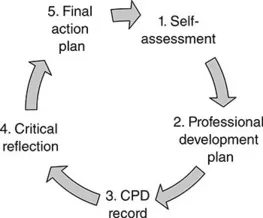
You could think of the professional formation process as a cycle which is based on a self-assessment of your role and what you need to develop. It continues with a plan for your professional development, relevant CPD activities, a critical reflection of what you have done, and ends with a final action plan, as in Figure 1.1. All these aspects will be explained as you progress through the book. The evidence you will need to provide for each is listed in Appendix 2.
Figure 1.1 The professional formation cycle
You can only work towards your professional formation once you have achieved a recognised teaching qualification, for example, the Diploma in Education and Training (DET) at Level 5. You need to have been qualified for at least six months. You must currently be teaching learners aged 14 plus (i.e. in years 10, 11 and above) and/or with adults for at least two hours per week. You must be able to evidence your current practice with groups of learners (not just on a one-to-one basis).
Tip
If you teach predominantly on a one-to-one basis, you can still apply for professional formation. However, you must be able to provide current evidence of teaching a group (five or more learners) for at least one of your observed lessons.
If you are working in a primary school setting, you can’t use any evidence of teaching younger learners. However, you may still be eligible if you are involved in a significant amount of family learning activity, i.e. with parents or carers at the school. If you are unsure, contact SET directly; its details are on the website listed at the end of this chapter.
Activity
If you would like to read about SET members’ experiences of achieving QTLS status, take a look at the case studies at this link: https://tinyurl.com/ycy6svbq
The key benefits of QTLS status
More than 20,000 practitioners have achieved QTLS status since its introduction in 2008.
The key benefits are:
- QTLS status is recognised in law as having parity with Qualified Teacher Status (QTS) for teaching in a maintained school in England
- career progression: QTLS status demonstrates your commitment, skills and knowledge to employers
- recognition of your status as a professional teacher or trainer (you will be added to SET’s online professional register)
- valuable CPD opportunities which can build confidence and enhance your knowledge and skills
- using the letters QTLS as a designation after your name
- taking advantage of certain benefits of being a SET member
- the opportunity to apply for Advanced Teacher Status (ATS) as your career progresses.
Who is it for?
- Teachers, trainers and professionals working in the further education and training sector.
- Qualified Further Education (FE) teachers working as teaching assistants, tutors or instructors in academies, schools or sixth form colleges.
- Teachers or trainers who have recently completed their initial teacher training, as well as those who already have experience of teaching.
The Professional Standards
The Education and Training Foundation’s (ETF) Professional Standards were developed in 2014 in consultation with representatives from the FE and skills sector. They are aimed at teachers and trainers working in the sector (excluding sixth form colleges), who work in a voluntary or a paid capacity. This includes offender institutions, the armed forces, charitable, commercial and any other public sector body and their employees.
Teachers and trainers are ‘dual professionals’; they are both subject and/or vocational specialists and experts in teaching and learning. They are committed to maintaining and developing their expertise in both aspects of their role to ensure the best outcomes for their learners. These expectations of teachers and trainers underpin the 2014 Professional Standards, with their overall purpose being to support teachers and trainers to maintain and improve standards of teaching and learning, and outcomes for learners.https://tinyurl.com/y7x7b5j2 (date accessed 16 July 2018)
The Professional Standards:
- set out clear expectations of effective practice in education and training
- enable teachers and trainers to identify areas for their own professional development
- support initial teacher education
- provide a national reference point that organisations can use to support the development of their staff.
https://tinyurl.com/o2cv9fs
Activity
Take a look at the Professional Standards in Appendix 1 to familiarise yourself with them. You will need to refer to them as you progress through the professional formation process.
The Professional Standards were designed to:
- motivate and enthuse teachers and trainers to take ownership of their own professional development and to perform at their optimum
- demonstrate professionalism through outstanding practice whilst striving to ensure all learners reach their full potential.
There are 20 Professional Standards which relate to three areas:
- professional values and attributes – six standards aimed at developing judgement of what works and does not work in your teaching and training
- professional knowledge and understanding – six standards aimed at developing deep and critically informed knowledge and understanding in theory and practice
- profe...
Table of contents
- Cover
- Half Title
- Title Page
- Copyright Page
- Contents
- Acknowledgements
- Author Statement
- Editor Statement
- Foreword
- Preface
- Introduction
- 1 Background to QTLS
- 2 Getting started with the QTLS professional formation process
- 3 About you
- 4 Role and responsibilities
- 5 Self-assessment
- 6 Professional development
- 7 Continuing professional development record
- 8 Critical reflection
- 9 Final action plan
- 10 Maintaining your professionalism
- Appendix 1 Professional Standards for Teachers and Trainers in Education and Training in England (2014)
- Appendix 2 QTLS Mandatory evidence
- Index
- Advertisement
Trusted by 375,005 students
Access to over 1.5 million titles for a fair monthly price.
Study more efficiently using our study tools.
Frequently asked questions
Yes, you can cancel anytime from the Subscription tab in your account settings on the Perlego website. Your subscription will stay active until the end of your current billing period. Learn how to cancel your subscription
No, books cannot be downloaded as external files, such as PDFs, for use outside of Perlego. However, you can download books within the Perlego app for offline reading on mobile or tablet. Learn how to download books offline
Perlego offers two plans: Essential and Complete
- Essential is ideal for learners and professionals who enjoy exploring a wide range of subjects. Access the Essential Library with 800,000+ trusted titles and best-sellers across business, personal growth, and the humanities. Includes unlimited reading time and Standard Read Aloud voice.
- Complete: Perfect for advanced learners and researchers needing full, unrestricted access. Unlock 1.5M+ books across hundreds of subjects, including academic and specialized titles. The Complete Plan also includes advanced features like Premium Read Aloud and Research Assistant.
We are an online textbook subscription service, where you can get access to an entire online library for less than the price of a single book per month. With over 1.5 million books across 990+ topics, we’ve got you covered! Learn about our mission
Look out for the read-aloud symbol on your next book to see if you can listen to it. The read-aloud tool reads text aloud for you, highlighting the text as it is being read. You can pause it, speed it up and slow it down. Learn more about Read Aloud
Yes! You can use the Perlego app on both iOS and Android devices to read anytime, anywhere — even offline. Perfect for commutes or when you’re on the go.
Please note we cannot support devices running on iOS 13 and Android 7 or earlier. Learn more about using the app
Please note we cannot support devices running on iOS 13 and Android 7 or earlier. Learn more about using the app
Yes, you can access Achieving QTLS status by Sharron Mansell,Ann Gravells,Author in PDF and/or ePUB format, as well as other popular books in Éducation & Formation pour adultes. We have over 1.5 million books available in our catalogue for you to explore.