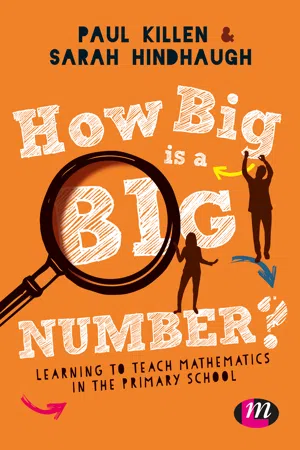
What, how and why? If you don?t really understand the content of the primary mathematics curriculum, how can you teach it? This beautiful full colour book is here to help. It covers all you need to know to be an effective teacher of primary mathematics.
It shows you how to explore number, shape and pattern with the children you teach. It examines what we mean by ?mastery of mathematics? and reviews what we can learn from Asian maths teaching methods. It helps you to see how areas of mathematics fit together and how you can support children to build their own understanding of the subject.
This book goes beyond showing you how to teach. It shows you that process is as important as product. That getting it wrong can be as useful as getting it right and that children can?t really learn the what without understanding the why.
Our book begins with consideration of what ‘mastery in mathematics’ actually is and what ‘mastery’ may look like in the classroom. We discuss key principles of mastery and how the teacher can develop mastery in their pupils.
Over the past few years, many educators, educational thinkers and politicians have promoted the use of the phrase ‘mastery’ in relation to mathematics. However, before talking about the value of any concept, we need to have at least some idea of what it is. Our, perhaps contentious, interpretation is that there are many commentators who use the term mastery, without knowing what it really is … but it does sound good!
Defining a‘master’
It may surprise you that we choose to begin this book on mathematics with a little English grammar. However, in order for you to gain an understanding of the term ‘mastery’, it is useful to consider our everyday use of the term, as the word ‘master’ can be a noun, an adjective or a verb. Exploring these different uses may give us some insight into what the phrase means in terms of teaching mathematics.
As a noun, ‘master’ could be used to describe such diverse things as:
• a person who owns a dog or other animal
• a person who captains a merchant ship
• a male teacher
• a young man.
These different uses of the word ‘master’ lead us to a number of other descriptions including: mastery; mastermind; masterclass; master of ceremonies; grandmaster; chess master; masterpiece; masterstroke; master of disguise; old Master; headmaster; bandmaster; station master; postmaster.
Equally, ‘master’ can be used as an adjective to describe many roles or objects, such as master chef, master baker, master bedroom, master’s degree, master tape. When used as a verb, one may talk about ‘mastering a skill’ or even to ‘mastermind a crime’.
TheOxford English Dictionary describes the verb ‘to master’ as, gaining complete knowledge of, or skill in a subject, technique, and the word ‘mastery’ as, complete knowledge or command of a subject or skills.
These definitions may lead you to ask, What is a complete knowledge?
Perhaps the greatest of all mathematical thinkers was Albert Einstein, who once said:
Only one who devotes himself to a cause with his whole strength and soul can be a true master. For this reason mastery demands all of a person.
Wow! This sounds hard doesn’t it? The term ‘master’ seems to imply being some sort of expert or genius – or even a wizard!
Given these varied perspectives on what mastery may be, it is worth considering how this can possibly apply to primary mathematics. Can a child actually be a master of mathematics? And if so, what would this look like?
It is our view that a child can indeed be a master of mathematics; the art of the mathematics teacher is to ensure that children are presented with the opportunities to enable this to happen.
Maths is a verb
It is possible to find a book that will show you where you should place your fingers on a guitar to play a D or an A minor chord. Alternatively, someone may show you where to place your fingers on a piano keyboard to play a C chord. Does that mean you can learn to play the guitar or piano by just reading about it? Similarly, we have watched many cookery programmes that show us how to bake bread or make a soufflé. Does that mean therefore that after watching these programmes we can bake a tasty loaf or know that our soufflé will rise? Like many things, the knowledge of what to do is important, but to become proficient at any of these activities, practice is required. The only way to become proficient at a musical instrument or at cooking is to keep practising. The more we engage with the activity, the better at it we become. It is the same with mathematics.
Mathematics has a body of knowledge that requires acquisition. However, that knowledge alone is insufficient for us to become proficient in it. We need to practise using this new knowledge. First, perhaps by relating it to existing knowledge. Then, this knowledge needs to be applied, in a variety of situations, moving from the familiar to the unfamiliar. In this sense, we see mathematics as a verb – a ‘doing’ word. Deep learning comes from doing mathematics. The Chinese philosopher Confucius famously said:
I hear and I forget. I see and I remember. I do and I understand.
This sums up the way we would like children to learn mathematics.
Just do it
It may have been easy for Confucius to say we should get children to ‘do’ mathematics. But what does that mean? For some teachers, in days gone by, that may have meant finding a worksheet with enough questions to reduce the chance that a child could actually complete their work within the lesson. In such lessons, differentiation of work can become using the same questions with harder numbers.
Many American school textbooks have perhaps over a hundred questions on each topic. The evenly numbered questions have the answers at the back and are completed in the lesson. Only the Teacher’s Guide has the answers to the odd numbers, so they become the homework.
Mastery moves completely away from this idea. Maths mastery is not about children completing the most questions, nor children completing similar questions with bigger numbers.
Reflection
Suppose you are planning to teach long multiplication. How would you know if each child in your class has learned long multiplication?
How many long multiplication questions would you expect children to do by themselves in order for you to be assured that they have understood the concept?
What does the National Curriculum say?
You may think that a good place to start considering any questions about maths mastery is the mathematics National Curriculum. Does it surprise you therefore that the words ‘master’, ‘mastery’ and ‘mastering’ do not appear anywhere in the mathematics content of the Primary National Curriculum? The words you do see in the mathematics National Curriculum include: fluency; conceptual understanding; mathematical reasoning; problem solving; enjoyment; curiosity and application. These are what we would like to define as some of theprinciples of mastery. It is perhaps by thinking of a child who can evidence some of these principles that we can move towards an image of mastery.
How to master maths
The primary mathematics curriculum is clear that children need to challenged by being offered
rich and sophisticated problems before any acceleration through new content.
You may be able to recall lessons from your own mathematics education where the teacher finished a topic before you had really understood it and then quickly moved on to something different. This is what we call aquaplanic learning as only the surface of each topic is considered. Children can ‘aquaplane’ from one topic to another, making no connections whatsoever between any of them. Such approaches result in learning not being secure and may lead to a child learning only what they cannot do. A mastery approach seeks to eliminate aquaplanic learning.
We see ‘mastery’ as a pedagogical approach to teaching and learning within mathematics. Any aspect of the mathematics curriculum can be developed to mastery level: by this, we mean that new learning is assimilated into each child’s existing knowledge and understanding. Children need to be able to apply new knowledge in a wide variety of contexts to fully demonstrate deep understanding of each new topic. By this token, a child ...
Table of contents
Cover Page
Halftitle
Advertisement
Title
Copyright
Contents
Acknowledgements
About the Authors
Introduction
1 Masters of the Classroom
2 Not as Easy as 1, 2, 3
3 A Ray of Sunshine
4 Maths is Mental
5 Making Sum Sense
6 Recurring Problems
7 The Joy of X
8 The Shape of Things to Come
9 Losing the Plot
10 Made to Measure
11 Statistically Speaking
12 Moving on
Appendix 1 What Maths can you see?
Appendix 2 Task Answers
Appendix 3 Mathematics National Curriculum by Topic
Appendix 4 Roman Numerals 1–1,000
Index
Trusted by 375,005 students
Access to over 1.5 million titles for a fair monthly price.
Study more efficiently using our study tools.
Frequently asked questions
Yes, you can cancel anytime from the Subscription tab in your account settings on the Perlego website. Your subscription will stay active until the end of your current billing period. Learn how to cancel your subscription
No, books cannot be downloaded as external files, such as PDFs, for use outside of Perlego. However, you can download books within the Perlego app for offline reading on mobile or tablet. Learn how to download books offline
Perlego offers two plans: Essential and Complete
Essential is ideal for learners and professionals who enjoy exploring a wide range of subjects. Access the Essential Library with 800,000+ trusted titles and best-sellers across business, personal growth, and the humanities. Includes unlimited reading time and Standard Read Aloud voice.
Complete: Perfect for advanced learners and researchers needing full, unrestricted access. Unlock 1.5M+ books across hundreds of subjects, including academic and specialized titles. The Complete Plan also includes advanced features like Premium Read Aloud and Research Assistant.
Both plans are available with monthly, semester, or annual billing cycles.
We are an online textbook subscription service, where you can get access to an entire online library for less than the price of a single book per month. With over 1.5 million books across 990+ topics, we’ve got you covered! Learn about our mission
Look out for the read-aloud symbol on your next book to see if you can listen to it. The read-aloud tool reads text aloud for you, highlighting the text as it is being read. You can pause it, speed it up and slow it down. Learn more about Read Aloud
Yes! You can use the Perlego app on both iOS and Android devices to read anytime, anywhere — even offline. Perfect for commutes or when you’re on the go. Please note we cannot support devices running on iOS 13 and Android 7 or earlier. Learn more about using the app
Yes, you can access How Big is a Big Number? by Paul Killen,Sarah Hindhaugh,Author in PDF and/or ePUB format, as well as other popular books in Bildung & Grundschulbildung. We have over 1.5 million books available in our catalogue for you to explore.