We start from the premise that young children are meaning makers, problem solvers and pattern seekers from birth, and that they live their lives in a world that is rich with mathematical potential. From these first-hand experiences they garner spontaneous everyday mathematical ideas that lay the foundations for scholarly and scientific concepts (Vygotsky, 1987; Van Oers, 2001). Play and exploration have a central role in supporting young children’s growing understandings of mathematics, and through engaging in imaginative play, children are able to bridge the gap between their innate and culturally embedded experiences towards the realm of mathematics that they will encounter as they continue their journey through school.
We need to remember that very young children learn differently to older primary children. For example, too rigid and linear an approach to children’s learning of early number concepts and operations could dictate that Early Years provision might have specific, separate sets of resources, on the assumption that children will pass through distinct stages in their mathematical understanding. A more flexible approach allows children to select resources and develop their own strategies, with the teacher ‘scaffolding’ learning, and introducing new objects, materials and concepts. The child develops a repertoire of approaches, as well as the self-regulatory abilities that enable them to develop as an autonomous learner. With the advent of two-year-old and nursery provision in school settings, it will become increasingly important that teachers provide very different experiences in Early Years classes than they would for older children. While being encouraged to continue to learn through playful activities, so they notice mathematical concepts, the tenor of the activities for older children will necessarily be more structured.
Often, however, we confine play (in general and) in mathematics to the Early Years and children, parents, teachers and carers assume it is something to be grown out of (Pound and Lee, 2011). If children are not allowed to play, explore and discover the awe, wonder and beauty of mathematics, they could be turned off it, possibly for life.
What is Play?
For young children in the Foundation Stage, play is the medium through which most of their learning will take place, for a very good reason. Vygotsky points out:
In play, the child is always behaving beyond his age, above his usual everyday behaviour; in play he is, as it were, a head above himself. Play contains in a concentrated form, as in the focus of a magnifying glass, all developmental tendencies; it is as if the child tries to jump above his usual level.
(Vygotsky, 1978)
Play is an exceedingly complex phenomenon that combines into a single whole, very different strands of thought and experience, helping the child to create abstract thought. It is the medium by which links between different aspects of learning embedded in a maturing brain, become established (Robinson, 2008). Play is something the child chooses to do: the child decides how to play, how long to sustain it, what the play is about and who to play with. It engages their bodies, minds and emotions. For very young children it is an essential part of the learning process and needs to be fully understood, and valued, by teachers, carers and parents.
Key characteristics of play in its many forms are:
- it is highly creative, enabling young children to engage in possibility thinking (Craft, 2002)
- it is open-ended and imaginative, including thinking beyond boundaries and challenging themselves (Vygotsky, 1978)
- it requires active engagement, a key aspect of how young children learn (Robinson, 2008)
- it is deeply satisfying. Learning should be a positive experience that adds to our self-esteem and wellbeing (Roberts, 2006).
(DCSF, 2009a)
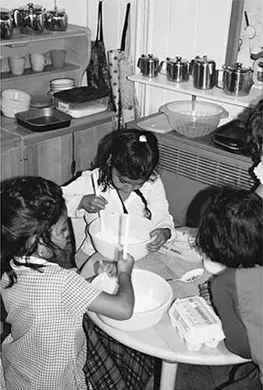
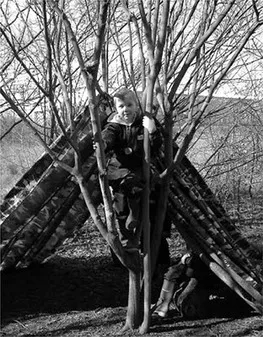
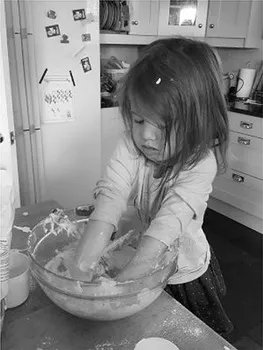
There are many different forms of play. For example, construction play can involve spatial and mathematical knowledge, problem solving and reasoning in particular, but mathematical learning can take place in less obvious play types. Children involved in socio-dramatic play in the home corner, mixing ingredients when making cakes involves estimation and measuring; exploratory play in the sandpit or water tray using different containers involves exploration of volume and capacity; locomotor play such as climbing trees involves children in estimation of space and position. It is more a matter of us, as adults, ‘seeing’ the mathematical learning that is going on in children’s play. We need to put on our mathematical glasses (see Figures 1.1, 1.2 and 1.3)!
Figure 1.1 Exploratory play
Figure 1.2 Outdoor exploration
Reflection
Consider Figures 1.4, 1.5 and 1.6 and think about the mathematical learning going on. What mathematical ideas are the children exploring?
It is through play that children begin to develop mathematical understanding as they explore, make and communicate their personal meanings. This is often referred to as ‘symbolic play’ since children use actions, speech or resources (for example, natural resources, unit blocks) as symbols or signs to mean something specific. Often, between the ages of three and four years, children begin to attach mathematical meanings to some of their marks and representations, using their marks as symbols to think about quantities and numerals. Children use their own symbols in flexible ways: this helps them understand that written symbols can be used to carry different meanings for different purposes (DCSF,...