![]()
1 Why Regenerate?
Let’s say you want the place where you live to both look better and operate more effectively for the benefit of its residents and its businesses.
Do you think you know all the local issues and all the answers for a better future for your area? Sometimes we do – but let’s double-check the ‘why’ of what we’re thinking about before we get bogged down in the detail of the ‘what’ and the ‘how’.
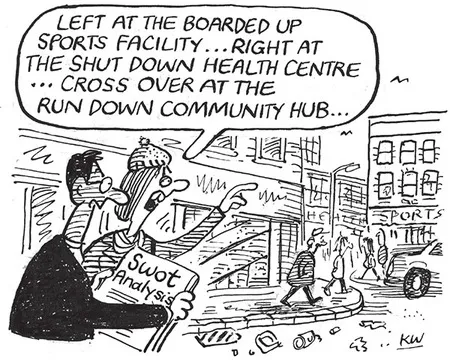
We should look at local aspirations, local strengths, weaknesses, opportunities and threats (SWOT analysis), and collect solid evidence to back it all up, as potential funders will want to know that we’ve covered the detail.
Energetic activists may not want to go to this level of detail and prefer to rush straight ahead to plan their regeneration campaign – with maybe more action than planning. I suggest we should spend the time to make sure that what we do will be long-lasting before we spend resources badly, and even if we fast forward from Chapter 1 to Chapter 8, use the other chapters for reference.
The other major benefit of coming up with a clear ‘why’ – perhaps expressed in a few words as a ‘mission statement’ – is that it will help keep you focused. Once you start a regeneration campaign, and in particular once you start being successful, all kinds of people will come to you with suggestions for new projects. In order to keep focused on the best use of your time, a clear ‘why’ will help you identify which projects are for you, and which – short of a bit of publicity support – should be managed by somebody else.
What’s It All About?
We know regeneration is a change process, but each place will have its own ideas about what to change into.
Research in Gloucester city centre in 2005 suggested that 50% of people equated regeneration with physical change – building new buildings, improving old buildings.
Another 25% felt the most important thing was to involve local people and businesses in decisions about the future – it was the way it was done which was key.
The rest of the survey replies were more detailed, very particular comments of different kinds, reflecting individual concerns.
Is this how it is in your area?
We need to find out what local people think is important, as whatever we do, we will be more successful if we carry the whole community with us. Depending on the size of our community, a couple of open days (one in working hours, one not) at fully accessible venues where people can look at new and old photographs and ask questions is good, and any survey forms should also be made available electronically for busy or housebound computerate people.
Hard copy surveys can be expensive for a large community, but may be handy if you can get volunteers to deliver them as not everyone uses computers. We devised a simple street survey in the summer of 2011 when we were gathering ideas to inform a parish plan for Mitcheldean in the Forest of Dean. We just asked three questions:
- What do you like about Mitcheldean?
- What don’t you like?
- What could be improved?
The feedback from this and from additional comments at a public event formed the basis for a detailed questionnaire that went round all local households and businesses, and the results formed the basis for the final plan.
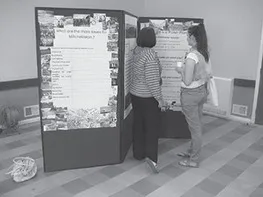
Parish plan exhibition in Mitcheldean community centre August 2011
Local Identity
What is so special about the place considering regeneration?
- Its location?
- Its history and culture?
- Its raw material and industries?
I could say its people, but that goes without saying – and they need to be involved in these discussions anyway.
Don’t pick a future that doesn’t make sense locally – not everywhere can be a major shopping centre, for example. The city council in Birmingham based their regeneration plans on the city’s handy location in the middle of England, with good transport routes, and it became the site for the National Indoor Arena. They also undid the isolation of the city centre caused by 1960s ring roads for the mighty motor car.
There is a ‘Transition movement’ view that every place should be replanning its future anyway, as so many past assumptions about things like financial markets, climate and the availability of resources now need to give way to greater local resilience. So the way forward may not be the mixture as before – though something that worked locally 50 or 150 years ago should be discussed rather than dismissed out of hand, as at least it worked once!
Get local people and organisations together, and carry out a SWOT analysis (list strengths, weaknesses, opportunities and threats) for the local area. Then put together statistical figures for the identified issues to create a ‘baseline’, so that you can measure progress over time. Success can then be judged on whether the measured figures are going up (e.g. employment) or down (e.g. crime) as appropriate.
Is there a regional context? Look at other similar places, spend some time on picking a direction, and then work at ‘place making’ together. Involving local people in determining local identity and what the future should look like is absolutely crucial. I firmly believe that most local issues, even if they seem to be subject to national policy, can only be really dealt with at a local level where the detail is known, rather than having solutions imposed on a community from above.
SWOT Analysis
This is a well-established process for setting the parameters for your local regeneration scheme, for example:
- Strengths – such as the value of your location for business, skills levels of local people, local amenities such as sporting facilities, strong local heritage
- Weaknesses – declining industries, high levels of unemployment and crime, low levels of health and wealth
- Opportunities – sites available for redevelopment or a new local market, government grant schemes, developer interest
- Threats – environmental issues like rising flood levels
Some issues you may find cropping up under more than one heading, such as a good road network providing economic opportunities but environmental threats. This is fine – a bit of perspective helps produce a balanced plan for the way ahead. And a clear SWOT analysis can help if you are ever faced with the dilemma of trading off one aspect of sustainability against another.
Evidence Base
You will need to find some clear facts and measures to fill out your SWOT analysis, such as:
- Local population – numbers, ages, genders, ethnicity, health and lifestyle issues
- Local businesses – types, numbers employed
- Local employment levels, including those who commute to work
- Local landowners (particularly of sites that need a new future)
Much of this detail can be found either through the Internet or by taking advice from local government sources.
We know quite a lot about regeneration now, and have access to local, regional, national and international statistics and UK good practice, for example:
- Learning the Lessons from the Estates Renewal Challenge Fund (Pawson et al., 2005)
- The Single Regeneration Budget: Final Evaluation (Rhodes et al., 2007)
- Final Report on the New Deal for Communities Programme (Batty et al., 2010)
Such reports along with properly charted local views, resources and aspirations will give us a much more solid basis for going forward.
The angel is in the detail.
Actually, there’s only one job in regeneration, which is effectively marshalling all the detail and then applying it in the right place and in the right way with the right people.
You heard it first here.
Outputs and Outcomes
What exactly are you trying to achieve? Measurable targets are very necessary to help focus a regeneration programme, but adopt them carefully, they’re better as a skeleton than a straitjacket:
- Mission statement – a one-phrase summary of what you’re trying to achieve, such as ‘Reduce local crime and the fear of crime’
- Outputs – things you can number, such as new community safety publications, and new closed-circuit television (CCTV) cameras in place
- Outcomes – the result of your activities, such as less fear of crime measured through public surveys
- Indirect outcomes – things that happen as a side-effect of your activity, such as reduced insurance premiums in previously high-crime areas
- Performance indicators – measures that show progress towards a particular objective, such as reductions in the number of burglaries over time
- Milestones – can seem like outputs, but are really stage markers in a project or process, such as local shops signing up to participation in a crime reduction campaign
In the UK a number of measures have been grouped into the ‘English Indices of Deprivation’ which are re-measured every three years (see Appendix 1). Bringing areas out of ‘deprivation’ (horrible word) is therefore a common regeneration target, though finding some generic positive measures would be good, and some of us are working on that.
Before UK government funding was cut, there was what I call a ‘percentage rugby’ (concentrating on the parts of the game likely to produce the best result) approach to regeneration in the UK, focusing on the 70% of issues around finance, skills qualifications, jobs and new buildings. A lot of UK regeneration funding has been predicated on economic outputs such as new jobs, training courses and workspaces, but this reflects a received view that these are the most important things – which are happily measurable!
There are other things as important to community life, some of them spiritual, and not everyone in the community will put ‘jobs’ at the top of their list anyway (don’t assume – ask them). So take any public funding by all means, but balance the official outputs with more local outcomes. Let’s not marginalise what the community want for themselves – people do not live by bread alone – and let’s go for the whole lot. If we don’t, I strongly suggest we’re admitting a degree of failure even before we start.
Poverty
Jesus said ‘The poor are always with you’. He never thought this would be underwritten by the UK government, who have since defined poverty in the UK as any family earning less than 60% of ...