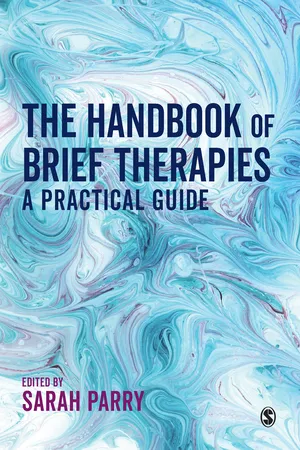
This step-by-step guidebook offers a range of contemporary and popular brief treatments, suitable for a range of client groups and professional settings.
Following a comprehensive introduction to the use of brief interventions in therapeutic practice, each chapter provides an introduction to the theoretical underpinnings and evidence-based brief intervention, followed by guidance on how to implement the approaches with useful ?top tips?, worksheets and examples from practice through case vignettes illustrating its application.
The Handbook reflects current recommendations and guidelines of the National Institute for Health and Care Excellence and recommendations of accrediting professional bodies in the UK and US. A must have for any practitioner working to support the wellbeing of others.
- 256 pages
- English
- ePUB (mobile friendly)
- Available on iOS & Android
eBook - ePub
About this book
Information
Publisher
SAGE Publications LtdYear
2019Print ISBN
9781526436429
9781526436412
Edition
1eBook ISBN
9781526481573
Part I Core Approaches
1 Brief Cognitive Behavioural Therapy
Introduction
Brief Cognitive Behaviour Therapy (BCBT) evolved around 20 years ago from traditional CBT as an evidenced-based and effective short-term treatment option for a range of difficulties.
This chapter aims to:
- discuss the distinct differences of BCBT compared to traditional CBT
- explore both the strengths and limitations of BCBT
- discuss the evidence base for the use of BCBT
- highlight the use of BCBT in practice with an emphasis on its structure and design.
Key Terms
Cognitive Behavioural Therapy CBT is commonly described as a ‘talking therapy’ but is an active and directive form of therapy that acknowledges that an individual’s environment, thoughts, feelings, actions and physical reactions are interlinked and changes to one can impact on other parts.
Brief Cognitive Behaviour Therapy BCBT is a compressed or short-term, problem-focused and goal-directed therapy that adopts similar approaches to CBT but in a more time-constrained and active manner for clients with a limited problem profile.
Background
BCBT is based on the underpinning theory and application of CBT approaches, which are applicable for a range of people experiencing emotional, physical and social difficulties. BCBT works with cognitions and the interpretations of such cognitions in relation to how the person feels and behaves. It challenges what might be seen as ‘maladaptive cognitions’ and typically focuses on the identification of automatic thoughts and potential ‘thought distortions’, especially in early sessions.
Although being cognitive in nature, BCBT and CBT do share specific symptom-reduction principles that are inherent in most medical models. Where BCBT and CBT veer away from this model is in the active participation of the person experiencing the problem and the collaborative nature of the work between client and therapist. More specifically, Bond and Dryden (2008) argued that BCBT should be conducted in fewer than 10 sessions as compared to traditional CBT, which commonly lasts between 10 and 20 sessions. Briefer formats of therapy than the range of 10 to 20 sessions have become commonplace in healthcare practice. The impetus for the move towards a more compressed approach in the UK probably lay with the implementation of Improving Access to Psychological Therapies (IAPT) following the Layard Report in the UK in 2006 (Layard et al., 2006). At this point in time, CBT practice branched out from being the domain of psychologists working in consulting rooms to being utilised by a range of therapists from various backgrounds (nurses, counsellors, social workers, to name a few) in multiple settings.
There is some debate relating to what differentiates BCBT from CBT, which is by nature a very structured, short-term compressed approach. Curwen, Palmer and Ruddell’s abridged description of ‘a series of sessions of brief cognitive behaviour therapy that uses time flexibly and focusses on client goals using a framework of cognitive conceptualisation’ (2018, p. 3) is one we advocate. An important message is that IAPT work and BCBT are not necessarily the same therapy. Although IAPT is not defined as a brief therapy provider, many low-intensity IAPT provisions are delivered in fewer than 12 sessions. Much low-intensity IAPT work involves the use of brief interventions, which can be delivered in person, or through computerised, telephone, or biblio-therapeutic platforms. A key objective of the work of all brief forms of CBT focuses on ‘skilling up’ the person engaging in the therapy with the tools to control their feelings and challenge negative thoughts (Layard et al., 2007, p. 3).
Research and Evidence Supporting BCBT
BCBT is commonly utilised in the treatment of anxiety and low mood/mild depression in adults in primary care services. BCBT is an approach that compresses much of the traditional CBT work into fewer sessions. Essentially, the evidence for or against a treatment modality relies on the outcome and one has to be realistic in the projected outcomes for a brief form of therapy, especially if the presentation is inherently complex and long term. BCBT is generally not recommended for use with people with more complicated difficulties (e.g. complex trauma histories). This is due to the complicated relational difficulties people with interpersonal trauma histories can experience and the integrative and transdiagnostic approach required for trauma-informed care. However, BCBT-type interventions may be of use with such clients as part of a therapeutic intervention with a specific, short-term goal. Bond and Dryden (2008) canvassed a range of researchers and found that BCBT was probably most effective with less severe problems, and could produce both short- and long-term positive outcomes.
Recent evidence has argued that BCBT has a positive outcome in a varied range of presentations: in treating anxiety and depression (Cape et al., 2010; McHugh et al., 2013), binge eating (Fischer et al., 2014) and depression due to homesickness in international students (Saravanan et al., 2017). Importantly, BCBT has been used successfully with anxiety and depression where comorbid presentations exist, including veterans with physical health problems and anxiety and depression (Cully et al., 2017), cancer-related PTSD with comorbid anxiety/depression (Kangas et al., 2014) and insomnia with people experiencing depression, some of whom described suicidal thoughts (Pigeon et al., 2017).
Such a range of positive uses in practice suggests that researchers are continually pushing the use of shorter-term therapies to treat more complicated problems (if not in total, in part), and are generating data that will guide future practice. Such work is now challenging the historic notion that BCBT is only of use in less complicated presentations, but much more evidence is needed.
Delivering BCBT in Practice
Throughout this chapter, the use of BCBT is illustrated by use of case studies and repeated reference to the structure and organisation of practice and interventions.
Structure of BCBT
An important factor in BCBT is that not all therapists may be both confident and sufficiently skilled in applying such a structured treatment. The therapist needs skills in motivating the client to address tasks and engage in exercises, and yet be sufficiently knowledgeable to maintain the therapeutic alliance. Often in CBT, attempts to identify automatic thoughts that are associated with problems are difficult to elicit. A refocusing on the emergent emotions and an exploration of personal meaning for the emotion can help unearth any automatic thoughts.
Structure of therapy for each session (template exemplar)...
Table of contents
- Cover
- Half Title
- Acknowledgements
- Title Page
- Copyright Page
- Contents
- Illustration List
- Table List
- About the Editor and Authors
- Acknowledgements
- Introduction
- Part I Core Approaches
- 1 Brief Cognitive Behavioural Therapy
- 2 Time-Limited Person-Centred Therapy
- 3 Motivational Interviewing
- 4 Solution-Focused Brief Therapy
- 5 Short-Term Family Therapy
- 6 Short-Term Acceptance and Commitment Therapy
- 7 Brief Dynamic Interpersonal Therapy
- 8 Cognitive Analytic Therapy and Psychodynamic Interpersonal Therapy
- Part II Integrative Approaches and Modalities
- 9 Brief Uses of Compassionate Mind Training
- 10 Brief Interventions Using Artistic Expression
- 11 Brief Interventions in Hospital Settings
- 12 Internet-Delivered Cognitive Behavioural Therapy
- 13 Psychoeducation
- 14 Integrating Core Approaches
- Comparative Summary Table
- Index
Trusted by 375,005 students
Access to over 1.5 million titles for a fair monthly price.
Study more efficiently using our study tools.
Frequently asked questions
Yes, you can cancel anytime from the Subscription tab in your account settings on the Perlego website. Your subscription will stay active until the end of your current billing period. Learn how to cancel your subscription
No, books cannot be downloaded as external files, such as PDFs, for use outside of Perlego. However, you can download books within the Perlego app for offline reading on mobile or tablet. Learn how to download books offline
Perlego offers two plans: Essential and Complete
- Essential is ideal for learners and professionals who enjoy exploring a wide range of subjects. Access the Essential Library with 800,000+ trusted titles and best-sellers across business, personal growth, and the humanities. Includes unlimited reading time and Standard Read Aloud voice.
- Complete: Perfect for advanced learners and researchers needing full, unrestricted access. Unlock 1.5M+ books across hundreds of subjects, including academic and specialized titles. The Complete Plan also includes advanced features like Premium Read Aloud and Research Assistant.
We are an online textbook subscription service, where you can get access to an entire online library for less than the price of a single book per month. With over 1.5 million books across 990+ topics, we’ve got you covered! Learn about our mission
Look out for the read-aloud symbol on your next book to see if you can listen to it. The read-aloud tool reads text aloud for you, highlighting the text as it is being read. You can pause it, speed it up and slow it down. Learn more about Read Aloud
Yes! You can use the Perlego app on both iOS and Android devices to read anytime, anywhere — even offline. Perfect for commutes or when you’re on the go.
Please note we cannot support devices running on iOS 13 and Android 7 or earlier. Learn more about using the app
Please note we cannot support devices running on iOS 13 and Android 7 or earlier. Learn more about using the app
Yes, you can access The Handbook of Brief Therapies by Sarah Parry, Sarah Parry,Author in PDF and/or ePUB format, as well as other popular books in Psychology & Psychotherapy Counselling. We have over 1.5 million books available in our catalogue for you to explore.