This session provides a framework for you to talk with the person about what recovery means to them and how they imagine life might be in their preferred future.
Before you start working through this session with someone else, take some time to really think about the idea of recovery and your own assumptions and beliefs about it. Work through the questions yourself. We honestly think that until you’ve done that you can’t effectively work with another person thoughtfully and know what you are bringing to the conversation that might not be helpful.
The session structure is a guide. Some of our conversations about recovery have been quite quick. But sometimes, they can take much longer. One of us spent nearly a whole session talking about what recovery might mean and look like. And it was time well spent. As you talk about potential hoped-for futures, make sure not to overwhelm people with what 100% would look like. Early on in a person’s recovery it can be hard to trust any progress they have already made (or that other people have seen) and so aiming too high too quickly (if it’s steered by you rather than them) can feel like too big an ask.
The meaning of recovery
This is one of the quotes that we have found most helpful in our conversations:
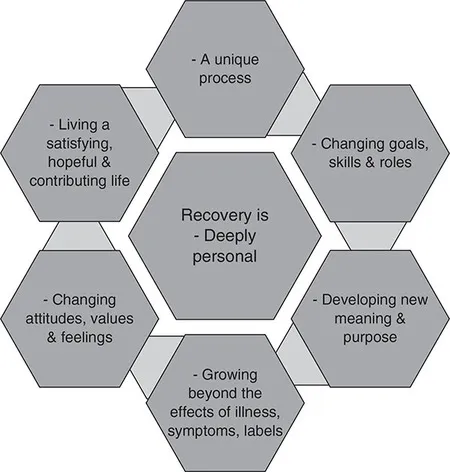
Recovery is … a deeply personal, unique process of changing one’s attitudes, values, feelings, goals, skills, and/or roles. It is a way of living a satisfying, hopeful and contributing life even within the limitations caused by illness. Recovery involves the development of new meaning and purpose in one’s life as one grows beyond the catastrophic effects of mental illness. (Anthony, 1993)
In the Session …
Explain to the person that you have one definition of recovery that you would like to share with them (the quote in the text).
- Ask them to think about how it maps onto their own expectations, hopes and fears.
- Does any of it surprise them?
- There are many others – would it be helpful to explore some of them together or outside of the session?
- Encourage them to make some notes about what stands out for them when they think about their own recovery from where they are now.
For us, this quote covers all the elements that we would want to bring into any conversation about the future that someone wants to live. There are some elements of it that are less comfortable for us but that discomfort is precisely why it is potentially useful. A meaningful conversation should allow you to look at areas of disagreement that the person may be experiencing with family, friends or people in the health or social care system. The purpose of this session is to help the person to develop a way of bridging that gap between now and the future and between different views of recovery.
The quote above has a number of chunks of information in it, so don’t skim over it in a rush to ‘get on’ with the next exercise. Take some time to think about which bit holds the most meaning for the person you are with. This is one of the points in the process where it can really help to have completed your own ladder and worked through the exercises yourself – you will be able to have much more fluent conversations if you have also thought about your own reactions to the quote.
Some people won’t identify with the term ‘illness’ or will have been given a diagnosis that does not sit easily with them. Remember that recovery is about them finding meaning in a way that enables them to live a life they want to live. That may or may not include the reduction of ‘symptoms’ or agreement with a diagnostic label that they’ve been given. Conversely some people will find a diagnosis supportive and meaningful and may well align themselves with more than one. The benefit of taking the approach outlined in this book is that the type and number of diagnoses that the person might have been given, do not make the framework any more or less potentially helpful. What’s more important is a sense of curiosity that there might be a different way of working through things and a relationship (with you) that is safe enough to explore that in order to come to their own conclusions. The language that people use might also change as they progress through their journey. Stay alert to this and use the language that the person brings with them.
One of the issues we have quite frequently come across is that the very nature of the concept of recovery, i.e. that it is unique to each individual and multi-layered, can make it difficult to start a conversation. And when a person is distressed and seeking help, it can seem impossible to imagine getting from where they are to a life that is personally meaningful and fulfilling. Even daring to hope, a central tenet of recovery, can feel threatening. Figure 1.1 breaks the quote down and might help you have this conversation.
There are many ways to ask about what recovery can look like to the individual. Some people can give vivid descriptions of what will be different; others can give an indication using scales e.g. 1–10 of where they are, have been and want to be. Others are very cautious and struggle to describe out loud what recovery would mean to them. They may be frightened of tempting fate, feel ‘unworthy’ of recovery, or be too traumatised to remember or imagine what life might be like rather than what it has recently been.
The process of recovery
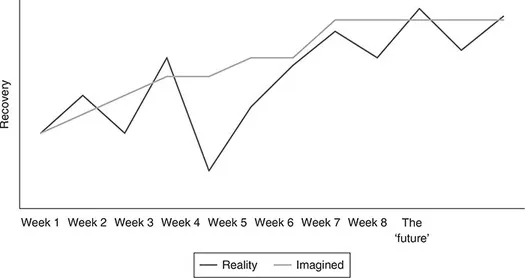
As well as the meaning of recovery, the process of recovery is worth time for a conversation. We have often spoken with people (and fallen into the trap ourselves) who assume that other people have a life that is smooth and ‘recover’ from any problems they do experience in a nice steady way that leads them onwards and upwards. In reality though we all wobble around a bit and have ups and downs. Recovery is not a thing that ‘happens’ and is then ‘done’. Getting to a more meaningful way of life can be characterised by a fleeting sense of optimism and sometimes rapid sensation of not being able to trust that progress. The graph in Figure 1.2 shows how we’ve talked with people about a more realistic path to recovery.
It’s not an end point, it’s a process that we’re all engaged with every day.
Figure 1.2 Recovery: how we might imagine it should be and how it often is
JR’s Story
After coming into hospital for support with feelings of low mood and hopelessness, JR started to engage in conversations about their recovery using the Steps to Recovery framework. After just a few sessions and a short time in hospital, JR commented on how their mood seemed to have improved quite considerably from the time they entered hospital. JR had also observed ‘other patients on the ward moving on’ and started to think about the next step for their recovery. Wanting to build on this positive change and with a fear of becoming ‘dependent on others’, they decided to quickly progress their discharge back to their own home.
When meeting with JR in the week following their discharge, it was clear that something had changed. JR appeared to be quite self-critical of not having had the motivation to ‘do more’ since returning home. This opened up an opportunity to consider JR’s perception of what their recovery might or ‘should’ look like. JR made reference to seeing others on the ward move ‘to discharge’ more quickly than them. Having noticed a quick positive change in their own mood, they had thought that their own progress would continue to be steady. Using the graph in Figure 1.2, we discussed how, for most people, the recovery process can have many ‘ups and downs’, where change can occur daily or even hourly. This resonated with JR and naming it felt important. At the end of the session JR noted ‘I need to give myself a bit of a break on the days when I’m having a dip in that graph’, which led to a conversation around the benefit of being compassionate towards one’s self during the process of recovery. We also took the opportunity to add ‘self-critical thinking’ to JR’s recovery ladder as a sign of when things may be going less well in their recovery.
In the Session …
Ask the person you are working with to think about this question and make a few notes: ‘What does recovery mean to you?’
If they can imagine that they are living a life that is characterised by the CHIME factors: Connectedness, Hope, Identity, Meaning and Empowerment:
- How does life look? How do they feel? What are they doing? Who is there with them?
- If they need to make some changes in order to get to that experience of life, what would be different?
- Ask them to write down things they would be excited about being different rather than things they would hope to leave behind (they will be more motivated to keep working towards positive things than away from things that worry or frighten them).
- Think of small daily changes that they or someone else would notice.
Ask them to look at the quote again.
- Does any of it surprise them?
- Invite them to make some notes about what stands out for them.
As with any therapeutic work, listen to the meaning. For James, the man whose story runs through the book, the concrete goals – ‘get out on my bike, go out in the caravan, see my friends more’ – would have technically been right and totally missed the point. Underlying all of it was a desire to see people, have some hobbies again that ‘created’ something that he could see (it was the hobbies that both generated the social contact and produced tangible things he could see), do things that gave life a purpose (the use of the caravan was related to v...