On the map of global trade, China is now the factory of the world. A parade of ships full of raw commodities-iron ore, coal, oil-arrive in its ports, and fleets of container ships leave with manufactured goods in all directions. The oil that fuels China's manufacturing comes primarily from the Arabian peninsula. Much of the material shipped from China are transported through the ports of Arabian peninsula, Dubai's Jabal Ali port foremost among them. China's 'maritime silk road' flanks the peninsula on all sides.
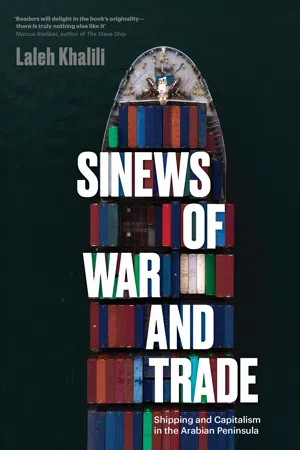
Sinews of War and Trade is the story of what the making of new ports and shipping infrastructure has meant not only for the Arabian peninsula itself, but for the region and the world beyond. The book is an account of how maritime transportation is not simply an enabling companion of trade, but central to the very fabric of global capitalism. The ports that serve maritime trade, logistics, and hydrocarbon transport create racialised hierarchies of labour, engineer the lived environment, aid the accumulation of capital regionally and globally, and carry forward colonial regimes of profit, law and administration.
- 368 pages
- English
- ePUB (mobile friendly)
- Available on iOS & Android
eBook - ePub
About this book
Information
1
Route-Making
We think of paths as existing only on land, but the sea has its paths too, though water refuses to take and hold marks … Sea roads are dissolving paths whose passage leaves no trace beyond the wake, a brief turbulence astern. They survive as conventions, tradition, a sequence of coordinates, as a series of waymarks, as dotted lines on charts, and as stories and songs.Robert Macfarlane, The Old Ways
The first time I travelled on a freighter, I boarded CMA CGM Corte Real in Malta in a Mediterranean winter. Though the headquarters of CMA CGM is in a building designed by Zaha Hadid in Marseille, the company’s European transport hub is in Malta. Malta’s free-port designation protects shippers from taxes on transhipments (goods that are passing through Malta from the port of origin to their final destination), while its proximity to the Middle East, Africa, and Europe makes it a geographically convenient distribution centre for goods to be transhipped from there. At that time, Corte Real was, at 366 metres long, one of the largest CMA CGM ships, and, because of its length and width, it could not berth at all the ports that dot the company’s maps of places it does business. Marsaxlokk in Malta has gantry cranes with arms broad enough to oblige Corte Real’s width, and berths long enough to allow the ship to fit alongside, and its harbour has been dredged deep enough to accommodate laden ships easily.
The village of Marsaxlokk teems with international seafarers, and buses full of crew members and officers arriving to board ships or leaving to go home ferry between its modest hotels and the sun-drenched airport. The day I came aboard, the officers of Corte Real were ashen-faced with hangovers, though warmly welcoming. The city of Valletta, some ten kilometres away, is known for its bars and nightclubs, and its proximity and ebullient atmosphere make it a welcoming port of call for the seafarers. The sailors were also relieved to be in the Mediterranean, after having come from Bremerhaven and Antwerp through the Bay of Biscay, where, predictably, the sea had been unsettled. The other two passengers on the ship told me awed stories of the ship listing forty-five degrees in the storm. They’d had to tie down all furniture in their cabins to prevent it from flying around when the ship hit the trough of a gigantic wave.
I travelled on Corte Real in February 2015, just before a dramatic collapse in global trade. Marseille ordered the ship to steam at speed to its next port of call, Khor Fakkan on the Gulf of Oman, a newish port in the Emirate of Sharjah, one of CMA CGM’s hubs and at the time one of Journal of Commerce’s top fifty ports in the world. As we arrived near Khor Fakkan, we saw dozens of tankers at anchor near the port of Fujairah, one of the busiest petrochemical terminals in the Middle East. After Khor Fakkan, our ship was to head to Jabal Ali, then and now the biggest port in the Middle East and the ninth busiest container port in the world, where I was to disembark and fly home. Because of congestion at Jabal Ali, Corte Real slowed down considerably after Khor Fakkan and spent a day or so at anchor while a berth became free at the port. Because the world trade in goods was still at full throttle, the containers transporting cargo from the industrial ports of northern Europe to the Middle East and onwards to China were all full and the arrangement of containers both below and above deck was dense, with boxes stacked high and blocking the view out of my cabin’s porthole.
By contrast, in August 2016, the containers were placed much less densely on the deck of CMA CGM Callisto. All the way to Jeddah (the penultimate destination of the route segment I was taking) I had a clear view from the porthole. On that second journey, Callisto had scheduled stops at Damietta (Egypt), Beirut (Lebanon), and Jeddah (Saudi Arabia) before arriving in Jabal Ali. However, a day or so after leaving Malta, the ship’s master was directed to also make a stop at the port of Mersin in Turkey, between Beirut and entry into the Suez Canal. This detour entailed spending half a day at Beirut, then steaming north at speed from Beirut to Mersin. The arrival in Mersin was also a bit of an adventure. The port of Mersin had only just extended its berths to accommodate the largest ships, and the quays were still half finished. What concerned the captain of Callisto, however, was that, despite the berths having been extended, the breakwaters for the port were far too narrow for easily manoeuvring a ship as gargantuan as Callisto. Throughout this trip, we did not really have to wait at anchor anywhere – surprisingly, not even at Jabal Ali – because ports were nowhere as congested as they had been the previous year. The last-minute detour to Mersin was added, to the chagrin of the crew and officers of the ship, in order to make the trip profitable. The decline in oil prices which made fuel cheaper for each trip than the previous year, and therefore the ad hoc addition of a port of call, had a lower marginal cost and a potential to earn a bit more for the shipping company. The captain and crew did not much like these lightning stops, though, because the length of the stopover was too short to make a visit to the town practical and because arrival and departure are often the most stressful portion of any journey, requiring the attention and work of all crew members on board.
Corte Real’s cargo had been loaded at the industrial harbours of northern Europe and seemed to contain basic materials for chemical manufacturing, high-tech medical equipment, and a disassembled yacht being transported to China. Callisto had very few full containers loaded at those industrial ports, and a great deal of what it took on at Damietta, Beirut, and Mersin consisted of refrigerated containers. Presumably, given the agricultural facilities and hinterlands of those three ports, the reefers (the refrigerated containers) were laden with fruits and vegetables and other farm products. I say ‘presumably’ because I could not view the bills of lading, but the hazardous goods documents indicated that not many of the reefers contained toxic materials (which are often shipped in refrigerated containers in order to ensure their stability).
Aboard both ships, we had to convoy on several occasions. Ships form convoys for safety or to follow prescribed routes. As expected, we had to form a cortège through the Suez Canal. A significant proportion of the canal is still one-way and either the southbound or northbound convoys must remain in bypass bays in the Great Bitter Lake until the other convoy has completely passed it and gone through the other one-way portion of the canal. But our ship also had to convoy with other ships upon arrival at Jabal Ali, because the approach channel from the anchorage to the port is surprisingly narrow; ships run aground far more often than one would imagine for such a significant port. In the Red Sea, ships are required to keep to their own lanes, with northbound ships closer to the coasts of Asia and southbound ships steaming along the African coast. Allowances had to be made in the ships’ routes for offshore oil and gas platforms, coral islands just under the surface of the sea, and tiny volcanic islets strewn near the coast, especially near the Bab al Mandab.
Another locale for convoying was along the coast of Yemen. Companies and navies often recommend that ships convoy together when passing through the southern Red Sea and the Gulf of Aden. At the height of piracy in the mid-2000s, the convoys were escorted by EU or NATO antipiracy forces or by naval vessels of individual European or Asian countries. The antipiracy convoys kept as far as possible from the African coast. They travelled along predrawn routes, marked and updated on naval charts.
When I was travelling on Callisto, the ship did not have the same imperative for speed as Corte Real and was commanded to slow down considerably in order to preserve fuel. Corte Real had also been ordered to steam closer to the coasts of Yemen and Oman to shorten its route. The ship thus held very close to the coast, and we could clearly see the dramatically jagged mountains of Arabia rising from the steamy shores. CMA CGM ships only bunker (or take on fuel) in certain countries because they get better deals in some ports, but also because the bunkering fuel in some ports is reputed to be adulterated.1 Both Corte Real and Callisto flew the British Red Ensign flag and had to follow European and British rules on sulphur emissions and other environmental regulations. Therefore, they could only take low-sulphur, untainted, uncontaminated bunkers on board. This also limited which ports were deemed appropriate for refuelling.
| Port | Annual bunker sale (millions of tonnes) | Last year available |
| Singapore | 42.4 | 2014 |
| Fujairah | 24.0 | 2013 |
| Rotterdam | 10.6 | 2013 |
| Hong Kong | 7.4 | 2012 |
| Antwerp | 6.5 | 2012 |
Table 1.1 – World’s biggest bunkering ports2
The differences in routes indicate that the delivery of specific commodities from a port of origin to a destination does not necessarily determine the path of travel. The specific qualities of ports that become nodes of trade matter: how updated their facilities are, how deep their harbours, what bunkering services they provide. Global factors also matter: a fall in trade saw many containers being shipped to China entirely empty. The volume of cargo shipped from one site to another in turn determines freight rates on those routes. The price of oil affects bunkering rates and therefore the unit cost of transportation by sea. But a ship’s route is not the outcome of a series of rational calculations. CMA CGM is, in some ways, distinct from the other European shipping firms with which it competes. The firm has Middle Eastern roots, with its founders hailing from Syria and Lebanon. A quarter of the company’s shares are, at the time of this writing, held by a major Turkish shipping and mining conglomerate, the Y ıldırım Group. CMA CGM has also long had shipping alliances with United Arab Shipping Company, the firm originally owned by several countries of the Arabian Peninsula. Many of CMA CGM’s hubs and smaller feeder ports (ports that receive transhipments from the hubs) are in the Middle East, and the sinuous routes that connect its European and Asian termini often snake through North African, Arab, and Turkish ports.
The routes that shipping companies or naval guards or international antipiracy organisations devise, for everyday shipping as well as in seas designated dangerous, so often seem ‘naturally’ made. Unlike markings on land, which the earth holds across time and space, the crossing of ships on the deep leaves little trace but the foam that forms in the wake. Yet shipping routes – or, more accurately, their representation on charts and maps and in the myriad documents of corporate planning – have a solidity, a durability that their marine ephemerality belies.
A range of political factors (including technological changes, economic calculations, and social upheavals) can spell the end of one route and the birth of another over the course of time. In the age of steam, ships are not beholden to wind and current patterns as they were in the age of sail, and routes are determined by the ports strung along them. Some ports remain constant and important: Jeddah, as the port of Mecca, has always mattered in the making of pilgrims’ sea routes and has been a crucial stop on the Red Sea, despite being flanked by perilous coral shoals. Aden was one of the earliest imperial coaling stations for Britain and for nearly a century and a half its most important strategic port in the Indian Ocean. The emergence of Jabal Ali (and its smaller cousins Khor Fakkan, Port Khalifa, Hamad, and Salalah, among others) in the Arabian Peninsula calls for an explanation: what accounts for such a proliferation of destination ports, when the population of the Peninsula is only around 60 million?
The answer is that everything from technological change – the coming of steam and the invention of telegraphs, tankers, container ships, and internet cables – to the end of empires and the emergence of new nation-states can shift the contours of these routes across the water. But this doesn’t happen in a uniform way. The technological innovations that remake communication and transportation sometimes reinforce existing routes and, at other times, redraw them. In the Arabian Peninsula, especially before the coming of oil, pilgrimage and the Suez Canal were the factors that determined where sea routes were pinned to the land.
But routes are not only prescribed by the exigencies of travel. What cargo is carried, and from where and in what volumes, determines the rates charged for routes. Routes are not only evanescent paths through the sea or lines upon the map, but also a series of calculations about costs and freight rates. The moment routes are quantified by way of pricing, they – the routes themselves, not what travels on them – can also become commodities to be speculated upon. So many of the ingredients of route-making in the age of sail shaped the paradoxes of our permanently transient routes; today, many of those old routes are embodied in the digital pathways of market models.
Admiralty Charts and the Making of Routes
Proudly, as always, the ships will set sailfor Madras, Algeria and Singapore;in an office bent over some nautical mapsI’ll make calculations in ledger books.Nikos Kavvadias, ‘Mal du Départ’
In the wheelhouse of the freighters on which I travelled, Admiralty Charts corresponding to our coordinates were spread on a table and updated every hour with a notation in pencil tracing our sea route. The wheelhouse abounded with electronic devices, and the captain and his officers directed the ship using global positioning systems (GPS) and radar. Nevertheless, the conventions of seafaring – at least for this shipping company – required that the ship’s officers regularly update these gorgeous charts. The charts recorded depths, forbidden areas, coastal zones, submarine ammunition dumping grounds, port approaches, and less frequent and often fascinating notations about whales, anomalous magnetic zones, volcanic activity, and treacherous reefs that had been sighted but not confirmed. On this route, the one legend that was repeated consistently across all charts was a warning about taking care with dragging the a...
Table of contents
- Cover Page
- Halftitle Page
- Title Page
- Copyright Page
- Dedication
- Contents
- Map
- Acknowledgements
- Preface
- Introduction
- 1. Route-making
- 2. Harbour-Making
- 3. Palimpsests of Law and Corporate Sovereigns
- 4. Roads and Rails Leading Away
- 5. ‘Mechanic, Merchant, King’
- 6. Landside Labour
- 7. Shipboard Work
- 8. The Bounties of War
- Epilogue
- Glossary and Abbreviations
- Bibliography
- Notes
- Index
Trusted by 375,005 students
Access to over 1.5 million titles for a fair monthly price.
Study more efficiently using our study tools.
Frequently asked questions
Yes, you can cancel anytime from the Subscription tab in your account settings on the Perlego website. Your subscription will stay active until the end of your current billing period. Learn how to cancel your subscription
No, books cannot be downloaded as external files, such as PDFs, for use outside of Perlego. However, you can download books within the Perlego app for offline reading on mobile or tablet. Learn how to download books offline
Perlego offers two plans: Essential and Complete
- Essential is ideal for learners and professionals who enjoy exploring a wide range of subjects. Access the Essential Library with 800,000+ trusted titles and best-sellers across business, personal growth, and the humanities. Includes unlimited reading time and Standard Read Aloud voice.
- Complete: Perfect for advanced learners and researchers needing full, unrestricted access. Unlock 1.5M+ books across hundreds of subjects, including academic and specialized titles. The Complete Plan also includes advanced features like Premium Read Aloud and Research Assistant.
We are an online textbook subscription service, where you can get access to an entire online library for less than the price of a single book per month. With over 1.5 million books across 990+ topics, we’ve got you covered! Learn about our mission
Look out for the read-aloud symbol on your next book to see if you can listen to it. The read-aloud tool reads text aloud for you, highlighting the text as it is being read. You can pause it, speed it up and slow it down. Learn more about Read Aloud
Yes! You can use the Perlego app on both iOS and Android devices to read anytime, anywhere — even offline. Perfect for commutes or when you’re on the go.
Please note we cannot support devices running on iOS 13 and Android 7 or earlier. Learn more about using the app
Please note we cannot support devices running on iOS 13 and Android 7 or earlier. Learn more about using the app
Yes, you can access Sinews of War and Trade by Laleh Khalili in PDF and/or ePUB format, as well as other popular books in Politics & International Relations & Political Economy. We have over 1.5 million books available in our catalogue for you to explore.